
FLAUNT! Podcast · Spirit · Infidelity & Betrayal
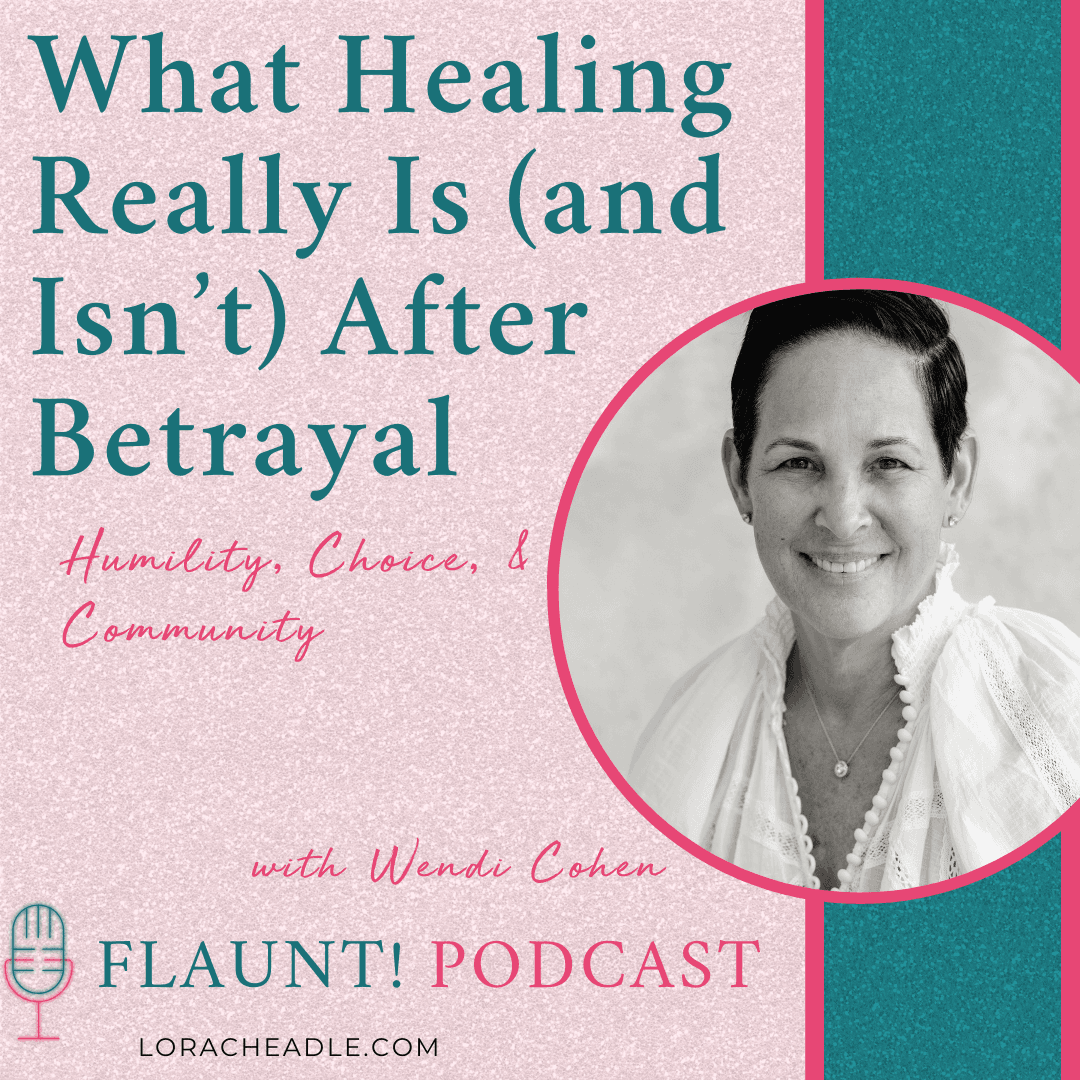
What Healing Really Is (and Isn’t) After Betrayal Humility, Choice, and Community –with Wendi Cohen
October 11, 2025 · with Wendi Cohen
Show notes
“Just because you make the final decision does not mean you were the cause.”
— Lora Cheadle
“Healing” gets thrown around a lot—but in real life it’s messy, non-linear, and humbling. In this intimate conversation, Lora and healer/mentor Wendi (formerly of the Chopra Center; now on the Lee Harris team) unpack what healing actually looks like after infidelity, health crises, and identity rupture—and why your “opening” matters more than any timeline.
If you’ve ever wondered, Why don’t I feel better yet? Am I doing this wrong?—this episode is for you. Lora and Wendi reveal the lived truth of recovery: three steps forward, two back; grief cycling; learning to receive; and choosing yourself even when others don’t approve. You’ll hear how meditation created space beyond the mind, why the body never lies, how community can “hold the frequency” when you can’t, and the liberating shift from I am my story to I write my story. Expect practical reframes you can use today—especially if you’re a high-achieving woman who’s tired of doing it all alone.
Top 3 Takeaways
- Healing is non-linear (and normal). Think Chutes & Ladders, not a straight line. You’ll revisit layers like grief, anger, and acceptance—and that doesn’t mean you’re failing.
- Humility opens the door. Letting go of the “if I do everything right, bad things won’t happen” myth creates room for curiosity, compassion, and real change.
- You’re allowed to choose you. Boundaries, receiving support, and rewriting the narrative are acts of power. Your agency—not other people’s opinions—defines your direction.
Episode Highlights
- The “opening”: the moment you realize you can author a different story than the one you were handed.
- From people-pleasing to permission: upsetting others vs. honoring your inner yes.
- Mind-Body-Spirit integration: why meditation quiets the narrative so the body’s intelligence can be heard.
- Community as medicine: when you can’t hold the frequency, let safe containers hold it for you.
- Identity shifts: you are not your past roles (spouse, fixer, PTA star, marathoner); you are the one choosing what’s next.
Resources Mentioned
- Group meditation & mantra practice (Chopra Center origins)
- Lee Harris retreats/“Soul Magic” weekends
- Nature as regulation (beach, trees, grounding)
- A Course in Miracles prompt: “Am I willing to see this differently?”
Favorite Quote
“Healing isn’t something you do once and finish. It’s the willingness to meet yourself again and again—with humility, curiosity, and love.” — Wendi
Join Sanctuary of the Soul — Just $47/month Your safe haven for healing after betrayal. Each month, you’ll receive:
· 2-hour live group coaching call on the 13th
· Channeled message from The Librarians
· Somatic processing and spiritual rituals
· Legal insight to protect your peace
· Sisterhood support from women who truly get it
You don’t have to walk this road alone. Step into a community that integrates mind, body, spirit, and safety — so you rise whole, sovereign, and free.
Join now » www.SparkleAllSeason.com
#BetrayalRecovery #HealingAfterInfidelity #NonlinearHealing #SomaticHealing #MeditationForTrauma #IdentityAfterBetrayal #WomenHealingWomen #LifeChoreography #FromWoundedToWise #FLAUNTPodcast
About Wendi Cohen
With contagious joy and heart, all that Wendi Cohen offers is with the intention of healthy change.
She has been a dynamic and instrumental force helping people from all over the world as an educator and mentor in the field of spirituality and wellness. Highly regarded for her many years at the Chopra Center for Wellbeing, she managed and facilitated their signature program, Perfect Health. Working with Dr. Deepak Chopra and being involved with cutting edge research in meditation and Ayurveda there, Wendi has been up close and personal with the brightest minds in the wellness industry. Now working with Lee Harris Energy, she is the Director of Studio Operations and a producer who uses her creative prowess, intuition and vision to support transformational work.
What makes her special in this field, is that she found meditation and mindfulness on her own path to healing after being diagnosed with a rare and chronic illness in 2003. Her insatiable curiosity and ability to think outside of the box led her to looking at integrative approaches. That is when she had profound shifts in her health and also fell in love with meditation. As a result of her journey, Wendi has a deep capacity to understand the many challenges people face when looking at healing and transformation. She is also a board certified Integrative NLP Practitioner and trained in Authentic Communication.
Being of service is when Wendi is the happiest - supporting people so they feel more peaceful, clear, and grounded, experiencing more love and inspiration in their lives is what lights her up. Her mantra is "follow the fun" and that is EXACTLY what she hopes to inspire in others.
The Humility of Healing.....
By Wendi Cohen
Healing is often a misunderstood journey that reveals lessons in humility and the chance for deep learning, uncovering aspects of ourselves, if and only if, we are willing to look at them. By allowing and receiving, staying open and getting creative, thinking with our hearts while feeling our bodies, there can be some profound shifts in how we experience the challenge - whether it is physical, emotional or heart based. In my case, it was learning to navigate a new 'normal' after a life-changing diagnosis that rocked my world.
My path has been messy while stunningly beautiful, scary and empowering - filled with moments I'd never ever want to revisit AND also so many moments of being the recipient of so much love and generosity, from unexpected places. When we have a better understanding that healing isn't necessarily linear - that it can be like a game of chutes and ladders or riding a roller coaster that takes your breath away, heart opening and heart breaking - but with the infusion of creativity, receptivity, a sense of humor and beginning new each day, it can become less jarring.
Now twenty years later, to have had the good fortune to learn and then work with some of the most extraordinary visionaries, teachers, healers, and with my clients, I am truly humbled by it all - the good, the challenging and what has yet to come.
Read the transcript
Speaker A:
You're listening to Flaunt. Find your sparkle and create a life you love after Infidelity or Betrayal. A podcast for women who've been betrayed by their intimate partner and want to turn their devastation into an invitation to reclaim themselves and their worth. Tune in weekly so you can start making sense of it all and learn how to be okay on the inside, no matter what goes on on the outside. Download your free Betrayal Recovery toolkit@betrayalrecoveryguide.com.
Lora Cheadle:
What is healing? Oh, my gosh. We all hear about healing. We're going to heal from infidelity. We're going to heal from betrayal. We're going to heal from trauma. We're going to heal, heal, heal, heal, heal. But what does that even mean? I think personally healing is one of those words that it means so much, but it is also so sort of become meaningless in a way because we don't know what it means. Today's guest is a lovely, lovely woman who has such vast experience and just wisdom around healing.
Lora Cheadle:
And I asked her to be on the show because I want to have a conversation around healing and. And what it means. And she'll tell you a little bit more. But she has worked at the Chopra center with Deepak Chopra. She works with Lee Harris right now. She has been in the healing space. She is a healer in her own right, and she has worked with other people in the healing space. She has witnessed so many people go through so much, and that's why I invited her on the show today.
Lora Cheadle:
So with that, welcome to the show, Wende. I'm really looking forward to our conversation.
Wendi:
Thank you so much for having me and it's delightful to be here with you.
Lora Cheadle:
Yay. Let's start a little bit just with you and with your whole history in I'm in the healing space. What does healing mean to you and what are the various capacities you have been involved in? The not only healing yourself, but witnessing others going through this journey.
Wendi:
It's. It's such a great question, and I agree with you. You know, so many people have their ideas about what healing is. And from my personal experience with healing, it's a process that offers humility, learning, heartbreak. It may even feel like a game of Chutes and ladders where you have the highs and then you have the lows. For me, what I found in my own experience was that healing was when I finally felt as if. It's hard to put into words, but it's as if I felt more aligned. My body, my heart, in my emotions, in my choices, there's many layers to healing.
Wendi:
I find it's not linear. I feel like, you know, it's. You may go three steps forward and two back, but along the way, it is, for me anyways, has been one of the most interesting, deep, powerful things to go through. And so I had a very significant healing around my health and. And it can take you down to your knees as you know, when you're going through something really difficult. And to have that experience and now to work as a healer, somebody who supports people in healing work, I have such deep appreciation and respect for the process because it is not easy. Right. It's.
Wendi:
You never know quite what you're going to be faced with, and you only understand it when you have enough space. You know, after, like, you know, in real time, it's. It's difficult and it's messy and. But then you get to a little bit of space and the other side. And I've seen this with people in the work and it's absolutely magnificent. Yeah.
Lora Cheadle:
So many different directions that I want to go from that. But let's. Let's start kind of at the beginning, something that you mentioned, and that's the humility around healing. I. I personally can really resonate with that because I. I feel like one of the things that I realized going through this infidelity journey was how I felt like I almost was arrogant in the past. And that's weird to say because I. I tried to be calm and loving and peaceful and I was.
Lora Cheadle:
But I also had this arrogance that if I do things right, bad things won't happen to me.
Wendi:
Yeah. I mean, again, I think that that's the. For me, anyways, that was the miss that was the missing piece is that I thought, well, your mind is strong. You have a good mindset, you have good doctors, you have all the things. But I had a little bit of that same feeling of, like, well, why is this happening to me? And I can do this and I should be strong. And when you have those really low moments, you're. You can't help but find the humility. And I think the more that we can come from that place, the more the mindset of, oh, isn't this interesting? Or what can I learn here? Or how can I be more open to this experience? Whatever the discomfort is in that, for me was an opening to help that humility and to help a different lens for how I was approaching things.
Wendi:
And so, yeah, it's humbling to be in a situation that you don't anticipate or. Or that's tricky or messy or hard and also that people don't understand. You know, not everyone can relate to your journey or my journey. And that's where I feel like we bridge the gap when we can be in that space of being humble.
Lora Cheadle:
Yes. And that was exactly. There were many reasons. I was going to say it's exactly the reason I wanted to talk to you. It's not the only reason. There are many reasons. But I didn't have the physical, I had the infidelity and betrayal. But even a physical issue can feel like a sense of betrayal.
Lora Cheadle:
My body is betraying me, my health is betraying me. And it doesn't matter what that betrayal is. It's the same being taken down to your knees.
Wendi:
Yes, yes. And I was just having a conversation about a friend just this past weekend and she said, how did it feel when your body failed you? I thought that was such an interesting observation because at a time I did feel very betrayed by my body because I have autoimmune challenges. But what I said to her, and this is again a 20 year journey, so a lot of time and a lot of learning and growth. I said to her, actually it's the nuances that I'm more interested in right now with my body understanding what my body wants to tell me. And I don't look at that in the same way as betrayal. I look at it as, this is information for me and how do I work with it and what, what does it mean to have that? And it's my choice how I move forward with it. And so yes, I understood, I understand the betrayal that I originally felt and how that has somehow beautifully morphed into wow, my body is so incredibly intelligent. It can tell me what is good for me and what is not so good for me.
Wendi:
So it's a constant learning. But, but yes, you're right, it does feel like it could be the same thing. Right.
Lora Cheadle:
And I love what you said, that this is a 20 year journey and it has morphed. Because that I think is so true. Whatever it is that we're facing at first it is that whiny, this is awful, I'm a victim, blah, blah, blah, all to fight it. And it's like we go through this range before we get to that level of peace, acceptance, curiosity. And I'm curious how that 20 year journey looked for you. Some of those highs, those lows, those shoots and those ladders.
Wendi:
Yeah, it really, it's weird to think it's that long because, you know, time is very strange when you're going through these things for me, I love this question because it's making me really think about how much has changed from that original diagnosis where I was just. I didn't know who I was. I felt very lost. I felt disconnected, misunderstood, all sorts of things, to a place of feeling like I really understand more. I think, too, Lora, it's like grief, you know, I think I've gone through the stages of grief where, like you said, I had a pity party. You know, those kind that you're like, oh, my God, you know, like, why me? You know, all the things. It was pathetic. Yeah.
Wendi:
Went from that. I experienced anger, I experienced sadness. And I think, you know, as, you know the stages of grief, I'm at the other side of acceptance and allowance. And it has, like I have alluded to before, it hasn't just been unicorns and rainbows and butterflies. It hasn't also been awful. There have been some of the most incredible lessons. And to be the recipient of so much love and generosity in places and from people and teachings and experience that I've been privy to that I couldn't have. It couldn't have been more incredible to sit here now and say, wow, you know, I will say, because I want to be very honest with you and your listeners, like, getting sick is not the best thing that ever happened to me.
Wendi:
Like, I am not enlightened enough to say that, and I don't know if I ever will be. But the truth. The truth is, is that I would not be here right now doing the work that I do and being in so much joy in that work if I hadn't gone through the past 20 years.
Lora Cheadle:
Yeah, yeah, I hear that. I. I feel the same. I don't want to glorify.
Wendi:
Yay.
Lora Cheadle:
Infidelity was amazing. But it did change our marriage. It did change me. And the good that. And I'm going to be a little. Speaking of arrogant, a little bit arrogant on this one. I think the good that I have intentionally attempted to cultivate from that and the reason that I went ahead and leaned into me, we do have free will. We do have choices.
Lora Cheadle:
And I had this very subconscious awareness early on that this experience really can take me down and ruin the rest of my life or I can make some different choices and I can at least eek as much good and learning and joy out of it as possible.
Wendi:
Yeah. And it is. It's always a choice. You know, in the very beginning of my healing, I was paralyzed by fear, and I was operating from that place, and I was very much Aware of all the noise around me. And it wasn't until I introduced some practices into my life that helped me to get more clear and more grounded in my truth that I could, could not be so stuck in that. In that fear and trying to make everyone else happy and what they needed in this, you know, in this healing. And I really do believe that that was a game changer for me. I made choices that were aligned with really where I wanted to go.
Wendi:
Now, did I always make the best choice? No. Did I learn from those things? Yes. And so, yeah, it is about, you know, okay, so what do I do with this? And there was a certain point where I could have even just given up and not work so hard because I was so medically unstable that I could have made an exit plan if I really wanted to. But my choice was to live and to live in a healthy body and to have joy in all the things that I have now.
Lora Cheadle:
You said something that I think is really important, and you said something, I'm paraphrasing a bit, but I could have pleased other people in what they wanted me to do through the healing. And that really stuck out for me because so many people do have opinions and judgments and wishes for us, I think, both positive and negative. And I, I'd like to talk a little bit about that.
Wendi:
Yeah, I mean, I can imagine. I mean, we live in a world that people have a lot of opinions and judgments and certainly when they're faced with things that they're not all that comfortable with, whether it's infidelity or if it's a medical diagnosis or something that is life changing, I find that people don't quite know what to do. And so in my case anyways, people had a lot to say and go to this doctor. You need to do this, you need to do that. And as a recovering people pleaser, you know, which many of us I know, raise your hand if you are. I was trying to make everyone happy. And it wasn't until I got really clear that that wasn't working for me. I really made that choice.
Wendi:
Okay. I can either, you know, to end this journey or I can really step into feeling empowered in my health again. I upset a lot of people. I'll be honest. People were not expecting me to say, no, I'm not going to go down this line of treatment, or no, I'm not going to see this doctor, or I'm going to radically change who I, who I spend time with. Because I couldn't. It was difficult to filter all the noise and the judgment. And so even though I upset a lot of people, the people that needed to be around me stayed.
Wendi:
And so that was a really big learning, because we do. We have to make choices based on, you know, what feels right for us. And we. We. You know, so many of us are intuitive, and we don't. We don't always follow that intuition. Right. And when you do, you feel better, even if it's.
Wendi:
Even if you might not have it 100%. So you.
Lora Cheadle:
You have done a lot. You are a spiritually connected person. You're intuitive. You have been in this space for a long time. What was the timeline around your. You and you getting sick and facing this and your spirituality? Were you completely connected and plugged in the moment of your diagnosis? So you were, like, instantly went to that spiritual space, or how did this develop for you?
Wendi:
Oh, gosh, I was. I was definitely not in that spiritual space. I've always been a curious person, and I've always been a lifelong learner. But, no, I got a diagnosis in 2003. I went from being a marathon runner, martial artist. I was even the PTA president. I know that sounds shocking, but I was very involved in a lot of different things, very happy, and was just having all sorts of health challenges, and it just took me down to my knees. I didn't know who I was.
Wendi:
I didn't know how to live that new normal, and got bounced around to a lot of different doctors and misdiagnosed and all of that. But it wasn't until 2005, with a series of events that brought me to a beautiful resort where the Chopra center was. I knew who Deepak Chopra was, but I didn't know that the center was on the property of La Costa. And I went there because my family, every summer we would go to the island of Catalina, and it was a family tradition. But my doctor said, you can't go because there's not a medical facility there in case something happens. So I had my pity party and took myself to a night or two to stay in La Costa. And it wasn't until I was wandering the property where there was a free group meditation. And, you know, like, Lora, when you go to a place and you step in, you're like, I know I'm supposed to be here.
Wendi:
Like, every cell in your body lights.
Lora Cheadle:
Yes.
Wendi:
That's how I felt when I walked in there and I sat down for the group meditation. And I just thought, wow, there's something. There's something here. And I happened to. It was led by a wonderful guy. David G. Who many people know and love in the meditation space. And he said, you should come back and get your mantra.
Wendi:
And I thought, yeah, I should. Two weeks later I went, received my mantra and fell in love with meditation. And that was the start and the opening of me understanding that if I could quiet down my mind and the story and the narrative and all this stuff, that that would help me. And, you know, the rest is. It's an unfolding of just a series of things that led me to do the work that I do. But that was really my opening was. Was creating meditation and into a daily practice for myself. And so that was kind of where it started.
Wendi:
And then because I needed something other than to just constantly focus on, you know, going to the doctor and having treatments and all that stuff, I did a teacher training and learned how to teach meditation. And that was unexpected. I thought, oh, I just love the teachings and this will keep me busy. But it led me to working with Deepak and teaching thousands of people meditation and Ayurveda. And yeah, that was kind of how it started. And since that kind of introduction, I've now taken myself into all sorts of areas where I look at what we can do with our intuition and how we can heal in many, many different ways. And I have a very full toolbox that I go to. And of course, as we change and age and what's happening in the world, that toolbox is even more precious to me.
Lora Cheadle:
Oh, yeah.
Wendi:
So that's what I. What I try to do and for myself and for the people that I work with.
Lora Cheadle:
What I think is fascinating is you found this and it changed your life, and then you continue to pay that forward. You did the teacher training and you have witnessed. I can't even imagine how many people you have witnessed going through some sort of transformative experience. I initially met Wendy through Lee Harris. Lee Harris is an energy intuitive. My husband and I have attended his Soul Magic full week retreats twice. We've done some of his weekends. I do a lot of his things because of how it makes me feel.
Lora Cheadle:
Like when you said knew I was in the right place, this was the place that brought me peace. It might bring you peace, it might not bring you peace. And that's. That's irrelevant. What is irrelevant and what matters is finding that thing that we feel good doing. And you found that initially at Chopra center and then got to witness other people and facilitate other people going through that. So my curiosity kind of around this whole long setup here is of the people that you have witnessed that you have processed that you have been through this. Do you witness people who it just doesn't click for as well as people who are like, ah, what's your experience around that?
Wendi:
Yeah. So my almost seven, seven plus years, eight years at the Chopra Center, I facilitated a program where it was an intimate experience. A six day program, signature program, was called Perfect Health. I actually did Perfect Health as a guest and then many years later ran it and facilitated it. And in those six days where people are learning meditation and yoga and having bodywork and being in community, there were definitely those that were like, oh my gosh, I am clear, I know what I need to do. And then there were some that needed more time because like I said, it doesn't happen always in the time that we want it. So it's a whole range. And the thing was, when I went through that same program, I didn't actually think I got anything from it.
Wendi:
I learned all these things and then I went home and it was too much for me to incorporate and people in my life didn't understand. So I wasn't supported in the way that you need to be in some ways. So I found that it was a range and people would, they'd leave and they'd come. They'd either come back at a different event or we'd keep in touch and it would be months later or it would be something that like, again, they had their opening. And I wish I knew what I know now to say to them because this is many years ago now, that be patient, be gentle, be kind with yourself through this. My work with Lee is different too, because I do. I've seen many, many, many people have breakthroughs as you have. Right.
Wendi:
Being a participant, especially just coming off of our July event that we were both at. You know, you see it happen and it's beautiful, it's moving. And people, I think, are just so grateful for any opportunity to even just create a little bit of an opening or explore something that maybe they didn't think of. But it's always a privilege. Like I always feel it's such an honor to witness that. Like, I feel so lucky to be in the room or to be providing, helping to support a course where there's thousands of people that are having these moments where they're getting guidance or direction or clarity or like you said, some peace, some joy. And so, yeah, it's an incredible thing to witness and it's never lost on me, ever. It's just, it's really profound.
Wendi:
Yeah. And I feel super grateful that I have the Opportunity to be part of that.
Lora Cheadle:
Oh, absolutely. You have used the phrase have their opening.
Wendi:
You know what?
Lora Cheadle:
You had your opening. People had their opening. And I feel like I really know what that means. It's that crack. It's that willingness to, oh, maybe this doesn't have to be the narrative that I was told that it had to be. Maybe this doesn't have to be the story that I thought it was. Maybe for me, that opening was around because you hear if somebody cheats on you, you're out of there. You gotta leave it.
Lora Cheadle:
I think I said that myself a hundred times. Well, if my husband ever cheated on me, I'd be out of there. And then it happens, and you go, well, the story that's in my head isn't really what my heart and my soul know I need to do. And how do I reconcile that? And that opening for me was I get to write my own story. I got to have my own experiences. You alluded earlier to sometimes you make mistakes. I get to make my own mistakes. That's amazing.
Lora Cheadle:
But it's that opening. I feel like that I have agency, I have power. I get to do things my way, whether or not I do it every single moment. It's just that awareness that something is different. And this is me and this is my life.
Wendi:
Yes. And I'm so glad you brought up the narrative, because I will share another example of what came to me. I was at an event, not well at all. And there was an exercise called the Namaste exercise where you look into the eyes of every participant. This was through a Chopra center event. And it was in that moment when people were looking into my eyes and I was looking into theirs, that I was not my story. I was not the story of this young woman that was, you know, wildly athletic and healthy and all the things, you know, became what I was medically. They didn't.
Wendi:
They weren't. That's not what they were. Looking into my eyes and feeling. It was my own connection to that narrative and that story. And the second I realized I'm not this story, that's when I went home and I made radical changes. And it's funny, because they say, don't go home and make radical changes. I did because I really felt I had no other choice. And I felt like I was ready.
Wendi:
And so I lost the story of this poor girl that was there with an IV pole. Because I was there with an IV pole. Yep. To. I'm gonna go home, and I'm gonna trust my gut. I'm gonna trust My heart, I'm gonna make choices that feel like they're true to me. And so it takes courage, like, and I didn't know that I was brave enough. And I think it takes courage in what you did and the choice that you made.
Wendi:
You know what's best for you. And it's a shame that we have all these judgments and people and. And I think to be able to get out of your way with that story is another way that again, you. You. You can shift what. What is happening. And so well done for you, because I know how hard that was for me to get out of that loop of, like, of all of is hard.
Lora Cheadle:
It is so hard. And it's my guess that, like, us, everybody listening has had that moment, have had that moment of this is what I want, but are in conflict, you know, myself and the story and the story that other people. It's not coming together. And we talked a little bit earlier about sometimes you go to a healing event, and it's not like rainbows and butterflies and choirs of angels singing. I have had experiences too, and I'm guessing you're the same where I go to an event and I have that shift. I have that opening. But it almost ticks me off because then it's like, ah, I am in charge. I do have to do this.
Lora Cheadle:
I'm not the victim here. I can't play that story anymore. Oh, my God, I've been doing it so wrong. And sometimes that crack can also be overwhelming. I feel like sometimes we don't go home and make all these positive changes and say, I get it. Sometimes we're angry.
Wendi:
No. And I almost feel like you get the experience that you need. Like, if you're in something, whether it's an online thing or it's a live event or whatever, even reading a book. But there's a process, and we are impatient as humans, and we expect that, okay, I paid all this money, I'm taking myself to this thing, and now I should leave there and feel great. I also witness people that are really in their discomfort and really in the process during these events. And it's difficult because you may see people that are euphoric or may see people that are joyful, and you're just. I remember I'm thinking of somebody just recently who was like, I must be doing this wrong because I'm feeling this way. And I said.
Wendi:
I said, honey, actually, like, you're. You're very present to what is. And that's amazing. Yeah. And so it is. Yeah, it can be that way. And that's why it's so personal. You know, healing is so personal, and it doesn't always go the way we want it to go.
Wendi:
But I think the discomfort is also the start of healing. You know, it's like the lobster that has to get out of its shell, you know, and then it does, and it feels so much better. And I feel like that's a little bit about what the healing processes for me and also the people that I observe.
Lora Cheadle:
Yeah. And it is a process, and it's. You had mentioned earlier the stages of grief. Okay, we know what those stages are, roughly, but nobody can tell you. Between Monday and Friday, you're going to feel this. From Sunday on, you'll feel that those stages of grief can last a long time and they can circle back through. And I feel like. I feel like that is so true with healing.
Lora Cheadle:
The healing can happen, but the story can still come in sometimes. The pain can still come in sometimes. There can be a different layer. And that's another thing that I want to talk to you about, those different layers. Because it's not just like every human has been given one lesson that they must overcome.
Wendi:
Ding.
Lora Cheadle:
I did it. I'm free now.
Wendi:
Right? Right. Yeah. I mean, I liken it to, like, you know, you step on gum and you get most of it off, and you're like. And then there's just that little tacky part that's left that every once in a while you hit it wrong and you're like, oh, yeah, still have some work to do around this. And that's where I think, you know, that's where I get excited. Actually. Anytime in the recent. In my recent last couple years, anytime I revisit something, it's like, okay, thank you.
Wendi:
Thank you. Because I really want to fully honor everything that I'm experiencing or learning or growing from, even if it is really uncomfortable and really not a fun experience. But I think that it's the revisiting, like you said, there are the layers. And when we often get handed something to look at again, if we can do it in a way where, like you said, we're curious and. Because now I just go, oh, isn't that interesting? You know, like earlier. Earlier, like in May, I was having a. I was making a very big life decision, and I went through so much deep grief around it, and it was. I just felt awful.
Wendi:
I felt heavy, and I just was like. But once I got to the other side of it, I had so much appreciation that I felt that awful because I knew that something really Needed to move out. And so maybe, maybe it was just a whole new layer that I was accessing because I was, I was willing to. I think part of it is a willingness.
Lora Cheadle:
Yes.
Wendi:
An allowance. And then, and then also, you know, we, we don't, as humans, we don't like to be uncomfortable. No, we don't really not. And that's why we're living in a time where, you know, here's a pill for that or just do this, or there's no patience in the process. And I'm definitely not a patient person, but I have, I have more. I think I'm better at. It's always, it's always me practicing this, but better at saying, okay, let me just allow some grace here and let me look at, let's take a little look, see at what's, what's here. And why is that gum still on the bottom of my shoe?
Lora Cheadle:
One of the things that I am really passionate about, and I feel like that makes me unique is, is I really see things from that holistic perspective. And you know, you've talked about, it's the mindset. It's the willingness to get curious, to see what is this about. It's shifting the mindset. But you also had a very physical body experience. You had the body in there and then, you know, the meditation that touches the spirit realm. And you're very intuitive and you're into all of the things. So it was very multi dimensional.
Lora Cheadle:
It was very multifaceted. And I'm curious how you noticed all of those different pieces coming together. If it was like, well, I have to start with the mindset or once my body felt better or just what was that interplay with those different dimensions?
Wendi:
Well, initially I could not connect the dots. I get it. Which I, which is this the truth? A lot of times we're focused on the. I was so focused on the body. It wasn't until I understood the meditation and understood that I could go beyond the mind, the intellect and the ego, which is like the most constricted part, and to move into the causal realm where I could access information or parts of me that had everything I needed to know already. So that was kind of the first. Okay, yeah, if I can work on accessing that more than maybe that will help me. And it's not all about the body and this illness because there's, there's layers, there's an emotional part of it there.
Wendi:
There's so many different things. But I would say it took me a really long time to connect the dots. And now I have such a deeper understanding that we are multi dimensional, you know, beings.
Lora Cheadle:
Yes.
Wendi:
I understand that we're an extension of our environment and we are in, in relationship. And for me, one of the things that united a lot, a lot of that was the importance of nature. Like, I understood that that was so, so important for me to spend time in nature. I happen to. I'm a beach girl. I am a spoiled California girl. And I have the blessing to, to live in a beautiful area where I can access the beach easily. And until I understood that, or outside my window here in my office is this gorgeous oak tree.
Wendi:
And, you know, it's to be in relationship to the beauty and the wisdom of the tree and to get my feet in the sand. So that helped me to kind of understand, oh, yeah, this is all interconnected. And I can't just focus on my mind, I can't just focus on my body. How can I work with all of it? And part of it is, it's, it's being in practice of that. Like when I have. Because I, I can be really heady, I can be really cerebral and analytical. But then I think, well, am I missing the heart piece? Am I missing what my gut's telling me? And so, yeah, it took a long time for me. It really did.
Wendi:
And I kind of get it a little bit more now. But I'm always learning about how important it is to think of it in terms of that multidimensionality, because it is, it's not just one thing.
Lora Cheadle:
Yeah, yeah. Because like you, you know, with my background as an attorney, I can get in my head and I can get to cause and effect, and you do this and then this is the result. And I want to quantify. And sometimes that can work.
Wendi:
Right?
Lora Cheadle:
But I, I can get locked there, and it doesn't help when I'm locked there. And yeah, and you had said something about, like, that willingness. One of my favorite quotes from Course of Miracles is just, am I willing to see things differently?
Wendi:
Yes. Yes.
Lora Cheadle:
And oh my gosh, I mean, I, I cannot tell you how often I return to that. Am I willing to see things differently? And earlier you had talked about your identity and letting go of our identity is huge. I mean, same thing. In the infidelity space. I am the cherished wife. I am the one who does it. All right? I am loved, I am witnessed, I am adored.
Wendi:
Who?
Lora Cheadle:
Oh, my God. For 15 years I didn't know that I'm intuitive. Really? How can I be intuitive and have my partner cheat for 15 years? Like my Identity. And from the listeners that contact me, that's what they talk about too, is that identity. So what about that willingness to see yourself differently?
Wendi:
Yeah, and it's funny because I mentioned my may, you know, kind of upheaval of, like, really looking at things and being deep in grief. And so much of that has to do with my identity, again, in a different way. My husband and I are thinking about renting our home that's been our home for 25 years to create a new, little, simple life in Laguna Beach. And I thought, you know, that my identity was, you know, everything I worked hard for, the beautiful home and. And all the things. Yes, that would. That really. It doesn't really mean a whole lot to my happiness anymore.
Wendi:
And no judgment if it does for other people, but for me, it doesn't. And I was like, but wait, you know, you. You. You raise your kids and you. You launch them and they're in a good place, but then you maintain a family home because that's what you do. That's. That was what I was raised with, that. That thought and that identity.
Wendi:
And I'm questioning it and being pulled in a direction where it's not that. So who am I if I'm not that? And so I went through the. Letting go of that and giving myself permission. Actually, like, create the life you really want, Wendy. Like, here's your chance, and you're in alignment with your, you know, with the love of your life. So how. How amazing is that? And you have the support of the people in. But it was my own stuff.
Wendi:
My own, like, well, who am I if I'm not that? And it. It took, like. It took me down because I had to, like, wrestle with that. That. That deep imprint of, like, this is how I should be. And though, you know, it's all the people pleasing again and just the, you know, wanting to be the good girl and all of the things. And I feel like, a joyous rebellion around this for myself because it is. It is.
Wendi:
I'm so much more than that. And what's funny about this is that when I first learned meditation, I was taught the soul questions. And the first question is, is who am I? You know, who am I really? And it's really not like the roles we play, you know, because those can always change, right? It's really about, like, how would people who know me and love me describe. Describe me? Right? So I revisited who am I? Many, many, many years ago. But I had to look at it again. And, yeah, I totally get what you're saying. About. About identity and how it has such a grip on us and when.
Wendi:
When. When you let go of that grip, how liberating and how fun it can be, like, how adventurous it can become. So I love that you brought that up. Yeah.
Lora Cheadle:
And fun and adventurous. Those are such good words. Because I used to think healing was a painful, boring process. You know, you talked about not being patient. I'm not patient either. I'm a doer. Let's fix it. Let's do it.
Lora Cheadle:
And just to rethink healing, that it can be fun, it can be adventurous. What next? What next might need to be disrupted that I didn't think or process or ponder or contemplate might need to be disrupted.
Wendi:
Yeah. And, you know, and it's funny, in good companies, they bring in disruptors, right. You know, to mix it up to get people thinking maybe differently, to have people get a little bit out of their comfort zone. And I think that that's okay. You know, I think that, you know, I look at these, you know, hiccups or these, you know, not understanding quite it going the way I thought it was going to go is like, oh, okay. And then I. Then I am able to go, oh, well, it's because I had some resistance there. Like, I call myself out, like, oh, you.
Wendi:
You were sending mixed messages, and you are resisting this. So when you're ready, you know, you know, you have those conversations with yourself. They're. They're. They're not as nice as I'm saying them right now.
Lora Cheadle:
No, they're not.
Wendi:
That inner critic. That's a little bit harsh. Yeah. That I'm working on making a little more gentle. But I do, I listen and I think, okay, yeah, what are you gonna do with this now? Okay, so that. That got your attention. Now what? You know, so I love that you brought that up because it is some disruption or. Or, you know, like, I operate oftentimes in flow.
Wendi:
Like, I'm very. I try to be intentional. I try to be flexible. And so when I'm not in that, it's. It really sucks. Like, I'm like, what is going on? And then I. I have to look around and go, oh, yeah, that's. That's because of this.
Wendi:
Maybe. Maybe it's not. But, you know, but, yeah, I think it's a thing for sure.
Lora Cheadle:
Yeah. Yeah. And I like how you talked about the conversations that you have with yourself, because that's huge. But I also think that is almost like, you know, advanced level. That's the next level. And I feel like sometimes when we are so in the thick of it. We can't do that for ourselves because the story has got too big of a grip on us or we are too much in grief. And having that outside force, that outside person, at least bring those questions, those ideas in, into our level of awareness.
Lora Cheadle:
And that's what I think is the power of whether it's one on one coaching or taking a meditation class or going to a healing retreat, it's just having somebody else look at you from the outside.
Wendi:
Yeah, yeah. No, I mean, I think that it's really important, like you said, to bring in whatever can offer another perspective, can give you some space from your, you know. And the one thing I really learned was we don't have to do this alone. You know, that was my thing. Like, I'm strong, I'm capable, and I thought I could just do it all on my own. And it wasn't until so many different people beautifully came in to help me, and it wasn't until I was able to really be willing to receive. You know, that was a big thing too. I think.
Wendi:
So many of us are uncomfortable with receiving. Yeah, we're amazing at giving. Like, it's, it's more natural for us to give, but to receive. And so I think you receive when you sign up for a class. You receive when you're a participant in something where again, there's potential for healing. And I was, I saw and I saw it for myself and I see it for others. When people are willing to receive, it changes everything because we're not meant to do this alone. You know, I think healing also means community.
Wendi:
You know, healing. Healing means, you know, finding those people that you can have a shared experience with, even though, like, it's not the same thing, but you have a. That common humanity of like, I can understand, you know, again, betrayal in the way the best that I can from your situation. And when we, when we can come together and be honest and authentic about that, which is also a little hard for people because people are very hard, you know, scared to be vulnerable. But when you, when you do and you, and you become the recipient of wisdom or compassion or love or whatever it is, it's a game changer. Yeah. Yeah.
Lora Cheadle:
It's interesting when you talk about receiving because I had a really hard time receiving. I still do. That's hard. But then that also ties into identity because I too, you know, did PTA and fitness and like all these things that my identity is the giver, my identity is the wise one. People would call me with their problems that Was my identity. So all of a sudden to be. I'm the one that needs help. Wait, what? I am the one that can't get out of bed or off the floor because I'm crying so hard.
Lora Cheadle:
That's not me. And the receiving doesn't make you weak. You know, you mentioned the vulnerability.
Wendi:
It.
Lora Cheadle:
That's what. That was a hard one for me. I'm not weak to receive. It's such an honor to receive from people who are loving and kind and wanting to give it. And it's that dance between people. And it's not about weakness.
Wendi:
No. And I think that's unfortunate that we see, you know, vulnerability or even sensitivity as a weakness. Yeah. I think that there's. There's a new awareness around the strength in that. And I think if more people had more courage, then it would change some of the kind of thought around that. And I'll tell you, like, the best way that I was in practice of receiving was my body kept saying yes. Like, when it was time, like, again, I was.
Wendi:
I was gifted a beautiful thing as a guest at the Chopra Center. And every cell in my body was like, yeah, yeah, yeah, you must say yes. And every. Everything in my head was like, no, no, no. How could you do that? So I think that it went, the body never lies. The mind can trick us, but the body never lies. So that's been helpful for me, understanding. Okay, yes, it feels good to receive this.
Wendi:
And there will be things where I'm like, I don't know if that feels right, but it's getting into practice of trusting that more. But, yeah, there's so many people that are way more comfortable in giving. And I was brought up with, it's selfish, you know, don't be selfish. And I want to undo that because I want to model for my kids, especially my daughter, that it's not selfish to receive. It's not. It's okay to ask for help. You don't just because you're capable and smart and, you know, all the things. Let get some help, you know? And I think more of us need to model that for others because it is an undoing of a long narrative of that, and it's just not true.
Lora Cheadle:
It is. It is. And it's, you know, it's one of those things that keeps us separate and disconnected from each other. Because if I pretend I have no needs, and you pretend you have no needs, and your husband and my husband and all of our kids, and we all pretend we have no needs, you're just these slightly pain Filled little islands, moving around. And it's so much deeper and richer and truer to be able to say, I need help and I'm hurting and just to be who we are.
Wendi:
Yeah. And I just find it fascinating that so many people, you know, how are you? Oh, everything's great. You know, how are your kids? Everyone's great. And I. And I'm like, wow. Because I know, like, I'm really going through it with my son or this has been challenging or. And I have less and less of those relationships in my life because I just don't do them well. And I want.
Wendi:
Especially now, being in my 50s, especially in my late 50s, I actually really gravitate towards authenticity more than. Than I ever have. I feel like we get to a certain point where we're like, you know what? I just want to be real. I want to be. In truth, I. I again, you know, like, my conflict was around. But if I'm. If I don't live here and I don't have this, then, you know, and I'm like, does that really matter if I'm.
Wendi:
If I'm happy and enjoy and, you know, and so it's a. It's a relearning of that. But, yeah, I totally know what you're talking about. How. Let's just get real, and let's trust that there will be those people that will understand and the rest. That's okay. You know, it's okay.
Lora Cheadle:
It is okay. And that's something that a lot of people listening to the show have expressed concern with. I want to save my marriage or I don't want to save my marriage or what happens if. And I so often tell people it's not about the marriage. It's not about if you stay or if you go in a way that's immaterial. What matters is, are you willing to evolve and grow with each other? Are you willing to show up differently, and is your partner willing to show up differently? And is that a good match and is that a good exception?
Wendi:
Experience?
Lora Cheadle:
And you had said earlier that, you know, you lost some people through this healing journey. Some people didn't understand, and it's painful to lose people, but it's also okay.
Wendi:
And I just. The right people remain, you know, and again, there's a season and a reason oftentimes, and it taught me a lot. It taught me about also, like, I probably was out of alignment with those people. I really believe that we operate on different frequencies, and I want to be in the frequencies that are high and that are healing and loving and not with the lower vibrations where people are just judgy and fear and have something to say. Sometimes it's the refinement of, like, who am I hanging out with and who really matters? And, you know, again, you know, especially in marriages, I will be married almost 35 years. And, you know, Esther Perel talks about how you can be married to the same person and have many marriages within the marriage.
Lora Cheadle:
Yeah.
Wendi:
You know, and one and two were great. Three is not so great, you know, and, you know, we're on our fifth one within our. Within our marriage.
Lora Cheadle:
Exactly.
Wendi:
I've never been happier. I've never felt more connected. And so we continue. We are always refining our relationships, always, if we're caring about them. And so the rest of the people, like, they just. It's okay. But, yeah, losing those people at the time was devastating. Like, it felt like a deep disappointment and hurt.
Wendi:
And now I understand why. I understand that that loss helped me to gravitate towards the people that were supportive and loving and. And were ready to go on the next phase with me. But it's not easy. It's not easy at all.
Lora Cheadle:
No, it's not. And, you know, you have been a part of and are a part of an incredible healing community. And I feel like that is the power of community. I know some people are like, I don't love community. It's not like we have to hang out all the time. But when you can't hold the frequency yourself, I really like to be able to rest in the fact that, you know, what, Other people can hold it for me.
Wendi:
Yes.
Lora Cheadle:
Yeah. And I feel.
Wendi:
I think we. In general, I think, you know, I think about back in the day with. With tribes, you know, with, you know, the primal aspect of it takes a village, you know, I do. I think what you're saying is very true, that we can't always, you know, hold it when we're going through our stuff, and we need that elevation or the holding. And I find that more and more community. And it's. It's one of. Actually the reasons I'm feeling drawn to move to Laguna beach because it is such a community and a community of people that care about the same things that I care about for the most part.
Wendi:
Yes. And so. And what they value and how they. How they, you know, show up. And so I think community is a really vital part of healing, because, again, you know, it's not just a doctor. It's not just a therapist or a coach or whatever. It's what each person can bring to that, and then to have a shared experience is just. It's connective and it's supportive.
Wendi:
And I found that through my years at the Chopra center and now through, you know, my work with Lee, it's so important to me that I don't know what I would do without it, actually.
Lora Cheadle:
Yes. Yes, exactly. And for me, sometimes I don't even think that I need it.
Wendi:
Right.
Lora Cheadle:
But if I attend, I will always get something.
Wendi:
Yeah.
Lora Cheadle:
You know, and then sometimes I have a very clear intention and I get it. And sometimes I have a very clear intention and I don't get it. But then I get something else that I didn't realize that I needed. I have just never left a community, a spiritual event worse off than I was before.
Wendi:
Yeah. Yeah. And a good. A good facilitator or leader is going to create a container that is safe and that is. Has the best interest. And, you know, you know, there I have been to things where it hasn't necessarily been that.
Lora Cheadle:
Right.
Wendi:
But I think it is a responsibility to create a container where you can explore anything, you know, in community that way. So, again, if somebody is really in it and is having a really hard time that they feel safe in that, like, I think that's so important too. Yes. Yeah. That's really. Yeah.
Lora Cheadle:
And to your point, I have been to experiences that were poorly facilitated or poorly explained. And the thing is, even for me, I didn't get what I wanted. But I also had this knowledge and this awareness that this is what was poor about it. But this nugget of wisdom I'm going to take and I'm going to chew over it and think about it and process it and, oh, wow, now I want to explore this.
Wendi:
And.
Lora Cheadle:
And Now I know 10 new ways not to do it when I'm doing it next time.
Wendi:
100%. I totally agree. I totally agree. Yeah.
Lora Cheadle:
Well, thank you so much for this conversation. There's just so much around the idea of healing, and I wanted to touch on it with you, and I. I think it's been explored beautifully.
Wendi:
Yeah. I really have loved your questions in this discussion. I appreciate your heart and I appreciate you're being willing to share all that you share. I think it will help a lot of people. And I also think in your own healing, like, it's. It's part of your own process, too, to be sharing this way. I. I thank you so much for having me.
Wendi:
And yeah, I. I really appreciated this time.
Lora Cheadle:
Good. You're welcome. And thank you for all of that. And yes to all of that. I I feel like it is such my mission to speak into things that people don't want to speak about and that they're embarrassed about and ashamed about. And healing is a journey and it's not fun. But you know what? We all are going to experience things, so let's just talk about it and hold each other and walk each other home. So thank you for your vulnerability and your willingness to share.
Wendi:
Thank you. Thank you so much listeners, as usual.
Lora Cheadle:
Have an amazing week. Reach out to me if you've got any questions. And as usual, always remember to flaunt exactly who you are, who you are at the deepest level of your being, knowing that who you are is always more than enough.
Speaker A:
Tune in next time to flaunt, find your sparkle and create a life you love. After inspiring Infidelity or Betrayal with Lora Cheadle every Wednesday at 7am and 7pm Eastern Standard Time on syndicated DreamVision 7 radio network, uncover the truth of what's possible for you on the other side of betrayal, and develop the skills and strategies necessary to embrace the future and flourish today. Download your free Betrayal Recovery toolkit@betrayalrecoveryguide.com.
Never miss an episode
