
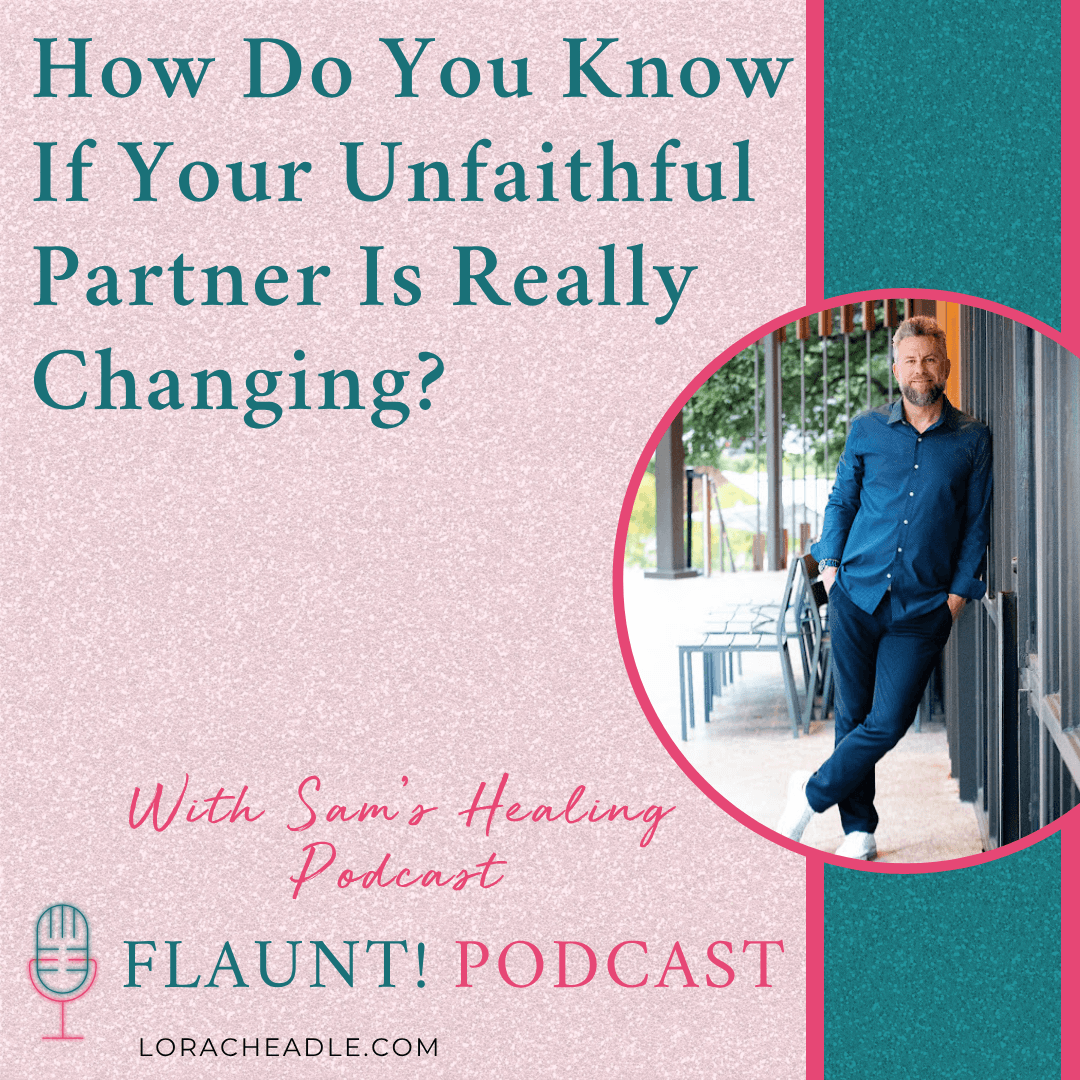
FLAUNT! Podcast · Infidelity & Betrayal · Rebuilding Trust
How Do You Know If Your Unfaithful Partner Is Really Changing?
August 23, 2026 · with Sam's Healing Podcast
Show notes
--With Sam’s Healing Podcast
After infidelity, promises can sound reassuring—but how do you know whether your partner is actually changing? In this episode, Lora Cheadle talks with Sam from Sam’s Healing Podcast about what real recovery looks like on the unfaithful side of betrayal. They explore why actions matter more than apologies, why the unfaithful partner needs to take initiative instead of waiting to be managed, and why becoming teachable, confrontable, and emotionally mature is essential for rebuilding trust. They also discuss communication tools like AVR—acknowledge, validate, reassure—along with self-regulation, co-regulation, childhood patterns, boundaries, and the difference between performing recovery and genuinely becoming someone new.
Top 3 Takeaways
- Stop listening only to what they say. Watch what they do. Promises like “It will never happen again” have very little value if they are not backed by consistent behavior. Real change shows up between sessions: seeking help, reading, doing exercises, attending meetings when appropriate, learning new skills, telling the truth, following through, and taking initiative without being parented by the betrayed partner.
- The unfaithful partner goes first. The person who created the rupture has a responsibility to lead the repair. That means booking appointments, finding resources, doing the work, becoming teachable and open to correction, and learning how to respond to the betrayed partner’s pain rather than becoming defensive or demanding that they “get over it.”
- Healing requires more than understanding why the affair happened. Childhood wounds and family-of-origin patterns matter, but insight alone does not automatically create empathy, emotional maturity, communication skills, or safety. Both partners eventually need to learn self-regulation and co-regulation, while the unfaithful partner demonstrates through consistent action that they are becoming someone capable of rebuilding trust.
Favorite Quotes
“Forget about what they’re saying. Look at what they’re doing.” —Sam
“The only currency is action.” —Sam
“There is a time where we as unfaithful stop saying what we will do. We just do it.” —Sam
“You can’t regulate yourself out of a toxic relationship.” —Lora
About Sam
Sam’s Healing Podcast is brought to you by one of Infidelity Recovery’s most prominent and renowned influencers and YouTubers. For over 15 years Samuel has been one of the leading content generators for healing and recovery of both betrayed and unfaithful spouses. After more than a decade of blogging and filming under one of the betrayal trauma’s founding fathers, clinician Rick Reynolds of affairrecovery.com,
Sam has ventured out to pursue, create, and live out his lifelong vision and passion for healing those touched by the trauma of infidelity. Through his new podcast and most recent project, Ask the Unfaithful Podcast, Samuel continues to bring his own personal experiences with infidelity recovery along with delivering the most current and up-to-date clinical wisdom and healing modalities for recovery after an affair.
You can catch Lora’s interview on Sam’s Healing Podcast Here: https://youtu.be/FzIx6yiCxw4?si=H23oDpoQu5-_KWET
About Sam's Healing Podcast
About Sam
Sam’s Healing Podcast is brought to you by one of Infidelity Recovery’s most prominent and renowned influencers and YouTubers. For over 15 years Samuel has been one of the leading content generators for healing and recovery of both betrayed and unfaithful spouses. After more than a decade of blogging and filming under one of the betrayal trauma’s founding fathers, clinician Rick Reynolds of affairrecovery.com,
Sam has ventured out to pursue, create, and live out his lifelong vision and passion for healing those touched by the trauma of infidelity. Through his new podcast and most recent project, Ask the Unfaithful Podcast, Samuel continues to bring his own personal experiences with infidelity recovery along with delivering the most current and up-to-date clinical wisdom and healing modalities for recovery after an affair.
You can catch Lora’s interview on Sam’s Healing Podcast Here: https://youtu.be/FzIx6yiCxw4?si=H23oDpoQu5-_KWET
Read the transcript
Speaker A [00:00:01]:
You're listening to Flaunt: Find Your Sparkle and Create a Life You Love After Infidelity or Betrayal, a podcast for women who've been betrayed by their intimate partner and want to turn their devastation into an invitation to reclaim themselves and their worth. Tune in weekly so you can start making sense of it all and learn how to be okay on the inside, no matter what goes on on the outside. Download your free betrayal recovery toolkit at betrayalrecoveryguide.com.
Lora Cheadle [00:00:35]:
How do you know whether the unfaithful partner is truly changing or just simply saying what you want to hear? Because remorse can sound convincing. Promises can sound convincing, especially, especially when you want that change to take place. It's true. A partner can show up beautifully in a therapy session and then return to defensiveness, avoidance, secrecy, or total shutdown the moment that you get home. So that's what we're going to talk about today is what does real change actually look like? I'll be talking with Sam from Sam's Healing Podcast about the difference between words And transformation. We'll explore why the unfaithful partner must become a student of recovery, what it means to be confrontable, why action is the only currency that rebuilds trust, and how to tell whether your partner is taking genuine initiative or expecting you to manage their healing. We also talk about emotional immaturity, childhood patterns, empathy, self-regulation, co-regulation, as well as practical communication tools you can begin using immediately. This episode is about helping you recognize the evidence of real change as well as the absence of it.
Lora Cheadle [00:02:21]:
Are you ready? My guest today is Sam from Sam's Healing Podcast, and he is one of infidelity recovery's most prominent and renowned influencers and YouTubers. For over 15 years, he has been one of the leading content generators for healing and recovery of both the betrayed and the unfaithful spouses. And yes, He has got personal experience in this area, just like I do, which honestly makes all the difference because—
Sam [00:02:57]:
It really does.
Lora Cheadle [00:02:59]:
Oh yeah. Because I don't care if you haven't been through it, you don't get it.
Sam [00:03:03]:
You're exactly right. And, and that's why, you know, it's a real honor to visit with you and talk with you. And thank you so much for having me on. It was just a joy to have you on my podcast and getting to know you more and Just seeing how much work you're doing in this space. It's, as we said before off camera, it's just a joy to work with people that you believe in and you support and you know their message is just right on. And I think your message is just right on for people that are trying to make sense out of one of the most nonsensical events they've probably ever been through in their life.
Lora Cheadle [00:03:40]:
Yeah, exactly. And thank you for that. And right back at you being on your podcast. I will link the episode below, was an absolute joy too. And one of the things that I appreciate so much about Sam is his honesty and his integrity in saying things, because I know we've all had those experiences where we work with someone or we talk with somebody and all they do is affirm for us. And that's not always it. It's like you gotta be challenged, you gotta grow, you gotta get raw, you gotta get real, and you've got to do the hard work sometimes.
Sam [00:04:15]:
You really do. I tell people in their first couple of sessions with me is that I don't blow smoke. But I'm also not a jerk. I'm going to be compassionate because I was where you or your partner might have been 25 years ago or so. And so I get it. But we're not here to just talk about what do you feel and how's your feelings? And how does that feel? And oh my gosh, I'll see you next week. And here's $300. That's not how I operate.
Sam [00:04:44]:
I teach people that, number one, you have to be confrontable. And I kind of train my clients that I'm not going to be a jerk, but I am going to confront some of the belief systems that you might have. If you can't be confrontable in a gracious, compassionate, mature way, you're not going to get anywhere when you're trying to heal from what you've done to both yourself and, of course, your spouse or partner.
Lora Cheadle [00:05:11]:
Right.
Sam [00:05:12]:
We have to be confrontable. The goal is, and I know that you know this, but the goal is to eventually be able to confront ourselves and say, wait a minute, wait a minute, why did I just say that? Why did I just get defensive? Why did I just yell? Why did I— why do I keep doing this? Why is this pattern in my life? When I can get a client to that point, and then, as you know, they're willing to do the work, to find out why they do it and change patterns, that's when growth can really happen.
Lora Cheadle [00:05:44]:
Yeah. Let's talk about some of that, because confrontation, even the name confrontation, being confrontable, people kind of go, ah, because they assume it's going to be adversarial. And when you're talking about being, you know, able to confront yourself, able to confront your partner, it's for for a reason. It's not I'm confronting you to be a jerk. It's not that I am just picking on everything that you're saying, but it's where, where are my blind spots? What am I not seeing? Maybe I've had this pattern, you know, for— I'm 57. Maybe I've had this pattern for 55 years and I think it's who I am, but it's not. It's a pattern that maybe my parents picked up from their parents And nobody has ever taken the time to break it down and to confront themselves.
Sam [00:06:37]:
Yeah, it's very well said. I met with a gentleman yesterday who in fact said to me, look, I've done this, I've done this, I've done this. I still don't know why I had an affair. And within one session, I was able to kind of make some points of connection there. But It's interesting where people will say, you know, I had a great childhood.
Lora Cheadle [00:07:01]:
Great.
Sam [00:07:01]:
It was great. You know, had 3 meals a day. Everything was great. And then I'll say, okay, and then we'll get into the weeds of it. And then my favorite thing is where I'll say to them, so did you ever see your parents fight? No, never fought. Oh, did you ever see your parents come to a win-win solution about school, about marriage, about finances? No, I don't really think I did. So is it Is it safe to say that you didn't learn how to communicate? Like you said, not adversarially, but to use your voice, to have boundaries, to have respect, and to come up with a win-win solution?
Speaker A [00:07:36]:
Yeah.
Sam [00:07:37]:
No, I don't. I don't. I don't think I did. Right. So can you maybe understand why you're not a good communicator with your wife or your husband? Can you maybe see how you probably need to consider the fact that you have some pretty significant blind spots Or what I love to do is help people understand how we trauma reenact. For example, we may have been raised by a controlling, disapproving, angry mom, and then we reenact that because we'll always choose a familiar hell over an unfamiliar heaven. And so we will recreate that dynamic with our wives in this case, where they're just being angry and controlling and bitter and all that. And now we've created that by infidelity or addiction or both, because subconsciously we don't know what we're doing and we don't know why we're doing it.
Lora Cheadle [00:08:32]:
Yes. Yes. So all of that is happening. We have gotten to the point where one partner has been unfaithful. Maybe they've had a series of affairs like my husband, and then we come together. And the explosion happens and we're trying to unpack this. And what do you feel? Shame, pain, anger, rage. Like you said about that one gentleman, I don't even know why I did it.
Lora Cheadle [00:08:59]:
And when you don't even know why you did it and your partner is saying, why did you do this to me? How could you do this to us? And is asking all of these questions. Let's talk about that dynamic because that is a blank wall. You know what I mean? Against all of these questions in. I think that's the first place where people don't even know how to move forward because they're like, I can't spend 10 years relearning how to communicate right now. I am in crisis.
Sam [00:09:25]:
Yeah.
Lora Cheadle [00:09:25]:
Let's talk about that moment.
Sam [00:09:27]:
Yeah. I tell people all the time that while, you know, it's funny, while I do make videos and I do try and teach people things through podcasts and all of that, at the end of the day, you're not gonna be able to sit home and just watch videos. about how to heal from the most traumatic event you've ever been through, or that you've ever created in your life and the other person. So you have to be able to understand, I say it this way, and I think you'll agree with it. When you find the right people, you find the right process. And when you find the right process, you can find a pathway to healing. It's not a perfect pathway.
Lora Cheadle [00:10:06]:
No.
Sam [00:10:06]:
It's not without some pretty awful, gruesome days, but there can also be good days. But when we've got 2 people who are just like, I don't know, I don't know. Number one, you need expert help. Number 2, you have to be willing to learn. And number 3, you have to be willing to be a student. I made a video not too long ago, and I don't make a lot of videos where I say this this way, Lora, but I basically said, look, I can guarantee you personal transformation if you take this approach.
Lora Cheadle [00:10:41]:
Yes.
Sam [00:10:42]:
The approach is become a student of recovery. If you, as an unfaithful, for example, say, you know what, I'm going to be a student. Nobody needs to make me go to school. Nobody needs to make me study. Nobody needs to, you know, mama me or dad me into doing my work. If I take an approach, and this is true statistically amongst unfaithful, for those that say, I'm going to go and show initiative and do work and make myself a student of what I've done. Those men, those women heal at least 50% faster. Those men, those women enjoy reconciliation at the very least 40% quicker than those that don't.
Sam [00:11:27]:
And those people get their lives back, or they get a life back that they enjoy. that they celebrate. And let's be honest, nobody has ever sat and said, I'm so grateful for the infidelity. Absolutely not.
Lora Cheadle [00:11:44]:
Right.
Sam [00:11:45]:
However, there is a— there are hundreds and thousands of couples that would say, I hate that it came through infidelity. But we have a marriage and a relationship I never thought we could ever have.
Lora Cheadle [00:11:59]:
Mm-hmm.
Sam [00:12:00]:
Mm-hmm.
Lora Cheadle [00:12:02]:
I'm going to confront on a couple of those things. Yes, I 100% agree with it. I 100% agree. You have to make yourself a student. You have to be willing to learn. And this is the part that I'm going to confront on. And yes, you need that and you need implementation.
Sam [00:12:21]:
Yeah.
Lora Cheadle [00:12:22]:
Because I think so often people are like, well, I learned about attachment style. Well, I learned how to have an Imago dialogue. Well, I learned, and it's like, great. And are you really doing it? Are you allowing that to change you? How are you showing up differently? And here, here's a real direct question that I want to talk about because so many of the listeners to this show want to know, how do I know if he's really changed? How do I know if he's getting it, if it's not just words?
Sam [00:12:52]:
Yeah.
Lora Cheadle [00:12:52]:
So talk to me about what does it look like to really be a student of What does it look like to embody change? What does it look like to truly have your mindset and your understanding of yourself finally change?
Sam [00:13:08]:
Yeah. No, those are fantastic questions. I'll start with a principle that I believe in, in my practice, and I know that you do as well, but I'm never gonna work harder than the client.
Lora Cheadle [00:13:21]:
Right.
Sam [00:13:22]:
Second of all, and this will really probably connect with the betrayed is that it is really not just what you do in session. I told a gentleman last night in a session, I said, listen, what really matters is what you do in between sessions. That's where the implementation and the rubber meets the road. Let's be honest, how many betrayed have been out there where they've come into a session with someone like us? And they've sat there and their spouse or partner puts on this face, this demeanor, this attitude, this approach, And by the time they're in the car, everything has changed. They are back to their old self. They've just come into session for 50 minutes and managed their image. They've put on their marketing face. And then the betrayed— and my heart breaks for the betrayed because they sit here going, I'm in crazy town.
Sam [00:14:16]:
Like, I'm in crazy town. This guy or this woman treats me like this for, you know, 6 days. And then we go in here for 50 minutes and he puts on this face.
Lora Cheadle [00:14:26]:
Right.
Sam [00:14:27]:
And so, the implementation comes because we have to have a heart to do the work. I was in an interview not too long ago, and I joke about how people all the time, what's the work? What's the work? If you're asking that question, you're probably not doing the work.
Lora Cheadle [00:14:44]:
Right.
Sam [00:14:45]:
And so, the work is, how do I heal my childhood trauma? What is childhood trauma? What was my parent— what was my childhood like? What were the patterns that I learned in childhood? Why do I make the decisions that I make? Or why did I do what I did? Have I invited anybody into my life to say, look, I can't fix me, I need you to help me? When I was playing minor league and professional baseball, I had a pitching coach in the middle of nowhere who said to me, listen, son, if you want to make it to the big leagues, you're going to be teachable.
Speaker A [00:15:23]:
Yeah.
Sam [00:15:23]:
going to be trainable, and you're going to be open to correction. And if you won't do those things, you will not last long. And I'm just telling you, in the world of infidelity, as an unfaithful, we have to be teachable, trainable, we have to be open to correction. That doesn't mean all we do is have somebody just come down on us. But here's—
Lora Cheadle [00:15:41]:
Yeah.
Sam [00:15:41]:
I have another podcast called Ask the Unfaithful. And we say this all the time. We say the game changes when we as unfaithful stop trying to fix this and we ask ourselves, who are we becoming?
Lora Cheadle [00:15:59]:
Yes.
Sam [00:15:59]:
What are we becoming? So to answer your question in a very direct way, for the betrayed, the answer is forget about what they're saying. Look at what they're doing. Empty promises mean nothing. It'll never happen again. It'll never happen again. That has zero currency with your betrayed. It didn't mean anything to me. Oh, that's a big one.
Sam [00:16:22]:
Let's unpack that one. It didn't mean anything to me. The betrayed goes, whoa, wait a minute. So you decimated me. If the children know, you've completely confused and decimated their viewpoint of, of you, me, marriage. And we are in absolute crisis. You may have lost your job. You may have been subjected to a lawsuit, all of this stuff.
Sam [00:16:45]:
But you're telling me you did all of that and it meant nothing? It has zero currency with the betrayed. What matters is what are they doing? What are they doing behind the scenes? Are they reading books? Are they watching podcasts? Are they doing exercises? Are they doing workbooks? If they're an addict, are they going to meetings? I mean, I learned this from Rick Reynolds, who has been doing this for 50 years. And sometimes when I have an addict come to me, I'll say, I want you to do 60 meetings in 60 days. And they look at me like, what? And the betrayed goes— I don't mean to get religious, but they're like, hallelujah, somebody's finally telling him what he should be or what she should be doing.
Speaker A [00:17:31]:
Right.
Sam [00:17:31]:
Because it is all about actions, Lora. The only currency that the betrayed has is actions. That's why so many unfaithful will say all the right things and then We're still lying, we're still trickle-truthing, we're not coming home on time, we're not checking in, we're not showing any work. How do you expect your betrayed to feel safe?
Speaker A [00:17:52]:
Yeah, you—
Lora Cheadle [00:17:53]:
because you can't feel safe unless things have changed. You absolutely can't. And that's something else too that I just wanna name here, because sometimes people will come to me and they'll be like, I want you to teach me how to be regulated, I want you to teach me how to do this. And then the more you work with them, What they're really saying is, make me okay enough to stay in a toxic relationship and feel good about myself. And it's like, no, no, you can't regulate yourself out of a toxic relationship. I mean, if you wanna make it okay for yourself, sure, go for it. But that's not the point. The point is healing on both sides.
Lora Cheadle [00:18:34]:
The point is instead of managing your own image, Being honest, being vulnerable, communicating, making mistakes. And you know what you said about people not being grateful for the experience, but grateful for what came from it? Yes. Yes. And at the same time too, my husband and I are on the other side. Do we, are we perfect 24/7? Oh, heck no. You know, do we fall into some bad patterns?
Sam [00:19:03]:
Yes.
Lora Cheadle [00:19:03]:
You bet we do. You know, can I—
Sam [00:19:06]:
Absolutely.
Lora Cheadle [00:19:07]:
Yeah, can I still go into a spiral? Yes. Can we miscommunicate? Yes. It's like, ultimately we are so much better and we are so much more raw and real and healthy, but it's also not heaven and nirvana, rainbows and unicorns 24/7 because we're human. And I love how you said it's about healing your childhood trauma. Which he's doing. But that doesn't happen in 5 sessions. That doesn't happen in 6 months.
Sam [00:19:35]:
No. And that's a great point. Here's some of the research too, that actually, there's a gentleman named Terry Real who's brilliant. He's been doing this like Rick Reynolds, 50 years. He's a wonderful human being. But he's actually over the last 6 months, and a lot of people have followed, has actually kind of shifted in some of his communication. And he outright said this the other day, I thought it was brilliant. And I've been parroting it to people every day since then, which is this: just because we heal trauma, just because we heal family of origin or childhood trauma, doesn't even mean we know how to communicate with empathy or respect or kindness or validation.
Sam [00:20:18]:
Even if we heal our trauma, we still need to learn how to better communicate out of love, Out of giving the benefit of the doubt, out of having to learn how to find verbiage. I teach unfaithful to be able to go, okay, okay, listen, I'm really missing it right now, and I know that I'm missing it, but can you let me use one of my tools that Sam has taught me? Okay, fine. Okay, here's the tool. What am I not hearing? Because obviously I'm not hearing what you want me to. Tell me what you're saying.
Lora Cheadle [00:20:53]:
Yeah.
Sam [00:20:53]:
And then the betrayed can say, this is what I'm saying. This is what I'm saying. And then I teach the unfaithful to go, okay, okay. What I hear you saying is blank, blank, and blank. No, it's also this, this, and that. Oh, so I hear you're saying this, this, and this. Yes, that's what I'm saying. And then we don't go right into, okay, well, listen, here's the— no, we go right into—
Speaker A [00:21:14]:
Okay.
Sam [00:21:15]:
Now, here's a little tool that— excuse me— James Aneer taught me that we teach unfaithfuls all day long. One of the best Easy resources to utilize is what we call AVR— acknowledge, validate, reassure. Being able to go, okay, okay, honey, let me, let me try my tool right now. I just learned this from Lora on her podcast. Let me try it. Okay, I want to acknowledge you have every right to feel what you feel. I've ripped your heart out. I've lived a double life.
Sam [00:21:47]:
I've, I've got this hidden addiction or what have you. I want to acknowledge you're being a human. Let me validate that you have every right to be scared, terrified, traumatized. You don't know what's up, what's down, what's left, what's right. Your whole world has been shaken. I just want to validate that I'm hearing what you're saying, and I love you, and I want to get better. And then let me reassure you, I'm willing to do whatever it takes to heal. I'm willing to turn over every stone I need to turn over.
Sam [00:22:23]:
I'm willing if it means I got to meet with Sam or Lora for years, and if we got to take out a loan and we got to do whatever. If you want to do an intensive, if you want to go, whatever. I want to reassure you, and here's where the rubber meets the road. This is what I have taught people from personal experience. There is a time where we as unfaithful Stop saying what we will do. We just do it. And we have the courage to go, okay, listen, just watch me. Just watch me.
Sam [00:22:54]:
Give, give me whatever amount of time, but just watch me. Now, that's a bold statement, because what that implies is you're going to do your work, you're going to go to your therapy sessions, you're going to book them.
Lora Cheadle [00:23:06]:
Yeah.
Sam [00:23:06]:
You're going to read books, you're going to read podcasts, You're gonna show initiative. You are going to be a student, and you're gonna stop telling them, and you're gonna start showing them.
Lora Cheadle [00:23:18]:
Yes. And that, even listening to that, how does that feel in your nervous system? I mean, listeners, honestly, how does that feel in your nervous system? Can you imagine, visualize, pretend your partner is saying, watch me, I've, watch me.
Speaker A [00:23:36]:
I've got it.
Lora Cheadle [00:23:37]:
I mean, that's an instant, oh, I don't have to manage this.
Sam [00:23:42]:
Right. That's a beautiful point. We could do a whole webinar or podcast, wink wink, on that because that would be a brilliant statement because when, let's put it, I'm always careful because there's so many men betrayed as well as women. But let's, let's use the dynamic of a betrayed female right here. When the betrayed female feels like they have to parent the unfaithful and the unfaithful's recovery work, the unfaithful male automatically steps into a child role. So the female is trying to manage and trying to be hypervigilant and trying to lead it. And then the unfaithful male's tantruming, getting angry, pounding their fist. Why are you so controlling? And we're just being a tantruming toddler.
Sam [00:24:34]:
The recipe for healing is where the betrayed is able to go, hey, I didn't cause this. I didn't do it. Here's another thing I tell the unfaithful. Look, this is an ironclad statement. The unfaithful goes first.
Lora Cheadle [00:24:50]:
Yes.
Sam [00:24:51]:
I learned that from Dr. Jake Porter, who's a wonderful human being. But listen, You did this. You go first. You lead. You lead by example. You lead by exercises. You lead by booking coaching or therapy appointments.
Sam [00:25:06]:
You lead by researching intensives. You go read books. You go find podcasts. You lead. Even if the betrayed is not easily able to be led, why would they be right now? So Take some initiative because the only currency is action. And if you have a lot of action, and watch this, if you have a lot of action and not everything you do is perfect, there's going to be a little bit more grace for screwing up. When you never do anything at all, that's a whole different story, right?
Lora Cheadle [00:25:41]:
Mm-hmm. No, absolutely. And building on that as well, Sometimes people have pushed back on me and they've been like, you have way too much grace and compassion for the unfaithful. They screwed it up. They made this choice. They ruined my life. Okay. Yes.
Lora Cheadle [00:26:01]:
And they're also a human. Let— what is the goal? What is the goal? What do you want? Do you want healing? Do you want peace? Do you want to be bitter and a man-hater the rest of your life? First, let's focus on that goal. If the unfaithful is going first and suddenly you can relax and you can begin trusting them, I'm not saying throw everything out the window and lean blindly into it because they were good for a week, but it does allow you to have more grace. It does allow you to see them and to be like, dang, this has to be hard for you. That inner child work is really tough. Now we have a dialogue going back and forth. Now we have compassion and grace and love flowing both ways. I can show up and be triggered and messy and crying, and I know you've got me, and you can show up saying, I just wanted to protect my identity, and I can't believe— and then I have grace for you.
Sam [00:26:59]:
Right.
Lora Cheadle [00:27:00]:
It's healing to both partners because something that people miss in the infidelity space is it's not just about the betrayed partner. It is about both people healing, and it's a journey. for everyone. So yeah, unfaithful, go first, it's gonna give you a better outcome. And it's going to make your relationship better. In the end.
Sam [00:27:26]:
It really will. Because when we take a step back, and we begin to understand, listen, there was 2 people in the marriage. And there may have been 2 people who were very unhappy. feeling very unseen, feeling very unloved. But most of the time, and certainly not all the time, but most of the time, only one person is cheated.
Lora Cheadle [00:27:50]:
Yes.
Sam [00:27:51]:
And when the unfaithful says, okay, I did this, now I'm going to take ownership for it, I'm going to find out why I did it, I'm going to make myself a student and consume information, then maybe I might understand that You know, on average, the betrayed spouse deals with anywhere from 50 to as many as 250 reminders every single day.
Speaker A [00:28:17]:
And that's—
Sam [00:28:18]:
And it's traumatic when we unfaithfuls rattle off, just stop thinking about it. Why are you always thinking about it? Or, come on, get over it. We don't understand that we just continue— and this is a big word— big statement, rather, but we just keep retraumatizing them.
Lora Cheadle [00:28:36]:
Yeah.
Sam [00:28:36]:
Because the betrayed feels like they can't be vulnerable, they can't be open, they can't talk about their pain. And when the betrayed feels like the unfaithful can't handle the emotion of the betrayed, something really sad, tragic, and I think really, in a very long-term way, undermines even more the fabric of the relationship is that When the betrayed feels like they have to coddle the unfaithful, and they have to, you know, put the unfaithful back together because, oh, I'm such a— just a piece of crap, and I'm a terrible person, and we go into this self-pity. The betrayed, what I alluded to is the betrayed really begins to lose even more respect for the unfaithful.
Speaker A [00:29:27]:
Yes.
Sam [00:29:27]:
And that's That's adding insult to injury, because for us as unfaithful, we have to win back respect.
Lora Cheadle [00:29:34]:
Right.
Sam [00:29:35]:
We have to win back love. We have to certainly win back trust. But we also have to win back safety. When we're throwing out these ridiculous euphemisms, and we're acting like tantruming toddlers, we're undermining the very thing that we really want, which is, again, love, connection, safety, trust, intimacy. But we are undermining what we say we really want, but our actions unfortunately prove otherwise.
Lora Cheadle [00:30:05]:
Yeah, I'm going to make a bold judgmental statement. Are you ready for this?
Sam [00:30:12]:
Always.
Lora Cheadle [00:30:14]:
I feel like with so many of the people that I have seen, the unfaithful faithful partner is such a child. They are locked in that wounded child.
Sam [00:30:28]:
Yeah.
Lora Cheadle [00:30:28]:
They are tantruming often. They are rebelling against their wife as if their wife were their controlling parent. And I feel like sometimes when it comes to the why, it's almost like, because I just wanted to rebel against women. And it doesn't make sense. It's so deep and dark, but they are not an adult. I'm like, you are not a man. You are not a leader. You are not true to yourself.
Sam [00:30:56]:
Yeah.
Lora Cheadle [00:30:56]:
And I think that's true. This is my wild statement. I think that's true for a lot of men, sadly. And I think it's a tough thing to come to terms with and to confront yourself on. I'm not acting like an adult here.
Sam [00:31:11]:
Well, so many people, we both know this in, in this world, everybody throws out the narcissistic word or narcissism or what have you. But the interesting thing is, You know, narcissism is really synonymous with emotional immaturity.
Speaker A [00:31:28]:
Yes.
Sam [00:31:28]:
So many betrays have these emotionally immature men, to your point, and it certainly goes—
Lora Cheadle [00:31:35]:
There, it goes both ways.
Sam [00:31:36]:
There's unfaithful women who are emotionally immature as well. And this is why a plug-and-go, just-do-this process really doesn't sustain long-term healing. Because you alluded to this in the first few minutes, If we don't know why we've done it, how can we prevent it from happening in the future?
Speaker A [00:31:59]:
Right.
Sam [00:31:59]:
If we don't know why we've done it, the betrayed constantly lives in fear. Well, how do I know what to look for in the future? How do I know the signs of relapse? How do I know what I should be looking for? So now we're just on a boat in the middle of the ocean and have no clue. Emotional maturity, unfortunately, comes from being able to understand how were we parented, how were we cared for or not cared for when we were little. Our personality— most clinicians will agree that our personality is kind of set by about 8 or 9 years old, but our brain continues to grow till about 25. But during the most formative years of our life, where we are the most malleable, we are the most—
Lora Cheadle [00:32:47]:
Hmm.
Sam [00:32:48]:
Open to impressions by parents. We can be harmed. We can be abused and not even know it. And I work with a large degree of childhood sexual abuse survivors who have been harmed. Any childhood sexual abuse survivor will tell you that when you understand what happened to you at such a little age, you feel like your soul has been murdered.
Lora Cheadle [00:33:13]:
Yes.
Sam [00:33:14]:
And any betrayed spouse will say, well, they're not trying to compare themselves to a sexual abuse survivor. They still feel like their soul has been murdered because everything that they knew about life has been decimated. And then we are over here rattling off these statements of, you just need to get over it. You just got to stop thinking about it. You just need to forgive me. You just need to do all this stuff. We just prove how disconnected we are from the pain, the hurt, the trauma, because trauma rewires our brain.
Speaker A [00:33:50]:
It does.
Sam [00:33:51]:
So this is why so many betrayed will sit on a Zoom call with me and go, I don't even know why I do what I do. I don't know why I have all of this pain. And it's like I can't control my mind, right? Because the trauma has rewired it. And we have to develop new neuroplasticity to get you back to the dignity of choice. The dignity of choice is choosing what you think about, choosing how you regulate yourself, choosing somatic work, choosing grounding. None of that is controlling your spouse. That is all about you.
Speaker A [00:34:27]:
Right.
Sam [00:34:27]:
To your point earlier, I think, and I would be curious to get your take on this, but This has been a little bit of a debate amongst a lot of clinicians for a while, but here's how I see it. If I can't self-regulate, it is going to be very hard for my partner to co-regulate me. But just because I can self-regulate doesn't mean that I can co-regulate if I don't learn the skills how to do it. The more self-regulated I am, the better we can co-regulate. But there is a responsibility on both the unfaithful and the betrayed to learn how to self-regulate, because the goal is to learn how to show up for each other, which is co-regulation. But it is incredibly hard to get there. It's impossible to get there by just watching videos, reading books, and just DIYing it. And I'm someone who believes in making videos, as do you.
Sam [00:35:30]:
But you have to have someone that can teach you how to both self-regulate and co-regulate. What is your take on that?
Lora Cheadle [00:35:39]:
I agree. I mean, obviously, not obviously, we have to do it for ourselves first. That is first and foremost. Sometimes we're going to do a good job at it. Sometimes we're going to do a bad job at it. I also know, just speaking for me personally, I know there are times when I could be with Mother Teresa and Gandhi and the most regulated people in the world, and I will not get there because I either I'm over, over, or I'm because I'm choosing it because I'm angry about something.
Speaker A [00:36:14]:
Yeah.
Lora Cheadle [00:36:14]:
So yes, co-regulation is ultimately it. And there are times when your partner is not going to choose to meet you there. And having that right. Yeah. And then having that wisdom of when can we lean in and co-regulate and when can we create something bigger, better? And when do we also need to be wise enough to choose to walk away?
Speaker A [00:36:37]:
Yeah.
Lora Cheadle [00:36:38]:
In a loving way. Not you, da da da da da. Now I can't even be here and fine, forget it. We're not gonna do this on Christmas morning, but when you can step away. Do your own work, allow your partner to have their experience, and know when and how to come back together.
Sam [00:36:55]:
Something that's really fascinating— I learned this from one of my clients who works with special needs children in school. And she taught me this. She said, you know, Sam, it's interesting, we were talking about co-regulation and all that. And she said, so in this particular school district here in Texas, she said, we work in teams. Because a dysregulated adult cannot— I messed it up. I got to say it again. A dysregulated adult cannot regulate a dysregulated child. So when one adult finally gets dysregulated, the other partner comes in and says, hey, you need a timeout.
Sam [00:37:36]:
You need to go de-escalate and really kind of ground yourself. Let me take over. Now the adult can regulate the dysregulated child. So we have to teach couples that, you know, sometimes we have a dysregulated betrayed, and they're allowed to be. They're allowed to be. But can we hold on to ourselves? Can we stay grounded and not try and fix it, but validate and listen and show empathy and compassion? But when we can't— now, this is where some couples don't like this, but we've already decided that we're going to talk about confrontation— Is that I teach couples when one partner is unreachable, it's time for a timeout. That timeout is typically minimum of 30 minutes to as much as an hour. Now, whoever calls the timeout— because there's a whole timeout protocol to this— whoever calls the timeout re-engages as soon as the alarm goes off.
Sam [00:38:33]:
I teach men when they feel like they can't reach their dysregulated, betrayed woman who might be in a spiral, To go, honey, let's take a timeout so we don't do any more damage. Or I teach them to go, look, I'm about to regress. I need a timeout. I don't want to say anything else. I've already hurt you enough. I'm going to take a timeout. I'll be back in an hour. He or she sets an alarm on their phone for an hour.
Lora Cheadle [00:38:59]:
Yes.
Sam [00:39:00]:
And then they go do breathing exercise, take a hot shower, take a hot bath, listen to music, get some food, pray, meditate, go for a walk with the dogs to really calm themselves down, get back into their adult. Then the betrayed, who may not like the fact that a timeout has been called, they have their own protocol. And then they come back because I learned this from Rick Reynolds— marathoning, where we're talking for 1, 2, 3, 4, 5 hours. It's like we teach our kids— Nothing good happens after midnight. Nothing really good happens after about an hour of marathoning in a trauma spiral conversation.
Lora Cheadle [00:39:41]:
No, no, it doesn't. And this is something that I want everyone to hear. When your partner calls a timeout, I know that drive to be like, but just tell me this one thing. Did you love her? Just tell me this one. Just, just, you can't do it. Do a better job. Come on, you can pull it together. Pull it together for me.
Lora Cheadle [00:39:59]:
Don't you love me? Don't you love me? And to really all of a sudden escalate your stress, your emotion, because you feel like, oh my God, I'm being abandoned. I'm being abandoned. We're getting to the good stuff. And he's bailing now.
Sam [00:40:13]:
Yeah.
Speaker A [00:40:14]:
That's hard.
Sam [00:40:15]:
That, that can feel like emotional abandonment. That's why I teach whoever takes the timeout to say, look, I don't think you're reachable. I'm not leaving the house. I'm not jumping in the car or the truck. I'm going to take a timeout. I will be back in an hour. Okay, so the betrayed or whomever gets the timeout called knows, okay, they're not leaving, they're coming back.
Lora Cheadle [00:40:38]:
I'll get my questions answered. You're not stonewalling.
Sam [00:40:41]:
I will reengage in an hour when we are both regulated and calm. And then we can talk for another hour. Because here is the thing, to the point we talked about earlier, I really want the betrayed to kind of hear that I teach guys to call timeouts when they feel like they are at the point of regressing. Regression is when emotionally I leave the present moment and I become a child who feels choiceless, powerless, and who is not getting what they need.
Speaker A [00:41:12]:
Right.
Sam [00:41:13]:
And when I regress, now I'm the tantruming toddler. Now I'm getting angry, defensive, being a jerk, saying stupid things. So sometimes we need a timeout because we're about to cause more harm. During that timeout, there is no contact, there's no text messaging, there's no emailing, there's no chasing and yelling. It is a cooling-off period that has a determined amount of time so that when whomever calls the timeout comes back, then they can start to use their co-regulation skills because they are self-regulated. Yes.
Lora Cheadle [00:41:51]:
Yes. Sometimes we default also, to your point earlier, into patterns that we grew up with.
Sam [00:42:03]:
Yeah.
Lora Cheadle [00:42:04]:
If our parents were never regulated, if there was always screaming and they thought, like, one of my husband's phrases early on was, you're just not speaking our family language. Our family speaks in loud voices. Our family yells.
Speaker A [00:42:21]:
Our fam—
Lora Cheadle [00:42:22]:
and it's like, Family language is one thing, and that's not it. Abusive behavior is not a family language that you just excuse.
Sam [00:42:33]:
Right.
Lora Cheadle [00:42:33]:
It's how does this look? Maybe you've never had it. The devil you know versus the devil you don't know. I've never had a calm, regulated conversation. I've never found that win-win. I don't know what it looks like to pause a conversation because Maybe growing up, every single conversation ended in somebody yelling and crying and then somebody giving in. Experiment. It can be better. Try it once.
Lora Cheadle [00:43:05]:
See how it works. That's that rewiring. Oh, wow. We were successful on this. Now it's going to be easier to do it again.
Sam [00:43:15]:
Absolutely. And it just takes practice. I mean, nobody's arrived. And so being able to understand it really takes a significant period of time to develop new patterns. I grew up in an old-school Italian family. Fighting was a form of communication.
Lora Cheadle [00:43:33]:
Right.
Sam [00:43:33]:
And what I had to learn was that volume doesn't mean you're right. One of the— there's, there's 4 markers to narcissistic behavior. There's defensiveness, dismissiveness, deflection, and then there's domination, which is that overpowering, one-up, always got to get louder, got to make my point. And as long as you are in one of those 4 markers, you're being narcissistic, and nothing good is going to come out of that. And so I had to relearn. I did a ton of trauma work, but I also had to relearn communication. I also had to relearn what empathy looked like. sounded like and talked like.
Sam [00:44:18]:
I had to learn to give the benefit of the doubt. I had to find my words and not regress to my younger, tantruming self that still needed to be healed. Because healing is possible if you commit to the process. John Maxwell said this maybe 35 years ago, and it's not even an infidelity expression, but it is something that works, is that the power is in the process.
Lora Cheadle [00:44:44]:
Yes. Now, Sam, just speaking personally, was it hard for you to all of a sudden have to confront yourself and to be like, everything was wrong, my whole life was wrong, and to have to go through, I have to change this and now I have to change that? Were there moments— I mean, there's exciting moments too, but were there times where it just felt like this is too much, it's just easier to Check out and go be me. Because that's why I am.
Sam [00:45:16]:
Only on days that ended in Y. So the early days of recovery were really, really hard. But I remember I sat in Rick Reynolds's office very early on in recovery. And I said, Rick, listen, here's the thing. I've grown up playing sports my whole life. I've played baseball my whole life. I can't handle you just being like, well, what do you think? And what do you feel? I said, I just need you to tell me the honest to God truth. tell me where I'm being stupid.
Sam [00:45:45]:
And he goes— now, Rick Reynolds is, I don't know, I think he's in his 70s now, and we're still great friends. But this was probably, you know, 25 years ago. He was younger, a little bit more fiery. So one day we were talking and he goes, do you want to just hear yourself talk, or do you want to shut up and let me talk? I go, now we're getting somewhere, Rick. Give it to me. And he goes, you're being short-sighted. Here's why you're being short-sighted. You're missing this point.
Sam [00:46:09]:
And I was like, Okay, that makes sense. What do I do? So yes, it was very difficult and it was hard. But when I finally was able to trust somebody, everything changed. It just got easier. It didn't change overnight. But I started doing what he said to do. And I started implementing the process because I had to trust the process. And that changed everything.
Sam [00:46:34]:
So yes, to your point, Man, out of nowhere, the door— the day can feel hopeless and helpless and just out of control. But it doesn't mean that the entire process is out of control. It's just a bad day.
Lora Cheadle [00:46:48]:
Exactly.
Sam [00:46:49]:
And, you know, Alcoholics Anonymous has made this statement famous, and obviously it's in the Bible in different verbiage, but all you can do is live one day at a time. When the early days of recovery were going on, I just got to get through today.
Lora Cheadle [00:47:02]:
Yes. Yes. And I also wanna say this to all of the betrayed partners listening. Unfortunately, your partner's not gonna wanna hear that from you. If you go up to your partner and say, I see that you're being shortsighted, they're not gonna take it well from you.
Sam [00:47:21]:
Right.
Lora Cheadle [00:47:21]:
Especially early on. That's why you need that outside person, that outside perspective. Because if you start managing their recovery, even when you think you're being helpful, let me tell you, I thought I was being helpful so often when I wasn't, then what does that do? It puts you in that parenting position. And what is it going to inspire your partner to do? To rebel, to tantrum, to get angry at you. So yes, I say this all the time, we see other people's blind spots so much more clearly than we see our own. And that is, please do not point it out to your partner, especially early on. That's why you need that outside perspective.
Sam [00:48:01]:
100% right. I couldn't have said it better myself.
Lora Cheadle [00:48:04]:
Yeah. Yeah. We are getting close to time, and I wanna really make sure of 2 things. First, is there anything else that you want to say to the betrayed partner as an unfaithful? What do you want them to hear from you most? And then how can people reach out and find you and listen to your podcast?
Sam [00:48:27]:
I think the thing that I would end with is the fact that who you might be married to or in a relationship with right now might not be the person that you discover in 6 months, 12 months, or 48 months. It is going to be important that you have some non-negotiable boundaries, non-negotiable boundaries, which are, of course, no more contact with the affair partner, and no more using whatever the addiction might be. Absolutely. There's nothing wrong with that. But it does take time for the medicine to work. And if they're getting help, regular help, doing work, they might be someone worth a second chance. But you won't know for somewhere between at least 6 to 36 months. It takes time for the medicine to work.
Sam [00:49:21]:
Now, if they don't honor and respect your boundaries, that's a whole different discussion. That's a whole different podcast. But you might— if you would have met me 25 years ago, you would say, what a jerk. Holy cow, that guy. We don't have enough words to describe what a jerkface that guy is. But due to— because I come from faith, God's grace, and a whole lot of work. This is how I know that God loved me, is that he knew how stupid I was. And he gave me so many people people to help me and educate me and support me.
Sam [00:49:58]:
Even now, I have a supervisor and my own therapist, and then I have another training therapist. I need all of that to help me not ever return back to the jerk that I was. If I can help, people can reach out to me at samshealingpodcast.com. They can reach out to me at samshealingpodcast@gmail.com. They can find me on YouTube or Instagram. However I can help. My, my, my prayer 20-some-odd years ago, I was in a field during one of the most depressing days of my life of early recovery. And I remember saying, man, if I could ever be used again to help people heal, if I could ever find purpose again, God, just give me another chance.
Sam [00:50:47]:
And so It's a joy to be with you. It's an honor to just be asked to come in and visit with you. It never gets old talking to you about this stuff. Because when you talk to someone who's been through it, there's a certain way they talk. There's a certain vocabulary. There's a meme that says, sit with the overcomers. Their language is different. Yeah.
Lora Cheadle [00:51:12]:
And it is.
Sam [00:51:13]:
It is.
Lora Cheadle [00:51:14]:
And thank you for all of that. And What I'd like to end with is I'm a student of A Course in Miracles. You know, that's the thing that anchors me. And something that keeps me going through in those early dark days, just like you in that field, is remembering that everybody else's bad behavior, it's a cry for love. Everything is a cry for love. And when we can just sit with that perspective, I think it brings so much grace to both parties. People aren't out to hurt you. They aren't out to betray you.
Lora Cheadle [00:51:51]:
As weird as it sounds, it's a cry for love. And we're all hurting and we're all human and we just are here to walk each other home. So, Sam, thank you so much for your grace, for your wisdom, for showing up so fully. I will definitely link the episode that I did on your podcast.
Sam [00:52:12]:
Thank you.
Lora Cheadle [00:52:13]:
And we will keep the conversation going. Before you go, I want you to ask yourself a different kind of a question. Not simply, does my partner say that they're sorry? I want you to ask, are they becoming confrontable? Are they taking initiative without being managed? Are they doing the work between sessions?
Sam [00:52:39]:
Yeah.
Lora Cheadle [00:52:40]:
Are they learning to tolerate my pain without collapsing into defensiveness, shame, or self-pity? Are they becoming more honest, more emotionally mature, empathetic, and consistent? And most importantly, are their actions being sustained over time? I mean, really, people can show up good for a week or a month, but How long can you keep up that good face? You don't have to decide anything today, but what I want is I really want you to stop measuring change by promises alone, because real change is visible over time. It shows up in that consistency, in humility, initiative, accountability, communication, and a willingness to do the work. And to keep doing the work even when no one is watching. If you need help determining whether you are seeing genuine transformation or just another cycle of empty promises and disappointment, you can book an introductory session with me at introductorysession.com. You can find Sam, his podcasts, video, and resources through the links in the show as well, because you deserve far more than words. You deserve enough evidence to trust what you know. As usual, have an amazing week and always remember to flaunt exactly who you are, because who you are is always more than enough.
Speaker A [00:54:26]:
Tune in next time to Flaunt: Find Your Sparkle and Create a Life You Love After Infidelity or Betrayal. With Lora Cheadle, every Wednesday at 7 AM and 7 PM Eastern Standard Time on syndicated Dream Vision 7 Radio Network. Uncover the truth of what's possible for you on the other side of betrayal and develop the skills and strategies necessary to embrace the future and flourish today. Download your free betrayal recovery toolkit at betrayalrecoveryguide.com.
Never miss an episode
