
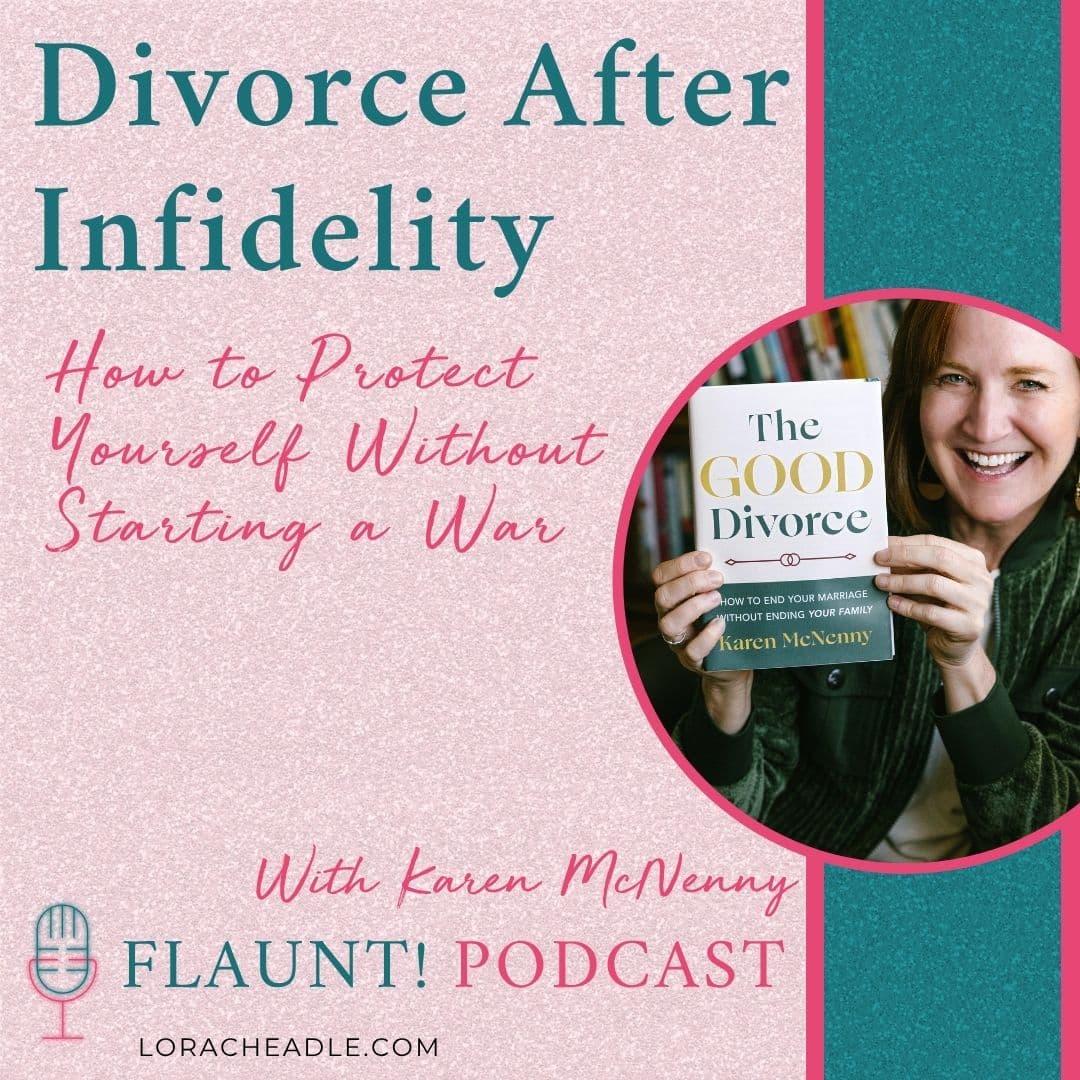
Divorce After Infidelity - How to Protect Yourself Without Starting a War
September 13, 2026 · with Karen McNenny
Show notes
If betrayal has suddenly made divorce a possibility, you may feel trapped between two terrible options: stay in a marriage that no longer feels safe or enter a legal battle that causes even more damage. But divorce does not automatically have to mean war.
In this conversation, Lora Cheadle speaks with divorce consultant, mediator, co-parenting specialist, and Good Divorce Method founder Karen McNenny about approaching divorce with greater intention, clarity, and care. Together, they explore how to protect yourself without allowing fear or anger to control the process, set boundaries with a hostile spouse, support children across two homes, navigate the painful reality of an affair partner entering family life, and recover emotionally after the legal process ends.
Top 3 Takeaways
- A good divorce is not painless or conflict-free. A good divorce is handled intentionally enough that the process itself does not create more damage than the marriage already did. The goal is not to avoid every difficult emotion, but to build a more functional future instead of automatically turning former partners into enemies.
- Protecting yourself does not require becoming hostile. You can establish firm boundaries without becoming a doormat or escalating every conflict. When conversations become insulting or emotionally charged, pause, clearly state what you are willing to participate in, and return to the discussion when it can be respectful and productive.
- The legal process can end a marriage, but it cannot recover you. Divorce may change your home, finances, parenting, identity, friendships, and imagined future. Legal guidance is essential, but emotional healing, nervous system regulation, self-trust, and creating the life that comes next require a different kind of support.
Favorite Quotes
“Your marriage is ending, not your relationship.” —Karen McNenny
“A good divorce does not mean denying your anger or rushing your grief. It means choosing where your pain belongs.” —Lora Cheadle
About Karen McNenny
About Karen
Karen McNenny is the author of The Good Divorce: How to End Your Marriage Without Ending Your Family. As a mediator, divorce consultant, and co-parent specialist, she helps families navigate separation without destroying the relationships that matter most.
In a culture that often treats divorce like a battlefield, Karen offers a radically different model — one that exposes the systemic failures of the traditional divorce industry and replaces them with a child-centered, dignity-driven approach. Her work reframes divorce not as a personal failure, but as a family restructuring that can be handled with intention, stability, and long-term family stability.
What makes Karen’s perspective especially powerful is that she has lived it. She navigated her own divorce and successfully raised her children across two homes — from kindergarten through college — proving that families can restructure without rupturing.
She is known for blending warmth, clarity, and practical strategy to help families navigate change with intention. A sought-after speaker, trusted advisor, and TEDx presenter, Karen also brings more than two decades of leadership coaching and consulting experience across the nonprofit, corporate, and public sectors.
Read the transcript
Lora Cheadle [00:00:02]:
Divorce. Oh my goodness. The idea of divorce can be so threatening. You know what I mean? Like, what's it gonna be like and what's gonna happen? And can I support myself? And where are the kids gonna be? And he's been in my life forever. Oh my gosh. How is it gonna be if I don't see him? And what about his family? I like them more than mine. If you are anything like so many of the people that I have talked to, and worked with, just the idea of divorce can be really triggering. And that's what we're gonna talk about today is the concept of what is a good divorce and how do you have a good divorce and how do you even maybe go down that path of thinking you might want a divorce and then decide, actually, I really don't want a divorce.
Lora Cheadle [00:00:51]:
Or I think this is a hard one too. What if your partner springs it on you and you're like, I thought we were fighting for the marriage. We're gonna talk about all things divorce today. Today my guest is Karen McNenny, and she is a divorce consultant, a mediator, and a co-parenting specialist who has become a leading voice in the family-centered divorce reform, which, as you know me as a former lawyer, big fan of. She has founded The Good Divorce Show podcast and The Good Divorce Academy. And she teaches couples how to divorce differently with less despair and destruction. So all that and more coming up soon. Karen, welcome to the show.
Karen McNenny [00:01:38]:
Thank you so much for offering and sharing this platform for such an important conversation.
Lora Cheadle [00:01:44]:
It is an important conversation. Um, let's kind of start, I think, with the overarching cultural beliefs about divorce.
Karen McNenny [00:01:53]:
Oh my gosh.
Lora Cheadle [00:01:54]:
Yeah.
Karen McNenny [00:01:54]:
How long do we have?
Lora Cheadle [00:01:57]:
Exactly. Because yeah, I think people see divorce, what, as a failure. They see it as the end. They see it as so many things that it's not. So let, let, let's start talking about that. What are some of the misconceptions about what it means to be divorced?
Karen McNenny [00:02:13]:
And, and I think so much the immediate expectation is those 2 people are now enemies. They're gonna go lawyer up. They're gonna fight to the death. Their kids are going to have terrible wedding days. They're not going to ever be able to have a holiday together. Like, we have all been drinking the Kool-Aid of destructive divorce for so long that we don't even give permission or recognition that it could be done differently. And I think if more people knew there was another option, they would totally choose it.
Lora Cheadle [00:02:46]:
Yes, I agree. And you know, something that I read in your book that I didn't know, and I appreciated that you pointed it out, how other countries do it differently. This divorce model is a US model. Can you say more about the way some other countries do things differently?
Karen McNenny [00:03:01]:
Well, I am about to make a deep dive on this, Lora. I've decided in 2027, my podcast, The Good Divorce Show, I'm going to do a whole series of divorce around the world.
Lora Cheadle [00:03:12]:
Good.
Karen McNenny [00:03:12]:
And speak with practitioners and individuals. I know that In the, uh, where this first came to me was those Scandinavian countries who seem to be leading the charge in lots of alternative ways for happy lifestyles. And in the documentary Divorce Corp, they interview families in Sweden, and they're kind of gobstopped of like, why would you go to battle? Why would you take things from each other? Why would you not get together when your kids have a school program? Like, they just didn't make any sense to them. And to them, divorce was very much an administrative task, not this whole giant undertaking that again is driven through a judicial system that is built in a binary— there's going to be a winner and a loser. And God love you and your colleagues as attorneys, you are trained to fight for your client against that opposing counsel, regardless if they're representing someone you had a love story with, someone you have a forever relationship with. So I just think the story of divorce and the methodology is kind of misplaced.
Lora Cheadle [00:04:28]:
I agree.
Karen McNenny [00:04:29]:
We haven't done anything to do a course correction collectively. And I don't— I'm curious what you would say, Lora. I don't know that we can make that course correction inside the system. It's kind of stuck. But if we go to the people, you who's listening right now today and wondering, as I was wondering, I cannot face a future of being an enemy with the parent that I am gonna grow old with. I can't do that. And then we get stuck. And we found our way.
Karen McNenny [00:04:59]:
And I think these kinds of conversations for people to demand something different.
Lora Cheadle [00:05:05]:
Yeah.
Karen McNenny [00:05:06]:
To know that there are alternatives to just lawyering up. But you've lived inside of it, so I don't know what your 2 cents is about that.
Lora Cheadle [00:05:17]:
I, I agree. And I think, I think it's frustrating because also within the system, a very real, a real reality, let's put it that way, of practicing law is people sue their lawyers for malpractice all the time.
Karen McNenny [00:05:35]:
Oh my gosh.
Lora Cheadle [00:05:36]:
And they get disbarred all the time. And you know what? One of those reasons lawyers get sued, because they didn't advocate zealously enough for me during my divorce, because I found out afterwards that I could have gotten, I mean, and it's usually paltry, $5,000 more. So everybody is in a defensive posture when you're in the legal system. That's right.
Karen McNenny [00:05:56]:
Yes.
Lora Cheadle [00:05:56]:
Lawyers are trained to advocate, and lawyers are also like, holy cow, these are some volatile, angry people, and they're gonna sue me if one thing goes wrong 10 years later. So I have to do everything and put everything on the record to show that, nope, I was doing my job correctly. So I'm with you within the system. So many layers would have to change. So many practices would have to change.
Karen McNenny [00:06:21]:
Yeah.
Lora Cheadle [00:06:22]:
Yeah.
Karen McNenny [00:06:23]:
And I have just heard that lawyers are wired to look for risk for the very reason that you just said. Everything is risk management, risk management, and they live within a fear.
Lora Cheadle [00:06:33]:
Yes.
Karen McNenny [00:06:34]:
Of the law that they are practicing. Like, oh, that sounds so exhausting.
Lora Cheadle [00:06:40]:
I—
Karen McNenny [00:06:40]:
so, you know, within the Good Divorce Method, we lean on attorneys. We need attorneys to be administrative.
Lora Cheadle [00:06:47]:
Yes.
Karen McNenny [00:06:48]:
But not to write our parenting plan, not to help with the rupture of the relationship, not to figure out how to keep track of the hockey gear once the ink is dried. Like, there's a whole nother story that this family is enduring Thank you, attorneys, for getting us legally divorced. Let's teach people how to be divorced. That's the goal.
Lora Cheadle [00:07:08]:
Yeah, absolutely. And I'm just gonna kick this can out there because this is one I think that's more to the end of the conversation. If people can follow people like you and your method and have good divorces and stay friendly with each other and stay compassionate and caring, I I think the chances of something going wrong later are less.
Karen McNenny [00:07:33]:
Absolutely. How we begin is often how we end.
Lora Cheadle [00:07:37]:
Yes.
Karen McNenny [00:07:38]:
And, and 2 things I would say about that. One, we usually don't begin soon enough. I think many of us just stay too long. And again, this social narrative that your house, your marriage has to be on fire to justify the exit. So we may have been driving by that exit for years.
Lora Cheadle [00:08:00]:
Yeah.
Karen McNenny [00:08:01]:
Nobody wants divorce, so of course fight for your marriage. I'm pro-marriage, I'm pro-family, I'm not pro-divorce. All I'm saying is if we're gonna have divorces, let's figure out how to do it better.
Lora Cheadle [00:08:10]:
Yeah.
Karen McNenny [00:08:10]:
But the longer we drive by that exit and think, I have to make a case against this person— so now addictions might start to show up, infidelity becomes present maybe as that catalyst. You know, I don't think affairs end marriages. I think affairs are a catalyst that gets us unstuck, but they do a lot of damage. We start only seeing all the bad stuff about our partner and our co-parent. Like, I, I, I have to now just start being angry about how you load the dishwasher and how you never ever help with, uh, picking the kids up and how you want to take more time on Saturday for yourself with your friend. Like, we just start the judge and jury in our head Ka-ching, ka-ching, ka-ching, ka-ching, until by the time we're on our way out, like, I really do hate you.
Lora Cheadle [00:09:00]:
Right.
Karen McNenny [00:09:00]:
And we start from there. And I remember a moment inside that messy purgatory. Are we in? Are we out? Am I leaving? Not— it's a terrible place to hang out. And thinking, I, I maybe need to leave while I still love this guy, at least like him. I may not be in love with our marriage and our union and the home that we're creating for our kids. It's now starting to get to have lots of high conflict because of areas where we're just not compatible.
Lora Cheadle [00:09:31]:
Right.
Karen McNenny [00:09:32]:
But do I actually want to grow to, to hate and despise this human before we start a legal process? What if we gave people permission to make an elegant exit? That would be transformative. That's what I want you to hear as you listen today, that if you're on the fence You don't have to wait till the fire is engulfed everything. It's really hard to recover from that level of damage. Yeah.
Lora Cheadle [00:10:02]:
And I think sadly, that's where most of the listeners are today. You know, for this show, it is on fire. They've just discovered the infidelity and they don't know they're being thrown into this. They may have never even contemplated divorce before. You know, I know that was my story. Like, I never thought about divorce. Why would I want that? I thought we had a great relationship. Oh my God, what do I do? And then all of these beliefs, and now I have to hate them.
Lora Cheadle [00:10:32]:
Now I have to fall out of love with them. Now I have to, uh, blow up my home.
Karen McNenny [00:10:38]:
I have to make a case, start collecting the evidence. I'm gonna go to battle. And we pick up divorce As a weapon.
Lora Cheadle [00:10:46]:
Yes.
Karen McNenny [00:10:46]:
Rather than as a tool of transformation to make something better. I mean, let's think about it. I'm in a bad marriage. It's not great. Things are difficult. Now let's go spend $50,000 apiece, 2 years of our soul, come out worse.
Lora Cheadle [00:11:02]:
Right?
Karen McNenny [00:11:02]:
Terrible business plan. It doesn't make sense.
Lora Cheadle [00:11:04]:
Yeah.
Karen McNenny [00:11:05]:
And I'm trying to remind all of us, divorce exists to take a dysfunctional marriage And improve and become a more functional family, right? It is there to make things better, not worse. Otherwise, just stay in your bad marriage. Why would I want to go to a worse divorce? But that's often what's on offer.
Lora Cheadle [00:11:25]:
Yeah. Yeah. And that's what I really appreciate about your work is that focus on, no, we're trying to make things better. We now, we're now a 2-house family. You know, that was one of the phrases that I really liked.
Karen McNenny [00:11:38]:
Yeah.
Lora Cheadle [00:11:39]:
Are things going to change? Absolutely. But shouldn't they change for the better? I feel like in, in the instance of infidelity, it gets changed for us.
Karen McNenny [00:11:51]:
Yeah.
Lora Cheadle [00:11:51]:
And then we really have— we're confronted with that decision. Okay, it got changed for me. What do I do with it? And I really like the fact of how can I make it better? How can I make it more functional?
Karen McNenny [00:12:04]:
Well, I'm working with a client currently, and it's not uncommon that infidelity has popped up and learned, and even if it's not currently active. And what I often hear from the spouse is, I don't want to be with them. I don't care. It's not like— it's the hurt. It's the betrayal.
Lora Cheadle [00:12:27]:
Yes.
Karen McNenny [00:12:30]:
So I, I wrote her a permission slip, a verbal permission slip. And if this is you listening and you need a permission slip, and I said, you, you get 10 days to be mad as hell.
Lora Cheadle [00:12:41]:
Yeah.
Karen McNenny [00:12:41]:
Angry, pissed off, beating, crying, all the things. But if you, if you take all of those big feelings into your negotiations, it's only going to do more damage and make attorneys more money, honestly.
Lora Cheadle [00:12:58]:
It's true.
Karen McNenny [00:12:59]:
Because attorneys are incentivized by high conflict and long duration. That's how they make their money. So, right, now we have an infidelity and you're really angry. Oh, we're gonna— not every attorney is this way, right? Let's be clear. But there is a crack in the system that does create a financial incentive for long duration and high conflict. Yeah. So you get your 10 days to be really hurt and angry in the midst of this. Don't— and then put it on a shelf.
Karen McNenny [00:13:29]:
Stick it in the crock pot and let it simmer there until you're done. And then if you choose to take it back out, you can choose to take it back out. But bringing it into your negotiations to punish is really like taking the poison yourself and hoping they die.
Lora Cheadle [00:13:47]:
Yeah.
Karen McNenny [00:13:48]:
You're really just damaging. And now, easier said than done.
Lora Cheadle [00:13:53]:
Oh, much easier said than done. Yeah.
Karen McNenny [00:13:55]:
To be clear. But I, I kind of come back to this mantra of what's more important to you right now, to be right or to make it right?
Lora Cheadle [00:14:05]:
Mm-hmm.
Karen McNenny [00:14:06]:
And if you want to be right, you're— you and your ego are gonna fight and fight and fight at high cost. And I'm not just talking dollars and cents. Your health, your physical health, your mental health, your kids if you happen to have kiddos, um, Your focus at work, your ability to progress. Or you can just, again, put it in the crock pot. It'll be waiting for you.
Lora Cheadle [00:14:28]:
You can pick it up. So here's my question. How would you define a good divorce? How would you define a good post-divorce marriage? Which sounds weird to say. Oh, it's a post-divorce marriage.
Karen McNenny [00:14:44]:
Lora, no one has said that before. I I think you might be onto something.
Lora Cheadle [00:14:49]:
Yeah. Because that's what it is. That's what I always tell my people. It's your post-divorce marriage.
Karen McNenny [00:14:54]:
I say your marriage is ending, not your relationship.
Lora Cheadle [00:14:57]:
Yeah.
Karen McNenny [00:14:57]:
If you have kids, you are still very much in relationship. So we're going to do like a renovation.
Lora Cheadle [00:15:03]:
Yeah.
Karen McNenny [00:15:03]:
Right. This kitchen, leaky, nonfunctional. I don't have any counter space. We need to renovate. And we all know, especially if you live in the renovation. It's miserable. It takes longer than you want, costs more than you want, but if you get through it, new kitchen.
Lora Cheadle [00:15:20]:
Yeah.
Karen McNenny [00:15:20]:
Much better functioning. So the post-divorce relationship that is good— and I'm gonna just maybe offer up an illustration, and you might remember it from the book— at the very, very end, and we were probably 3 years post-divorce, and we were at an event for our daughter who was probably 9 years old at the time, and she was in this group called Super Skippers, and they were getting ready to out all the, you know, we've got an updated performance and here's what you need to know and where to park and how your kids need to dress and they need pigtails and they need these ribbons and whatever it all might be. And Dad and I were there watching the dress rehearsal and the coach was coming around to hand out the important piece of paper for the performance. And she stopped in front of us and she looked at one and she looked at the other and she had one piece of paper and It was so awkward. And she said, I, I don't— I heard you're divorced, but I can't tell. Are you divorced? Do you need 2 of these?
Lora Cheadle [00:16:20]:
Yeah.
Karen McNenny [00:16:21]:
And I thought, that is so great. People should not be able to tell. And we said, yes, we are a 2-home family. And that is the phrase we use. Like, we're still a family, we just live across 2 homes. Yeah, it's just less loaded. We have to change this language. Yes, we will happily take 2 of your handouts so we have one for each home so that nothing falls through the cracks and that our kiddo is totally prepared and ready to go.
Lora Cheadle [00:16:47]:
Exactly. And if she only had one, I'm sure you would be happy to take it and take a picture of it.
Karen McNenny [00:16:55]:
That's right.
Lora Cheadle [00:16:56]:
Or send— it's not about setting the other person up for failure. It's about setting the other person up for success.
Karen McNenny [00:17:02]:
Yes. But our ability to be on the same side in that moment of every moment that belongs to our kids, the same side of the, assembly, the Christmas morning, the graduation day, right? Our kids can look out and see us as a co-parent team, not as 2 warring enemies. But that starts at the beginning, how you approach your divorce from the very, very beginning. I want to paint one more picture of what I think a good divorce looks like.
Lora Cheadle [00:17:37]:
Please.
Karen McNenny [00:17:38]:
My daughter, and we— she went from kindergarten to college, more or less, both of our kids, kindergarten to college, we say. They lived across 2 homes, 6 blocks apart, parents in both homes, Christmas morning alternated houses, but other parent was always there. And let me tell you, it was not always rosy or easy, but we have onstage and offstage, and Dad and I really tried to keep things that needed to be offstage offstage.
Lora Cheadle [00:18:02]:
Yeah.
Karen McNenny [00:18:02]:
To the degree that when my daughter went off to college, she came home for Christmas break, and I was in the first season of my podcast, The Good Divorce Show. And she— we were having brunch, and she said, you know, Mom, I think I should be a guest on your show. I said, oh, do you really? She's like, I got a few things to say. And I'm like, huh, okay. So we had a pre-conversation, and I talked to Dad. Are you comfortable with this?
Lora Cheadle [00:18:26]:
Right.
Karen McNenny [00:18:27]:
Said the whole family can listen to it before it airs. I don't entirely know what's gonna come out of her mouth. But we did sit down and record that interview. And at one point I referenced the parenting plan and what we did and the dates and the thing. And she stopped me and she said, wait, what? A parenting plan? What? I don't understand. What's a parenting plan? I said, oh, we all have to have a parenting plan and it dictates how things are paid for, right? Balance of dates, decision-making. She said, really? That's so Weird. And I thought, our children never knew a parenting plan existed.
Lora Cheadle [00:19:08]:
Right.
Karen McNenny [00:19:09]:
That's a good divorce.
Lora Cheadle [00:19:11]:
Yeah.
Karen McNenny [00:19:12]:
Which is huge. So proud of that.
Lora Cheadle [00:19:15]:
And the kids are living life. They're living life. And that's a kid's job is to live life. It's not to think, well, I can't be in football because it's going to cost dad money and then mom's going to get mad. And that it's—
Karen McNenny [00:19:27]:
Which happens. And you know it, Lora, that happens. And I think the best parenting plan is the one that gets written in concert together and actually talks about more than dates and dollars.
Lora Cheadle [00:19:37]:
Yes.
Karen McNenny [00:19:38]:
Right? Let's talk about, oh, Johnny lost his phone on Saturday for a week from his first home, and now he's going to the second home. Yeah. What are we going to stay consistent as parents with that consequence? Right? That— those are the things that matter to your kids. What age can they get their driver's license? What is our curfew going to be at 16 and 18? And, you know, so I think the best parenting plan is the one that encompasses all of that, even if it's not legally binding.
Lora Cheadle [00:20:08]:
Exactly.
Karen McNenny [00:20:08]:
You and your co-parent have had conversations about how you're going to parent, and then it kind of goes in the drawer and we all forget about it. And then we just go on, like you said, we're just parenting. And if grandma comes to town for a surprise visit because she's got to get her gallbladder looked at, You're like, I'd really like grandma to be able to have time with the kids. Can we switcheroo?
Lora Cheadle [00:20:29]:
Sure.
Karen McNenny [00:20:30]:
We say, sure, let's, let's look at the balance of the month, of the week. Let's find a way to say yes before we're constantly saying no, those are my dates and you can't. And even parents who are like, you can't call your other parent while you're in my house. Like, do you know how much damage you're doing to your children? I mean, of course, if there's abuse issues and out of the norm, but a lot of us are just normal neurotics trying to raise our kids together.
Lora Cheadle [00:20:55]:
Exactly. Exactly. So here's my hard question for you. I think you've done a great job at painting the picture of, yeah, what a good divorce can look like and what a good relationship can look like. And you've been very realistic that it's not always easy, but—
Karen McNenny [00:21:10]:
Oh no.
Lora Cheadle [00:21:10]:
Oh no. We can do the work for ourselves. People can hire people like you, people like me to do this work. We can breathe, we can dig deep, we can do all of that. What do you do when your soon-to-be ex is in full-blown, I am right, I'm gonna burn this thing to the ground, I'm gonna show you?
Karen McNenny [00:21:33]:
Yeah, so there might be a yes and answer here, Lora. If you have somebody who's guns a-blazing and never wants you to have a happy day in your life, you're probably gonna have to protect yourself and, and fight fire with fire.
Lora Cheadle [00:21:48]:
Sadly.
Karen McNenny [00:21:49]:
But there's this interim place where, you know, I, I'm kind of a unique divorce consultant in that I work with both parents on the same side through the entire process, which I think brings about the best outcomes because you get to design your divorce, not divorce by default.
Lora Cheadle [00:22:05]:
Yeah.
Karen McNenny [00:22:05]:
But I have clients who come to the table like, my spouse will never get on board with this. Forget it. And so when I'm representing and working alongside that one partner who wants to infuse their family with good divorce mojo.
Lora Cheadle [00:22:23]:
Juju.
Karen McNenny [00:22:24]:
Yep. I like to remind them they can be a really powerful sheepdog. You can facilitate and guide the energy you bring when you don't pick up the rope to the battle, the language you start using. You know, this particular client, I'm like, just introduce the 2 homes by name, not mom's house, dad's house. See if other people pick it up. Start to talk as if you're, you know, use the language 2-home family. Use the language transition, not divorce, not devastation. And she, and she comes back every week.
Karen McNenny [00:22:59]:
She's like, Karen, it's working. It's working. My spouse suddenly like yielded. And I said, well, that's because you you took a non-hostile position. There's nothing to push against. And the kids are using the language that I'm introducing.
Lora Cheadle [00:23:18]:
Yeah.
Karen McNenny [00:23:18]:
And when I think of that sheepdog, right, we can't pick up all the sheep and put them on our back and walk them there. We have— we're leading from behind. And if someone gets off course, we go over and we try to bring them back in. So I'm sheepdogging my clients to guide them To then sheepdog their family, that precious herd.
Lora Cheadle [00:23:39]:
Yes.
Karen McNenny [00:23:39]:
And I really believe behavior, emotions, energy are contagious. So what are you spreading? You have power, even if you are the power of one.
Lora Cheadle [00:23:52]:
Yes. And a lot more power than I think you realize. I, I think it's very common for us to be in this position of victimhood.
Karen McNenny [00:24:03]:
Yes.
Lora Cheadle [00:24:04]:
And I say that lovingly because no, none of us want to say, oh my God, I'm a victim. But we do get locked in, this marriage has happened to me, this bad marriage has happened to me, my toxic partner has happened to me, their narcissism is happening to me, the infidelity is happening to me. That's normal. But we do have so much more power. And I, I love your suggestion. Just start with the language. And don't give somebody anything to push against. Not hostile.
Lora Cheadle [00:24:36]:
It's— and there's a difference. Let's talk about this. What is the difference between being a pushover and a doormat and not being hostile?
Karen McNenny [00:24:45]:
Yeah, so a lot of that comes around, you know, those, those boundaries. And, and if someone is being belligerent, mean-spirited, the things they're saying, um, you know, again, we can either ping pong to that and like, oh, you think I— and I— and it's hard to resist because sometimes I just want to be a 16-year-old on the playground, maybe more like a 9-year-old, and like, yeah, and pick up the fight. Or we hold our space and say, I'm not interested in being in a conversation where you're slinging insults. So we can either change the direction of the conversation or we can come back to it later. Which do you prefer? And I'm keeping my cool, but I'm being really clear about what I will and won't tolerate.
Lora Cheadle [00:25:33]:
And before you go on, say that again, because I want people to hear. I teach boundaries also. So well said. It's not, you can't do this to me. You never made it. So say, say that boundary again, because I want people to hear you put down a boundary.
Karen McNenny [00:25:54]:
Yeah. So if someone is coming at you with the insults and the hostility, I would just pause and say, I'm not interested and I'm not willing to receive your hostility and your insults today. So we can either change the course of the conversation and come back to something that's more respectful and kind and productive, or we can just pick it up at some other time. Yeah. Which do you prefer?
Lora Cheadle [00:26:16]:
Yes. Do you hear, audience, all those different parts? It's about me. I'm not interested. I'm not available.
Karen McNenny [00:26:24]:
I'm not willing. I'm not going there. Yep. Yeah. No, this is my request. My request is we can be kind and respectful or, or later. And now I'm giving you a, like, what's your capacity? Yeah.
Lora Cheadle [00:26:38]:
Which do you prefer?
Karen McNenny [00:26:39]:
And, you know, watching that, and I'm, I'm sure this is part of your education, Lora, when we see the other person having their emotional hijacking. And what we know about our brains is I'm either operating from my executive function, my wise brain, or I'm in my limbic system.
Lora Cheadle [00:26:57]:
Yeah.
Karen McNenny [00:26:57]:
And it's primal. You cannot have a rational conversation with someone who's operating from their irrational hemisphere.
Lora Cheadle [00:27:06]:
No.
Karen McNenny [00:27:06]:
And irrational doesn't mean it doesn't matter. It means it's emotional. Irrational and emotional is synonymous. So sometimes taking the break, the walk, the reschedule. I mean, when I was married, My spouse always, we would start to get spicy and he'd be the one like, we are done. We will schedule the end of this argument for tomorrow or on Saturday.
Lora Cheadle [00:27:30]:
Yes.
Karen McNenny [00:27:31]:
And then you actually come back to a productive conversation and not a hostile takedown. And again, their emotional hijacking is contagious. So you, you gotta watch yourself to not get hijacked along with them.
Lora Cheadle [00:27:43]:
Yes. And I love that you went there because here's what I see people doing. They learn how to set the boundary. They say that, and then that last question, which would you prefer? And then their partner says something spicy like, I would prefer you're not such a blah, blah, blah, blah, blah. And bam, suddenly they're in it.
Karen McNenny [00:28:03]:
Yeah.
Lora Cheadle [00:28:04]:
It's hard to walk away from something like that.
Karen McNenny [00:28:06]:
Yeah.
Lora Cheadle [00:28:07]:
Or if their partner is able to ground and say, yes, I prefer to talk about this later. than to keep, yeah, but I want to talk about it now.
Karen McNenny [00:28:17]:
Right. And we're all just such a hot mess when we're going through divorce. People really externally underestimate the emotional turmoil. Like, it is just a constant turmoil. And if there's children involved, that's like your precious, precious— of course your limbic system is on high alert, right? You're, you're meant to protect. And It's also resources. It's my livelihood, the roof over my head, my ability to put food on my plate. Like, it ignites every part of our survival mechanism that is precious and important.
Lora Cheadle [00:28:53]:
Yes.
Karen McNenny [00:28:53]:
So what Lora and I are talking about is not easy. These are like ninja black belt skills of self-awareness and self-regulation. It is, it is not easy. Under any condition, let alone when you're navigating a divorce.
Lora Cheadle [00:29:10]:
No. And just to tag on that, it's not easy. And the more we are exposed to language like this, that's why I had you say it twice. The more we are exposed to the ideas like this, the more it gets rewritten in our subconscious, in our culture, in our society, that we can do this. Other people can do this. Wow. Did you just hear what she said? I bet I could say that too.
Karen McNenny [00:29:34]:
Mm-hmm.
Lora Cheadle [00:29:35]:
Just like we learned a bad divorce model, we can also learn a good divorce model.
Karen McNenny [00:29:41]:
Beautifully put. We're practicing. We're all practicing.
Lora Cheadle [00:29:45]:
Yeah, we are all practicing. And if we get it wrong, that's okay too.
Karen McNenny [00:29:50]:
Yeah.
Lora Cheadle [00:29:50]:
Now, yeah, you mentioned something right there about how hard it can be, how emotional it can be. And I know in your book you point that out too, when you talk about like family medical leave. Take time off if you need time off. I know when I found out about my husband's infidelity, I could not function. I was not in my prefrontal cortex. I was in survival mode. And I think sometimes there's some shame around needing time off.
Karen McNenny [00:30:22]:
Mm-hmm.
Lora Cheadle [00:30:23]:
And I like how you said earlier, I gave a client permission to be angry for 10 days and then to be done. You also talk about grief. What about taking time off to grieve? Maybe even having to unschedule, take an afternoon off because the grief is overwhelming. Let's talk about grief and this emotion.
Karen McNenny [00:30:46]:
And well, and to catch everybody up on what you mentioned, Lora, around FMLA, the Family Medical Leave Act. And, you know, I come to this work as a business consultant of 25 years and working in HR and kind of the invisible relational human behavior part of work. And crossing that over now as a divorce consultant, I started to see the intersection that the family medical leave exists so that if there is a life crisis, you can take time off and your job is protected. And that includes, I'm having a baby, I'm— we've lost a baby, we're adopting a baby, I have an aging parent who needs care, I have medical needs that need to be addressed, or my spouse.
Lora Cheadle [00:31:28]:
Right.
Karen McNenny [00:31:29]:
But divorce does not fall under the umbrella of the Family Medical Leave Act. Which is wrong. Which, which is wrong. And we're right here. This is one of the things that I'm speaking to the Disrupt HR community. I speak at HR functions like, this is skunk work. We're gonna get this changed. And so what you can do until the laws change and tell your organization they can make their own policy, I encourage you to go to your immediate supervisor and let them know what's going on.
Lora Cheadle [00:32:04]:
Yes.
Karen McNenny [00:32:05]:
And your HR professional. And, and just because the reality is a lot of us on those hardest days, we're worthless employees anyway. It's better to send us home.
Lora Cheadle [00:32:14]:
Yes.
Karen McNenny [00:32:15]:
And the grief component, again, wildly underestimated. It is not the death of a spouse, but it is the death of our marriage, the death of my identity as a partner, the death of our family as we knew it, that future aspiration we had for our family. Sometimes it's the death of our social or religious circle, friend groups, things that we— oh, all the tennis people went with my spouse and I'm left with the golf people.
Lora Cheadle [00:32:49]:
Right.
Karen McNenny [00:32:50]:
They took the church, the whatever it might be. There's a lot of grief and loss. And the shame— you mentioned the shame around divorce, Lora, and I think there's shame and isolation that we self-inflict.
Lora Cheadle [00:33:03]:
Yes.
Karen McNenny [00:33:03]:
Well, I— or externally, you asked for it, you did this, you somehow either picked a bad marriage or didn't work hard enough, or you're the one that left, so you have no right to your grief. I'm calling BS on all that. It's way more complicated.
Lora Cheadle [00:33:21]:
Mm-hmm. Way more complicated. And, and I think what I wanna say to anybody listening, it's okay to have it be way more complicated.
Karen McNenny [00:33:31]:
Yes.
Lora Cheadle [00:33:32]:
You know, again, we get this idea, everything's great, suddenly it's not. We get divorced, we hate each other. It's, it's not that. There's moments of love for your partner. You did have a love story before.
Karen McNenny [00:33:46]:
Yeah.
Lora Cheadle [00:33:46]:
There's things you will always love about them.
Karen McNenny [00:33:49]:
I recently learned about ambiguous grief. Ambiguous loss, I think, is actually the phrase where they're gone, not gone. And I remember that weird experience of I'm no longer living with my spouse. I'm a divorced woman, but I'm texting with him every day about who's picking up after piano and where are the dance shoes? And did you get the instrument picked up from the repair? And we've got a doctor's appointment, the dental—
Lora Cheadle [00:34:16]:
Yeah.
Karen McNenny [00:34:16]:
Like, you're, you're so in the business of raising your kids, gone but not gone. That's the ambiguous loss. A lot of times it gets attached to like prisoners of war.
Lora Cheadle [00:34:26]:
Yeah.
Karen McNenny [00:34:27]:
Where, you know, they're gone, but we didn't have closure, or someone drowns and the body's not recovered, or they're lost in the backcountry after a backcountry trip, where it's closure, not closure. And that is a tormenting sort of emotion. I'm grieving the loss of this person in my life, the loss of having a person. Even if I don't want to be married to you anymore and we know this is better, there's like a phantom pain.
Lora Cheadle [00:34:56]:
Yes.
Karen McNenny [00:34:57]:
Of feeling their absence. And yet I'm gonna see you this afternoon at the soccer game.
Lora Cheadle [00:35:04]:
Yeah.
Karen McNenny [00:35:05]:
Oh, and, and if you haven't lived it, I think it's hard to relate to it. And for those of you who anticipate We're just here to tell you, you're not losing your mind. It's hard. Get a therapist. Let your friends know how to support. Lean on people like Lora, myself, and other pioneers in the industry who are doing more than getting you divorced. We want to support you and provide you tools to navigate these really just unknown and sometimes intolerable situations.
Lora Cheadle [00:35:37]:
Yes. Yes. Now, along those lines, I wanna lean into something that's really sticky and really uncomfortable. And listeners, we're going to talk about the other woman. So if you need to pause, if you need to regulate yourself, if you need to get tea, if you need to cry, like, do that.
Karen McNenny [00:35:55]:
Hmm.
Lora Cheadle [00:35:56]:
Especially, I mean, in any divorce, seeing your partner with somebody else is a weird shock. But when it's the affair partner and you look at that person and you're like, I hate you with every fiber of my being and you did this to me, my family and you and oh my God, and now my, my, my partner is living with them. And now my kids have to see the affair partner and she did this to my family. And now she's going to, quote, raise my daughter. I mean, bam, forget it.
Karen McNenny [00:36:26]:
That sounds impossible, Lora. That sounds impossible to tolerate. And yet it's just being done to you. I think that is the— I think that is the hardest version of the new person. Is there the one who already was swimming in the waters? Or I've had clients where they had an affair, it was ended, they go back to fight for the marriage, they get divorced, and they go back to that person.
Lora Cheadle [00:36:54]:
Yes.
Karen McNenny [00:36:55]:
And they come back in.
Lora Cheadle [00:36:57]:
Yeah.
Karen McNenny [00:36:58]:
Yeah. You got any advice for that one?
Lora Cheadle [00:37:00]:
I was gonna ask you the same thing. I mean, my advice— I'll pop this in, and then I want you to pop in yours too. None of it is about you. Yeah, we're all, we're all in charge of ourselves. And when you're a parent, you absolutely have to be aware of and fight for the best interest of your children. But sometimes the best interest of your children does not mean hating the affair partner as much as you did.
Karen McNenny [00:37:31]:
Yep.
Lora Cheadle [00:37:31]:
And in your book, you talk about baking a love pie and that there can be some more love to go around.
Karen McNenny [00:37:36]:
Yep.
Lora Cheadle [00:37:37]:
And this is not kumbaya, let's welcome the affair partner in and have everybody, you know, instantly do holidays together. I think my advice is just breathe and accept and be willing. Be willing to be pleasantly surprised. Be willing for it to get worse. Be willing for it to get better. Just show up. Be the best version of yourself you can be. Be wise and neutral and be mindful of what— how to do no harm.
Karen McNenny [00:38:09]:
Mm-hmm. Yeah, that— and again, easier said than done. Yeah, there is a mantra that I want you to always keep in mind. Can it— does the love I have for my children— is that love greater than my hate for this person? And pretty much the love of our children can eclipse anything else, right? That's kind of how we keep them alive, because if we didn't love them that much, there's days we just, you know—
Lora Cheadle [00:38:41]:
Otherwise we wouldn't.
Karen McNenny [00:38:43]:
Right? So, so leaning on the love of my child— you don't have to accept this person as your friend But can we prevent the kids turning them into their enemy when they're partnered with their other parent? It really does come back to this: what am I doing for my child? And if that child returns home and says, oh my gosh, Dad and his girlfriend, we all went to the lake this weekend, it was awesome, and she has a speedboat and I learned to water ski, like, inside, I am I am weeping daggers of pain, shards of glass I am swallowing. And you can say the snide thing, well, must be nice that your dad found his little young hottie with a million dollars.
Lora Cheadle [00:39:38]:
Yeah.
Karen McNenny [00:39:39]:
Yeah, like, it's so easy to find the snide remark. Save it for your bottle of wine with your girlfriends. But to your kids, again, they just had an amazing weekend, and this new person Brought a wonderful experience. And if it were the neighbor next door at the lake who like, oh, you know Aunt Judy, she's not really our aunt, but who we know, she had a speedboat, you would be delighted for your kids. So you kind of got to do your own little mind game.
Lora Cheadle [00:40:05]:
Yes.
Karen McNenny [00:40:06]:
And all you have to do is say to your kids, I am so delighted that you had a great weekend with your dad and his new friend. That sounds amazing. Tell me more.
Lora Cheadle [00:40:17]:
Yeah.
Karen McNenny [00:40:18]:
You don't need to comment on that person or the relationship. You're just gonna see my kid is happy. Do you want to be a thief? Because that's what we do, parents.
Lora Cheadle [00:40:30]:
Yes.
Karen McNenny [00:40:30]:
We steal the joy and the love from our children when we start putting all sorts of commentary and telling them who should be an enemy. They're gonna grow up, they're gonna see the story for what it is as they age, as they come into their own relationships, and they're going to decide for themselves. And you have a whole lifetime of relationship with your children. It's not just these 18 years where you're co-parenting, right? Really 25, because we all know it's not done at 18.
Lora Cheadle [00:40:59]:
No.
Karen McNenny [00:41:00]:
And, and maybe just to give a call out, thank you for mentioning love pie, because this was a really a, um, a mindset change for me that a, that a mentor, a wise older woman gave in the midst of, of my journey. And it initiated of just my children. Like, I had a baby I loved, and I'm gonna have another baby. How could I possibly make room in my heart and my life for a second child? Will I really love them as much? And, and she said, Karen, you're not taking slices out of your daughter's pie to give to your son. We're not dividing your love. For one, you're just gonna go make another pie for your son.
Lora Cheadle [00:41:38]:
Yeah.
Karen McNenny [00:41:38]:
They each get their own love pie.
Lora Cheadle [00:41:40]:
Yeah.
Karen McNenny [00:41:41]:
So when there was a new woman on the scene, I started to feel the threat. Like, there is one— there is one love pie for one mama figure, period. And this new woman is going to start taking slices from me. I don't like it. From me. And not only was I feeling that way, I started to see it in my kids. They got really protective of their love pie. Like, so loyal to our mom.
Karen McNenny [00:42:07]:
We don't Can we like her? Can we be happy when she brings Dairy Queen Dilly Bars for after-school snack? Like, am I allowed to be happy and like her? Because again, our children are living in the same negative narrative of our social structure.
Lora Cheadle [00:42:22]:
Yes.
Karen McNenny [00:42:23]:
So I had to give them permission and my parents, because they're also like, I don't know, can we like this new woman? We're supposed to be loyal to our daughter. And told them all that I have so much love We have so much. We're making her her own love pie.
Lora Cheadle [00:42:37]:
Yes.
Karen McNenny [00:42:37]:
So everybody just— what is wrong with more love in the world? When we just come right down to it, this is one more person in the good, in the good stories. We know there's the dark, nasty, bad ones. We're not talking about that. That's a different set of stories. But more often than not, these people are showing up in our family to be bonus parents. To be bonus siblings, that it's just more love to go around. Let's not deny our children of that.
Lora Cheadle [00:43:07]:
Right. And what I will say is if, if love feels like way too far of a stretch, let's have a, let's bake a tolerance pie. Just, I'll give you tolerance, whatever. Because yeah, it's, it's you, you do you, I'll do me. And I will just have some tolerance for everybody.
Karen McNenny [00:43:26]:
At least let's not bake a pie. full of daggers and resentment and bitterness and hatred. And, and if you are baking that up as the parent, your, your children, they're gonna take the modeling from you. And I, and I'm, I'm so glad. Yes, you said, Lora, it is not— we don't have to be friends. Can we be friendly? Can I just treat you as I would any other parent on the playground?
Lora Cheadle [00:43:51]:
Right.
Karen McNenny [00:43:52]:
Let's go for that.
Lora Cheadle [00:43:53]:
Yeah, that's all it takes. Now, where I wanna also talk about is we've talked a little bit about pre-divorce, you know, circling, going by the exit. Maybe it's time to leave. About the process, you don't have to give the narrative that was given to you. You can do things differently. You can mediate, you can create a whole different vision. But then I also wanna talk about after divorce because that's a thing too. It's, I feel it's similar to when somebody dies and then you all think, I'm gonna get through it.
Lora Cheadle [00:44:25]:
And you get through the funeral and then after the funeral is usually when people crash because now it's life. And I feel like there's a lot with divorce. Okay, it's, it's the kids and can I support myself and can I do this? And now we did it, we did da da da. And then, whoa, what happens after divorce? Let's, let's talk about that whole trajectory.
Karen McNenny [00:44:45]:
One specific skill. are these moments. If you have school-aged children that are moving between homes, that transition day when they say goodbye and they go pick up their life at the other house, have a plan. Have a plan, especially in those early years. Um, many of us are so accustomed to our children being all around, and I even remember when I was married looking at divorced friends and kind of having divorce Yeah.
Lora Cheadle [00:45:16]:
They have all the time for themselves.
Karen McNenny [00:45:18]:
Free time, right? They go to the gym, they get real breaks. They, they now have a partner who is co-parenting 50% of the time. It's required, right? We're talking about the standard. But it is extraordinary how the silence of the house is deafening, how suddenly all I want to eat is chips and salsa standing at the kitchen counter. There's no point in cooking a meal.
Lora Cheadle [00:45:44]:
Yeah.
Karen McNenny [00:45:45]:
Sort of circling around the house where there's all this little kid detritus, right? Their little fingerprints everywhere. So 2 things to think about in those transition days. One, have a plan for yourself. The kids go, or I drop them off, or playground, school, whatnot. That, that next part of white space, you have a dog walk planned, you have a friend you're going out with, you are taking a new pottery class. Like, trying to re-identify so that you're not at the, at the cliff of that solitude. Yeah. You've, you've got, you have your own transition plan.
Lora Cheadle [00:46:21]:
Yes. Yes. And a lot of my women have older kids and like I found out about my partner's infidelity as my youngest was graduating from high school.
Karen McNenny [00:46:33]:
Mm-hmm.
Lora Cheadle [00:46:33]:
And that whole empty nesting transition. Totally. And that's something you mentioned too, because we do have it in our minds. Empty nesting means now it's me and my partner again. Empty nesting means, and I think that's a whole other different transition. Like, and now the kids are gone and my partner's gone.
Karen McNenny [00:46:52]:
Yeah. Yep. And that's right where I'm at. My kids are 20 and 21. I certainly thought I would be repartnered by now. I haven't quite landed that plane. I've had a couple swing and a miss. Yep.
Karen McNenny [00:47:03]:
And so I'm, I'm, I'm almost having like a divorce echo.
Lora Cheadle [00:47:08]:
Yes.
Karen McNenny [00:47:09]:
I'm, I'm feeling the loss a second time because it would be our, our kids launch and now we go off into the sunset and begin our travels and our hobbies together and just having more white space to reconnect in the relationship. And, and if you haven't repartnered and, and if you're going through divorce and empty nest and moving out of your house— I have a client right now, like, all of that is happening. I'm like, it's compound interest.
Lora Cheadle [00:47:35]:
Yes.
Karen McNenny [00:47:36]:
One builds on the other, and you have such a heavy, heavy load of grief. Um, so these post-divorce norms of, you know, reclaiming yourself, finding your hobbies, making sure that if— that you're in some way building that circle of support and friends, having your own independent therapist or coach Can be really useful. And plugging in and recognizing it is a time not just of reinvention, but reorientation.
Lora Cheadle [00:48:12]:
Yes.
Karen McNenny [00:48:13]:
Yeah.
Lora Cheadle [00:48:13]:
Yes. And I love that you said that because that is like, not that is like, that is the second step in my process. I tell people, first you have to regulate, then you have to reorient because everything is different. Then you have to reconnect, and then you re-choreograph your life. So I love so much that you use that word because—
Karen McNenny [00:48:36]:
And the re-choreo— I was a choreographer and a dancer, and it is— you're re— is that part of your background too, Lora?
Lora Cheadle [00:48:42]:
Yes. Isn't that fun?
Karen McNenny [00:48:44]:
Of course. Like that, to re-choreograph. You don't stop dancing.
Lora Cheadle [00:48:49]:
Nope.
Karen McNenny [00:48:50]:
You just have to find the new steps. And it takes time. Time is this elixir that cannot be replaced by anything else. You just keep moving through it, and over time it will get better. It just so often— we can't make any guarantee here, but if you can put your faith in the elixir of time and you just, you know, I think about going down the river It'll keep moving, but you got to keep your paddle in the water. Yeah, that's your job.
Lora Cheadle [00:49:29]:
Yeah, you do. And then to wrap this up, because this is a big one too, especially after infidelity, I'm gonna go out and I'm gonna find me somebody new. I'm just gonna have that new relationship and I'm gonna be repartnered in like 3 months. It's gonna be great.
Karen McNenny [00:49:45]:
Red alert, red alert, red alert.
Lora Cheadle [00:49:49]:
Yeah, let's talk about that. How, how do you go out meeting people?
Karen McNenny [00:49:54]:
What is the—
Lora Cheadle [00:49:55]:
I know you have some beliefs on how long it should take and how long. Well, and let's talk about all that.
Karen McNenny [00:50:02]:
Again, nothing definitive for any one person. I refer to this as the divorcegasmic period, where you kind of brush yourself off and realize, oh my gosh, I'm gonna date again. Ooh, I'm gonna get in the back seat and make out with someone. I haven't done that for 30 years. I'm gonna have a new lover. I'm gonna have a new life. I— and sometimes we just— it's so energizing. And I have people who say, no, no, not interested, not gonna happen.
Karen McNenny [00:50:33]:
I love that. I said, you, you also have to be aware your energy is going to change. You might start dressing a little differently. You don't have so much cortisol, stress hormones running through your body. You're just a little lighter. You find yourself in the produce section, you're picking out the perfect oranges, and suddenly the banana man is flirting with you and you're like, uh, hi, me?
Lora Cheadle [00:51:01]:
Yeah.
Karen McNenny [00:51:03]:
And sometimes it just appears because your energy— you're not wearing your ring anymore, you're feeling a little lighter, you're more independent. Like, it's so unconscious. So it might come looking for you even if you're not looking for it. And there are those of us who go out looking for it. Now, a girl's gotta eat. So if that's your deal and you gotta scratch that itch, make all the good choices, right? Be wise. But also know that it's— it might just be touch therapy.
Lora Cheadle [00:51:33]:
Yeah.
Karen McNenny [00:51:34]:
And, and kind of putting our self-esteem back together, because coming through divorce just takes a total It shreds our self-esteem on so many levels. I'm not lovable. I failed at this. I nobody will ever want to be with me. I'm alone. I'm midlife. Whatever the case may be, it really shreds our self-esteem. So sometimes a little flirting in the produce section goes a long way, and then you decide to meet someone for drinks, and then you got your online da da da da da.
Lora Cheadle [00:51:59]:
Yep.
Karen McNenny [00:51:59]:
However, there is value. There is therapeutic value in being sure that. One thing has ended before something else begins. And ended means I have my signed decree from the judge. That's a clock that starts. They might have moved out 2 years ago and everyone's been dating, but know that psychologically, that dark cloud of divorce proceedings is still walking with you.
Lora Cheadle [00:52:27]:
Yeah.
Karen McNenny [00:52:28]:
Until it's done. And give yourself the gift to date yourself.
Lora Cheadle [00:52:36]:
Yes.
Karen McNenny [00:52:36]:
And to fall in love with yourself and to know what it is to be alone and not lonely.
Lora Cheadle [00:52:44]:
Yes.
Karen McNenny [00:52:44]:
Now I am preaching to myself right now. This was so hard for me. It took years and lots of bad choices and barking up the wrong tree and coming back down and scooping myself up again. But 12 to 18 months of, of solitary dating to oneself. Because the other thing, and I'm sure you, you see this, Lora, we don't want to rinse and repeat.
Lora Cheadle [00:53:12]:
No, we don't.
Karen McNenny [00:53:14]:
And if you jump in a little too quick, you might go back not only looking for the same person, but you're bringing the same operating manual to your relationships.
Lora Cheadle [00:53:24]:
Yeah, no, I could not agree more. We have to do our own work. I cannot be fully and healthily partnered with somebody unless I can know how to fully and healthily partner myself.
Karen McNenny [00:53:39]:
And if you're that healthy person listening today, you're like, I've done it, I've been through the divorce, I'm doing good, then when you go out to do your shoe shopping— yeah, for the next bachelor or bachelorette I would just caution you that if you start to stumble into someone's world and they're freshly divorced, I always think they should have like a warning sign on their head, like just not quite ready to come out the other side because they're processing and, and you might be part of their recovery, not part of their future.
Lora Cheadle [00:54:14]:
Yes. Yes.
Karen McNenny [00:54:15]:
Something to watch for.
Lora Cheadle [00:54:17]:
Yeah. And so much, much of it is just awareness. I am going out for an ego boost. That's all I'm doing right now.
Karen McNenny [00:54:24]:
Yeah. Great.
Lora Cheadle [00:54:25]:
You know, like you said, make healthy decisions, but be aware. Mm-hmm. I am looking for somebody to be my knight in shining armor. Like, if you can just name that way. Wow. Yeah, I am looking for that.
Karen McNenny [00:54:38]:
And it is like shopping. Am I going to get a pair of boots or a pair of heels?
Lora Cheadle [00:54:43]:
Yeah.
Karen McNenny [00:54:43]:
What is it that you're looking for? And if you're like, eh, I'm just looking for shoes, well, that's fine. But the consciousness, I think that's really what's beautiful about what you're saying is have that emotional consciousness of yourself to know what you're up to. 'Cause then you're gonna just make better choices.
Lora Cheadle [00:55:02]:
Yeah.
Karen McNenny [00:55:03]:
And try on a few pairs.
Lora Cheadle [00:55:04]:
Exactly. Exactly. There's no rush. Oh, so thank you so much for all of this. I want to leave listeners with some information on how they can listen to your, your podcast, how they can find your book, how they can get in touch if they have any, um, any questions. And then also just know if you have any last words of wisdom to get people through, whether infidelity has just been sprung on them and they're thinking, I don't even know what I'm supposed to do. Or if they're midstream or 2 years out.
Karen McNenny [00:55:39]:
Yes. Well, I would be delighted to chat with any of you through my website, karenmcnenney.com, or The Good Divorce Coach. That you'll probably remember. And I offer a free discovery call to anyone who reaches out. And if it's you and your spouse, I'll offer that to both of you. If you're thinking, I don't even know if my spouse is interested, that's fine. Let's you and I start. And then we'll talk about the other party.
Karen McNenny [00:56:04]:
And that doesn't— I always say a conversation isn't a commitment. Just connect with Karen on my website and we can explore more about the services I provide there, which include the Good Divorce Academy, where you're going to have time with me, other experts on a regular basis, support. You're going to just like, I'm not in it alone. And it may be that you and your spouse or you are candidates for a little more handholding to really walk you through the process. I invite you to go find The Good Divorce book on your favorite, uh, best bookstore, right? It might be bookshop.com or Books-A-Million or Amazon, Barnes Noble. You'll find it everywhere. And it's a short, easy read you can dig into in a weekend that has a bit of our personal story and what I went through in those early years. Certainly throughout the book is the good guide Some of the things Lora and I've talked about, some really tangible tools that you can actually apply that will help you in the moment.
Karen McNenny [00:57:06]:
And it overall is a call to action and commentary about our system and some of the things that we can all be a part of changing the narrative around that. And The Good Divorce Show, where, uh, you know, I established The Good Divorce Show to talk to people about their good divorce experiences and adult children of divorce. So you can hear couples or individuals sharing a story and go, oh, that's what it looks like, that's what it sounds like, that's great modeling. Because all we ever hear is the really crappy things, and then we just keep repeating those examples. Um, so The Good Divorce will get you, get you to me. Would be happy to explore and chat with anyone. And the thing I would want you to think about is, as you move forward, is just to remember how we begin is how we end. So if you're in the beginning period, really thinking about how to be more intentional.
Karen McNenny [00:57:57]:
If you're in the heat of it, remember your behavior is contagious. You are powerful and can make a difference. And if you're on the other side, in the after, just continue to ask yourself, do I want to be right? Do I want to make it right? What battle do I actually want to fight? And do I love my kids more today than I hate Someone else in the story. Keep loving on those kiddos at any age.
Lora Cheadle [00:58:23]:
Yeah, absolutely. Well, thank you so much. This has been a really great conversation and I know, I don't know, I hope, I hope that the wheels are turning. I hope that you're starting to question some narratives and thinking, hmm, what might be possible for me? So as usual, have an amazing week and always remember to flaunt exactly who you are because who you are is always more than enough.
Never miss an episode
