
FLAUNT! Podcast · Infidelity & Betrayal · Rebuilding Trust · Affair Recovery
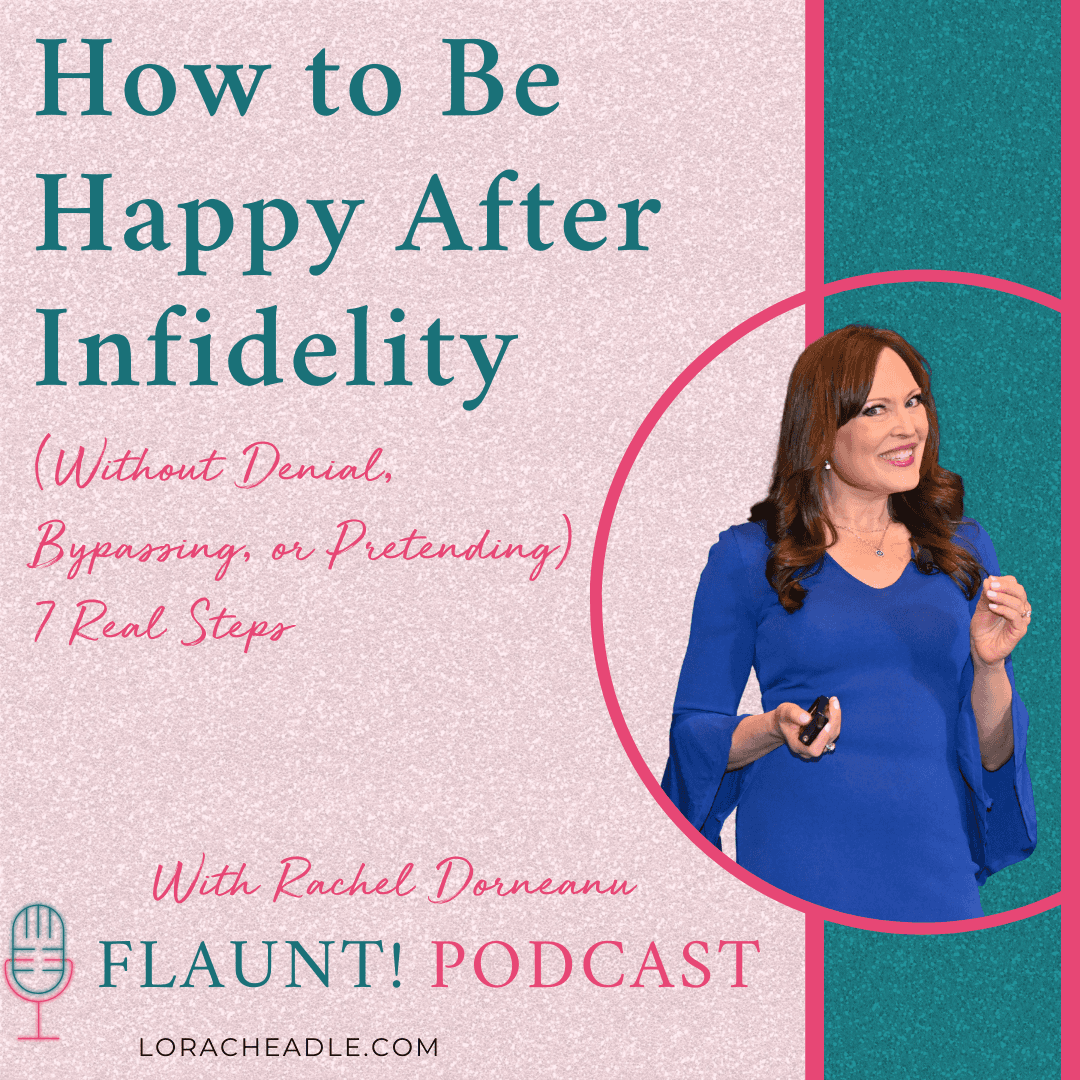
How to Be Happy After Infidelity (Without Denial, Bypassing, or Pretending): 7 Real Steps
March 1, 2026
Show notes
Can you really be happy after infidelity?
Not through denial.
Not through toxic positivity.
Not through spiritual bypassing or pretending everything is fine.
In this deeply honest episode, I answer the question I’ve been asked more than any other:
“Are you really that happy?”
Eight years after betrayal, I share the 7 pillars that helped me move from devastation to grounded, embodied happiness — without minimizing the pain, excusing the betrayal, or bypassing the trauma.
We talk about:
- Why happiness after infidelity is a conscious choice
- The real psychological roots of cheating (and why it wasn’t about you)
- How betrayal trauma impacts your nervous system
- Why understanding the “why” creates emotional safety
- Healing invisible wounds like perfectionism, self-abandonment, and martyrdom
- How to stop performing and start being
- Why you cannot break the habit of being yourself by yourself
If you’re navigating betrayal, questioning your future, or wondering whether true happiness is possible after infidelity — this episode will show you what it actually takes.
Not perfection.
Not pretending.
But rising.
Top 3 Takeaways
- Happiness after betrayal begins when you stop identifying as the victim and choose to become the creator of your life.
- Understanding the real psychological root of infidelity (and why it wasn’t about you) creates nervous system safety.
- You cannot think your way into happiness — you must regulate your nervous system, stop performing, and get real support.
The 7 Pillars of Real Happiness After Betrayal
- Choose to rise instead of identifying as the victim.
- Understand the true psychological root of infidelity.
- Heal your invisible wounds (perfectionism, self-abandonment, martyrdom).
- Stop saying you “wasted” your life. Reclaim what’s left.
- Regulate your nervous system.
- Stop performing and start being.
- Get real support — you can’t break the habit of being yourself by yourself.
Favorite Quote
“You were victimized. But staying a victim is a choice.”
Read the transcript
Speaker A [00:00:01]:
You're listening to Flaunt: Find Your Sparkle and Create a Life You Love After Infidelity or Betrayal, a podcast for women who've been betrayed by their intimate partner and want to turn their devastation into an invitation to reclaim themselves and their worth. Tune in weekly so you can start making sense of it all and learn how to be okay on the inside, no matter what goes on on the outside. Download your free betrayal recovery toolkit at betrayalrecoveryguide.com.
Lora Cheadle [00:00:29]:
Today's show is a show that has been one of the most requested topics that I have gotten in the last year, and I have put off answering it because I kept thinking, oh, that's a one-off. And finally I've decided, you know what, the fact that people keep asking this means they really wanna know. So I'm just gonna address it and I'm just going to speak candidly and answer your questions and share my experience. The number one thing that people ask me time and time again is, are you really that happy, Lora? And if you're really that happy, how? How is it possible for you to be that happy? Because A, maybe I don't believe it, or B, maybe you're lying to me, or C, um, how can I do that too? So that's what we're going to talk about today. We are going to talk about happiness. We are going to talk in particular about my happiness and my marriage and my relationship after infidelity. In service of letting you in on so many different things, my personal insights, my personal thoughts, the way I've done things, so you can find this level of happiness too. And I wanna kind of start by saying, no, my life is not perfect.
Lora Cheadle [00:02:14]:
I'm not happy because my life's perfect, because that's not it. I get triggered sometimes. I do. Sean gets triggered sometimes. Sometimes we're great at handling each other's triggers. Other times we're both just off and it's a train wreck for a while. And that's okay. Yes, I still sometimes have hard days.
Lora Cheadle [00:02:40]:
Not very often anymore. It's been 8 years. But you know what? Yeah, I still have hard days, days that aren't related to the affair, days that are related to the affair. I'm a human. You know what I mean? Life is imperfect. My marriage isn't a total fairytale marriage. It's not. Sean still has a lot of trauma.
Lora Cheadle [00:03:04]:
He's got complex PTSD. He pretty much always will. And no, Our marriage is not a fairy tale, but oh my gosh, it's pretty darn good. And the thing is too, the world is chaotic. There is a lot going on, in case you haven't noticed, and there's a lot of people with a lot of different opinions. And most people, if you're anything like me, most people in my life don't think and believe the exact same thing that I do. So there's always these little levels of discord and stress and strife that happen. And yet, in spite of all of that, I am happier now than I have ever been.
Lora Cheadle [00:03:49]:
And I do mean ever been. I am truly and honestly grateful for this journey. I am so in awe of the gifts that infidelity have brought not only me but Sean and our boys and our friends and our family and my listeners and my community and all of the people that I work with. Like, the gifts, the ripple effect is endless. And truly, for that I am eternally grateful. And I want to anchor that in. I'm not happy because the betrayal happened. I'm not happy that the betrayal happened.
Lora Cheadle [00:04:42]:
If I, if I could rewind and have that not happen, yeah, I would take that option. But what I'm really, really happy about is I'm happy that I didn't let betrayal define me. I'm happy that I was able to use that betrayal as a catalyst for growth and love and connection and joy. And for that, I wouldn't trade this experience for anything in the world. Now, I want to start by talking a little bit about happiness. Because, you know, we all define happiness a little bit differently, and some of it is dependent on your personality. Some people are expressive and excitedly happy, and some people are quiet and calmly happy. So however you do happy is how you do happy.
Lora Cheadle [00:05:44]:
I tend to be more exuberant and bouncy and, you know, connected and extroverted when I'm happy. And yet still, I can also have some of those times where laying in my bed with my animals and a book and a cup of tea, I'm really, really, really happy. So for you, how are you happy? Is it that exuberant, connected happy, or is it that more introverted, calm, and peaceful happy? And I think that's where I kind of want to start this episode, is what makes you happy? What is your happy place? Who are you when you're happy? And then also to ask you, when were you the happiest? Because if you can remember back and think back to how you were and how it felt and what made you happy, you have that anchor point too that you can go back to and be like, yeah, this is it, and this is the place that I can strive for. And if you're in that situation where you're like, you know what, come to think of it, I've never been as happy as I wanted to be, then now is also your opportunity to uplevel, to find that new level of happiness that and to learn how to lean into that. So now that we've kind of talked about what happiness is for you, not for me, not for your friends, not for your sister or your mom or anybody else, but for you, I also want to talk a little bit about what happiness is not. And I do get pushback on this sometimes, and I— oh, makes me fight mad sometimes. Happiness is not naivete. Happiness is not being naive.
Lora Cheadle [00:07:41]:
Oh, he said he would never do it again, and I totally trust that. You know, we saw a counselor and they fixed everything. Being happiness is— being happy is not being naive. And on the same token, happiness is not denial. Happiness is not denying that, dude, your actions gutted me. Your actions made me question my reality. Your actions directly caused me to question my own identity, to question my own self-worth. They led me to lay on the floor and cry and vomit and shake and scream and rage for months at a time.
Lora Cheadle [00:08:28]:
They have caused years of triggers and upset and all of that stuff. We're not denying how bad this was. We're also not denying how bad it was for you, how harmful it was for you to do this behavior. We're not denying that you hurt other people. That by bringing in all of these other women, all of these other circumstances, you did not cause a lot of harm. We're not denying that. We're not bypassing that. Speaking of bypassing and not bypassing, we're also not using God or religion or spirituality to bypass.
Lora Cheadle [00:09:10]:
Happiness is not forgiving. Happiness is not moving on, forgiving and forgetting. Happiness is not praying it away. Happiness is also not, we had a soul contract to do this to each other so we could learn. That is not what happiness is. It can help you understand, it can help you find some peace, but happiness is not bypassing things. Happiness is not using spirituality to just not have to face something. And along that same vein, happiness is not toxic positivity.
Lora Cheadle [00:09:50]:
Happiness is not toxic positivity. Happiness is not just thinking your way through things or getting a better mindset or doing it without your husband's buy-in. That is not what happiness is. And then coming back to what I started saying when I first started this episode is happiness is not a personality trait. I am not this happy now because I'm a happy person. Yes, I've been a happy person, and I've also been a miserable person, and I've also been a totally broken person. And it doesn't matter who you are now or who you were then. The only thing that matters is who you want to be in the future.
Lora Cheadle [00:10:41]:
And if you want to be happy, then this is the show for you. So if you want to be happy, this is the show for you. Let's start right at the beginning and let's talk about the 7 pillars of how I got here. And how you can too. Here are the 7 pillars that create my happiness. These are the things that I did specifically after infidelity. These are the things that I work with my clients on, whether they are working with me one-on-one or in a group program. And these are these 7 pillars that you can use to that will help you find happiness.
Lora Cheadle [00:11:34]:
The number one thing, number one thing that I did to find happiness was I stopped living as the victim in my story. I stopped living as the victim in my story. You've heard me say this before, and I'll say it again. I was victimized. You were victimized too. Anytime your partner lies, cheats, steals, does anything like that, you were victimized. But I stopped identifying with the role of victim. Being betrayed was something that happened to me.
Lora Cheadle [00:12:14]:
A lot of bad things happen to us in our life. Being betrayed was just one of the many things in my lifetime that was bad. That happened to me. But staying miserable the rest of my life, that would have been something that I was choosing. There is a definite fork in the road timing that happens for all of us. That fork in the road is, do I live life as a victim Do I continue telling the story of what he did to me and what happened and what was so unfair and what she did and what they did? Do I continue telling that story, or do I just choose? And it is a choice, just like cheating is a choice. Just like cheating is a choice, it is a choice to get off that victim pathway and to step on the pathway of being a creator. I create my life.
Lora Cheadle [00:13:23]:
It's not about blame. It's not about shame. It's about ownership. Yeah, this happened to me. It did. It happened to me, and I hate it. I hate that it happened to me, but I am going to act as the creator and I'm gonna take ownership over myself in this situation, not ownership over another person, 'cause we can never do that, but I'm gonna take ownership over myself and I'm going to choose to be happy and to move forward in a way that makes me happy. Now, some of this we need to break down.
Lora Cheadle [00:14:04]:
This is not deciding whether to go or whether to stay. This is deciding whether or not to rise. I'm going to say that again. This is not about deciding whether to stay, whether to go, whether to do this, whether to do that. It is a simple choice. It is the decision to rise. I have been burned to the ashes and I choose to rise. The end.
Lora Cheadle [00:14:30]:
And that is the number one most powerful thing that you can do. Is to choose to rise. Now, some other things that I wanna say about that. I'm not saying I choose to rise right now, or I choose to rise by next Thursday. It's not saying I don't have room in my life to feel all the messy emotions and to go through all these things. It's at the end of the day, I choose to rise. I know it's gonna be really difficult right now. I know there's going to be some really painful moments, some really angry moments, really stress-filled moments.
Lora Cheadle [00:15:09]:
I know some other things are going to happen that are probably wildly unfair. But what I know is, at the end of the day, I choose to rise. And even though I make some mistakes, quite a few mistakes along the way, I'm going to keep going because I know that this is what I am choosing for myself. I am taking ownership and I am choosing to not walk the path of victim anymore and to walk the path of creator instead. Now, like I said, it's not that you go bing and you shift and you're on that path and everything miraculously falls into place. That's a lie. That's not how it works. And again, anybody that tells you that is also gaslighting you.
Lora Cheadle [00:16:06]:
The number 2 thing that I did to find happiness, and this is super important because it is exactly what comes up right after you make the decision to rise, is you have to understand the why of infidelity. You just do. You have to figure it out. And There's so much to say around that, but the reason that you have to figure it out is once you figure it out, you will realize that the infidelity was not about you. The infidelity was not about us. The infidelity is not about you and your partner. It was about them. The infidelity is about them.
Lora Cheadle [00:16:50]:
It has nothing to do with you. It has nothing to do with the other woman or the other women. It has nothing to do with the porn industry or the escort industry or anything like that, it has nothing to do with your relationship. It has to do with him. And the reason I put this as number 2 is once you've made the decision to rise, truly the next thing you need to do is to understand what it was about. Because until you make peace and find the true reason why and get to that real underlying core issue, it's always going to suck you back in because there's so much of a cultural narrative out there telling you that it's your fault. There's so much of a toxic beauty and fitness industry out there telling you that if you would have only been prettier or thinner or smarter or a better wife or a better mom or a better house cleaner or whatever it is, that this wouldn't have happened. So the number 2 most important thing to do right after deciding that you're gonna rise, darn it, is to figure it out.
Lora Cheadle [00:18:03]:
To understand truly in your heart, in your soul, with every fiber of your being, the why of infidelity. To anchor that knowledge that it's not about you. Truly into every fiber of your being. Now let's talk about why. Why do you really need to be that clear on the reason why? And you know, there are many different types of affairs. People cheat for many different reasons. And in pretty much no universe and in no situation is it your fault. And was it justified? It is never your fault.
Lora Cheadle [00:19:02]:
People cheat sometimes to avoid things that they don't want to face. They avoid saying, hey, maybe we should get a divorce, or they avoid saying, I don't know how to connect with you when I'm feeling lonely and hurt. Hurt, or they avoid looking at their own trauma, and they avoid looking at their own issues, and they avoid having these difficult conversations because they don't know how to have them. So why, why does infidelity happen? Avoidance. People don't want to have difficult conversations. People don't want to do hard things, so they avoid it, and they act out, and it all comes out in this weird sideways way where they're having an affair And they're really just avoiding what is right in front of them. Ego. People cheat because they've got ego problems.
Lora Cheadle [00:19:51]:
They're trying, they feel like, they feel like they're entitled to it, or they feel like I've worked so hard, I really, I really deserve it. And it becomes like this reward. Sometimes people have this grandiose personality type where they really think they are God's gift to the world and that they're just out there doing that. Sometimes people are so weak inside and they can't build themselves up that the only way they can feel good enough about themselves to literally show up in life is to get all of this external outside validation from everybody and everything, because they cannot fill themselves up enough to even come up to like that baseline level of feeling okay. A lot of this comes from trauma. A lot of this comes from attachment wounds, from being literally, emotionally, physically abandoned as children, from poverty, from neglect, from sexual abuse, from other kinds of abuse. But it always, always has some roots in shame. Shame that somebody's not enough.
Lora Cheadle [00:21:04]:
Shame that somebody has been through something. Shame that Whatever it is, it's this shame that they're not good enough. And emotional immaturity. People who cheat have a level of maturity that is immature. They are not aware. They are not adept. They cannot regulate themselves. They cannot identify what they're feeling.
Lora Cheadle [00:21:33]:
They cannot talk about that shame and express that shame. Their ego is so fragile that they feel as if they are a broken person every day of their lives. And then they have shame because they think, I shouldn't be a broken person. And then they fall into this whole immature thinking about all of these things that they can do to fix it, to Band-Aid it up on top, to make themselves feel better. And when women start understanding the psychology behind it the psychology behind why their partner cheated and that it has nothing to do with them, whoo, that is the first time that their nervous system can finally calm down. Because here's the thing, as a lawyer who helps people understand the legal system, knowledge is power. Yeah, knowing what you're entitled to is powerful. Knowing what the divorce process might look like, that's power.
Lora Cheadle [00:22:38]:
Knowledge is power. And yet, knowledge is also safety. Knowledge isn't just power, it's safety too. And when I really know, when I know in my head, in my heart, and in my body the reason why my partner cheated, and that it had to do with his immaturity and shame and trauma and lack of self-esteem and self-worth and avoidance of problems. Like, when I know all of these reasons why, and when I know not one of those reasons is about me, whoo, that knowledge creates a level of safety that goes so much deeper than platitudes, than false promises. I'll never do it again. I'm so sorry. It's that knowledge of what was really going on that creates safety.
Lora Cheadle [00:23:42]:
People ask me all the time, like, how do I know he's not going to do it again? And the thing is, You don't. However, when you really know what's going on, when you really know what the root cause was and is, when you know that reason why and you see your partner either addressing that root cause, becoming more emotionally mature, learning how to express and process their shame, dealing with our trauma, finding healthy ways to build up their self-esteem and their self-worth, and then initiating conversations with you and having difficult conversations, then you can say, oh hey, I am safe. I do feel safe because I see how all these reasons why you're being addressed versus, well, nothing has changed. But he's promised he won't doing it again. That doesn't feel good. It's the knowledge of what caused it and the knowledge of what he's doing or not doing to take accountability and ownership. That's what creates safety. And what I'm going to say is even if they're not doing the work and you see it, you can be disappointed.
Lora Cheadle [00:25:07]:
Yeah, absolutely. You can be disappointed, but you're also safe. Because now you know what not to trust. Now you know who not to trust, what not to trust, and why these things aren't being worked on. So you are safe because you now know what to do, and you know you're going to make a decision that is not going to lead to regret. You know the reason why is not being worked on, and you know you're probably being gaslit, and your whole system can calm down because you know you're keeping yourself safe. Now, that was a lot right there. He is working on it.
Lora Cheadle [00:25:47]:
He's not working on it. This is what I can do. This is what I can't do. That was a lot right there. So I want to take a pause. I want to take a beat. I want to take a breath, like literally take a breath and pause. Because that's a lot for the brain.
Lora Cheadle [00:26:08]:
And I also want to mention, this is where my coaching work really comes in. This is where we can take time and we can take space and we can unpack those reasons why, and we can draw very clear parallels. Here are the reasons why. Here are the ways that those reasons why are being addressed. Or here's where the gap is. And if you're wanting to work it out, here's the gap that needs addressing. And if you're not working it out, here are the things that I can let go of because it doesn't matter. So this is what we unpack.
Lora Cheadle [00:26:51]:
This is just one of the myriad of things that we can unpack when we coach together to help you understand the psychology of betrayal in your specific situation with your specific partner so your body and mind can finally stop attacking you. So you can stop the obsessive thoughts, the compulsive behavior, that endless loop of, am I safe? Is he going to do it again? Do I give him another chance? Oh my gosh, what if I do and I regret it? Oh my gosh, what if I don't and I regret it? This is what we unpack. And you know what I'm going to say about that too is something else that people say a lot is, I didn't realize I could work with you. Yeah, that's why I'm here. You can work with me. You can work with me in a huge variety of ways. I— it's easily accessible. I offer an introductory session to everybody.
Lora Cheadle [00:27:53]:
For $97. After that, you can book one-on-one sessions with me on Zoom. I work virtually. It doesn't matter where you live, what time zone you're in. And if you're truly committed to yourself and healing, I love working in a 6-month container with you. Yes, I have structured programs that will absolutely change your life. And if you're not ready for that, because you're still like, oh, I don't know what I wanna do. Work with me a few sessions.
Lora Cheadle [00:28:23]:
We'll get it figured out. We'll figure out either, yes, I am the coach for you. I am the coach for your husband. I'm the coach for your partner. I'm the coach for you as a couple. Or you know what? No, this isn't a good fit, but these people might be. That's why I partner with BetterHelp. BetterHelp is an online therapy platform.
Lora Cheadle [00:28:45]:
Sometimes people need therapy. Often they need coaching. But when they need therapy, I refer them— I will refer you to BetterHelp. And if you'd like to learn more about BetterHelp, go to betterhelp.com/flaunt. F-L-A-U-N-T. You can find more about their online coaching programs— not coaching programs, therapy programs. I'm the coach, they're the therapist. And better yet, you can get 10% off your entire first month of therapy through betterhelp.com.
Lora Cheadle [00:29:21]:
So yes, reach out. I can be your strategic partner. I can let you know you need a lawyer, you need a therapist, you need me. We don't resonate, you need a different coach. And let's figure it out together, because the bottom line is It is confusing, and if you're confused, you can't be happy. And that's what this show is about, is about happiness. Okay, back to my 7 steps to finding happiness after betrayal. The third thing that I did was I started managing started learning about, started looking at my invisible wounds.
Lora Cheadle [00:30:12]:
Wait, what? Betrayal didn't create wounds in me. It exposed wounds. Betrayal didn't create my wounds. It ex— it exposed wounds that were already there that I didn't know I had. One more time, for those of you who are like me, and we're like, no, no, no, no, no, I'm fine. I'm working really hard. I'm taking care of everyone for everything. I've read all the books, I've done all the things.
Lora Cheadle [00:30:50]:
This is him. He screwed it up. It's not me. Betrayal didn't create my wounds, it exposed them so I could finally see them and heal them. And anytime we expose and then heal our wounds, we create a lot of happiness. Now let me name some of those wounds for you. And as I name them, I'm going to give you a little caveat. Before infidelity, if I would have been listening to this show and I would have heard somebody say, these are my wounds that were, that were exposed, I would have been like, nope, don't have it.
Lora Cheadle [00:31:39]:
Nope, don't have it. Nope, don't have it. Nope, don't have it. Not that I was an egomaniac. But I was really together and I was really emotionally intelligent and I tried really hard and I really, honest to God, thought I had it all together. Let's talk about those wounds that got exposed that I suddenly had the opportunity to see and address thanks to my husband's infidelity. Perfectionism. No, I wasn't just a high achiever.
Lora Cheadle [00:32:18]:
I had many perfectionistic tendencies that were absolutely slowing me down. My good girl conditioning. Wait, what? Aren't you supposed to be a good girl? I'm a good girl. I'm always a good girl. What do you mean? Here's a big one. Self-abandonment. Aren't you supposed to sacrifice for your kids? Aren't you supposed to power through? Aren't you supposed to take care of everybody else before you? Spoiler alert: no, that's self-abandonment. My need to please, my need to make everybody like me, my need to please my friends, my family, my parents, my partner, my neighbors, my dog, my cat.
Lora Cheadle [00:33:00]:
Yeah, that need to please was something I needed to address. My fear of not being enough. Wait, what? No, I'm fine. I'm enough. Mm-mm. There are some real deep-seated fears that I had truly about not being whatever it was— smart enough, pretty enough, good enough, have a good enough house, good enough kids, good enough, whatever it is. And then I think my biggest one was my tendency to be a martyr. Honestly, I was proud of the way that I would sacrifice.
Lora Cheadle [00:33:45]:
I was proud of the way I would sacrifice. I wore it like a badge, my exhaustion. I did all of this for all of you. Look at how much I give. Even though I don't have it returned, I am just like Cinderella. I am just good all the time and I give from the heart. Look at how much I endure. I could tell you stories that truly horrify me now when I look back on them.
Lora Cheadle [00:34:15]:
There was this one time, I'll just, just tell you one. There was this one time, uh, Sean coached Little League baseball for the boys. And there was this one time he had gotten there early and he hadn't lugged the big baseball bags with the bats and the bases and all of that stuff to the field. So I got out of the car and instead of doing several trips, I put all the bags all over myself and I lugged them over to the baseball field while he was lounging on the side talking to other parents and talking to other kids. And I consciously remember having this thought like, people are going to see, people are going to see how abused I am. They're going to see how hard I am working. And there he is sitting there talking to the parents and I am suffering, dragging these huge bags from the car all the way across the park to the field. Why? Like, why was I having that thought? I can't even answer that for you right now.
Lora Cheadle [00:35:20]:
Why did I think that was a good thing? Why did I want to be seen in that light? Why did I think that was noble? I don't even know, but it's this weird combination of being a good girl and having this need to please and performing. Have we talked about my tendency to perform? Yeah, that was a problem that I didn't see, but there I was performing hard work, performing being a good girl, performing self-abandonment, performing this need to be enough and to please. And again, I wouldn't have seen that if it wasn't for the infidelity. I swear to you, I would not have seen it. I would have been like, yeah, but no. Yeah, but no, I do like things done right. And yeah, but no, I do like doing everything for everybody. It's just me, I'm just that way.
Lora Cheadle [00:36:15]:
I'm so good and selfless. Yeah, here's the thing that I have learned the long, hard way because of this journey: martyrdom isn't love. Self-sacrifice isn't love. It's truly this underhanded, manipulative way to get love and to erase yourself. And oh my gosh, that's not who I am, and that's not who I strive to be, and that's not how I want to model for my children either. And that, for me, was when I started to wake up. I thought since the betrayal was Sean's actions Sean's problem that I really didn't have any extra work to do. I just had to deal with this betrayal.
Lora Cheadle [00:37:19]:
And once I had that shift that, uh-uh, Lora, it's your own time to look. Do you have a daddy issue? Do you have a performance issue? Do you have a perfectionist? Oh yeah, there's some things for me to look at. Maybe my issues weren't as big and as glaring as Sean's were. But it didn't mean that they weren't there. And it was only when I stopped trying— I stopped trying to be the good wife. I started becoming honest. I stopped trying to be the perfect couple, and I just exposed us for who we were. I stopped trying to get anybody to think anything about me, and I just let go.
Lora Cheadle [00:38:03]:
Of all of that fear of judgment, into wanting to be seen in a certain way, and to try to perform and protect and perfect— that was when I could really finally start looking at myself and healing my own wounds. And again, not that I didn't have wounds— of course I had wounds. Some of them weren't that deep, but they were still wounds. And the thing is, when you take 15 not-that-deep wounds and stack them together, it sure creates one big wound. And my challenge to you is, if you're resonating with any of that, to take a deep breath and to be brave and to really look at yourself and be like, okay, yeah, Maybe I don't have this big glaring issue or trauma that my partner has, but what can I look at in myself? Do any of those tendencies resonate? Any of them? And what might shift if you were brave enough to start addressing even the smallest of your wounds, because addressing those wounds is sure to create lasting happiness in a way that trying to manage somebody else's recovery never will. Now, the number 4 thing that I did to find happiness after betrayal is I stopped saying this one phrase. Do you want to know the one phrase that I wish everybody would stop saying because it's damaging and toxic? That phrase is, "I wasted so many years. I gave the best years of my life to this relationship." What I want you to say instead is, "For a while, I got stuck in a situation that I wanted to— didn't want to be in." For a while, I was letting my life pass me by.
Lora Cheadle [00:40:19]:
For a while, I felt like I was wasting years. But then I realized I am wasting my life fixating on wasting my life. I decided that I'm not going to waste another moment of my precious life being miserable about what I had wasted. That's sovereignty. That's perspective. That's maturity. I stopped focusing on what I had lost and what I had given and what I was never going to get a return on investment for. And I started focusing on what I had left.
Lora Cheadle [00:41:02]:
And it was like, whoa, I don't know how many years I have left, but I know a good chunk of my life is behind me. My kids are now grown. I know I have a limited time, and in that limited amount of time, I am not going to waste one more moment on being miserable about what I lost. You can grieve without being bitter. You can learn without collapsing into shame. You can use what you did as perspective and as a way to light the fire to do more and to take more and to gain more and to make the most of the time and the relationships that you have left. That's a huge reframe. And if you take nothing else from the show— and I do want you to take a lot from this show— but if you take nothing else from this show, I want you to stop saying what you wasted, what you lost, and to start focusing on what you've got left and what you're going to do to make the most of that time that you've got left.
Lora Cheadle [00:42:19]:
Now, the number 5 thing that I did to be this happy after infidelity and betrayal is I learned how to regulate my own nervous system. I learned how to regulate my own nervous system. I learned it. It's something that you have to learn. You can't outperform your nervous system. Insight is not integration. I've said that before. You can't fake it.
Lora Cheadle [00:42:50]:
You can't just put on a happy face and take a few deep breaths and feel calm. You can't outperform your nervous system. You can't fake your nervous system into feeling regulated. At some point, that insight needs to become embodied. At some point, those practices need to make a difference in the way that you're showing up. And if they're not You need to figure out something else to do in order to feel regulated, because regulated is a feeling and you can't fake it. Now, the tools that I use— I use and I teach somatic processing, that's using the body. I use and I teach rage work.
Lora Cheadle [00:43:35]:
I use and I teach Yogalesque. That is my whole embodiment practice on releasing. I use and I teach hypnosis. I consciously use different methods to help integrate all of the things that I know and that I'm learning into my body and into my nervous system. And I now have a heightened level of awareness that, whoo, I'm starting to get overwhelmed, or whoo, I'm going off track down somewhere that I don't really want to be, and this is what I can do to pull myself back in. And whoa, if that's not working, this is the other thing that I need to do. And whoa, if That's not working. Like, I know my tools and I know how to use them and I know when to use them.
Lora Cheadle [00:44:20]:
And I am in charge of my nervous system for the most part. If a gun goes off in a crowded shopping center and I'm there, no, I do not have complete control over my nervous system. None of us really want complete control over our nervous system because if a bus is speeding at us or if a gun is going off somewhere and it's a really dangerous life or limb situation, we need our nervous system to kick into high gear to keep us safe. However, that said, in our everyday reality, we need to know how to regulate our nervous systems. We need to befriend our nervous systems, make friends with our nervous systems, so we can live the way that we choose to live, which ties back to the beginning number one thing I did, which was I chose not to be a victim and I chose to be the creator of my own life. And if I'm the creator of my own life, I need to know how to regulate my nervous system. Which leads me to number 5, and I've touched on this as well. I stopped performing.
Lora Cheadle [00:45:28]:
I stopped performing in every single way possible, and I just started being. I stopped pretending. I stopped saying fine when I didn't mean it. I stopped cleaning the house and taking care of, like, the laundry on schedule. I stopped caring about so many things because I just stopped performing and I allowed myself to be. And this ties in identity. Healing isn't about becoming someone new. It's about becoming somebody true.
Lora Cheadle [00:46:10]:
I was a perfectionist. I had to have the perfect birthday parties for my kids, and I always wanted to look nice, and I always wanted to clean the house before people got here, and I wanted to do all those things that were socially acceptable, not to like a neurotic state, but to a place of like, I really want to do this. It's really important to me. To be the nice family. It's really important to me to look the right way. It's really important to me. But there were moments where it was such a shield. It was such a mask and it was inhibiting my joy.
Lora Cheadle [00:46:50]:
Today, I, when people come over and my house is a total mess, yes, there's a part of me that's like, oh my God, it's not picked up. It's not perfect. And there's another part of me that consciously knows, you know what, Lori, in the past, that's something that would've shut you down. In the past, that's something you would've been like, oh my gosh, give me 15 more minutes. And if you would've, you know, put things away and run the vacuum. And now I'm like, come on over. It's a mess, but I'm keeping it real. So it's not that I've totally become this entirely different person who just doesn't care.
Lora Cheadle [00:47:27]:
I still care. It's just that I recognize what is the mask, what is the performance, and what is really meaningful to me. And the connection is more meaningful than the perfection. And things can fall apart, and it's okay. I am dropping image management. That's why I'm here on the podcast, like, telling you all of these things. Some people like me, some people love me, some people hate me. Yeah, I feel that.
Lora Cheadle [00:47:58]:
And I'm not going to say it never hurts. Yeah, it hurts sometimes when a snarky comment pops up on YouTube or whatever. I'm like, yeah, that hurts. But it's not my job to perform and to pander and to get you to like me. Either you resonate or you don't, and it's okay. I don't have to be the good girl anymore. I don't have to have that martyr pride that, oh my gosh, I can screw things up. I'm going to keep it real.
Lora Cheadle [00:48:26]:
And when I am, I'm happier because I can be me. Then I can be true to my own values of connection and fun and friendship and laughter and joy and like all of those things. And I don't have to perform that everything's okay in my marriage. I can talk and I can be and I can feel. A big part of that was I stopped asking, why did this happen to me? And I honestly focused on who do I want to become because of it? Why does it happen to me doesn't really matter. What matters is what am I going to do with this and who am I going to become because of it? And I wanted to become somebody who was happier and more connected and free. Free from inhibition, free from judgment, free from shame, free from— I wanted to express myself in my marriage. I wanted to get the support that I needed.
Lora Cheadle [00:49:30]:
I didn't want to quietly feel resentful and alone and emotionally abandoned and creep upstairs and text with my friends about how sad this was. I mean, I kid you not, early on I had a couple of friends and our main hobby was complaining about how emotionally abused and neglected we were. One of my best friends was married to a physician. I was married to a lawyer. They worked a lot and we'd be like, we're here alone. I don't wanna live like that. I don't wanna tell that story. If I'm emotionally neglected and abandoned, I need to express myself and create a new story and figure some things out.
Lora Cheadle [00:50:09]:
Which leads me to number 7, which is the last thing that I did that— they're all important. I don't want to say it's the most important, but it is one of the most important steps. My 7th step is I got help. I got help. I got a lot of help. Some of the help was amazing. Some of it was so-so. Some of it was not that great and actually kind of harmful.
Lora Cheadle [00:50:40]:
But I kept going. I kept having the belief that there was somebody out there who was gonna help me. I truly knew to the depths of my core that I could figure this out, and I just needed to keep going and trying until I got it figured out. And I did. And I want to say this plainly: you cannot break the habit of being yourself by yourself. You cannot break the habit of being yourself by yourself. The Joe Dispenza book by the title Breaking the Habit of Being Yourself I love that title so much because it's true. We are who we are, and we think who we are is just who we are, and we don't realize that so much of our behavior is habitual.
Lora Cheadle [00:51:43]:
It's conditioned. We don't think, believe, and do things just because we think about it consciously. We think, believe, and do things because they're habits. Our beliefs are habits. Our habits are beliefs. Thoughts that we think over and over become beliefs. Beliefs turn into actions. It's like this whole cycle, and I didn't used to really see that.
Lora Cheadle [00:52:16]:
Or when I would see it, I'd think, well, I'm just going to change that. I'm just not going to do that anymore. I mean, come on, have you ever just tried to not eat sugar anymore, or not have your afternoon cup of coffee anymore, or not complain anymore? Whatever it is, habits are hard to break. And I don't want to say that you can't ever do it yourself, but really, people, you can't do it yourself. Because so often, not only is it hard to be that accountable, it's hard to be that aware because we slip into doing things that we've done for so long that we don't even realize we're doing them. Funny little story. Um, one of my clients, she is my Voxer Life Betrayal Lifeline client. Betrayal Lifeline is asynchronous Voxer coaching.
Lora Cheadle [00:53:11]:
We talk all the time. It's amazing because that way you get to vent in the moment, real time, and then I get to listen back and share things that I hear. Anyway, she was talking about justifying herself and how she justified so many different things. So I pointed that out cuz we were having kind of a conversation around that and I was like, you know, you don't have to justify things. You can just make decisions and do it. You don't need permission, right? She was like, oh my gosh, you're totally right. I see that. And then she started to justify it.
Lora Cheadle [00:53:46]:
The thing is, I do it because— and then she caught herself and it was hilarious. She's like, oh my gosh, I just heard that. I just heard myself justifying why I justify things. And it was hilarious. But it just goes to show, that's the kind of situation where getting help is imperative. Because if you didn't have somebody doing that back and forth with you, if you just made the decision, oh hey, I'm not going to do this anymore, then you're not doing it out loud and you're not doing it with something— somebody else. So you don't see what you're doing. We are wired as humans to perform.
Lora Cheadle [00:54:27]:
We are wired to be martyrs. We are wired to self-abandon. We are wired to have that overlevel of responsibility as women, as, as human, as women living in this society. We're all wired for certain things. Different cultures are wired a little bit differently. Different, um, socioeconomic groups are wired a little bit differently. It's just that we get in these little pods of society and we all get wired to do things and we think it's just us. And then all of a sudden we see another way of living and we're like, oh, whoa, there's another way of living.
Lora Cheadle [00:55:02]:
I want some of that. But unless you've grown up with that and had that modeled, you're not going to get that. You've got to get help to get that. So yeah, think about that in terms of happiness. One of the things that I asked at the beginning was, how happy have you been in your life? Where is your peak level of happiness? And do you want to get back to that, or do you want to get to something greater? Because if you want to get to something greater, you need to get help. You need to get help. You need to get out of yourself, and you need to have somebody else to hold that vision for you and then give you the steps. Yes, I was there too.
Lora Cheadle [00:55:56]:
First we do this, now we do this, then we go here. Okay, we'll backtrack, we'll hang for a moment. Okay, now let's move forward. You need to get help because our patterns are invisible Just like so many of our wounds are invisible. I hope this show has given you a lot to think about. These 7 concrete steps truly, I promise you, will help you to find and create the happiness that you want, whether it's a happiness level that you've had before or whether you're like, no, no, no, I want more. I want your level of happiness, Lora. I want to feel like that.
Lora Cheadle [00:56:44]:
Give me some of that. Yes, you can have that. You just have to, number 1, choose, choose to stop living as the victim and to create your story. Number 2, get really granularly clear on the why of infidelity, that it is never about you. Number 3, Have the courage and the bravery to expose your invisible wounds and then to treat them. Number 4, stop focusing on what was wasted, what was lost, and start focusing on what you have. Number 5, learn how to regulate your own nervous system in any situation except a bus coming straight at you. Number 6, stop performing.
Lora Cheadle [00:57:32]:
And start being. And yeah, that sometimes takes a lot of help because we don't know what it's like to just be. We're too used to performing, which leads us right into number 7. Oh my goodness, go get help. Get help. With that, I am going to close out this episode because do you know what I know? I know that happiness is is not only possible but is probable. Happiness is probable for you after infidelity because infidelity exposes so much and is such a powerful catalyst for growth. So reach out.
Lora Cheadle [00:58:16]:
I am counting on you to reach out, whether it's one time, whether it's a month, 6 months, or a year that we are hanging out together, or 10 years. Whatever it is, I am counting on you to reach out to me. Send me an email, laura@laurachiedel.com. Book your introductory session at introductorysession.com, and I will help you figure out where the best place for you is. Have an amazing week, and as usual, always remember to flaunt exactly who you are, because who you are is always more than enough.
Speaker A [00:58:56]:
Tune in next time to Flaunt, Find Your Sparkle, and Create a Life You Love After Infidelity or Betrayal with Lora Cheadle, every Wednesday at 7:00 AM and 7:00 PM Eastern Standard Time on syndicated Dream Vision 7 Radio Network. Uncover the truth of what's possible for you on the other side of betrayal and develop the skills and strategies necessary to embrace the future and flourish today. Download your free betrayal recovery toolkit at betrayalrecoveryguide.com.
Never miss an episode
