
FLAUNT! Podcast · Infidelity & Betrayal · Rebuilding Trust · Affair Recovery
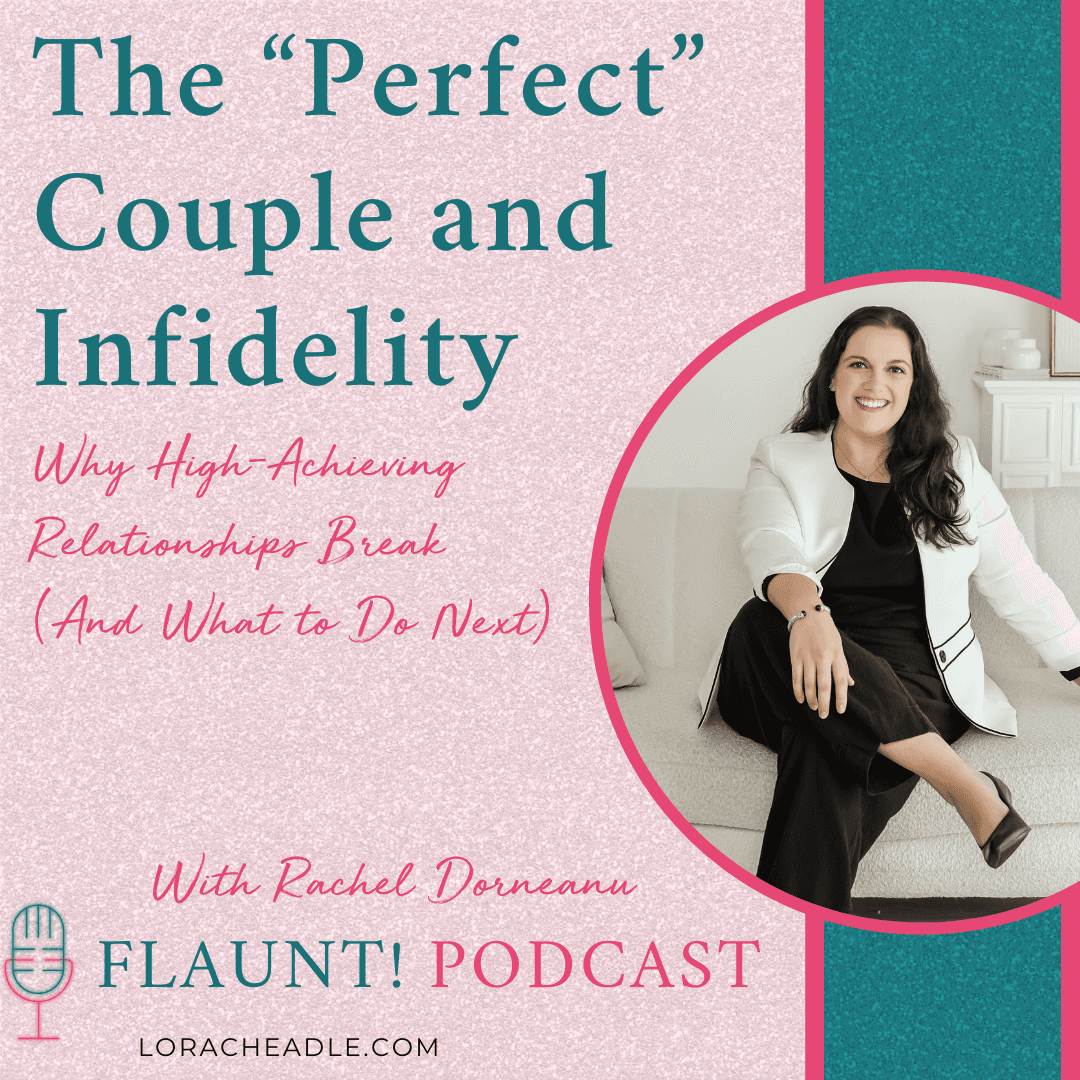
The “Perfect” Couple and Infidelity: Why High-Achieving Relationships Break (And What to Do Next)
February 22, 2026 · with Rachel Dorneanu
Show notes
Here’s why infidelity happens in high-achieving “perfect” couples — and what it actually takes to repair or rebuild after betrayal.
You did everything right.
You were the smart couple. The committed couple. The high-achieving, “we’ve got this” couple.
Date nights. Careers. Kids. Goals. You worked hard. You showed up. You performed well.
So how did infidelity happen to you?
If you’ve ever thought, “We were the perfect couple. This doesn’t make sense,” this episode will open your eyes in the most grounded, compassionate way.
In this powerful conversation, I sit down with Rachel Dornianu of Sage Counseling & Wellness to unpack the hidden dynamics behind the “perfect couple” myth — and why high-achieving, Type A, perfectionistic relationships are often more vulnerable than they appear. We explore how perfectionism, people-pleasing, high sensitivity, emotional avoidance, and the Gottman “Four Horsemen” quietly erode intimacy over time — even in relationships that look beautiful on the outside. If you’re navigating infidelity, feeling blindsided, or wondering how something could fall apart when you both “did everything right,” this episode will help you understand what really happened — and what healing actually requires.
Top 3 Takeaways
- Perfection Isn’t the Same as Connection High achievement, polished date nights, and shared goals can mask roommate syndrome, emotional loneliness, and avoidance. When couples stop pausing, attuning, and truly connecting, resentment and unmet needs quietly build beneath the surface. Performance is not intimacy.
- Infidelity Is Often a Maladaptive Coping Mechanism While betrayal is devastating, it’s frequently rooted in avoidance, trauma, shame, unmet emotional needs, and poor coping skills — not pure moral corruption. Understanding the why doesn’t excuse the behavior, but it creates clarity. And clarity is the first step toward healing.
- Healing Requires Addressing What Was Already There Perfectionism. People-pleasing. High sensitivity. Fawning. Walking on eggshells. Avoidance. Emotional flooding. Infidelity doesn’t create these patterns — it exposes them. Whether you choose to stay or separate, the real work is learning how to regulate your nervous system, communicate honestly, and stop performing so you can start being.
Favorite Quote
“Perfection isn’t intimacy. Performance isn’t connection. And infidelity doesn’t create the cracks — it exposes the ones that were already there.”
About Rachel Dorneanu
Rachel Dorneanu (she/her) is a licensed therapist, AASECT-certified sex therapist, and board-certified coach specializing in Anxiety, HSPs, People Pleasing, Perfectionism, and Sex Therapy, with a passion for helping people reconnect with their bodies, reduce shame, and find freedom in their wellness journey. She holds a Master's in Counseling and brings over 8 years of experience working with millennial women and moms.
Through her work as a therapist and coach, Rachel integrates evidence-based approaches with compassionate education to normalize topics often left in the dark—like pelvic pain, pleasure, and embodiment. She is known for her relatable, down-to-earth style and her ability to make complex or uncomfortable topics accessible and affirming.
Outside of her professional life, Rachel enjoys practicing yoga, spending time with her husband and 2 children, and traveling.
👉 Learn more at: www.sagecounselingtherapyandwellness.com or www.racheldorneanu.com
CBT Workbook for Perfectionism:
About Lora
Lora Cheadle, JD, CHt is a former attorney turned betrayal recovery coach, hypnotherapist, and author who helps women rebuild their identity and reclaim their power after infidelity and profound emotional betrayal. Using her signature Life Choreography® approach, she integrates legal insight, nervous system regulation, somatic practices, and deep spiritual support to help clients move from shattered to sovereign.
Resources & Links
- Download the free Betrayal Recovery Guide: https://betrayalrecoveryguide.com
- Book your $97 Intro Session: https://introductorysession.com
- Learn more about Rise & Reign: https://loracheadle.com/rise-and-reign
- Follow on YouTube, Instagram, and Facebook @loracheadle
LOVE THE SHOW? TAKE THE NEXT STEP
Don’t just listen—start healing.
Download your FREE Betrayal Recovery Tool Kit and take back your power with clarity, confidence, and support that meets you where you are.
✅ Calm the chaos
✅ Rebuild self-trust
✅ Stop the spiral of second-guessing
✅ Reclaim your worth and your future
👉 Download Now ➜ www.BetrayalRecoveryGuide.com (MAKE THIS A BUTTON)
You deserve more than survival. You deserve sovereignty, peace, and joy.
#PerfectCoupleMyth
#InfidelityRecovery
#BetrayalHealing
#PerfectionismInMarriage
#HighAchievingWomen
#RelationshipAfterInfidelity
#EmotionalIntimacy
#MarriageAfterAffair
#FlauntPodcast
Read the transcript
Speaker A [00:00:01]:
You're listening to Flaunt: Find Your Sparkle and Create a Life You Love After Infidelity or Betrayal, a podcast for women who've been betrayed by their intimate partner and want to turn their devastation into an invitation to reclaim themselves and their worth. Tune in weekly so you can start making sense of it all and learn how to be okay on the inside, no matter what goes on on the outside. Download your free betrayal recovery toolkit at betrayalrecoveryguide.com.
Lora Cheadle [00:00:36]:
Here we are, the perfect couple. We have done everything right. We are smart. We are together. We are connected. We are committed. And we put on this great show. And then what happens? Oh my gosh.
Lora Cheadle [00:00:50]:
Infidelity? Betrayal? How could that happen to us of all couples?
Speaker C [00:00:56]:
Couples.
Lora Cheadle [00:00:57]:
If you have ever felt that way, then this is the show for you. My guest today is amazing. I'm just going to say that right up front. We connected before this episode, and I loved what she has to say about perfectionism, about that whole perfect couple veneer, and how we try so hard, honestly and legitimately, but what it does to us both in the downfall and in the healing. My guest is Rachel Dornianu, and I hope I said that correctly. Welcome to the show, Rachel. I'm really looking forward to this conversation.
Speaker C [00:01:40]:
Me too. What, what a solid intro. That was beautiful.
Lora Cheadle [00:01:43]:
Oh, good. Thank you. Thank you. Could you start by sharing a little bit about more about yourself, why you are an expert in kind of this whole trifecta of perfectionism and highly sensitive and being a Type A personality?
Speaker C [00:02:00]:
Sure. Yeah. So besides personal experience that I'm a recovering perfectionist, highly sensitive person, recovering people pleaser, if anything, I think there's a lot of power in personal experience. But besides that, I have done an absurd amount of trainings, worked with many, many clients. I must say, for a long time, 80% of my caseload was that cute little trifecta. And so it I figured it was a lovely thing to add when there's some perfectionism in couples and when we get overstimulated, dysregulated, all those fun psych terms out there.
Lora Cheadle [00:02:36]:
Yeah. Yeah. And, you know, I just want to throw in around about this too, because I too can relate to that. But here's the thing. When I was going through this before the infidelity, if somebody would have said, are you a perfectionist? I would have said, No, no, no, no, no, I just like to do things right.
Speaker C [00:02:57]:
It's a great thought. Yeah, a great thought. But usually it's a lot of the perfectionists that I work with. It is wild how many of them say that. They're like, no, I either just want to do things right, or I'm a high achiever, or I'm just a great academic student, or any— you know, I work well at my job and I have the hard work ethic. I hear all of that all the time. And then as we start going through, um, something called the CBT Workbook for Perfectionism. I'll link it in show notes if that's helpful.
Lora Cheadle [00:03:32]:
Please.
Speaker C [00:03:32]:
Uh, but it— as we start going through different types of perfectionism, how it affects our lives, how it affects our relationships, they're like, oh God, I am a perfectionist. Got it. So now please help me. So it's wild, the people that come in thinking of something else.
Lora Cheadle [00:03:49]:
Yeah, absolutely. And I know you can't diagnose just in a vacuum here, but in general, What is the difference between, no, I just like to do things right and I am a high achiever, and perfectionism? Sure.
Speaker C [00:04:03]:
Um, so the things that I think about is there's 3 main types of perfectionism. So there's self-oriented, other-oriented, and socially prescribed. So with self-oriented, it's, if anything, it is all about you, of having high standards for yourself, doing well. And then there's the other-oriented, of where it's more if you have high expectations for others, and when they don't meet those expectations, then you're frustrated. Uh, and then socially prescribed, where it's maybe like a parent, an authority figure, a coach. I think a lot of people that are like— were athletes in high school and college— they're like, oh well, they have these expectations for me and I must meet them. When in actuality, they're just trying to make sure you're doing okay. So I think about those main types of perfectionism, but there's nothing wrong with wanting to do well.
Speaker C [00:04:52]:
Nothing wrong with that. I just want to go ahead and validate the whole audience that it's okay to want to do well, but there's a difference of wanting to do well and letting it become all-consuming, letting it affect your mental health, letting it bleed into other parts of your life of where we can't maybe fall asleep at night because our brain is running of like, oh, let me solve this and this and this and this, and then I'll be able to do this. There's a lot of that hurdle situation and thinking of if I just did this, I'd be okay. But then there's a million other hurdles too.
Lora Cheadle [00:05:24]:
Yes. And I want to come back to that when it comes to healing from infidelity, because that certainly shows up all the time. If I could just get validation, if I could just do this, if I could just figure that out. So definitely I want to come back to that. But for now, I kind of want to talk about that whole persona of the perfect couple. It's usually both people who are kind of leaning into that, and it is a good relationship. So what's wrong with two high achievers wanting the best for themselves and the best from each other and the best from the relationship, even though it's still kind of hard sometimes? Oh.
Speaker C [00:06:11]:
I mean, hey, on the outside it sounds lovely. In, in a book, and, uh, maybe like when you're going out for coffee with your girlfriends, anything like that. That all sounds lovely, but that is, to me, that feels like an Instagram highlight reel of it just being like, oh, we're achieving well, we're doing okay, the kids are in great schools, we love each other and have cute Valentine's posts. Because this is, we're recording this a couple days after Valentine's, that this is a, you know, a truly lovely marriage, relationship, partnership, whatever it is that you call it. But the concerning thing is, is like, where's the deeper connection, the emotional intimacy, maybe the physical intimacy? When was the last time you did something with your partner? The, the lack of empathy and understanding and allowing for this person to just be human for a moment, that, that tends to be lacking if you're just saying go, go, go all the time.
Lora Cheadle [00:07:17]:
I really love that description because I know in my own marriage, pre-infidelity, and I know in a lot of the people that I work with too, I hear this phrase, life is like a sprint to the finish line and I'm exhausted every day and I'm working full tilt. My partner is working full tilt, but you're right. There's no pause. There's no intimacy. There's no, let's just drop it all for a little bit and connect.
Speaker C [00:07:42]:
Right. That, uh, as a therapist, that sounds lovely. Just a moment to sit and chat. And if that's a weekend away, I'll love that for you. If it's 5 minutes of cuddling on the couch before you pass out after putting the kids to bed, that counts too. Yeah.
Lora Cheadle [00:08:00]:
Yeah. And I want to point out there is a difference between a date night because we do a date night every Thursday and it's perfect and we do things perfectly and a real connected date night.
Speaker C [00:08:13]:
Sure, absolutely. I mean, something I'm curious about is how would you describe that to your audience of what is this every Thursday date night versus a deeper connection? What does that sound like with the people you've worked with?
Lora Cheadle [00:08:25]:
Yeah, so often people will say, well, we had dinner every Thursday. I got dressed up every Thursday and we had dinner every Thursday and it was amazing. And we always go to like the best restaurants and we always do these best things. Which sounds wonderful. I want that too. But what I have often am saying to people is, can you just sometimes, like you said, lay in bed and talk? Take a walk. You know, some of my husband and I, we've had our deepest conversations sometimes taking this walk in the mountains that's near our home. We're not dressed up.
Lora Cheadle [00:09:03]:
We're not doing anything. We're sticking on our old hiking boots and we're walking this big hour-long circle hike and we're talking. And then sometimes we're just in silence together and that's delicious.
Speaker C [00:09:18]:
That sounds so nice right.
Lora Cheadle [00:09:21]:
Now. Yes, it does. So here's the thing that I really want to unpack with you. We know on the one hand that a perfect relationship is a myth. We truly know that. Yeah. And yet we do live in this social media, Instagram-focused world where we want to get that. And very few of us are trained with relational skills, and we don't know what it means because our parents didn't have it.
Lora Cheadle [00:09:54]:
So what are we supposed to do? Hmm.
Speaker C [00:10:00]:
So, oh my gosh, I have so many things I could share. The things I think about first is taking a hard look at how you treat yourself and how you treat your partner, because there's a lot to say about how you treat yourself. If you're someone that's being walked all over, or if you're walking on eggshells, that all of that can be really telling of a relationship. But also knowing that if you take a moment to check in with your partner and say, hey, what were your highs and lows of your day? Not just, was your day okay? Like, that, that's such a brief check-in, which feels okay in the moment. Okay, check the box. I checked in to make sure they didn't die on their way home. Okay, they're fine. And we're moving on.
Speaker C [00:10:47]:
And now I'm doing the dishes. And it's just, hey, what were some highs and lows? Did you have that great conversation with your boss? Did you get a chance to check in on your colleague that just had their partner pass? What What's going on in your world? Because I want to know because I care. If that's happening, that's beautiful. And that's what we're talking about, the emotional intimacy and the great conversations. It doesn't have to be this beautiful dressed up Thursday night swanky dinner. It's how, how are you, rather than how are we in the state of the world? How are we measuring up against our neighbors? That, that's not the same. So checking in with each other first is something I think about. But I also would think about how you're talking to each other.
Speaker C [00:11:34]:
Um, it's— are you using I language? If I feel, I saw, I heard, I observed, it's all from your perspective rather than you did this, you did that, you screwed this up, right? So think of how you're talking to each other. There's something called the Four Horsemen of the Apocalypse from, uh, the Gottman Method couples therapy, if you guys have heard of that for and maybe covered it in a past episode. If not, I'm happy to run through it.
Lora Cheadle [00:12:00]:
We have— yeah, we have not covered it in a past episode, and it's powerful. So yes, let's take a pause and go through that because— yeah.
Speaker C [00:12:07]:
Oh, I would love to. Okay, get ready for a small monologue. Okay, so, uh, there are 4 main ways that we handle conflict, uh, ineffectively. So that would be criticism, defensiveness, contempt, and stonewalling or emotional flooding. Criticism is critical. You did this, you screwed that up. Defensiveness is when you shy away from responsibility. You might play a victim of, I know I did this, but you did that.
Speaker C [00:12:35]:
And then contempt is the nasty one. Technically, that's the one that's more predictive of divorce and separation, is you knock your partner down a peg, it's insulting. One of the examples I use when describing it to clients— I don't use this by any means— but, you lazy slimeball, how could you forget to do this thing. I knew how to tell time when I was 5. Get your shit together. Like, it's mean. And then there's stonewalling and emotional flooding. And that's when you're not just mad, you're not just sad.
Speaker C [00:13:08]:
It's okay to feel those emotions. Yay for emotions, therapist approved here. But when you are emotionally flooded, your prefrontal cortex— like, if we imagine this is your prefrontal cortex— your brain's going offline. You're operating on the brainstem back here of where it is true fight, flight, freeze, or fawn. Those are just basic responses of survival. And so if your body is experiencing that, you are not in the headspace to have any kind of healthy conversation anymore. It's not happening. So those are the 4 main ways we handle conflict.
Speaker C [00:13:41]:
I would suggest for you to figure out which one or ones do you deal with most and which ones or ones does your partner deal with and have a conversation. If it's helpful, I can go over ways to combat them if that would be helpful, Laura.
Lora Cheadle [00:13:54]:
Yeah, that would be great. And before we do into— go into that, I want to say thank you. Yes. And you had mentioned something earlier. You had mentioned something about walking on eggshells. And what I want to say is if you were thinking, oh yeah, my partner does that. But I know how to manage him. I just never set him off.
Lora Cheadle [00:14:16]:
That is not a perfect relationship. That is not healthy. That is you diminishing yourself, not getting your needs met, and completely shrinking. So yay, you created a quiet household, but at what expense? Mm-hmm.
Speaker C [00:14:33]:
Oh, I feel like we need to put that on a t-shirt somewhere. That's so needed. Just check in of like, am I actually being my true self or am I fawning? And fawning is where you diminish yourself and you're like, there, there, let me calm the, the lion, whatever is attacking me so that I'm safe. Oh, it's intense. There's plenty of, of women that do fawning and walk on eggshells is what feels safer. So I get that. Yeah. The ways to combat the Four Horsemen.
Speaker C [00:15:04]:
So if we're dealing with criticism, we're going to use something called gentle startup. And so gentle startup is instead of, you screwed this up, it's, hey, could you help me with this? Would you mind making it a priority this evening to do this? It's a literal gentle lead-in into an ask or a request. The way to combat defensiveness is to take responsibility. As a fellow defensive individual, this is easier said than done. With that said, it's, um, My bad, I forgot to unload the dishwasher yesterday. I'll make it a priority this morning. Thanks for the reminder. Difficult.
Lora Cheadle [00:15:43]:
Yes.
Speaker C [00:15:44]:
If you're dealing with contempt, what you want to do is describe your own feelings and needs and not describe your partner. So there's a really helpful sentence formula of, I feel, fill in the blank of this emotion, when this situation happens, and I need blank. So for an example, I feel flustered when we're late to a dinner reservation and I need for us to be on time so I can enjoy quality time together and not feel rushed. So keep in mind that that need is, I need to be able to be calm to enjoy our quality time and our date night, if it's on, you know, date night Swanky Thursdays, not I need to be early to look at the drink menu. That's a want. Right. So keeping that in check. And then the way to combat the emotional flooding, the stonewalling, that kind of thing, is to do something called physiological self-soothing psychobabble.
Speaker C [00:16:39]:
Find a way to calm down. The way to do that, keep in mind, is that they've done research on this. They have cortisol, which is the stress hormone in your brain. It's released from your brain into your bloodstream, and it takes 20 minutes for cortisol to leave your bloodstream.
Lora Cheadle [00:16:53]:
That's a long time.
Speaker C [00:16:57]:
So that— I mean, for anyone that's like a millennial, Gen X kind of person listening, that's an episode of Friends without commercials. So you can try and maybe watch an episode of Friends, go for a walk, something like that. But the thing that I suggest is if you or your partner are planning to leave the situation for any reason, please tell them where you're going. When you'll be coming back, because as the person that's going to be on the receiving end of that, they may be freaking out saying, oh my gosh, is my partner leaving me?
Lora Cheadle [00:17:28]:
Yes.
Speaker C [00:17:29]:
Nope, they're going for a drive. They'll be back in 30 minutes. We can check in and chat later. So that's the Four Horsemen.
Lora Cheadle [00:17:36]:
I love that. I love that. So what we've got, we have this couple that pretends to be perfect on the outside. These Four Horsemen probably keep popping up. But for some, in some way or another, they're pushed down, they're ignored. We, we're legitimately busy. We're not, we're legitimately busy. We have families, we have kids, we have everything.
Lora Cheadle [00:17:56]:
We move on. And then all of a sudden infidelity happens. Wait, what? How can that be? I thought you were perfect. You thought I was perfect. I put you on a pedestal, you put me on a pedestal, we live to each other's standards. And now what, what, what happened?
Speaker C [00:18:22]:
Mm-hmm. Well, keep in mind, every couple is different, but typically the things that I think about is that there was avoidance. We brushed things under the rug, which tends to happen often. Oh, oh, that, that one thing that was missed. I'm annoyed, but it's fine. Or, um, they forgot my birthday. I'm a little bit more peeved, it's building, but it's fine. Don't worry about it.
Speaker C [00:18:48]:
That avoidance, right? I got this, it's fine. Actually, you're still hurt. Let's talk about it. Um, more of that defensive stuff we talked about. It could be maybe some pulling away, some withdrawing of like, no, I'm going to make sure I focus on getting the kids to soccer at 5. I'm going to do X, Y, and Z. This is my priority. The in-laws, especially anyone in the sandwich generation, you guys are exhausted of dealing with the kids and the in-laws, the parents possibly living in your home.
Speaker C [00:19:20]:
You're swamped whether you work in the home or if you have a job outside of the home. You're doing a lot. And when that's happening and you get more and more busy and overwhelmed and you're just go, go, go all day and then crash, You're not having that connection with your partner and things are going to build. There's going to be maybe avoidance, withdrawing, resentment is going to build and build and build. And that's what I've noticed with the clients I work with, that it's just we, we've completely missed each other and we're ships passing in the night. It's roommate syndrome at that point sometimes. Yeah.
Lora Cheadle [00:19:55]:
And you know what's interesting about that too, because this happened to me and my husband. And it's a very common thing that I hear from other people. You don't realize you're in roommate syndrome. You don't realize your ships passing in the night because you think I'm adulting, I'm dealing with my own stuff. You deal with your stuff. I got mine. I'll, you know, connect with my friends when I need your emotional stuff.
Speaker C [00:20:19]:
Don't worry.
Lora Cheadle [00:20:20]:
And I know, I know you're busy. Don't worry. You don't even realize you're falling apart. And I think that's the most insidious piece of this whole puzzle.
Speaker C [00:20:30]:
It's so sad when you word it that way. But yeah, it's so, so true. And you want it to be great. You think it's great, right? If there was a concern, hopefully you would have talked with your partner or gone to counseling or therapy or coaching or something to be like, let's talk about this and work on it. But if you think everything's lovely, that's Oh, that's a full knockback of what are you talking about? Yeah, scary stuff. Yeah. With, with the clients that you work with, what, what are some of the biggest things that they mention when they first reach out to you of their concerns of where did this come from?
Lora Cheadle [00:21:12]:
They are so blindsided. They truly are blindsided. And Most people will say, I thought we were in this together. He was doing his part, I was doing my part, but we were all working for the common goal. And little did I know, I was over here doing my part, pulling all of this weight again, whether it's emotional weight, financial weight, whatever. Here I am working for this and they're over there philandering on the side. And it seems like such an additional slap in the face. Because they're working so hard.
Speaker C [00:21:49]:
Oh, I wish I could be a fly on the wall and sit in on all the calls that you have, because I have no doubt that it would be, one, fascinating from a therapeutic perspective, but two, to understand that the women that you're working with are not alone, but also the listeners that are just trying to understand what— before we even get to this point, I'm starting to have an inkling of something going on, I'm being proactive, how can stop this from happening, that they're able to realize, wow, there— I feel validated, I feel heard. Oh, you got good stuff.
Lora Cheadle [00:22:22]:
It is good stuff. It's just a shame that it has to be so bad in order to get to the gold, because there's always gold there. And that's something I do want listeners to know. There really always is gold in there, it— you can uncover connection, you can uncover better intimacy, you can uncover your own trauma history, your own past. Whatever it is, there's something there that is worth doing the work.
Speaker C [00:22:54]:
For.
Lora Cheadle [00:22:55]:
Beautiful.
Speaker C [00:22:56]:
I just love how you talk. I could listen to you talk all day.
Lora Cheadle [00:23:00]:
Thank you. I feel the same about.
Speaker C [00:23:05]:
You. I know that there was something we mentioned earlier about that affairs rarely happen in a vacuum. There's maybe there's loneliness, identity crisis, lack of validation. There's opportunity, vulnerability. What, what are the things that you see first?
Lora Cheadle [00:23:20]:
Yes. Yes. Because everybody is hurting in life. I think everybody hurts in relationships. And you were talking about the four horsemen. They are bad coping mechanisms. We have so many bad coping mechanisms, and it's my personal belief that an affair is yet another bad coping mechanism. And I thought we were the perfect couple, and I was emotionally lonely, but I thought that was okay because it was something that we were going through because we were working together for it.
Lora Cheadle [00:23:55]:
So to cope with my emotional loneliness, I reached out to friends, I did yoga, I leaned into spirituality, I had a whole bunch of healthy coping mechanisms, and yet still they were coping mechanisms because I was lonely and neglected in my marriage. On my husband's side, he had a background in trauma. I think many people who cheat do have a background in trauma. And when we were unpacking this and I'd say, what 'Were you thinking? How could you do this?' His answer was always, 'I thought I was helping myself. I thought I was feeling better. I thought I was getting validation. I was getting validation. It didn't have anything to do with sex.
Lora Cheadle [00:24:43]:
It didn't have anything to do with the marriage. It didn't have anything to do with you. I was getting something that I needed, and I needed validation, and I needed easy fixes, and I needed somebody who was always available.' So it's a coping mechanism.
Speaker C [00:24:57]:
Makes sense to me. Not that I'm— to clarify, I'm not saying like cheating is fine. Disclaimer, I'm not saying that.
Lora Cheadle [00:25:07]:
No.
Speaker C [00:25:07]:
But if you come from, from that perspective of I was seeking something to feel a glimmer of hope, to feel better in some way, to have a Band-Aid. Makes sense.
Lora Cheadle [00:25:22]:
Yeah, it does make sense. And it also makes sense. Why weren't you thinking about me? Why weren't you thinking about the kids? Well, because it wasn't about you. It was about me having somebody stroke my ego. Right. It.
Speaker C [00:25:38]:
Wasn'T about me. No, that's fair. Yeah.
Lora Cheadle [00:25:42]:
Yeah. So you have this perfect couple. Who's really working hard, trying hard. Nobody's doing anything wrong. I think that's the biggest thing that I want to get across. People usually aren't doing anything wrong, even the cheater. I don't think the cheater is usually a morally corrupt individual who is out to create havoc. I think they are a wounded person who is doing the best that they can with the resources they have and is making horrific decisions and doesn't really get.
Speaker C [00:26:15]:
It.
Lora Cheadle [00:26:16]:
Everything hits the fan. Yeah. The identity crumbles. I'm not perfect. He's not perfect. We're not perfect. How can I get back to that? Because from that state of, holy cow, everything I thought I was is not true. Everything I thought we were is not true.
Lora Cheadle [00:26:39]:
How do we recover both as individuals and as a couple from that state of we're on pedestals and it's amazing to.
Speaker C [00:26:51]:
Nothing? Hmm. Oh, I have so many fun things. Okay. So the thing I think about first is making sure that if you for some reason don't have a great support system in the first place, that you find one. If that's a support group, if that's reconnecting with an old friend, if it's being part of some kind of group, uh, maybe something that Laura offers is something to look into. That I want to make sure you've got really lovely people that will listen to you and not judge you, whichever side you're on. If you're on the cheater or the chee or whatever words we're going to throw in here, that you want to make sure that you've got people that will be understanding, just be like, hey, this is a tough spot and I'm going to support you however you want to work on this. So great support system, great support system is great.
Speaker C [00:27:44]:
We want to make sure we have great coping skills as well. Are you— you mentioned yoga. Yoga is lovely. Deep breathing, ways to have nervous system regulation. If we're not regulated, we're not going to have a great conversation, we're not going to be in a good headspace to get to coaching, to therapy, what have you. It's not going to go well. So I want to make sure that you're able to calm yourself, and then at some point, whether that's with any of the services we've talked about, they're able to do some co-regulation as well. That if that's just saying, oh, let's take a breather, timeout, pause, blue banana, whatever code word you want to throw out there, that you're able to be like, okay, I'm getting too heated.
Speaker C [00:28:25]:
I need to take a step back and we can talk about this at a different time. That all of those are great foundational pieces. There's also something— if you can't tell, I'm obsessed with Gottman Method couples therapy— that they have something called atone, attune, and attach. Yes. And I think that's really, really important when you're doing any kind of repair work, is that you're atoning for what happened. You're tuning into each other again. And we're going to build some new attachments and have a new chapter. One of the trainings I went to, surprisingly, during COVID was that it was— you are closing that chapter of your marriage, of your partnership, not that the whole thing is ending.
Speaker C [00:29:07]:
But if you're willing to work on it, you're both willing to work on it, that you're going to be starting a new chapter together going forward. And that's building a new foundation, There's even like an imagery of building a chair, the, the chair method in a sense. I wish I knew all the details on it. I am not specialized in that piece, so let me clarify that. But if you don't have the four legs of a chair sturdy before you place the seat on top, it's going to wobble and it's going to fall over. So you want to make sure that you have certain pillars, and I would love to find them.
Lora Cheadle [00:29:42]:
And I'll just say a few things while you're looking too. I do— there's many things that I appreciate about the Gottman Method. There's, there's many things about many methods. I do a lot of relational life therapy as well. Um, there's so many pieces that I think it's important to pull from because you had said earlier too, all couples are different. And I think now is a really important time to say all affairs are different too. And my specialty is really the kind of affair where there's trauma, where it's a coping mechanism. There are affairs, not as many, but there are affairs where somebody legitimately falls in love with somebody and they are in a legitimately bad marriage and it's an exit affair and they, they want to do this to get out and it's okay.
Lora Cheadle [00:30:25]:
I mean, there are, I don't want to say it's okay, but there, there are many, there are many different kinds of affairs, but I think the most confusing kind is the kind that I talk about the most, the kind that I specialize in. And that is when there's trauma and the partner is cheating in a weird way in order to stay in the marriage.
Speaker C [00:30:48]:
Hmm. Say more on that. What, what does that look like? Give me an example.
Lora Cheadle [00:30:51]:
Yeah. It's, it's where one partner, and again, typically with a trauma background, does not really know how to identify what it is they're feeling, does not know how to communicate their needs. Does not know how to be relational. They are just hurt all the time. They are doing whatever they can in the moment in order to survive, in order to feel good. And sometimes that looks like some kind of maladaptive behavior, like cheating, like prostitution, like porn. Like they're doing anything desperately to feel good because they want to be a good person. They want to be a good husband.
Lora Cheadle [00:31:32]:
They want to be a good father. They want to be a good man. It's just that it's so hard and they can't even identify what's wrong. And it's taken— I've talked about this on the show before too. It's been 8 years since this all came out for my husband and I. He is still figuring out different things that he didn't know. You know, he'll, he'll be like, whoa. Did you know humiliation feels like— and he'll say, I can look back and I realize I felt humiliated by that, but I didn't have the words for that.
Lora Cheadle [00:32:07]:
And to communicate that to you would have broken me down. I would have felt so worthless. So instead of feeling humiliated and then feeling worthless, I'm just going to be a butthead to you. I'm going to dismiss you, dismiss the kids, create a fight so I can go sit in the car and text a girlfriend because she's going to tell me I'm great.
Speaker C [00:32:31]:
For anyone that's listening, I hope that she just like rang a bell for you because I hear that all the time. Yeah, all the time.
Lora Cheadle [00:32:41]:
All the time.
Speaker C [00:32:42]:
From, from, from both sides. I work with men and with women, anyone non-binary, all the fun alphabet soup things. But I I hear it of, I am going to do the thing that feels easier rather than I'm going to do the hard thing and be able to communicate with my partner and find some safety and validation and understanding from them.
Lora Cheadle [00:33:06]:
Yeah. And it's hard to do the hard thing, especially when you don't know what it is.
Speaker C [00:33:13]:
Yeah. And finding the words for it is hard. I've noticed so many men are having trouble with finding emotion words. Women are just naturally really good at it. We are chatty, chatty ladies, and that's okay. We're cool with that. We're literally why we're on a podcast right now. But with, with that said, the men will be like, I'm mad, I'm angry, and that's the only societally acceptable emotion to have compared to I'm sad, I'm scared, I'm anxious, I am feeling not good enough.
Speaker C [00:33:44]:
Those are not societally acceptable, so they're going to lash out because that's what feels okay in their mind. That's— this breaks my heart. Yeah. Um, I did find an attempt at what I'm looking for.
Lora Cheadle [00:33:59]:
Okay, just so frustrating.
Speaker C [00:34:01]:
I— if I find the actual thing, I will let you know because it was gold., and I learned it years ago, but it's left my brain. So that's okay. Dear Google says the Four Legs— a stable relationship like a sturdy table requires four key pillars. If one is missing or weak, the relationship becomes wobbly. Fair. So it says emotional connection, which is intimacy and understanding, physical connection, which is compatibility and affection, intellectual connection, shared values, goals, and mental stimulation, and social or spiritual identity, a shared worldview or public identity as a couple. So I think that's quite well done. It's not the exact thing I'm looking for, but it'll do for now.
Lora Cheadle [00:34:52]:
It does. And I like that and I appreciate that. And what I also like about that is it feels normal. It makes sense. And I can see again doing this perfectionism thing. Yes, we have that. Let's not talk about the ways we don't disagree because yes, we have that.
Speaker C [00:35:08]:
Right. Oh my gosh. Yes. Especially whenever I have couples, like when I first have them come in, it'll be— we'll do the Gottman Method relationship checkup assessment. It is lengthy. It's like 200 questions. It's a doozy. And so when they're going through it, they're like, most of that sounds right.
Speaker C [00:35:28]:
Yeah. And I'm like, no, take it again. Take it again. Don't perform for the assessment. Don't try and get an A+1. There's not a thing on that assessment. But to I, I need you to tell me where you are currently. What's the snapshot of where you are in your relationship? Because that's where we're going to do the work.
Speaker C [00:35:46]:
Not everything's great.
Lora Cheadle [00:35:47]:
Then why are.
Speaker C [00:35:49]:
You here? So I, I love when they'll be like, we, for the most part, we agree, but then we disagree on this one political figure or on this one cultural event. We, you might want to talk about it. Let's not brush it under the rug.
Lora Cheadle [00:36:05]:
Right. And it's so hard to talk about some of the things because it puts in your face some of the things that you don't want to deal with. And that is one of the— I hate saying the gifts of infidelity because it just sounds so cheesy, but that is one of the gifts of it. It puts these things in your face that you're like, well, darn it, I didn't want to have to talk about that. Darn it, I didn't want to have to address that. Darn it, I didn't want to have to.
Speaker C [00:36:36]:
See that. That's where— that's that new chapter.
Lora Cheadle [00:36:40]:
Yes. So here's what I want to hear from you. Yeah. You get that gift and you have the decision, do we stay together or we separate? And sometimes people say, what's easier? And I usually say, it depends. Yes. It really does. But I'm a firm believer in either way, you need to address those things that you finally see. You see it, you've got to address it.
Speaker C [00:37:08]:
Absolutely. Yeah. The thing that I also think about is there, just because you guys are able to get to a great talking space, or at least cordial talking space does not mean that you're supposed to stay together or that you're supposed to separate. Thank you. There, there can be healing, there can be recovery, whatever word that feels okay for you. It doesn't have to be— I just think of the area that I live in, that it's a very conservative, traditional part of town, that it's unheard of for there to be divorce or separation. And if there is, then, oh, you guys must be, you know, horrible and just hate each other and out for the worst things. Um, that— no, you, you can still be great co-partners of, of fur babies or real babies, uh, because I know that that takes work in itself, of being co-parents, of being able to have healthy things that feel right for you guys and make sure there's still shared values and ways you want to raise the kids, interact with loved ones, especially a really close support group of friends, that there's ways to navigate that.
Speaker C [00:38:27]:
And I would hate for it to just be an expectation of either we heal and we're together, or we, or.
Lora Cheadle [00:38:35]:
We don't. What are some of the most common sticking points that.
Speaker C [00:38:43]:
You see?
Lora Cheadle [00:38:44]:
For staying in it? Yeah. Well, actually, for either. Just the points where couples might come to you and they're doing the work and they're making progress, and then something comes up and either one or both partners are like.
Speaker C [00:39:04]:
Yeah, no. That's hard to narrow it down. Lately, it's— I'm so torn. Lately, it's been anything that deals with the kids. Of figuring out what that's going to be. I've also noticed a huge influx of it being political, of like, I cannot, will not be with this person because they believe in X, they believe in whatever. And that's been wild. Uh, perhaps that's just the, the technology age that we're in and, and that kind of thing, but Previously, it just wasn't discussed of like political, religious, cultural stuff.
Speaker C [00:39:49]:
So I, I've loved— maybe selfishly, I've loved seeing that come up of like, we're covering everything in, in the room when we talk about things. So those are things I think about. But I'm curious what comes up for you. What do.
Lora Cheadle [00:40:05]:
You notice? Typically, men initially will deny, deny, deny, deny, deny, deny. And then this moment hits where they realize, I really am losing everything over this, and I don't want to lose everything. I want to make it work, but I don't know how. So that's usually that first place of vulnerability, and I need help, but I'm not necessarily sure how. So that's point one. Then, you know, going through the Gottman stuff, because I do a lot of that too, it's the atoning. I'm atoning, I'm atoning, I'm atoning. And then the second sticking point is women don't know how to receive that.
Speaker C [00:40:48]:
Oh my gosh. Yes. Yeah. I see that so often. The men are, or whomever, mainly men, but whomever is the one that has done the betrayal. That they're like, I'm doing everything that you said you wanted. Why? Why can't you take it? Not in a like, how dare you not accept my apology? It's not that. It's like, I'm groveling here.
Speaker C [00:41:15]:
What else do you want from me for us to move forward? Yeah. And the women are like, just like you said, they're, they're stuck. They're not sure how to move past it. They're not sure, you know, do I want to forgive? Do I want to move on? Do I want to make them grovel a little more secretly? What— oh my gosh, I see it all the time. What, what are the things that stick out most for you for the women of why they can't move forward or what they're.
Lora Cheadle [00:41:41]:
Looking for? Um, shame. Shame in taking them back. Shame in saying, yes, I did stay. There is kind of this perception that you need to be strong and walk away, and that if you stay, something is wrong with you. You were a doormat or you're staying for the money or that you have just said, oh, hey, it's okay. And that's another thing that I'm really passionate about. We need a new narrative because most of the women that I work with who stay are the strongest women I have ever met. They are like, whoa, you can handle anything.
Lora Cheadle [00:42:18]:
You are the strongest person. And when they call me, like, I do Voxer coaching. And I hear this all the time, like, am I being weak? Am I so stupid? And it's like, no, you're my hero. Honestly, you are holding so much and you are changing. And you've looked at your own wounds. You've looked at like your own perfectionism. You are breaking out of all of these things to become a better person. And the fact that your relationship is now successful is by and large a testament to who you are.
Lora Cheadle [00:42:51]:
That's how weak you are, right?
Speaker C [00:42:54]:
Right. The fact that you decided to turn a page and keep figuring things out, that's— I applaud anyone that's willing to do that and has the courage to do that because it's scary to be vulnerable again. You could just let it scab over and be.
Lora Cheadle [00:43:13]:
Done.
Speaker C [00:43:14]:
Yeah. Yeah.
Lora Cheadle [00:43:15]:
So cool. Yeah. Yeah. It's amazing. Well, getting— we're getting close to the end here, and what I really wanted to ask you about was, we talked at the beginning, women who— people who are perfectionists, Type A. But then we were also talking about HSP, which is the high sensitivity. Yeah, I know there's some people who are like, I know what that is, but I don't really know what that is. And in conclusion, I was hoping you could share a little bit more about that and why is an overlay that makes everything that we've talked about even feel so much more amplified?
Speaker C [00:43:55]:
Sure. So, uh, with highly sensitive people, also known as HSP, is that it's a personality trait. It's not a diagnosis. I just want to clarify that piece. There's people who are like, well, is that like a sensory processing disorder? No, it— there's some differences there. I don't have time to cover all of them, but that is interestingly, it affects men and women equally. It affects 20% of the world. Uh, with that said, is that as a highly sensitive person, it's not just like, oh, it's an itchy fabric, oh, it's I can't go to concerts.
Speaker C [00:44:31]:
Like, it's not just one small thing. It's things I've noticed at least is that it's a majority of one sense. So for me, it's sound that I am really, really, really in tune with. Like, if I listen to music, I'm sobbing. If I'm hearing the yard work people in my yard, I am like super irritated and just like tweaking over here because it's too much. If it's like nails on a chalkboard or like silverware on a plate, I'm done. Count me out. If I'm stuck in a car with my precious children and they're screaming and throwing a tantrum, I'm considering leaving the vehicle.
Speaker C [00:45:11]:
That it is intense. It's not just, oh, I'm a little irritated. So keeping that in mind, when someone says they're highly sensitive, it is an overload, it is an overstimulation. Their nervous system has gone out the window. Um, with that said, a lot of highly sensitive people are perfectionists or people pleasers because they're one, trying to have control of their environment as much as possible, or Or they're trying to perfect a certain situation and not have it happen again. They're trying to have a relationship that feels okay, that feels quote unquote right for them. Or if it's— and so that's what the perfectionist— with the people pleasers, it's more of the doormat effect of, or fawning, of I will do anything to not be yelled at. I'll do anything to not have to have X, Y, and Z happen in front of my children.
Speaker C [00:45:59]:
I don't want this to be a thing, therefore I'm just going to stay silent and cower and get out of the situation as quickly as possible. So that the people pleasers and the perfectionists tend to go kind of hand in hand with highly sensitive. And I don't know the exact number because I mean, trying to take statistics and research with every therapy client ever would just not happen. But the majority of therapy clients that I've worked with and many of my other therapy colleagues have worked with is that they're highly sensitive. And so the things we've also noticed is that there tends to be a trend of adult women with ADHD that they're coming in and being like, well, I saw this TikTok that talked about all these symptoms, and I've noticed that I might have this, or I might be, you know, like level 1 on the spectrum of autism because I'm noticing these certain things. So if anything, HSP might be a small gateway of, I'm noticing I'm sensitive. Oh, I actually have these things, and this is where some of my trauma comes from with academics, with relationships, with trying to mask and figure out what does society want me to do and act like versus how I actually feel on the inside. And when am I turning off inside when I need to be a little more vulnerable? Be like, none of that clicked for me.
Speaker C [00:47:20]:
Uh, obviously I could talk about this all day, but I think there's really important things for people to just look inward and figure out, am I sensitive? Am I a perfectionist, a people pleaser? You don't have to label. You can just look at some of the symptoms, a quick ChatGPT or Google search of what do these things look like, or even doing some really cool individual coaching and therapy and figure out what's going on for me before you even dive into your relationship. That could be powerful too. Yeah.
Lora Cheadle [00:47:48]:
And I so appreciate that because We have to figure out ourselves first before we can come together in a relationship. And thank you for bringing together all of those pieces because there are so many things. And, you know, whether it's attachment or being on the spectrum, we all have all the things.
Speaker C [00:48:08]:
Exactly.
Lora Cheadle [00:48:08]:
All have them. And it's not about— it's not about you're so messed up. It's about Okay, this is where I sit. This is where I stand. This is how I feel. And these are the things that make it challenging for me so I can better manage myself. And then as a loving partner, we can better support and manage each other.
Speaker C [00:48:35]:
Absolutely.
Lora Cheadle [00:48:36]:
Yeah, because, yeah, I, I've said this on other episodes, my husband has complex PTSD. It's not that I have to cower to that, but I have to be aware and I have to support him because I am choosing to live with somebody with complex PTSD. Yes, I have my own sensitivities. I'm definitely an HSP. There are clutter, visual overwhelm is my thing. He has to support me with that clutter and that visual overwhelm, not because we're cowering to each other, but because we're coming together and to support each other.
Speaker C [00:49:15]:
Well said.
Lora Cheadle [00:49:15]:
I love that. Thank you. So I know you're licensed in several different states. I know you also do some coaching and some other things. You do a lot of work around sex therapy, all the different pieces. Yeah. Can you let people know where they can find out about you? How can you help them? All of those things.
Speaker C [00:49:36]:
Yeah, sure. So, um, like you said, I can do therapy for Georgia, Florida, South Carolina, and Vermont for funsies. Uh, and then coaching is worldwide. There's no— there's not really as many restrictions with coaching. Uh, past that, you can find me on social platforms with Sage Counseling and Wellness. Um, and if you happen to be local in the Atlanta area, I have an office in Cumming, Georgia, which is really convenient being a sex therapist in terms of marketing. Exactly.
Lora Cheadle [00:50:05]:
Well, thank you so much for this conversation. I, I hope it rang a lot of bells, you know, that people can kind of self-identify. Oh, maybe that is me. Maybe I am highly sensitive. Maybe, maybe it's just a bit of perfectionism coming out. And I hope so too. Yeah. So thank you for your wisdom.
Lora Cheadle [00:50:26]:
Listeners, reach out. I'm going to go ahead and link the things that you had mentioned to the show notes as well as your website. Um, thank you. I really appreciate it. Awesome.
Speaker C [00:50:36]:
Thank you so much for having me. I had a great time.
Lora Cheadle [00:50:39]:
Good. And listeners, uh, as usual, I want you to really focus on yourself, how you are feeling, what you want, what you're ready to step into from a place of curiosity. You know, not from that place of judgment or shame or pointing fingers and diagnosing somebody else, but just from that space of, huh, I'm curious, how could I feel? What might somebody else be feeling? And then as usual, always really, really, really remember to flaunt exactly who you are from that same space of acceptance, from vulnerability. And remembering to drop the perfectionism, drop the people pleasing, stop performing, start being, and flaunt exactly who you are because who you are is always more.
Speaker A [00:51:38]:
Than enough. Tune in next time to Flaunt: Find Your Sparkle and Create a Life You Love After Infidelity or Betrayal with Laura Cheadle every Wednesday. Tuesday at 7 AM and 7 PM Eastern Standard Time on syndicated Dream Vision 7 Radio Network. Uncover the truth of what's possible for you on the other side of betrayal and develop the skills and strategies necessary to embrace the future and flourish today. Download your free betrayal recovery toolkit at betrayalrecoveryguide.com.
Never miss an episode
