
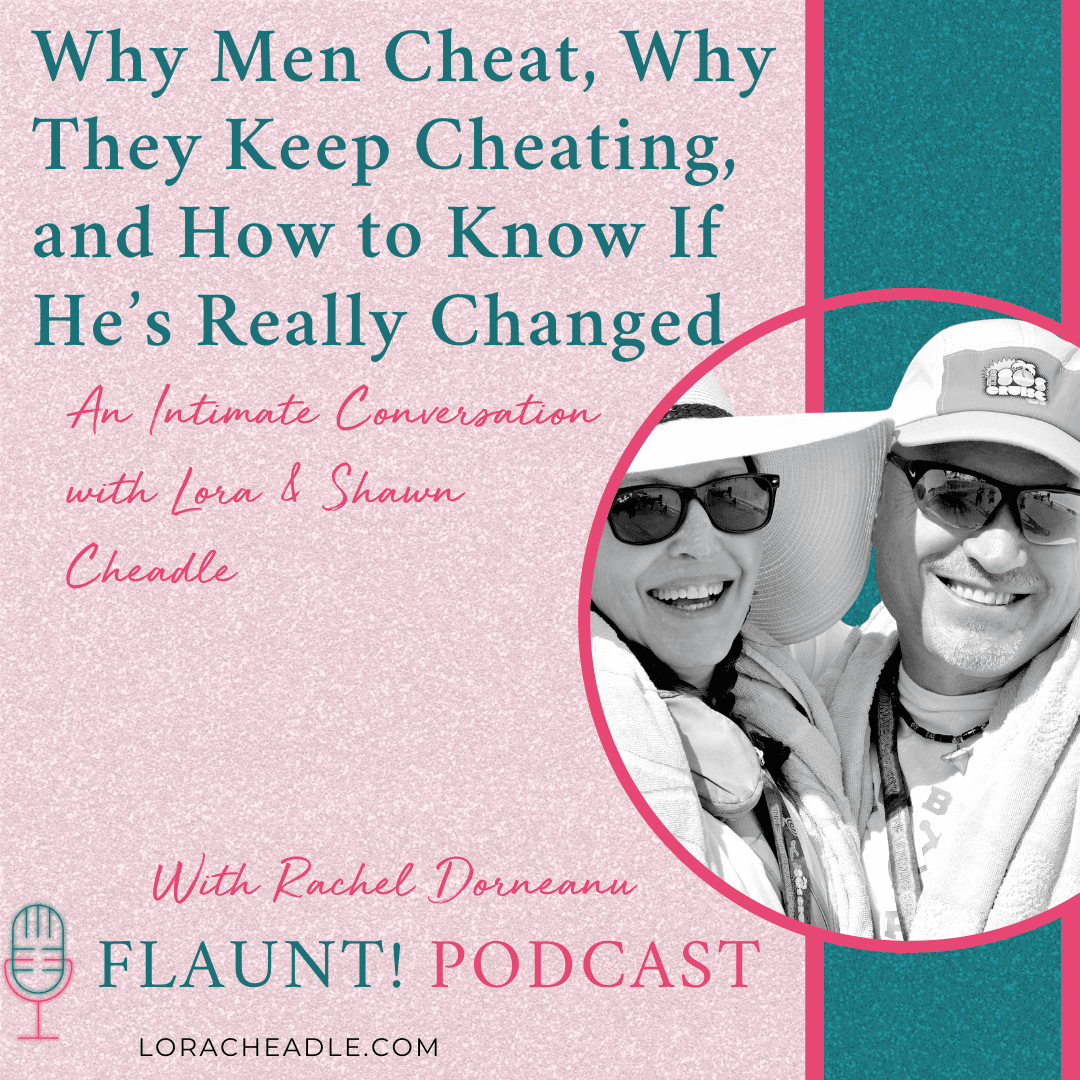
FLAUNT! Podcast · Infidelity & Betrayal · Affair Recovery
Why Men Cheat, Why They Keep Cheating, and How to Know If He’s Really Change
March 15, 2026
Show notes
You asked the hardest questions—so we answered them.
Why do men cheat? Why do they keep cheating? Can a man love you and still betray you? Why won’t he talk about the affair? And how do you know if he’s truly changed?
In this deeply honest episode, I sit down with my husband, Shawn, to answer the real questions women ask after infidelity—the same questions they post in my Facebook group, whisper to themselves at 2 a.m., and type into Google when their world has fallen apart.
This conversation is raw, thoughtful, and incredibly real. Shawn shares openly from the perspective of the betrayer—not as a clinician, but as a man who lived it, hid it, justified it, and ultimately had to face the truth of what he had done. Together, we talk about validation, compartmentalization, shame, emotional avoidance, repair, trust, intrusive thoughts, and what genuine transformation actually looks like over time.
This is not a conversation about excusing betrayal. It’s a conversation about understanding it clearly enough to stop repeating the cycle.
If you have ever wondered whether he truly understands the pain he caused… whether change is real… or whether healing is possible for you, this episode will meet you there.
Top 3 Takeaways
- Cheating is often a coping mechanism—not an honest solution. Shawn shares how seeking validation, emotional immaturity, and unresolved childhood wounds fueled his choices. This doesn’t excuse betrayal, but it does explain why many people cheat instead of leaving or speaking the truth.
- Real repair requires far more than saying “I’m sorry.” Healing only began when the conversation stopped being about words and started being about transformation, accountability, emotional safety, and the ability to stay present with discomfort.
- Trust is not rebuilt through promises. It’s rebuilt through patterns. This episode breaks down the difference between performance and real change, why trauma triggers can still arise years later, and how trust is rebuilt one regulated, honest, consistent moment at a time.
Favorite Quote
“Trust is not rebuilt through promises. It’s rebuilt through patterns.”
📌 Hashtags:
#WhyMenCheat #InfidelityRecovery #CanAManLoveYouAndStillCheat #AfterTheAffair #BetrayalRecovery #HowToTrustAgain #HealingAfterInfidelity #MarriageAfterInfidelity #RelationshipTrauma #EmotionalHealing #AffairRecovery #LoraCheadle #FLAUNTPodcast
Read the transcript
Lora Cheadle [00:00:02]:
Today's episode is different. Shawn and I are sitting down together to answer some of the real questions that you have asked. These are the questions that you have asked in my Facebook group, and these are also the questions that many women have been Googling at 2 AM after discovering the infidelity. Questions like, why do men cheat? And then, why do they keep cheating? How do you know if he's truly changed? Why won't he talk about the affair anymore? Will I ever trust again? And I think a big one is, can a man love you and still betray you? And then, after all of this, how can I rebuild myself and my worth? After being cheated on? What I want you to know is these are questions every woman asks. These are the questions that I asked, and today we're going to answer them honestly from Shawn's perspective without defensiveness. There's no pretending. We're just answering truthfully. And with that, Shawn is not a clinician.
Lora Cheadle [00:01:17]:
He is answering from his point of view as my husband, as a man. So the answers that he shares, they might be a little bit different than some of the answers that you have heard before. So the first section that we are going to cover is why do men cheat and keep cheating? Some of the top search phrases that people Google are why do men cheat, Why didn't he just leave instead? Can a man love you and still cheat? And why does he keep cheating? So we're going to unpack all of that and more today. I think the first question is, why didn't you end it the first time? Because you, like many other men, have the experience where They cheat once, they know it's wrong, but then they keep doing it again, or they are found out, they say they're going to stop, and then they go back and do it again.
Shawn [00:02:24]:
Yeah, that's a good question, and it's a tough one to answer. I think anybody who is a betrayer should understand his or her why. Why did they venture away from their spouse to begin with, or their partner? For me, my why was seeking validation. I felt disregarded at home. I felt invalidated— my needs, my wants, my desires. And this is kind of in important areas for me, where it was maybe my position as a father watching our kids being raised in a normal— a normal environment compared to how I was raised, but needing to be able to express my feelings and not being able to, not just because my spouse didn't let me, but because I didn't have the ability to do so. That persisted is one reason why I ended it. My invalidation, my feelings of invalidation continued without my ability to express what I was feeling and what I needed from my spouse and have that dialogue and that connection daily, weekly, with a lot of trust and truth, knowing that you're going to be honored and heard and get a reaction that makes it seem like I'm not just a rock-solid person who never is affected by emotion.
Shawn [00:03:57]:
There's a lot more to that, but that's kind of the surface answer for why I would continue on seeking validation in all the wrong places.
Lora Cheadle [00:04:07]:
So continuing to get a need met in a way.
Shawn [00:04:11]:
Well, we all need our needs met, and sometimes the why is physical. It was not my why, but there's lots of whys, and I think people need to explore that. It takes a little bit of work too, by the way. This did not come to me. Just because I disclosed the truth. This was a few years in the works before I realized exactly what the why was and why it persisted, because that came up for us, right? It's a tough question. I mean, and ours is extraordinary, the number of years that the first affair lasted and then others inserted in that time period. So 15 years, a long time.
Shawn [00:04:51]:
It's not just a 1-year or a 1-week blip. This was really damaging stuff that I had to explore about myself, uh, to determine this validation concept. How do I overcome and how do I deal with it effectively so that I feel satisfied and I feel whole when I'm having a conversation with my wife going forward and getting the marriage I always wanted? That was my phrase.
Lora Cheadle [00:05:18]:
So going back to the idea of why didn't you end it after the very first incident where you had that realization that it was wrong? Was there a drive to end it, to be like, oh my gosh, I just made a horrible mistake, I shouldn't do this again? And then what overrode that desire to stop?
Shawn [00:05:40]:
Well, this was for me something that, first of all, whether you feel guilt or shame initially may not happen. You may realize it's wrong, but you kind of reflect on it and you go right to secrecy. And so for me, compartmentalization was an incredible clinical description of what I was doing. I had to do this at work with different level of information, sensitive information. You have to close the drawer and literally close and lock a drawer on particular information that no one else can see. Mentally, compartmentalization is something that we do. And I quickly closed the drawer and returned to my life and tried not to think about what I had done. It bubbled up at times.
Shawn [00:06:34]:
It's not something that I'm suddenly revealing it at the moment. Now, some people do and have, and that's a good thing because they stop it short. Still crossed a line, but don't persist. So, but there's still a why, even for that one, the single event people, it's men and women alike, right? It's, but for me, that drawer then became open again and continuing with the activity and then closing the drawer.
Lora Cheadle [00:07:01]:
And that goes right into that second question is so many people think, how can you say you love someone and still cheat? Why don't you just leave? Because how can you love someone and still cheat?
Shawn [00:07:16]:
I had a therapist ask me before I was able to secure the right therapist. He was not the right therapist, but we were kind of in an interview phase. And in an hour's time, he asked me 5 times, why are you still married? Why are you still married? As though I should have ended it a long time ago instead of causing all this pain. The reason why I was still married is because I still loved Lora. What I was struggling with is how to really connect, how to have a dialogue that was meaningful so that instead of, I don't want to talk about it, instead of stewing on something for a week at a time, not just 24 hours or 48 hours, this would burn me up. And a lot of that was really masked depression and other things from my childhood that I didn't have the capability and I needed to start practicing and learning. I was fully capable as a successful human being, but I had my failings on dialogue and choosing the right words and understanding what the feelings were I was trying to express. And so, it's intriguing to think that you want to go back to your marriage, even though you've committed these atrocities against the marriage and you've hurt people.
Shawn [00:08:39]:
And that old phrase, hurt people. I was a hurt person. I wanted to be where I was safe and at home with my wife. I didn't know how to sustain it.
Lora Cheadle [00:08:49]:
Yes, exactly. And I love the way that you were explaining this because what it shows is a lot of justification going on, a lot of lying to yourself. Like, this is what I need so I can get this here. And yes, I do love Lora, I do love our life, I want this, but this is what it's going to be. And I feel like part of that justification is lying to yourself about how bad this was, lying to yourself about whether or not this was going to hurt me. And I'm curious twofold. One, how did you not think this would hurt me? And then two, at what point did you really start realizing that you were lying to yourself, or was that just kind of coming in all along the way?
Shawn [00:09:35]:
Well, for long-term affairs, and I've done some work in this area, but I think that part of, of what many of us experience is that at some point we want it to go away., and we want it to never be revealed, and we want the secret to die with the end of whatever it is. We've had counselors and coaches and others tell us similar stories about our feelings of a long-term affair, and that we wish that it would end somehow on its own. There's some sort of tipping point that would happen, and that happened to me, and it happened early on, but it turned out to still be a— on part of that, that goofy affair was discussion and texts and dialogue, getting validated. The focus was not on the physical. That happened. But the challenge for me was I don't really need this physicalness. I needed the texting. I needed the dialogue that felt, made me feel comfortable for some reason.
Shawn [00:10:38]:
So the thought of, did it hurt you? Was it going to hurt you? I absolutely knew if it's ever disclosed, I need to leave. And if you recall, after our D-Day, I did leave for almost 6 weeks before we realized that we want to fight for each other.
Lora Cheadle [00:10:55]:
So those realizations, it sounds like that you were lying to yourself. They would come up and then it would be so uncomfortable. You would push it back down. They would come up, it would become uncomfortable and you'd push it back down.
Shawn [00:11:08]:
Yeah. You compartmentalization is in effect too, because you're closing out the scariness of it. You're closing out the worry, right? Mentally, I'm like, I'm not thinking about it. And oh, by the way, for everyone out there, there is a drawer in our compartment chest of thoughts of nothing. Men do think of nothing sometimes. And you try not to think about something, you compartmentalize it and close it. And there's good and bad about that. And it's good if you can do it for work and security and all those things you need to do.
Shawn [00:11:42]:
But it's bad when You know, it's relationships when you really should be sharing. Exactly.
Lora Cheadle [00:11:48]:
So what I'll do now that you've answered is I'll go through and I'm just going to provide my answers from my perspective, and then we will move on to the second section, which is why he won't talk about it. From my point of view, why men cheat and keep cheating— they cheat as a coping mechanism. Something doesn't feel good, something doesn't feel right, they don't know how to address it. They think for some reason that this is going to do it, that this is going to make things feel better. They don't leave because they don't want to leave. Leaving isn't what it's about. They want to feel whatever it is— validated, happy, whatever. Can a man love you and still cheat? Absolutely.
Lora Cheadle [00:12:28]:
I think some of the reasons that men cheat is because they almost don't want to hurt or bother their wife stumbling along trying to express what's going on. So it's just kind of easier to ignore it so they can still keep showing up as your partner? And then why does he keep cheating? I feel like so many men keep cheating because, well, one, they don't really know how to stop and they're already in it and they do feel kind of stuck. And although it is meeting needs, it's also becoming wildly uncomfortable, but they get put themselves in a catch-22 where no good option is really a good option. And Shawn, I would just love a quick yeah or no or yeah, but on my comments.
Shawn [00:13:15]:
Yes. And that was my experience. Yeah.
Lora Cheadle [00:13:19]:
Yeah, exactly. And then section 2, why he won't talk about it. Some of the things women ask me all the time is why won't my husband talk about the affair? He says he wants to move forward. He says he just wants peace. Is that normal? 'Can we heal if he refuses to discuss it?' And the questions that I'm going to throw to Shawn are, first, what does it mean when a man says he just can't keep talking about this?
Shawn [00:13:52]:
Well, what does it mean? It means he's got work to do, unfortunately. And I think anybody who's the betrayer needs to go to their core, their greatest core, the deepest goodness in them and realize that— fight for your marriage by talking about it. Your partner needs to hear the explanations that you can provide. And get help to the degree you can, right? Get help elsewhere, because a lot of people can help you with the dialogue. There is a great book called I Don't Want to Talk About It by Terence Real. It really changed my life. Chapter by chapter, I had to stop and process So many sections of that and go out to the fire pit, which is our shop talk for me and Lora. And we went out there many times.
Shawn [00:14:40]:
I was reading it during the summer, so it was not like the winter. But, but the point is I had to learn to talk about it. You have to train yourself to talk about it and you have to be strong enough to know. Now, I like boundaries around when you talk about it. We had to make a rule not past 11, not on the pillow talk. Write notes down if you have questions, betrayed partner, right? Don't just start filling somebody with questions in the middle of the night, but do set time as the betrayed to be willing to talk. Now, I want to say something else. There's trained dialogue that you can do and learn.
Shawn [00:15:17]:
Imago dialogue is one of them, right? There's other forms of imago dialogue where you're echoing back, you're listening, you're wanting to know if there's more before you make any response. When you're hearing somebody talk about a difficult topic. And Lora and I did this a dozen times. If we did it once, it was really important on some really big areas of the affair process. And some of it was the why, some of it was a big event's coming and she feels vulnerable. You have to still live your life, right? But it doesn't mean that you should be intersecting with other people that were involved. Avoid that as much as possible, right? It's really difficult when it's a neighborhood, when it's some local community event where church or something where the person's constantly there. Sometimes you have to change lifestyles to move away from that.
Shawn [00:16:11]:
But the point is there still needs to be a time to talk. And it's not always over dinner. It's not always in the car every time there's a quiet moment, right? But Lora really fed into that for me. She would say, can we talk about— I have a difficult question. That was the phrase. I have a difficult question. Then I knew, okay, when, right? And now it's going to be after dinner, we'll take a walk or we'll go sit on the patio or we'll do something, go up to the bedroom if the boys are home or whatever it was, and create a safe place so you can have this dialogue that really needs to happen. And believe me, for the betrayed, it's really important to, to do this, have this dialogue, get it out.
Shawn [00:16:58]:
Because some of it is teaching you why you did things or why this happened. Because we don't ask all these questions of ourselves necessarily, right? So I think we need to stand in it and be strong if we're going to fight for the marriage.
Lora Cheadle [00:17:11]:
And my answer to that is very similar. What does it mean when a man says he can't keep talking about it? It means he's not comfortable feeling the feelings that talking about it bring up. He can keep talking about it. It's just that he doesn't know how to regulate his own discomfort in that space due to his own shame, his own guilt, things like that. The next question, is refusing to visit it healing or is that avoidance? Refusing to visit? Revisit the affair, refusing to revisit. Is that healing?
Shawn [00:17:48]:
One more time, read the question, please.
Lora Cheadle [00:17:50]:
Is refusing to revisit the affair healing, or is that avoidance?
Shawn [00:17:58]:
Well, it feels like avoidance to me not to revisit the factors that led into the affair, that the outcome, the damage that it caused. If you're not revisiting that, And I don't know if all that's revisiting per se, but to me it's dealing with.
Lora Cheadle [00:18:17]:
And to your point, it's having the boundaries. Refusing to revisit it, yes, is avoidance. But there are not— there are times where you can't go there. So having a boundary around, I'm about to give a major presentation for work, I can't do this right now. I think that's a different story. Than I can't ever talk about.
Shawn [00:18:37]:
That's why having safe zones for the talking is really critical. Avoiding is not healthy in any stretch. Avoiding for 6 hours or until the evening or until our safe zone. Yes, but to keep both of you safe, right? And productive or as productive as you can be, but not avoiding, not revisiting, not dealing with is a non-starter to successful reunion of two people.
Lora Cheadle [00:19:05]:
Right. The next question, is there a timeline for processing betrayal? What was your timeline for moving through this?
Shawn [00:19:14]:
Well, it's interesting because Lora and I were videoed one time and the guy who came to the house to video us about this topic said, oh, my affair was 10 years ago. My wife still loves to talk about it, but I don't want to talk about it anymore. And I wonder, it's been 8 years for us and here we are still talking about it. There's probably no timeline. There's no right timeline. It's all about the people that, and how much of an affair was it, right? Mine persisted a long time. There's a lot to talk about. So I've got to stand in that and others, if it's a blip or whatever, not to mitigate any affair, it's just that maybe there's less to consider.
Shawn [00:19:54]:
That needs to be talked about over time. So I think every situation, every case is different, as we'd say in law. But for this, I think you need to fill it out though. You both need to explore. And I think there's a natural tendency for the betrayed, if I can reflect what you kind of showed me, is your questions just went down over time. Right. And we felt a lot more normal and trusting as time went on.
Lora Cheadle [00:20:20]:
Right. And as far as my answer for that, I feel like Shawn's correct. It's different for everybody. And I kind of laughed when he said, here, it's been 8 years and we're still talking about it. We talk about it every day because it's the work that I do, but we don't talk about our situation every day. And when we do, there's no emotional charge to it anymore. It's like, oh hey, this is coming up with a client. Let's, can we talk about this? Or, oh my gosh, this is what happened.
Lora Cheadle [00:20:50]:
It's not like there's this huge emotional charge emotional charge. And if I were not doing this work, I'm not quite sure how often it would come up anymore. But then my question for you, Shawn, is, as the betrayer, there is guilt, there is shame, there is regret, there's like all of those ickiness. And how long has it taken you to move through some of that? And I know some things you're still moving through.
Shawn [00:21:19]:
Well, yes, there was a horrible feeling when not only you're caught, but you're reflecting on what you've done and you're realizing that what in the hell? I felt like it was an out-of-body experience for me. This is, what am I doing? Right? What did I do? Yeah. So there's shame with that. There's a lot of guilt and shame. I worked with a therapist that I create, she had me create a shame album.. And if you think of the old 33 records, right? So each track is a shame story, but I had to go back into childhood, right? So we're doing sort of a life review in a way. And I wound up with pages and pages of writing. I'm not pressing a record that you can go buy, but I had a lot of shame to deal with in my life.
Shawn [00:22:09]:
And then I had to learn the difference between something that I caused versus something my parents did to me. And there was a big difference in, in understanding that shame. And when it came back to the affair, now I really felt like, all right, I know what I did. I did cause that. That is my shame. And it was easier to manage, right? Especially over time. And you don't think about it every day. It's not haunting, but it can be early on.
Shawn [00:22:35]:
It was 3, 4 years when I was still pretty feeling pretty heavy.
Lora Cheadle [00:22:40]:
Yeah, yeah, it does take longer, I think, than most people realize because it is so impactful. And that moves right into this next question: what does real repair require? Not just processing the shame, not just processing I did it, but repair— repairing your relationship with yourself and repairing your relationship with your partner.
Shawn [00:23:08]:
We have this concept in, in business where we ask, what does success look like? If you replace that with what does repair look like, place yourselves out 2 years, 3 years, 5 years. Are you in a honeymoon phase again? Are you reconnected? Are you having open, safe dialogue? Are you able to express yourselves? In ways that you didn't before, right? Whatever your why was, and maybe it's physical, maybe it's some other level of intimacy. Maybe you need to learn what love languages are. There's lots of things you can do in repair, but what does it look like when you're successful? What do you envision? If you can envision that, the path to get there becomes easier to me. But you also know that there's things that have to be done in order to do that. And I need to go work on this. I need to work on this. And let me say something.
Shawn [00:24:04]:
Going to work on something for repair is not going one time to a shrink and hearing what's wrong. It's going and practicing what you learn. Practice what you preach. Practice makes you good. And we know this in sports and work and writing and everything we do, right? You get better at working on cars the more you do it. You get better at cooking the more you do it. Practice, practice, you repair. Tools, right? You're gonna have lots of tools to help you on this repair, but understand what you're trying to achieve and you'll get it.
Lora Cheadle [00:24:38]:
Yeah, I really feel like, on my perspective, it requires emotional safety and it requires accountability. And for me, yes, it was nice to hear Shawn say nice words, but it was him showing up differently. And that's what repair required for me, was him to become a different person. And by that, it's not like, oh, he's gonna change for me and he's gonna do this, that, or the other thing. It's he is processing his emotions differently. He is holding space for my emotions differently. I just wrote a newsletter that comes out in a week. So if you're not on my list, go to betrayalrecoveryguide.com, download your free Betrayal Recovery Guide, and then you will be on my list and you will get my newsletter.
Lora Cheadle [00:25:24]:
But this newsletter that I just wrote was all about how things are so different now, the tangible things that are different. When I have a bad day and fall apart now, I can let myself be seen and I can let Shawn hold space for me because I'm not afraid anymore that, oh, I have to tiptoe and walk on eggshells because what if I offend him? Because that was something that would happen in the past. Like, I'm having a bad day, and yet I have to monitor my behavior and my bad day because I'm afraid that I might upset him, and then that'll cause another problem. Like, all of those little games are gone. He is a different person. He sees me now in an entirely different way. He holds space now in an entirely different way. He steps up in an entirely different way.
Lora Cheadle [00:26:15]:
And I have this whole list of ways that we connect, ways that we are vulnerable. But it's that, yes, it's the change. And yes, I see that change. In some ways it's hard to put words around it, but he's a different— he's more regulated. He regulates himself. He regulates. He can co-regulate with me. He is safe to be around now.
Lora Cheadle [00:26:43]:
In a way that he wasn't before, and he's accountable now in a way that he wasn't before. So for me, you have to see those changes.
Shawn [00:26:54]:
If I could add, I would like to just supplement. To me, I'm the same, I'm the same political party, I'm the same athletic kind of person that I was. I like food or I don't like food, or I like drink or I don't like drink. But a different person to me means a transformed person. It was a transformation. And so I'm really transformed into someone who can read the room, read my wife's emotions, and express mine at a much better scale. And I'm not out of any woods yet, but I can see the edge of the forest.
Lora Cheadle [00:27:31]:
Yeah. And part of that too, I am also a different person. I mean, to Shawn's point, it's not like I fundamentally changed who I am, and now I don't do all the things that I used to do. Yes, I'm still the same person, but we're in a different relationship. There was so much that I did in Marriage 1.0 where I was worrying about managing his emotions and where we were not being vulnerable with each other. And I'm different in the relationship too. And I think that's a big part of it. Having your partner heal isn't saying, well, great, I did it right all along and you cheated, so you screwed it up.
Lora Cheadle [00:28:04]:
So now you have to conform to my way of doing it. That's not it at all. It's how do we create a marriage where I can show up as my fully healed self and you can show up as your fully healed self, and we can move forward and create a better version of ourselves and our marriage. And that moves really nicely into this third section, which is how do you know if he's truly changed? How do you know if he's truly sorry? How do you know he won't do it again? That's a huge fear. And then what are the signs that he has actually changed? So, Shawn, my first question to you is, what has changed internally inside of you, not just behaviorally? Because we talked a lot about behaviors, but what's changed inside of you?
Shawn [00:28:59]:
Well, I had a big inner critic phrase, and it was that I'm the bad guy. Somehow I felt like I was in a family of 4, I was on the outside, and in a marriage I was on the outside. And I had really abusive parents, and I really felt like I was told I was a bad kid and bad guy, and I did nothing wrong. I know darn well I did nothing wrong other than being a kid. I was a really good kid, I thought. And I get into marriage and I'm really thinking that, holy cow, I'm a bad guy. I'm not. And I just lashed out at that phrase, going and seeking validation that people ensure me that I'm not a bad guy.
Shawn [00:29:39]:
I'm a good man. Coming back to that core and understanding that that is my strength, that I am good, wholesome, interior, my center core is good. I live by that. I used to live by that. And I overcame this, I'm the bad guy. I have dialogue for that now. I don't worry about ever feeling lack of worth. That takes some time for all of us, depending on what maybe drove you to a similar position of lack of worth, or it could be something else, right? There's other, other aspects that we fight, other critics, other dialogues that we fight.
Shawn [00:30:16]:
And so you have to overcome those. You have to repair, you have to transform. And you have to practice who you are in order to be successfully engaged in a relationship. And then this will never happen again. I'm not going to let it happen again. I don't need it to happen again. I want the marriage that I've always wanted, and I'm getting the marriage, and I have the marriage that I've always wanted. Right? So that was the process over these last 8 years.
Lora Cheadle [00:30:41]:
Yeah. The next question is, how does a woman know if he truly understands the gravity of the situation. And I do know that's something that we struggled with because I would think, how— if you didn't know early on that this was not what you should be doing, how can I trust that you understand really how hurt I am and how painful this is? And I also think this is something that sometimes keeps women stuck because they think, I can't let him off the hook, so to speak. I have to keep showing him how bad this was because I don't think he gets how painful it was. So how would somebody know if the betrayer really does understand the gravity of the situation?
Shawn [00:31:33]:
Well, you can see the wound, you can see the wounded. If the visual is not enough, the times that you've held each other and felt the betrayed cry. You broke a spirit, you broke a heart, you broke a lot, right? And I could feel it, and you could see it. And so it was pretty obvious for me, but I can understand that maybe some people are more stoic or more angry and not showing just how deep the hurt is. You can always self-reflect. What if it happened to you, right? I wouldn't have had the strength. I wouldn't have the strength to do what you've done. Right? If the shoe was on the other foot, it would've been a weakness for me that I would just had to— and you and I have talked about timelines.
Shawn [00:32:17]:
If our lifelines had split, where would I be today? Probably not transformed. I would rather be transformed than not, believe me. And I think, hope most people would be if they envision the strength that they can gain from lots of good tools and practice techniques to be a better person. Hold to your core, right? Speak your own truth and be the true good person that you really are meant to be. A lot of us can do that, and some fail in this venture, but I'd just say never stop getting help.
Lora Cheadle [00:32:50]:
Right, right. These next two questions really are kind of about the difference between real change and performance. Oh, I'll never do it again, honey. Don't worry. Some of the red flags some of the ways that you intentionally pull the wool over somebody's eyes versus the sign of real change. And I know in our case, we can go back to some of the ways that you intentionally gaslit me to hide this. What were some of those red flags that you knew were going on for you? And now what are the signs of some real change?
Shawn [00:33:32]:
Well, that's a compound question. It is. The red flags were, you just know that it's not right. And when something goes into writing, when there's an encounter of another person in the same room with you, there's a feeling of, this is, this needs to end. What have I done? Right? And then you compartmentalize it again. To try to make it through. But the latter part of that is when you feel more, when you feel repair, you'll feel it. You'll feel safe.
Shawn [00:34:13]:
You'll feel safe as a betrayer. It's not going to happen. It's never going to happen again because I don't need it to happen again, ever again. And I have the skills now. I have the tools. I got this great toolbox of things that I can use. To have good conversations, stay connected, to hold space for my wife's emotions and her challenges. And those keep coming.
Shawn [00:34:35]:
Life keeps coming. You lose people, things happen, jobs change, right? Money goes up and down, whatever it is. Those are— those challenges are there. So, those don't become excuses anymore. You really are in this together and now you sort of feel it. And so, if you got to travel for business, you just know and you start trusting yourself. I think that was a big thing is when I knew that never again I could go anywhere and now I'm staying connected. There was times when you would call me and I didn't pick up.
Shawn [00:35:08]:
Right now I just pick up. I'll have to call you right back, but I'm gonna pick up and just say hi. So, you know, you have a touchpoint with me and you know where I'm at and I know where I'm at and I feel good about giving you a quick barometer Everything's safe, right? And so, and then it's just, it's such a different life and so much more healthy.
Lora Cheadle [00:35:29]:
Yeah. And my answer on that, similarly, it's hard to put into words because there were times early on when I was like, is this it? We're doing disclosure. Is this it? And Shawn would be like, yes, it's it. And it wasn't it. Or I'd say, you cannot have any contact. There's no contact. Did you have any contact? No, no contact. Oh my God, I just found out there was contact.
Lora Cheadle [00:35:50]:
So there was lying early on, though, those— and yet there was still the, I'm stopping, and then the behavior was happening. So there was that mismatch. So to me, like, how could I tell if there was a red flag? It's hard to tell. But from my side, it was almost like the performance was too big sometimes. Oh, this is it. This is it. And I think he's sitting there pretending to be sincere, but I don't feel sincerity around that. And again, it's not like I can say, here are the two things for you to look for and you'll catch it every single time.
Lora Cheadle [00:36:32]:
But there were times where I just knew something was off and I didn't know what was off and I didn't know why. And I would sense anger and I'd think he's just ticked off about something and I don't know what's going on. I don't know what's going on. He's got a problem, but I don't know what it is. And to me, that was the red flag. And the signs of the change are where I can say now, what's going on? Things feel really weird. And he'll be like, oh, this is what's going on, or I just need some space, I've got a call going on. And he validates the fact that I feel that something is off, and then the answer that he provides makes sense.
Lora Cheadle [00:37:13]:
And I felt like for a lot of the times when he was lying, it just didn't make sense. And he'd give me these answers and I'd think, I don't get it. Now, Shawn, this is directly for you. If you could tell a man like 3 things that he has got to understand So he doesn't repeat this in 10 years. So he doesn't repeat this the next time he feels invalidated. So he doesn't repeat this the next time he, you know what I mean, loses a job or has a death in the family. What would, what would those things be?
Shawn [00:38:02]:
Well, 3 things. I think, I think you've got to, number one, commit to your work, your repair. Do your side of the ledger in the relationship. If you need to explore I Don't Want to Talk About It book or some other way to get you to express what's really going on with you, then you need to do that. If you don't feel like your spouse has received— because not all women receive well either, and they may need some effort here, right? Then you have to be able to recognize that and say so. That's kind of step one. It's all about the repair skills that you're going to acquire. Number two is I think you have to learn how to forgive yourself.
Shawn [00:38:56]:
I think before you decide that you're never going to do this again, if you've not forgiven yourself, you're going to do it again. And so you have to let yourself off the hook. Might be the hardest for the betrayed to do. They might, they might be forgiven by the, by the betrayed rather. The hardest for the betrayer to do is let themself off the hook. And number 3, I think, is now in a trust reinventing trust, um, trust in yourself that when you go to lunch, when you go on a trip, when you— whatever it is, right, wherever these encounters happened, you have to trust that it's a different environment for you now and it's not this what you're seeking. Otherwise, you're not there yet. And I think trust also, if you're trusting in yourself, that's going to exude confidence in your partner.
Shawn [00:39:53]:
That she or he can start trusting again that your behavior is truly different and that you don't have to have a cell tracker or a tag-up call or whatever, right? And maybe you have to early on and it takes time, but I just think that repair and, and tr— repair, getting, and forgiveness and trust, repair, forgiveness, and trust. You have to have those three categories solid.
Lora Cheadle [00:40:19]:
Yeah, and I wanted to just point out too, when you talk about it's a different environment, it's a different inner environment. It's because I know in the past when you would approach women, sometimes it would be approaching it from a needy inner environment or from that, oh, I gotta connect and share about my bad wife and how I'm the bad guy inner environment. And that's kind of an extreme putting into words, but now you approach people, I feel, where your inner environment is very cleaned up. You are in a space of integrity. You are not in a space of how can you fulfill my need. You are not in a space of let me tell you all these stories. Your inner environment is very clean.
Shawn [00:41:04]:
Fair. And I would call it I'm not selfish. I'm not there to serve myself and have used them. Right. Yeah. I felt like that was a big problem for me with affair partners was using them to validate myself instead of do the work at home and get where I am today. Right. And still need to go.
Lora Cheadle [00:41:28]:
Mm-hmm. Yeah. It's a, an affair is a great distraction for what really needs done and what really needs working on and what really needs cleaning up. I think this is a great way to slide into this next section, which is about trust triggers and intrusive thoughts. Some of the things that people talk about is, how do you ever trust again after infidelity? Do intrusive thoughts ever go away? And why am I so triggered? And I think this is really on both sides. I mean, obviously, as the betrayed partner, yes, how am I going to trust you again? But you also have, how are you going to trust yourself? And then how are you going to trust me? How are you going to trust that what I say I'm doing and that I'm forgiving you and all of that takes trust on your behalf too. And I think sometimes people forget that. So how did you rebuild trust?
Shawn [00:42:28]:
Well, it was a slow process. It required, it required I think I did have to do work. It required repair first, right? It— for me to trust that you're validating me and would validate me. And you had an epiphany in that phase where you were doing work too, and you realized that you thought I was this rock solid— no, I'm as vulnerable as any human. It turns out, right? And I need to trust that you're going to treat me with some vulnerability and validate me. And I also need to know how to express what I needed validated, right? That's a huge repair cycle and improvement. So that took time and that equated to trust as we kind of landed on a pretty good dialogue between each other. So I felt really safe and you felt safe, obviously.
Shawn [00:43:27]:
Now that you knew that I was validated. And so it's kind of an infinity almost. It's not just back and forth arrows to me. It's these things come up, other events come up. And because over time, if you looked at 15 years, there's a lot of events in life that you lose a close loved one. You have 9/11 happen. You have other just catastrophic things that impact us. And how are we as a couple or as each individual humans dealing with it so that we don't go to somebody else to deal with it? Right.
Shawn [00:44:01]:
And gaining trust around that as more events keep coming. Right. So let's stay connected.
Lora Cheadle [00:44:08]:
Right.
Shawn [00:44:08]:
And we have some physical energy things we do to stay connected and good dialogue. And it's not always dinner and TV. It's— and there's just different ways people can do it. Right. We have good morning talk. Over coffee, which is our thing, but there's lots of ways that people can remain connected to ensure that they are developing trust.
Lora Cheadle [00:44:30]:
And I also wanna say around that, that mistakes, not really mistakes, a lack of trust can still pop up. But when you both know that trust is your ultimate goal, I think it's easier to navigate some of the missteps. Because there have been many times over the years where I'll say something positive to Shawn and he'll be mad at me. And it'll be like, wait, I'm validating you. I've learned that you want validation and I'm validating you. And then sometimes he'll be like, oh, I felt that was sarcastic, or I didn't think you were valid.
Shawn [00:45:08]:
You just made fun of me.
Lora Cheadle [00:45:09]:
Yeah, you just made fun of me. And it's like, wait a minute. And it's having that trust of No, Shawn is starting to really trust me. He does really trust me that I'm not out to hurt him. I'm not out to twist the knife, but it takes a while because the perception was there built on so many different things from the past that if he believes he's the bad guy, then he believes I'm gonna make fun of him. And I'm like, no, I'm saying something positive. And then on the flip side too, there's things where he'll try to reach out and say something or do something nice to me, and I'll be like, ew. And then he has to explain to me, that's— I'm meaning this as a way to connect with you.
Lora Cheadle [00:45:54]:
So it's having that grace and that understanding with your partner that, yeah, I'm trying, and maybe that's a misstep, or maybe that's a misunderstanding, but okay, I trust that what you did was coming from a good place.
Shawn [00:46:11]:
Yeah. And there's something else. I don't wanna get too far away from the question, but there was a nugget in there where you said that sometimes somebody is going to have a difficult thought or a memory or something could come up and we call it a trauma trigger. You know, read The Body Keeps the Score. But I would, I would say don't expect it to never come up again. Because even for us, it was been maybe 6 years since you've had these papers kept that had some emails and we just found them as we're doing a cleanout. And you had a trauma trigger that day. And we had to work through that.
Shawn [00:46:50]:
And it was a hard day for both of us.
Lora Cheadle [00:46:53]:
Right.
Shawn [00:46:53]:
It was almost a renewal of secondary trauma. Right. Let's get rid of some of this stuff that we don't need anymore. Right. The truth is there. However, even if you don't have some memento or like traveling to an area where something happened, we just had to do that at the beginning of the year. And thank you for that, cuz it went really well and you had a lot of anxiety going into it. And I wanted to hold space for that because it was a really important event for me to be at, a celebration of life.
Shawn [00:47:23]:
Right. And so I think these things are gonna come up over time.
Lora Cheadle [00:47:26]:
Mm-hmm.
Shawn [00:47:27]:
And I think those, as you have that trust and you've done the repair, A trauma trigger happens. Okay. Right. Hold space for a moment. Right.
Lora Cheadle [00:47:36]:
Right. And then move through it. Yeah. And that was that next question is, do intrusive thoughts ever fade? Yeah, they fade. But to your point, things will still come up. I mean, like that, I will still find something or see something and it's still going to be a shock. It's still going to be hurtful. But I trust that I can get through it.
Lora Cheadle [00:47:59]:
I trust that I can speak honestly to Shawn and he'll hold space for it. And then same thing on your side, Shawn, because I know early on you had your own haunting thoughts about what I did. What about your intrusive thoughts? Have they been fading over the years?
Shawn [00:48:16]:
Yeah, they've faded quite a bit, but it's interesting because many people have had multiple relationships, right? And an affair can happen in their third relationship or something. Some of your trauma can be from prior relationships too. And I think you need to understand, right, and analyze what is the impact of the intrusive thought, and is it at the core of this affair recovery or is it something else, right? For me, I had to go into childhood, and so a lot of my invalidation started way back. And not trusting adults around me to ever validate me, right? And much less see me. So my intrusive thoughts can be not just related to the affair, but a similar emotion that's really tied to some prior event. I really have to understand myself in order to figure that out and have a good dialogue with you. And we've been doing that lately as I'm writing a book. So that, that is a lot of intrusive thoughts for me right now.
Shawn [00:49:25]:
Yeah. It's not always about the affair, but it's a very similar emotion.
Lora Cheadle [00:49:30]:
Exactly. And shame. We had mentioned shame. Shame is a big one, and shame spirals happen, and it is so easy to be like, to fall into that. I messed this up. This is all fake. It's not gonna work. I'm never gonna get better.
Lora Cheadle [00:49:45]:
Oh my God. And it's so easy to kind of spiral down a shame spiral. What do you do now when you start having a shame spiral or when you realize, oh my gosh, I'm in my third hour of a shame spiral and I've got to stop? What do you do to help break yourself out of that?
Shawn [00:50:05]:
Well, I would say what I did, because I don't have them too much anymore, fortunately, because I do think repair helps.
Lora Cheadle [00:50:11]:
It's—
Shawn [00:50:11]:
you're not going to experience this stuff if you're having them now. I want to give you hope. That, you know what, you're not going to have them eventually. You might feel a little bit here and there, right? But it's a big cycle like that was early on for me. And that's first couple, 3 years. I was, it was a lot to deal with and I went and got help, right? I had to talk to qualified people that can help me with shame. But I also read a lot and I get a lot out of reading. It helps.
Shawn [00:50:38]:
A self-help kind of book. Terence Real's got some other stuff on shame that's extraordinary.
Lora Cheadle [00:50:43]:
Brené Brown does.
Shawn [00:50:45]:
There you go. Brené Brown. Yeah. Phenomenal on shame. And then I studied stuff online so that when I'm feeling it, I, I don't want to just compartmentalize it. I wanted to process it this time, right? If I want to close the drawer and not think about the shame, I'm not going to ever deal with it. And it'll come up again. That's part of what you learn in your cycle is your repair cycle is don't close the drawer, guys.
Shawn [00:51:12]:
Open it wide, pull out the shame clothes, and let's put them on and let's go figure out how to wash them up. Because I, I had shame, the shame album, as I mentioned earlier, going way back, absolutely incredible amounts of shame. So it was difficult to separate the shame from the affair encounters to what I was experiencing as a kid. And the whole thing just felt like one big bundle of horrible shame.. So it was a lot to unpack, but as I got into sort of, all right, part of that forgiveness and letting yourself off the hook is healing the shame, right? And really to heal the shame, it means that you're not going to experience it as much anymore in those cycles you're talking about, right? So that's really important to work through and understand what shame is, how you're feeling it, how you process it, and how you release it. Because when you truly are released, if you're still feeling it, you're not released. There's lots of ways to do it. You can do it through medicine men, you can do it through therapy, you can do it by yourself technically, but it's— sometimes it just takes a lot of extra work on shame in particular.
Lora Cheadle [00:52:22]:
It's such a big emotion. Right. We are not even halfway through with the questions that were submitted, and we're down to the final minute or so of the show. So I think we're definitely going to have to do a part 2 to get some of these answered again. But I think the biggest question that I want to end with before I close out the show is the whole idea of what kept us together. Because I, I know my answer, but I'd like you to hear it from the betrayer's point of view. What kept you in it? What do you think kept us together?
Shawn [00:53:05]:
Quite simple for me. It was desire to have the marriage that I always wanted. I thought I had it in the first years of our marriage, and then those things started creeping in, and then I swayed, and that trainwrecks. And you didn't think those 15 years counted in our marriage, right? And it, to me, they did, but it's a bumpy damn road and caused a lot of pain. But I need to have the desire to fight for the marriage. And I loved you always. And I wanted us to just be peace and harmony. And we weren't.
Shawn [00:53:47]:
And more so now than ever, fortunately, but there's still things that we have emotions and things come up. So, but now we have some skills, at least I do, right? I have more. You do too. But it's amazing to fight for a marriage.
Lora Cheadle [00:54:00]:
And then get the marriage you want. Yeah. Thank you. And I'm gonna echo all of that. I knew something in me knew the story wasn't done and I wasn't willing to move on until I knew for certain that it was time to move on. I will definitely come back next week, talk more about trust triggers, intrusive thoughts, self-worth, about being cheated on both sides, staying, leaving, detaching, what it means, how We each do our own work. And that's kind of the note that I want to leave this on is infidelity repair is not just an us repair. It is not just a you and me and we will fix the relationship.
Lora Cheadle [00:54:43]:
A relationship is comprised of two individual people that have two completely different needs and trauma histories and beliefs. Both people need to get help. I often say the betrayed partner absolutely needs coaching. Otherwise they won't know which direction to go. And the betrayer absolutely needs therapy so they can unpack why this happened so they can stop doing it again. And then you need some couple support to see how you can bring that together. But usually in my estimation, couples work is not where to begin. It is to begin at the individual level so you can heal yourself.
Lora Cheadle [00:55:24]:
So you can figure out what is going on with you. And if there's one thing I think that we both hope you take from this episode, it's that healing from infidelity really isn't about pretending that it didn't happen or doing all these different things. It's about the truth. It's about really figuring out the truth of what happened, figuring out whether change is real, Speaking the truth about what you need, speaking the truth about what kind of a relationship you want going forward, and what are you becoming. It doesn't matter if you stay or go. Healing is possible in any situation. And quite honestly, unless you heal, chances of repeating the cycle are pretty high. So my challenge to you personally is How can this situation become a catalyst for both of you as individuals and maybe for you as a couple? If you are ready to book your own clarity session with me, whether it's as an individual, as a couple, or as the betraying partner, book online at introductorysession.com and we'll take the first steps in unpacking, figuring out what you need what you want and what is possible.
Lora Cheadle [00:56:50]:
As usual, have an amazing week and always remember to flaunt exactly who you are, because who you are is always more than enough.
Never miss an episode
