
FLAUNT! Podcast · Infidelity & Betrayal · Affair Recovery
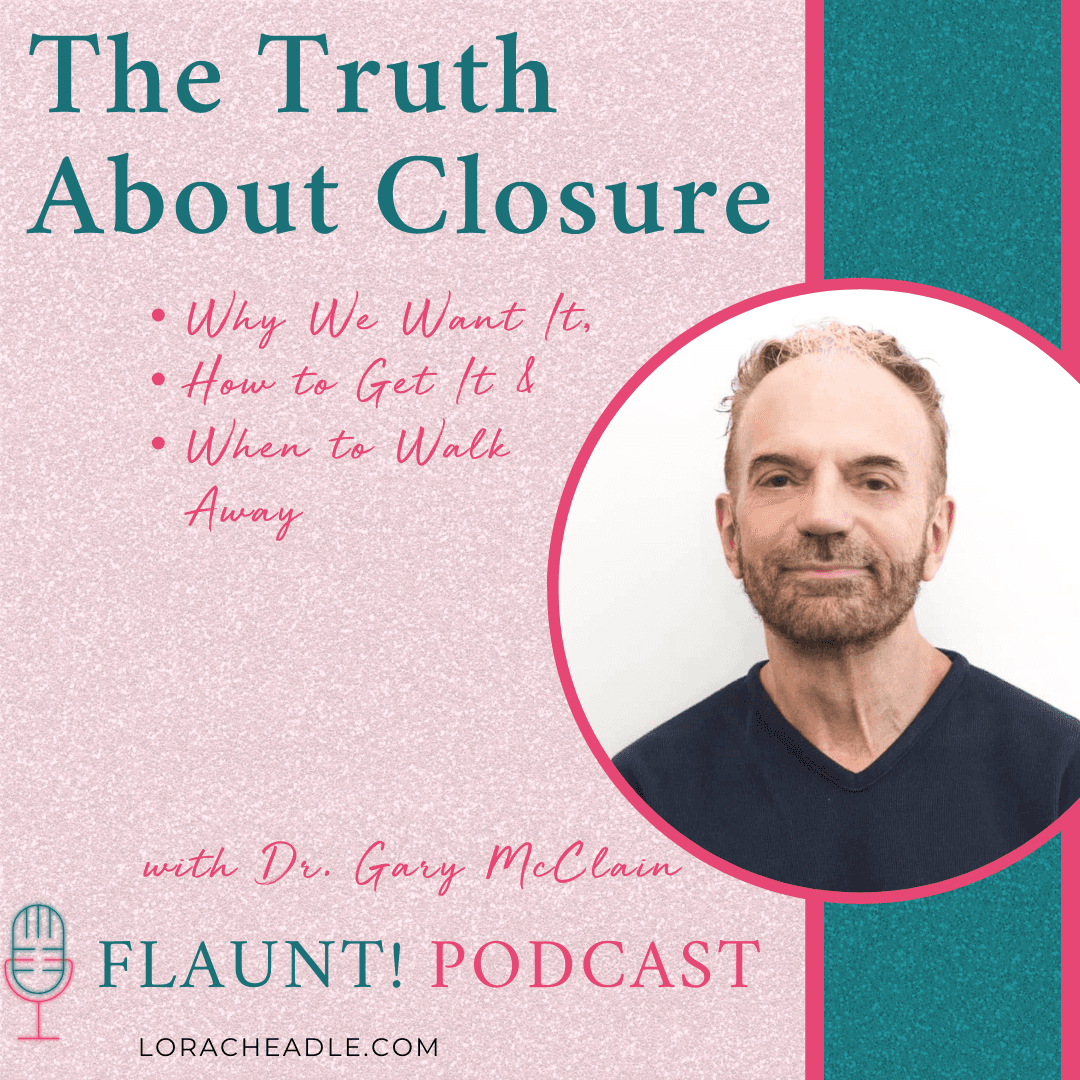
The Truth About Closure: Why We Want It, How to Get It & When to Walk Away with Gary McClain
September 28, 2025 · with Dr. Gary McClain
Show notes
If you’re seeking closure after betrayal, this episode with Dr. Gary McClain makes it practical—clear definitions, safe steps, and when to walk away.
“Know who you’re dealing with before you seek closure. Can you be okay with every possible reaction? If not, don’t set yourself up for more harm.” — Dr. Gary McClain
“If I could just get closure…” How many times have you said those words after betrayal, breakup, or loss? In this powerful episode of FLAUNT!, Lora Cheadle sits down with Dr. Gary McClain—psychotherapist, relationship coach, and author of The Power of Closure: Why We Want It, How to Get It, and When to Walk Away. Together, they unravel the myths about closure, why we crave it, and the surprising ways it can either heal or harm us. From ghosting to infidelity, narcissistic partners to unspoken endings, you’ll learn how to stop chasing the fairytale ending and start creating compassionate closure—whether or not the other person is willing to participate.
This is the episode that will change the way you think about “the end” forever.
Top 3 Takeaways
- Closure isn’t always what you think it is. Sometimes it’s not about a neat ending—it’s about validating yourself, choosing compassion, and walking away whole.
- Intentions matter. Before seeking closure, ask yourself: Do I want understanding, forgiveness, to be “right,” or to hurt them back? Your intention determines your outcome.
- You don’t always need them to heal. Even if the betrayer refuses contact (or is unavailable), you can find closure by processing your grief, reconnecting with yourself, and embracing life again.
“Closure doesn’t always come from them—it often comes from choosing yourself.” – Lora Cheadle
Join Sanctuary of the Soul — Just $47/month Your safe haven for healing after betrayal. Each month, you’ll receive:
· 2-hour live group coaching call on the 13th
· Channeled message from The Librarians
· Somatic processing and spiritual rituals
· Legal insight to protect your peace
· Sisterhood support from women who truly get it
You don’t have to walk this road alone. Step into a community that integrates mind, body, spirit, and safety — so you rise whole, sovereign, and free.
Join now » www.SparkleAllSeason.com
About Dr. Gary McClain
About Dr, Gary McClain:
Dr. Gary McClain is an educator, psychotherapist, relationship coach, and author. He has a practice in New York City. He also works with employees onsite at local corporations as a mental health professional. He is an adjunct faculty member at Montclair State University in the graduate program in mental health and at Excelsior College in health sciences, where he was named the Distinguished Faculty Member in 2013 and received the Faculty Scholarship Award in 2023. He is known for his warm, sincere, compassionate approach both in his work with clients as well as in his many presentations.
He has two specialties. He works with clients who are facing chronic and catastrophic medical diagnoses, as well as their caregivers and healthcare professionals, on issues that include coping with emotions, communicating with family members, self-advocacy with healthcare professionals, staying informed, making treatment decisions, embracing change, and planning for the future.
Books Published
"The Power of Closure: Why We Want It, How To Get It, and When To Walk Away," TarcherPerigee, expected Summer of 2024
"After the Diagnosis: How Patients React and How to Help Them Cope" (supplemental textbook for nursing/Allied Health Education), Cengage/Delmar, 2010
Read the transcript
Narrator [00:00:01]:
You're listening to Flaunt. Find your sparkle and create a life you love after Infidelity or Betrayal, a podcast for women who've been betrayed by their intimate partner and want to turn their devastation into an invitation to reclaim themselves and their worth. Tune in weekly so you can start making sense of it all and learn how to be okay on the inside no matter what goes on on the outside. Download your free Betrayal Recovery toolkit@betrayalrecoveryguide.com.
Narrator [00:00:35]:
Struggling with the lingering weight of unresolved emotions after a breakup, loss, or significant life change?
Dr. Gary McClain [00:00:41]:
You're not alone.
Narrator [00:00:43]:
Dr. Gary McLean, a distinguished psychotherapist and relationship coach, understands the profound impact of seeking closure. In his book the Power of why We Want it, how to get it, and when to Walk Away, he delves into the complexities of closure, offering readers a compassionate and insightful road map to navigate the journey towards inner peace. Dr. MacLean also identifies key signs that may indicate a lack of closure, empowering readers to recognize and address unresolved emotions. These signs include reaching out to someone for conversation, rehearsing dialogues to express feelings, holding visions of future relationships, and even fantasizing about retaliation. In his book, Dr. MacLean identifies healthy ways to find closure, as well as guidance for the reader regarding when the healthy decision is to choose to walk away.
Narrator [00:01:39]:
The Power of Closure is available on Amazon and other bookseller websites.
Lora Cheadle [00:01:46]:
If I Could Only Get Some Closure how many of you have said that to your best friend? Whether you're talking about the infidelity or something else, because sometimes it's even like, you know, the loss of a job and you're like, I just need some closure around this. Or a friend who ghosts you and you're like, I don't know, I just can't figure it out. But if I can only get some closure, I would feel better. Yeah, I know. Me too. And here's the thing, you know, if you've been listening to me for a while, that I have often said in a lot of ways there's kind of no such thing as closure. And does closure even mean what you think it means? And what is closure anyway? And how do you know if you find out this one little piece of information that it will really close the chapter? Or if it will open up a whole new world of well, now I need to figure this out. And then once I figure that out, oh my gosh, I didn't even know this was here.
Lora Cheadle [00:02:43]:
Now I need to figure that out. So that is what we are going to talk about today. We are going to Talk about the power of closure, why we want it, how to get it, and when to walk away. And that topic is also the name of an amazing new book by Gary McLean. And Gary is my esteemed guest today, and we are going to talk all about closure. So it's going to be a good one. It's definitely going to change the way you think about things. And welcome to the show, Gary.
Dr. Gary McClain [00:03:19]:
Thank you so much. I'm just thrilled and honored to be here. Really appreciate having this opportunity to talk about closure and get the word out. So thank you. Thank you very much.
Lora Cheadle [00:03:29]:
Yeah, you're welcome. Okay, let's start with a little bit of background on you. Who are you? Why do you know about closure? What do people need to know about your expertise in this area?
Dr. Gary McClain [00:03:43]:
Well, thanks. Thanks for asking that. I am a mental health professional. I have been for 20 years or more. And I often work with clients facing illness and sometimes end of life and grieving. And also many, many clients who have experienced breakup or loss, divorce, loss of a relationship, betrayal, and have many of those discussions and in other kinds of losses as well. Job loss, other kinds of losses. But so often the theme that consistently up is, how can I get closure? I need closure or I demand closure, or I can't go on until I get closure.
Dr. Gary McClain [00:04:30]:
Right. So I have this discussion so often that, that at some point a few years ago, I said I got to write a book about this because I'm having this discussion so often in so many different ways. So.
Lora Cheadle [00:04:42]:
Yeah, absolutely. Well, let's start with the beginning then. What is closure?
Dr. Gary McClain [00:04:50]:
Great question. To me, closure is, is tying up loose ends in communication. And I think as humans, we, we, we don't like loose ends because loose, loose ends make us feel helpless and, and uncertain. And we, we. We don't like that. We want, we want things closed. And the, the, you know, the, the bow tied at the end. And so I think when we feel a lack of closure, we, we just feel that.
Dr. Gary McClain [00:05:21]:
I gotta, I get it. I gotta, I gotta get this closed. This loop is making me uncomfortable for many reasons.
Speaker E [00:05:30]:
Yeah, yeah.
Lora Cheadle [00:05:31]:
And I appreciate that you said tying up loose ends and that specifically around communication because that means it's not me doing the work inside myself, it's me talking to you and saying, what happened? What's going on with you?
Dr. Gary McClain [00:05:47]:
Why.
Lora Cheadle [00:05:48]:
Why did you fire me, cheat on me, steal from me, hurt my cat, dog, mother, sister, friend, all of that.
Dr. Gary McClain [00:05:57]:
Exactly. It's wanting. It's wanting, understanding. I want you. I think as humans, we want to know and, and we, we, we need to know. And I think closure looks to us as an opportunity to finally have understanding. We want to be understood. We want to.
Dr. Gary McClain [00:06:15]:
And we want to understand what happened.
Speaker E [00:06:18]:
Yeah, yeah, yeah.
Lora Cheadle [00:06:20]:
So is closure mostly us getting information from another person, or does it also include them understanding our perspective as well?
Dr. Gary McClain [00:06:31]:
Ideally, I think it's both. I think it's both. I think we, we may walk into seeking closure because we were. We're hurt.
Speaker E [00:06:43]:
Yeah.
Dr. Gary McClain [00:06:44]:
Feel sad. We've been hurt. We're angry. We may want that person to ask for our forgiveness. Pain to go away.
Lora Cheadle [00:06:55]:
Yes. That's a big one. Wanting somebody to ask us for, for our forgiveness. Say more about that one.
Dr. Gary McClain [00:07:05]:
Yeah, I think especially in, in a situation of betrayal or, you know, I, I, you know, we're using that term ghosted a lot these days, and where people date someone, they're with somebody for a while, and then they feel. Ghosted.
Speaker E [00:07:19]:
Yeah.
Dr. Gary McClain [00:07:20]:
You know, or, or they were betrayed or they were mistreated, they were emotionally or physically abused in some way, and they want that other person to say, I'm sorry. Yeah, I'm sorry I did that to you. Here's why I did it. And I'm sorry. I want, I want you to forgive me. We want that. That would close the loop for. Or we at least think it would.
Dr. Gary McClain [00:07:46]:
It feels like it would.
Speaker E [00:07:48]:
Yeah.
Lora Cheadle [00:07:49]:
And I think that's. That Next place that I want to go into is. Does it really? Because like I said in my intro so often, I'm like, closure is not really a thing because it feels like it always opens up so much more. I mean, I just know for myself, very infrequently in my life have I had this big issue, and then somebody asks, answers my questions, and I go, oh, great, done. Have a nice day. Bye.
Dr. Gary McClain [00:08:17]:
Yeah, exact. Exactly. No, it's a very good point. Yeah. I think, you know, I think closure doesn't always give us the answers or we may not get the answer we were expecting.
Lora Cheadle [00:08:33]:
That's huge as well.
Dr. Gary McClain [00:08:35]:
And I think. I do think that's huge. And, and, you know, if you're going to seek closure with someone, it's important to be willing to, to speak and also to listen, knowing that you may not hear what you had hoped to hear. And, and I think it's important to know, to think about who am I dealing with here. And I know this person, and is it possible they will give me the closure I'm looking for? Or will they gaslight me? There's another term we're hearing a lot these days. Right.
Speaker E [00:09:11]:
Yeah.
Dr. Gary McClain [00:09:11]:
Well, the guest like me, will. Will they tell me, I. I'm the one who caused the problem? Will they say they were just reacting in the way that, that they had to because of my behavior and can I hear that? Or is that just going to make me more miserable? Yeah, you know, we have to go in with open, open eyes and open ears or say, you know what? I don't want to set myself up. You know, maybe I'll be more unhappy. And do I want to risk that?
Lora Cheadle [00:09:40]:
You know, I love that. I love what you just said. I don't want to set myself up because you're right. When we play through, you know, speaking infidelity specific, when we play through the scenario in our head, what I want is my cheating partner to say, oh, my God, I have loved you forever. I have always loved you. I don't know what I was thinking, but this is what I think that it was about. And I think it was about me, and I think it was about my pain, and I think it was about this, and I'm horrified. And, and in reality, what happens so often is it's because you were, you know, because you were a bitch.
Lora Cheadle [00:10:24]:
Because you were, you know what I mean? Because you didn't pay any attention to me. Because you. They so often turn it around and make it about you. And when you're already in a wounded state, then that just can cut you down even more. What did I do wrong?
Dr. Gary McClain [00:10:41]:
Oh, my gosh, absolutely. Totally. I, you know, I've. I've heard that so often from clients where they come back to me and say, you know, I was told that, you know, I'm a nasty person. I'm. I was told that I was ignoring my partner. I was, I was. Or they didn't trust me or, or, you know, I drove them away.
Dr. Gary McClain [00:11:06]:
And so that was, you know, that that was the only choice they had was to betray me. And, you know, do you, do you, you know, then you're in the position of, do you want to come back at them and say, no, this. Do you want to. Do you want. Do you want to walk down that path and do you want to just feel worse? And again, you know, that person, you know, what they're capable of. I always recommend is if you're going to seek closure with someone, know who that person is and think about what are the possible ways they might react and am I okay with all of those potential reactions? Will I be okay? Or is it possible they may react in a way that's going to make me Feel worse, more miserable and more in pain. And again, do I want to put myself in that position? Am I going to be gaslit? Am I going to be blamed? And then what will I do? Is that again, will I be more miserable?
Lora Cheadle [00:12:02]:
Yeah, yeah, that's, that's so wise because there are scenarios when you know who somebody is and sometimes it's, it's affirming because you're like, wow, they truly are exhibiting many narcissistic tendencies and they're continuing to do it. And I validate for myself that this is not a person I want to be in a relationship with.
Dr. Gary McClain [00:12:28]:
Yes, that's a very good point. You know, that's a really good point. That, that, that behavior that the other person shows towards you may just reconfirm, validate what you had suspected and can help you to walk away. Okay, now, you know, I see again who this person really is. I'm done, I'm done. I can walk away now. This is, this is validation. Very point.
Dr. Gary McClain [00:12:57]:
Very good point.
Speaker E [00:12:58]:
Yeah, yeah.
Lora Cheadle [00:12:59]:
And that in a way is its own form of closure. It's not the fairy tale ending closure, but it is the closure of I choose myself and we're done.
Dr. Gary McClain [00:13:10]:
Definitely. Absolutely. Absolutely. And you know, in, in, in light of that, I think it's important to be aware of your intention going into, into this, you know, what, what is my intention? Do I want to be understood? Do I want forgiveness? Do I want to be made right, which means they have to be wrong?
Speaker E [00:13:30]:
Yes.
Dr. Gary McClain [00:13:30]:
Or do I want to potentially validate who they are? You know, I think having an intention and again being okay with the outcome, I think is, is going to be productive and in a way for you to be able to walk away.
Lora Cheadle [00:13:48]:
Now let's break down all of those elements that you were talking about. It's the intention, it's do I want to make somebody else wrong? Do I want say more about all of those? Because I don't think a lot of people necessarily go into an interaction honestly from this open hearted place saying I want to understand and be understood most of, and I will say us because I include myself in this too, want to go in and have like the TV courtroom drama type of an interaction. And that's not real, not necessarily healthy and not closure.
Dr. Gary McClain [00:14:29]:
Absolutely. And, and ideally the intention is understanding to be heard and, and to hear, hear from the other person and come to you and understanding. That's, you know, that's the ideal intention. But, but I think again knowing who that person is, how they might react again, can I be, be okay? With that. But I, you know, often, certainly in a situation of betrayal, which so often people need closure after feeling betrayed in some way. There is an expectation of forgiveness. There is an expectation of being made right. And I think it's human nature when we go into a discussion with someone, especially when there's, we're seeking closure, I want to be right.
Dr. Gary McClain [00:15:17]:
And if I have to be right, you have to be wrong. And, and that's an agenda that can lead to more pain and more frustration. You know, if that's your agenda, you know, you may, you may, you may find yourself in more pain and more frustrated. You know, sometimes there's also an agenda of revenge. We often seek closure out of revenge, or we may set up ourselves for the other person to get revenge. You know, we're human. And the need, the, the desire to express anger can often have a, as a, as a corollary, partner up with revenge, whether it's to hurt somebody back again, for them to admit that they're wrong and then drive it home.
Speaker E [00:16:07]:
Yeah.
Dr. Gary McClain [00:16:08]:
Or, you know, to hurt them back in some way. And that, you know, that's, that's a setup for, for more recycling of, of more the drama and more self harm, ultimately. More self harm.
Speaker E [00:16:22]:
Yeah.
Lora Cheadle [00:16:24]:
I, I, I want to talk a little more about that because I really like it. And before we started recording, we were talking a little bit about the Sacred rage show, which I did a few, a few episodes back. And if you haven't checked it out, check it out because it's important to understand rage. But there is that place of, how do I let you know how hurt you made me? You know what I mean? How do I get that valid? I need to be witnessed, I need to be seen. You need to feel the impact of this. But it's from that place of making each other whole, not from, you are a jerk. You did this awful, you are a bad person. How can we go about finding that balance in both parties?
Dr. Gary McClain [00:17:15]:
Yeah, that's a really important point, a really good question. You know, I think if you're going to ask for closure, ask for that conversation. And I'm asking you to listen to me. And I want you to know how deeply I was hurt. You're making yourself vulnerable. There's a vulnerability with saying, will you talk with me? You're making yourself vulnerable. I need a conversation, further vulnerability. You hurt me very, very deeply.
Dr. Gary McClain [00:17:46]:
You destroyed me emotionally. And I want you to know that. Again, more vulnerability. I think there's a strength in opening up and being vulnerable. But, but at the thing I think at the same time, are you okay with the may that, with the way they may respond? You know, are you okay with that? Can you listen to that and, and can you be okay with that again? Or are you setting yourself up for more pain? You know, I, I listened to your sacred rage. I thought that was just an outstanding, outstanding program. I, I took notes on it and I thought it was just incredible. And I, I do think that, you know, there sometimes we, we, we find ourselves in relationships where we have a story to complete.
Dr. Gary McClain [00:18:39]:
Yeah, I think that story is sacred rage. I think it's generational. I think it's past experiences. I'll give you a very quick example. A parent who is emotionally unavailable. You know, your parents are those first, first human beings that we develop this connection to. Hopefully not always. And, but I think you, if you have, for example, an emotional, emotionally unavailable parent or an emotionally abusive parent, there's a story that you may find yourself completing, and you may complete it with the people you bring into your life, including the person you decide to partner with.
Dr. Gary McClain [00:19:23]:
And you may not be aware of that story you're trying to complete, but you may attract a person who's emotionally unav, emotionally unavailable, who's emotionally abusive. You may attract them to complete that story. And the story is, if I can get somebody who's abusive or unavailable to love me, that story is going to be complete. And I think sometimes seeking closure can help open a, Open us up to that, that. Wait a second. Here I am again. Yeah, maybe I need to look at something. Maybe there's something.
Dr. Gary McClain [00:20:03]:
My own rage, my own disappointment, my own abuse, my own need for validation that I need to look at first. Maybe this is the lesson that I. Something I need to work on. Does that make sense?
Lora Cheadle [00:20:20]:
Oh, absolutely. And you know, I mean, they all say, and it's true. We married our unfinished business.
Dr. Gary McClain [00:20:26]:
Yes. Do so lutely. I think we do often. Yes.
Speaker E [00:20:32]:
Yeah, I do.
Lora Cheadle [00:20:33]:
So I, I really appreciate how you brought it back home. Like, what are the things I need to complete in my psyche, in my life and my understanding? So what if the person you're seeking closure from is not available? Maybe they're, maybe they've passed away. Maybe, you know they're going to hurt you. Maybe they are just not interested. What are the things that you can do to find and bring closure in yourself, exclusive of that other person?
Dr. Gary McClain [00:21:05]:
That's an awesome question. That is a great, great question. Because often that person. I don't have statistics on this, but often that person is not available.
Speaker E [00:21:16]:
Yeah.
Dr. Gary McClain [00:21:17]:
Either they refuse to have any more contact with you. Or they say, I'm not talking about this anymore. Okay. Over this. I'm not doing it. Or maybe they moved on, or maybe they passed away. Exactly. Something has happened that.
Dr. Gary McClain [00:21:33]:
That you can't have that conversation for whatever reason. First one often being refusal. I'm not doing this and not going there with you. And I think that leaves us to find our own way to have closure. And. And I think, looking at the lesson, would I learn from this, what I learned about myself? What did I learn about. As I found myself getting more involved in this relationship? What were the warning signs that I may have ignored, then I made excuses for or that I somehow enabled?
Lora Cheadle [00:22:10]:
What did.
Dr. Gary McClain [00:22:10]:
What did I learn from this? I think is a good starting point.
Speaker E [00:22:14]:
Yeah.
Dr. Gary McClain [00:22:14]:
And then I think. I think embracing your life is so. Is so important. You know, I think one of the ways we walk away from closure is to embrace our life. Bring something new into your life. Reconnect with things that you enjoy. Connect with people who you appreciate and who appreciate you. Get involved in.
Dr. Gary McClain [00:22:39]:
In your work.
Speaker E [00:22:40]:
Yeah.
Dr. Gary McClain [00:22:41]:
You know, find ways and just really wrap your arms around your life and embrace it. I think that can really help you to let go of the situation that's been really eating at you and causing you to need this closure, you know, is to be able to say, I'm gonna let go of this. I'm going to replace it by really embracing my life. And, you know, it's one of the healthy ways to cope after divorce.
Speaker E [00:23:11]:
Yeah.
Dr. Gary McClain [00:23:12]:
Somebody has, you know, broken up with you is embrace your life.
Speaker E [00:23:15]:
Right.
Lora Cheadle [00:23:17]:
So important. And I find it fascinating that it can be so hard because people are often like, I don't even know what I like. What do I want to do? I don't even know that you're right.
Dr. Gary McClain [00:23:30]:
You're right. And sometimes you've been so involved in a relationship that you've let go of your friends, you've let go of other things you. You've enjoyed. You want to spend time with that person. You kind of built yourself around them. We know we do that. We do that. Of course.
Dr. Gary McClain [00:23:49]:
And so I think that it's a matter of saying, okay, what, What. How do I reconnect the people that I've let go that I can reconnect with other interests? Or maybe this is a time to explore new interests.
Speaker E [00:24:03]:
Yeah.
Dr. Gary McClain [00:24:03]:
Maybe take a class. Maybe I can get involved in something.
Lora Cheadle [00:24:07]:
Right.
Speaker E [00:24:08]:
Yeah.
Lora Cheadle [00:24:08]:
There's a lot of. There's a lot of different things. So I'm putting. Putting together a scenario yeah, something happens, you know, infidelity, because that's what the show is based on. But it can be anything else too. You want closure, so you ask someone for closure. You ascertain for yourself, is this a safe person and is it going to harm me or is, does this have the potential to feel good? Then you ask somebody, do you ask them for an in person conversation? Do you ask them for an email exchange? What, what does it depend on the person? What, what are your top recommendations for somebody to do to seek successful closure?
Dr. Gary McClain [00:24:50]:
Yeah, that's a great question. That's, that's a really good question. I think it's ideally, it's important to meet in person. Yeah, I, I recommend a neutral place, you know, not if you're living in two different places. I don't recommend having them come over or going to their place. A neutral place can be a walk in the park. It can be a quiet corner of a, of a, you know, of a restaurant. Someplace where you can have a conversation and maybe get emotional, maybe voices raised.
Dr. Gary McClain [00:25:26]:
So maybe not a restaurant, but a place where you can, where you can do that and we can have that conversation. So that I think is, is important. I think when you reach out to that person, being clear, I want to talk about what happened between us. I'd like to have a conversation. I'd like to talk about how I feel. I'm here to listen to how you feel. And I think having, having, making that clear. I'm here to talk, I'm here to listen.
Dr. Gary McClain [00:25:54]:
I'd like us to understand each other.
Speaker E [00:25:57]:
Yeah.
Dr. Gary McClain [00:25:57]:
So I think that, I think that's ideal. I think it's important to keep it evidence based. And what I mean by that is not to point and diagnose. You're toxic and you're anxious or you're depressed or you're angry. Not to, not to label but to keep it evidence based. This happened. This is how I felt. You said this.
Dr. Gary McClain [00:26:22]:
This is how I felt whenever we went out. I experienced this. This is how I felt. And you know, evidence based.
Speaker E [00:26:31]:
Yeah.
Dr. Gary McClain [00:26:31]:
And this, I just want you to know how these things happened. This is my interpretation. This is how I felt. And then said, I'm here to listen to your side, what was going on with you when this happened, when that happened, and see if you can have that way forward. I don't recommend email because sometimes closure happens through email, but it's that back and forth with email, you don't know the emotions behind it.
Speaker E [00:26:59]:
Yeah.
Dr. Gary McClain [00:27:00]:
And so I think it's very easy to misinterpret email or I'm going to give you a very quick example. I had, I had a client come in once and, and he said, you know, had a conversation with my girlfriend and it kind of went off the rails. And she said this, and I said that, and then she said something that implied to me that maybe she was cheating on me. So I said this and, and I said, so what was the resolution? He said, well, let me show you. I said, what do you mean, show me? He said, well, we texted all this. I said, you texted all of this? Really? Was that the best way to handle this? I said, you don't know the emotion behind it.
Lora Cheadle [00:27:42]:
Right, right.
Dr. Gary McClain [00:27:42]:
So you started interpreting. You put her on the defensive. She started interpreting. She put you on the defensive. This went off the rails, maybe because you weren't talking about this in person. So we need all five senses here.
Lora Cheadle [00:27:59]:
Right, Right. And that's another great thing, when you sense a conversation going off the rails. And do you have recommendations on how to pull that back in?
Dr. Gary McClain [00:28:09]:
Good question. I, I, I, I think it's really helpful to say, let's take a step back and this, where, where this is, this is overheating. Let's take a step back. Let's take a couple of breaths. Take a couple of step back. Steps back. Or to say, you know, maybe we've gone as far as we can today. Yeah, you want to set up another time to talk? And we're both kind of, kind of over the top here.
Dr. Gary McClain [00:28:36]:
Maybe we should set up another time if you feel comfortable doing that.
Lora Cheadle [00:28:40]:
Right. You know, or maybe enough is enough.
Dr. Gary McClain [00:28:43]:
Maybe enough is enough. Okay. Absolutely. Maybe. Okay, we've gone, maybe we've gone as far as we can. Maybe we're not going to come to an understanding. I'm hearing this, I'm seeing this. You're feeling this way, you know, do you feel like we can go forward? Do you feel like this is, we're in a, we're at a loggerheads, we're at a stalemate.
Dr. Gary McClain [00:29:05]:
I'm feeling that we're at a stalemate. What about you? Okay, maybe, maybe we've gone as far as we can. Yeah, Every time. Maybe this is our closure. You know, maybe our closure is to agree that we can't agree. And maybe this is where. As far as we can go.
Lora Cheadle [00:29:23]:
I really like that phrase that you used, that maybe this is as far as we can go. I really like that we're at a stalemate because you are making all of that internal explicit. So then if that is your Understanding. If I'm saying to you, Gary, well, I think we've gone as far as we can go. I think we're to stalemate. And then you could be like, oh, my gosh, no, I'm just actually having a stomach cramp here, Let me go get some water and stretch, and I can be back and be present for you in 10 minutes. And it can be like, oh, wow, that's not what I interpreted at all.
Dr. Gary McClain [00:30:01]:
Right, Exactly. To leave that possibility, I'm feeling like we're at a stalemate here. I'm feeling like maybe we. We just can't go any further in this discussion. How are you feeling? You know, but if you're sensing a lot of defensiveness, if you're sensing gaslighting, it's all being turned back towards me. If you're starting to ridicule me or roll your eyes at me, maybe this is as far as we can go. And just say that, okay, you've rolled your eyes three times now you're telling me this is all my fault and I'm trying to explain my side. If this is the way you see it, okay, I accept that.
Dr. Gary McClain [00:30:43]:
Maybe this is as far as we can go.
Speaker E [00:30:45]:
Yeah, yeah.
Lora Cheadle [00:30:47]:
Okay. I'm gonna push on something because you just said, I accept that. Here's what I see so often. People trying, and then the other person is gaslighting, manipulative, defensive, turning it around on them. And. And I know this for myself, too. There's times where I can't let it go because I'm like, dude, you're a smart person. You can see this.
Lora Cheadle [00:31:10]:
You're. You being a butthead. That's really, really hard to be in the prefrontal cortex sometimes and be like, oh, I see that we have gone as far as we can go, and I'm going to call a hiatus. So what are your tips and tools for not allowing yourself to get locked in? Horns locked, head down.
Dr. Gary McClain [00:31:35]:
Yes. That's a. That's a very important point. I think one is, is again having intentions going in of. I'm going to state my. My case, sent the evidence, my talk about my feelings, I'm going to listen to their side. I'm going to hope that we can come to an understanding. But at some point, but at some point, if I sense that a lot of defensiveness, I'm sensing that they're.
Dr. Gary McClain [00:32:07]:
They're angry and won't let go of it. If I'm sensing that they're just trying to make this all my problem, then I'm going to state that I'm sensing that you're really defensive. Feeling defensive here. It's not my intention to cause you that. But that's what I'm sensing here. I'm sensing you're really angry at me. What do we need to do to try to resolve this? Or I'm sensing that you don't really care what I think.
Speaker E [00:32:33]:
What do you think?
Dr. Gary McClain [00:32:34]:
Do you think I'm crazy or imagining this? That's what I'm sensing from you. Is that. Am I. Am I correct in my perception? Yes. Well, okay, then maybe we can't take it any further. You know, I think. I think I always say to people, take good care of yourself.
Speaker E [00:32:53]:
Yeah.
Dr. Gary McClain [00:32:54]:
And don't set yourself up for more abuse. And if you feel it's going in that direction, you feel there's a wall up and deflection and abuse towards you, then maybe it's time to begin to walk away. Don't set yourself up for more of you. Of abuse.
Speaker E [00:33:12]:
Yeah.
Lora Cheadle [00:33:14]:
I'm really getting from this, and I. I just want to verbalize it for everybody listening.
Dr. Gary McClain [00:33:21]:
Yeah.
Lora Cheadle [00:33:21]:
Closure does not happen a week after D day when you found out your partner's cheated. Because I. I feel like these conversations go wrong when we are still so raw, when we are still so emotional. And it's. It can be years later. I mean, it really can be years later. So don't seek closure too soon. Because I feel like when we're seeking speaking from the wound instead of the scar, all we're doing is picking up that scab for ourselves and creating so much more pain.
Lora Cheadle [00:33:57]:
Like closure is the end of the route. It's not something. It's not something that's going to make me feel better. I'm in raw pain from infidelity. So I need closure. No, no, no.
Dr. Gary McClain [00:34:11]:
I totally agree. Absolutely. I think, I think that's a really important point. Absolutely. Is to take time and process what happened. You know, take time and process it because you're right. The emotions are raw. You know, you're feeling all over the place.
Dr. Gary McClain [00:34:28]:
You're feeling. Feeling really hurt and rightfully so. And you have, you have a good reason to be hurt. You've been betrayed, you've been abused. Take some time and process that. Maybe talk to a coach, a relationship coach, and a breakup divorce coach. Maybe talk to a therapist, somebody who's trained to listen and can help you get perspective on it.
Lora Cheadle [00:34:55]:
Yeah, and I like. Yeah, I like that. Because I do feel like you need the coach to help you sometimes, I think, move forward and to know where you are on the map. Because I feel like a lot of the work that I do is helping people see the forest. And here's where you are. You're not here, you're here. But then for you, like the therapy, people need to go in and be like this, possibly a childhood wound that I need to address. This is a long standing pattern that I need therapy around.
Lora Cheadle [00:35:29]:
And you need both.
Dr. Gary McClain [00:35:30]:
Absolutely. And I think taking time to process it, you know, sometimes right after such an important thing. I'm so glad you brought that up. I think one thing really important is that when it's so raw, we don't always know how we're feeling. We don't really know what our intention is. Which sets you up for going in, trying to move forward when maybe the relationship is toxic and you, you need that time to process. You're setting us, yourself up for makeup sex. Right.
Dr. Gary McClain [00:36:03]:
Which, you know, people set themselves up, they have makeup sex, they go back in, and then the toxicity repeats itself. Right?
Speaker E [00:36:10]:
Yeah.
Dr. Gary McClain [00:36:11]:
So I think, so I think taking that time to really process and as you said, sacred rage look back, what's really, what, what really upset me here, what, how am I really feeling, what's really going on with me helps you to have clear intentions when you do see closure further, further down the road, if you do.
Speaker E [00:36:32]:
Yeah.
Lora Cheadle [00:36:33]:
So here's another question around that, because what I see a lot too is when women that I work with say they need closure and they want closure. What I hear is the outside perspective, which I think is a little more clear often than the inside perspective, is I want to prove myself right. I want to prove myself right. I want them to see how I was the best that they could ever get. And I want to see how much they screwed themselves up. And I want to see, I want them to say that they were wrong. So what do you do when you're like, actually, my intention isn't closure. My intention is to be right.
Lora Cheadle [00:37:09]:
What do you do when that's your intention?
Dr. Gary McClain [00:37:12]:
I think that's human nature. You know, I think we want to be proven right. We want to think that everything we do is correct and that the other person is wrong. And, and I think when you've been betrayed by somebody, they are wrong and you are right.
Speaker E [00:37:29]:
Yes.
Dr. Gary McClain [00:37:29]:
But the point I think you're alluding to is they may not, the other person may not agree with that. They may. Their agenda may be to make excuses for themselves to make themselves right by making you the one who caused the problem. And, and I think, you know, I think that so often happens in betrayal is you. You want them to ask you for forgiveness.
Speaker E [00:37:55]:
Yeah.
Dr. Gary McClain [00:37:56]:
They have to admit that they were wrong before they can do that. And so often someone who's betrayed you doesn't feel that way or is. Is needs to feel they were right. They. They don't want to accept that they were at fault.
Speaker E [00:38:13]:
Yes.
Dr. Gary McClain [00:38:13]:
So again, are you setting yourself up again? Distance can help with that and taking the time to process it.
Speaker E [00:38:21]:
Yeah.
Lora Cheadle [00:38:22]:
And. And I like that you went with distance because that was the next. That was the next topic that I kind of wanted to explore at a certain point. It feels like you don't always need closure. You know what I mean? It's like I, I found out about my husband's first infidelity end of 2017. I found out about all the big ones. 2018. It's been a long time.
Lora Cheadle [00:38:46]:
We've had a long journey. We're still together. We're much more deeper and vulnerable and more connected. And he's done all this work and I've done. And it's like we never sat down and said, let's have a closure conversation. But we're really good. It just happened along the way. All these little pieces have come into place and I have the narrative, and he has the narrative and I have the understanding, and he has the understanding.
Lora Cheadle [00:39:12]:
So do you always need closure?
Dr. Gary McClain [00:39:15]:
You know, sometimes closure can be a reset also. You know, sometimes couples sit down and say, you know, some things have happened or I'm. Or I'm feeling like I'm doing all the work here, all the emotional work, and you're not doing. This is why I feel this way again. Evidence based or I saw this. I saw that. I know. You know, I know what you've been up to.
Dr. Gary McClain [00:39:42]:
This is why I suspect or you've admitted whatever. I want you to know how I feel. And then can we move forward? And here's what has to happen if we're going to move forward so it can be a reset. And I, and I think. I'm so glad you asked that because I think we think closure, closing the door. And sometimes we're closing the door, but also opening a new door in the relationship.
Speaker E [00:40:09]:
Yes.
Dr. Gary McClain [00:40:10]:
You know, that's a possibility also. Yeah.
Lora Cheadle [00:40:12]:
Yeah, I. And I like that you said that too, because. And this tends to be a little bit more on the spiritual realm. My husband and I came to a place where we were like, I felt like we had a soul contract to go through this. And we went through it and then it was done and we both. And I have a show about this, too, where we both had this overwhelming sense, like, soul contract done. We can walk away. This is all done.
Lora Cheadle [00:40:38]:
And we spent a year, a full year with. What are we going to do with this? Are we. What are. What are we gonna do? Are we gonna enter another soul contract? Are we just gonna hang out together or are we friends? Are we partners? Are we creating a new marriage? But it took a year of just kind of being in that, you know, the. The messy middle. Another phrase people use a lot, but just being like, well, there was closure, but we don't need to open something else yet. We can just kind of hang here and see how things are going before we figure it out.
Dr. Gary McClain [00:41:13]:
That's great. I mean, I think that's very mature. You know, that's two mature adults who can have this conversation even on an ongoing basis, as they figure out, do we reset or is there. Do we part ways? What's the way forward? And you're able. I think that says a lot about you and your partner that you're able to have those discussions and figure that out.
Speaker E [00:41:36]:
Yeah.
Dr. Gary McClain [00:41:36]:
Yeah, that's great. It doesn't always happen, but it's, you know, it's. If that can happen, if you're able to do that, I think that's great. Can be, you know, closure doesn't have to be one conversation, I think. Is your point, right?
Speaker E [00:41:48]:
Yes.
Dr. Gary McClain [00:41:49]:
Multiple. As we figure this and navigate. This is the word, I guess.
Speaker E [00:41:53]:
Yeah, yeah, yeah. It is. It is.
Lora Cheadle [00:41:57]:
So speaking about the navigation, I. I want to hear more about. Share more about your book with the audience because that does really kind of give you some steps to navigate through. And I'd love for you to say a little bit more about that. What they could expect, what, you know, what tools are in your book, just so they know a little bit more about that.
Dr. Gary McClain [00:42:16]:
Oh, thank you. Sure. Yeah. Thank you. Yeah. I. I talk about the reasons that we see closure. And, and as I, as.
Dr. Gary McClain [00:42:26]:
As I go through that process, I have various exercises that I add in at the end of each chapter. Kind of they're really questions to ask yourself and ways to kind of help explore your. Your. Your motives around closure, whether it's asking for forgiveness or feeling helpless or childhood damage, you know, salt stories that need to be. That we think, you know, need. Need to be solved at the end, completed. So I talk about that, and I. And I provide exercises for the reader to help look at themselves.
Dr. Gary McClain [00:43:04]:
And then I. I have a section on how to see closure, and I talk about finding the neutral place and intentionality. Very, very important. Looking at your own motives. Being, being cautious about rehearsing, you know, being careful about rehearsing conversations where you walk in with an agenda. I'm going to say this, and I know you're going to say that, and here's my response. Being careful about that, because that's not how you prepare. And being ready to, you know, and being ready to listen, preparing yourself to listen as well.
Dr. Gary McClain [00:43:39]:
And then how to process whatever's occurred as you saw closure, being able to process that. Did I learn something? Did we reset? Do I. How do I feel? And, and, and then looking at taking what I learned or what, how, how this was resolved or not resolved right forward, and what are the ways that I can help myself to walk away as well? And then at the end, you know, I also talk about the importance of finding closure every day, you know, with your partner. Every day. Finding closure, not leaving loose ends. You know, you said something today that I didn't really understand. I just want to ask, when. When you said that, what did you mean by that? Oh, okay, I got it.
Dr. Gary McClain [00:44:25]:
Because I kind of felt this way. I said you didn't intend that. I got it. Having those discussions, my, you know, what, what is. I think used to say, don't go to bed mad.
Speaker E [00:44:34]:
Yeah, right.
Dr. Gary McClain [00:44:35]:
Don't get to bed. Don't go to bed mad. And I think that's important with our friends, our family, our co workers. Close those loops. Don't let them build up, because they build up over time and then, whoosh, it all comes out at once.
Speaker E [00:44:51]:
Yes.
Lora Cheadle [00:44:52]:
You know, and I feel like for a lot of the listeners here, because I unpack. I unpack. The reason that typically men cheat, and a lot of that reason is because they have build up and build up and build up, and they don't know how. They don't know what they're feeling. They don't do that. Intern. They can't look inside. They have.
Lora Cheadle [00:45:11]:
Our culture does not train men to look inside, identify what they're feeling, share their vulnerability, cry on the woman's shoulder. Like, we don't train men to do that. And I like that you said, say, close those loops every day because then that does give a couple. And I know I'm being stereotypical, but.
Dr. Gary McClain [00:45:31]:
No, not at all.
Lora Cheadle [00:45:32]:
Stereotypes are often there for a reason.
Dr. Gary McClain [00:45:35]:
Oh, totally. I. And I think you're right. Men are not taught that way.
Speaker E [00:45:40]:
Yeah.
Dr. Gary McClain [00:45:41]:
And often with. With, with men, I will say here's a, here's an exercise. If you choose to do it every night when you come home from work and your wife comes home from work. Share how you, how the day went.
Speaker E [00:45:55]:
Yeah.
Dr. Gary McClain [00:45:56]:
And when you share the day, ask her how her day went. And then when you share things that happened during the day, also share how you felt. This happened at work and I felt this way. This is practice as training wheels. And then ask your, your partner, what was your day like? How did you feel when that happened? Oh, okay. And can you connect on those feelings? Practice that every day. You'll get better. Yeah, you'll get better, but you have to practice it.
Speaker E [00:46:26]:
Yeah.
Lora Cheadle [00:46:26]:
I really appreciate that you said that. Two simple questions. How was your day? And how did you feel? And I really appreciate that you just say practice, because I know that was one of the therapeutic tools that my husband's therapist had for him is write down how you're feeling. And he, like the first day he's like, I don't know. And he'd be like, mad, happy, mad, happy, mad. And she's like, there are more emotions than mad or happy. And he was like, wait, what? I don't know what they are. And she gave him a feelings wheel.
Lora Cheadle [00:47:01]:
And it was like, start identifying. And he was blown away. He's like, life is so rich and complex. And I didn't know this. I was either mad or happy.
Dr. Gary McClain [00:47:10]:
Absolutely. And I, you know what I would add there? I'm glad you brought that up. I think especially for men, anger is often what's called a covering emotion. They feel scared, they get mad. Right. They feel sad, they get mad. They don't. They learn to use anger to cover other emotions.
Dr. Gary McClain [00:47:29]:
And so I think, I think learn. Learning about how to express what's below the surface. Okay, you're mad because what's going on.
Speaker E [00:47:38]:
Yeah.
Dr. Gary McClain [00:47:39]:
And to explore that. And again, practice.
Speaker E [00:47:42]:
Yeah, practice.
Lora Cheadle [00:47:44]:
And then that final piece that I want you to say more on is you said, and then process. Sometimes I think we don't really understand what it means to process because we're in this forward moving society. And it's like, well, I get the concept of intellectually it happened. And then what do you mean? Sit with it? What do you mean? Process. So say more about that because that's hard for people to do also.
Dr. Gary McClain [00:48:11]:
Yeah, I'm really glad you asked that. You know, I think a betrayal is a loss. A death is a loss. A breakup is a loss. A betrayal is a loss. It's a loss of trust. It's a loss of vision that you had for your future that suddenly got smashed. And when we, when we have a loss we go through a grief process.
Dr. Gary McClain [00:48:33]:
And how do we get through grief? We talk and we cry, you know, essentially. So when I say process, talk about it, you know, and. And sit down with a friend or a family member or coach or therapist and say, I just need to talk about this. And if it's a friend or family member, a coach is trained to say. To not start telling you what to do. A therapist is trained not to do that. Friend or family to say, you know, I need to vent. I just need to talk.
Dr. Gary McClain [00:49:01]:
You don't have to fix me. Please don't judge me. I just want to talk. And. And I think by talking, things click into place.
Speaker E [00:49:12]:
Yes.
Dr. Gary McClain [00:49:12]:
You know, and I think that's why those of us like you and I who. Who listen to people. One of the miracles of what you and you and I do is by explaining it to us, people process, and it clicks into place by saying it out loud, they start putting the pieces together. Right.
Speaker E [00:49:31]:
Yeah.
Dr. Gary McClain [00:49:31]:
And have your feelings, you know, if you need to grab one of my pillows and pound on it. Pound on it. If you want to cry, I've got a box of tissues here. Let your emotions out. Talk about it and let your emotions out. And I think that's. To me, that's processing.
Speaker E [00:49:47]:
Yeah.
Dr. Gary McClain [00:49:48]:
Getting through this. Yeah.
Speaker E [00:49:50]:
Yeah.
Lora Cheadle [00:49:51]:
And I've had people. You tell me you might have had people, too. Sometimes people are like, can I just sit here for a minute? And we don't talk. And it's like, yes. But it's almost like the permission to sit in stillness.
Dr. Gary McClain [00:50:04]:
Yes, absolutely. And, you know, I will often say, take your time. Take your time. I'll just sit with you if you want to. Take your time. I think that's really important. That's. You know, we're using that term creating space a lot or creating a safe space has become kind of a cliche, But I do think that there's a place for that, and I think it is creating space just fine.
Dr. Gary McClain [00:50:30]:
I'll just. I'm here with you.
Speaker E [00:50:33]:
Yeah. I love that.
Dr. Gary McClain [00:50:35]:
Yeah, me too.
Lora Cheadle [00:50:36]:
Yeah. Thank you so much for. I'm almost said for the slowness of the conversation and that I realized that's the wrong word for the kindness of the conversation, for the context container of this conversation. I don't exactly know what the right word is, but I feel like it has been encapsulated beautifully that closure is this beautiful thing. It's not really what we think that it is. It's. It's okay to have an agenda. Just be aware.
Lora Cheadle [00:51:05]:
My agenda isn't Actually foreclosure. It's to vomit all over you or it's to prove myself right. And it's just that beautiful awareness and. And I just feel like I don't have the right words for it, but it feels like this has been a very beautiful container or capsule to talk about what closure is, what it's not, how. How we can best get it, what to do when we don't get it, and then just how to sit with it and process it and then bring it into our lives in a more daily basis.
Dr. Gary McClain [00:51:35]:
I appreciate that. And you know, there's a word that I use that I was hearing as you were speaking, and the word that I use a lot is compassion. Yeah, it's an in. Compassion is an inside, outside job. It starts with being compassionate towards yourself and asking yourself, what's the most compassionate thing I can do for myself? Is it to reach out for this conversation? Maybe that or conversation. Or maybe the most compassionate thing is for me to sit with this and. And to talk about it, to embrace my life and give myself some time.
Speaker E [00:52:09]:
Yes.
Dr. Gary McClain [00:52:10]:
Right.
Speaker E [00:52:11]:
Yes.
Lora Cheadle [00:52:11]:
And you're right. That is the word. It's. It's a compassionate process. It's compassionate for everybody. And thank you for that.
Dr. Gary McClain [00:52:18]:
Sure, sure.
Lora Cheadle [00:52:19]:
And then where can people find your book and learn more about you?
Dr. Gary McClain [00:52:23]:
Oh, thank you. I have a website called powerofclosure.com and where I have some articles and talk about closure more. And then my book is available on bookselling websites like. Like Amazon. Yeah, it's. It's an ebook. It's hard cover. And it's also a.
Dr. Gary McClain [00:52:43]:
An audio. Audio book. That's the term. Yes. As well. Yeah.
Lora Cheadle [00:52:46]:
Perfect. And I will put all the links in the show notes below. So thank you. Yeah. Thank you for your time, for your wisdom and for your presence here today, and also just for allowing that compassion, I love that word to flow through, I think, think this entire conversation.
Speaker E [00:53:03]:
Yeah.
Lora Cheadle [00:53:04]:
And listeners, I hope you feel that my charge to you for this week is to feel that compassion both for yourself and also, and I know this is hard, but also for the person who betrayed you, just to let a little bit of that compassion flow both ways. Have an amazing week. And as usual, always remember to flaunt exactly who you are, because who you are is always more than enough.
Narrator [00:53:32]:
Struggling with the lingering weight of unresolved emotions after a breakup, loss, or significant life change. You're not alone. Dr. Gary McLean, a distinguished psychotherapist and relationship coach, understands the profound impact of seeking closure in his book, the Power of why we want it, how to get it, and when to walk away. He delves into the complexities of closure, offering readers a compassionate and insightful roadmap to navigate the journey towards inner peace. Dr. MacLean also identifies key signs that may indicate a lack of closure, empowering readers to recognize and address unresolved emotions. These signs include reaching out to someone for conversation, rehearsing dialogues to express feelings, holding visions of future relationships, and even fantasizing about retaliation.
Narrator [00:54:25]:
In his book, Dr. MacLean identifies healthy ways to find closure, as well as guidance for the reader regarding when the healthy decision is to choose to walk away. The Power of Closure is available on Amazon and other bookseller websites.
Speaker F [00:54:43]:
Here's the thing about infidelity. You don't have to do the healing alone. You shouldn't do the healing alone. Because if you're anything like me when you're alone, when you're in it, that's when you start spiraling.
Lora Cheadle [00:54:58]:
That's when you start making up all of these stories in your head about.
Speaker F [00:55:02]:
How bad things are and what it.
Lora Cheadle [00:55:04]:
Meant and how you're never going to get over it and how unfair it was.
Speaker F [00:55:08]:
And pretty soon you don't feel better, you feel worse. That's why I have created the Sanctuary of the Soul. It is a 47amonth membership where healing meets sisterhood meets soul level support. Starting September 13th you will join me.
Lora Cheadle [00:55:35]:
And other women going through exactly what.
Speaker F [00:55:38]:
You are going through every month in a live two hour group coaching call. You will also get a monthly moon ritual to help align your energy, continue the process of sacred release and intention setting. You'll also get monthly somatic processing videos, sometimes in the form of dance so you can learn a dance and shake your groove, other times in the form of small movements that you can do every day in the moment that will help calm, realign your nervous system and bring you back home to who you are. This is the kind of deep soul level connection that can only happen in a safe place sacred circle with other women who truly get it. If you've been betrayed, you know the ache in your heart. You know the questions in your mind and the exhaustion, the knots in your body. But you also know the longing. The longing for a safe place to land, to be held, to be witnessed and to rise into your own power.
Speaker F [00:56:57]:
You can join right now for only 47amonth. You can cancel anytime, but this is your opportunity to start building the future that you choose. Sacred, sovereign and free. Go to SparkleAllSeason.com and claim your spot in the Sanctuary of the Soul today because healing is powerful, but healing together is unstoppable.
Lora Cheadle [00:57:30]:
Tune in next time to flaunt, find your sparkle and create a life you love after Infidelity or betrayal. With Laura Cheadle every Wednesday at 7am and 7pm Eastern Standard Time on syndicated DreamVision 7 radio network. Uncover the truth of what's possible for you on the other side of betrayal, and develop the skills and strategies necessary to embrace the future and flourish today. Download your free Betrayal Recovery toolkit@betrayalrecoveryguide.com.
Never miss an episode
