
FLAUNT! Podcast · Infidelity & Betrayal · Affair Recovery
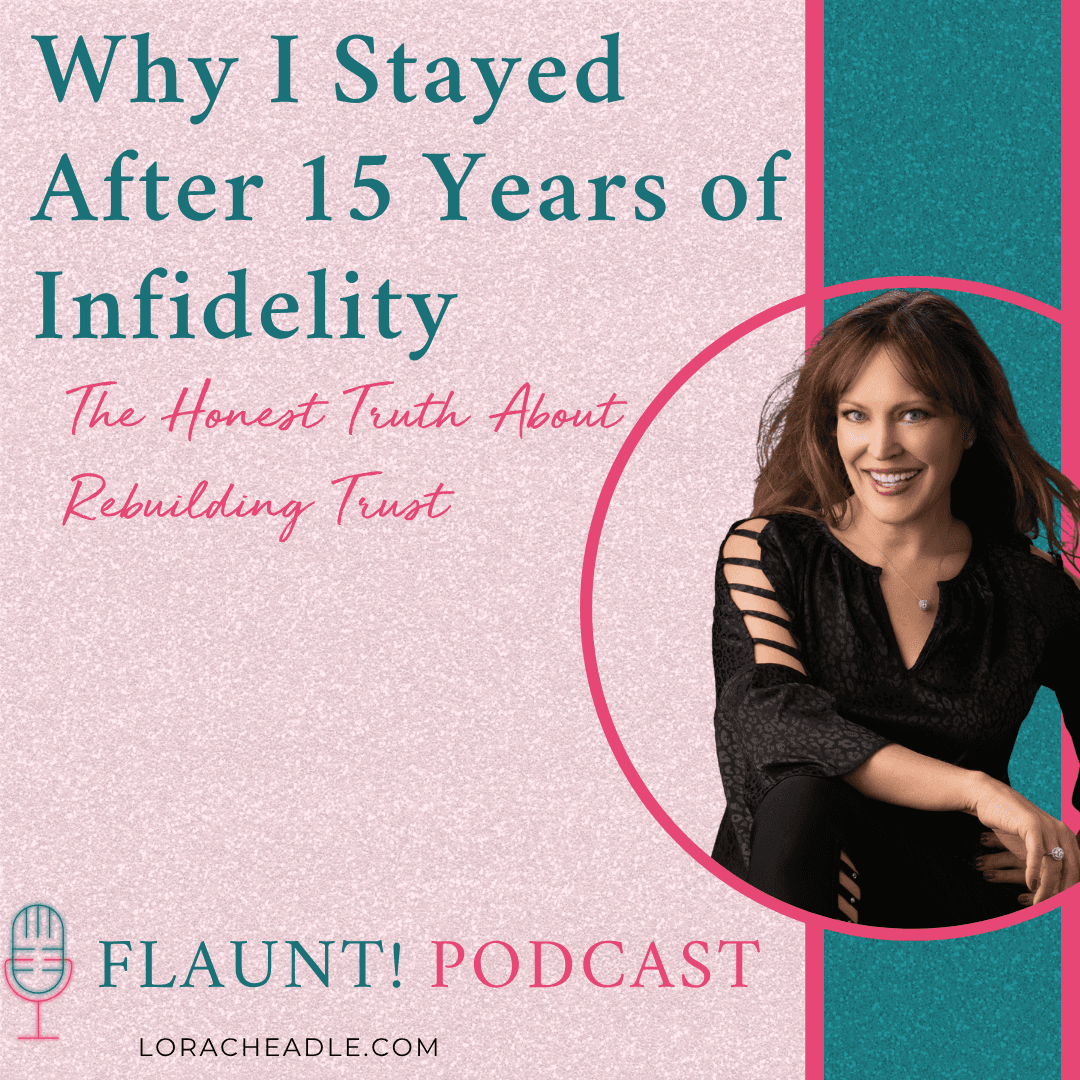
Why I Stayed After 15 Years of Infidelity — The Honest Truth About Rebuilding Trust
March 29, 2026
Show notes
What if staying after betrayal wasn’t weakness, denial, or fear — but one of the most conscious,
self-respecting decisions a person could make?
In this deeply personal episode, Lora answers one of the hardest and most frequently asked
questions of her life: Why did you stay? After years of infidelity, heartbreak, and shattered
trust, she shares the honest, nuanced truth behind her decision to remain, heal, and rebuild.
This is not a story about excusing betrayal, minimizing pain, or pretending the past didn’t
happen. It’s a story about truth, justice, self-respect, and the courage to stay present long
enough to see whether something truly new could be built.
Lora explores the assumptions people make about women who stay, the difference between
blind loyalty and conscious choice, and the emotional, relational, and spiritual work that real
reconciliation requires. She also speaks candidly about love, risk, accountability, integration,
and why healing is never about replaying the worst moment of your life forever. If you’ve ever
wondered whether someone can love you and still betray you, whether staying means you’re
weak, or what it actually takes to rebuild trust after infidelity, this episode offers a raw, grounded,
and powerfully clarifying perspective.
Top 3 Takeaways
1. Staying after betrayal is not the same as accepting anything.
Lora did not stay “no matter what.” She stayed present, kept listening to herself, and
continued choosing based on what was actually happening in the relationship.
2. Reconciliation only works when truth, accountability, and repair are real.
You cannot heal by pretending it didn’t happen. Rebuilding trust requires full truth, real
change, emotional honesty, and the willingness to create an entirely new relationship.
3. The goal is not just saving the relationship — it’s reclaiming yourself.
Whether you stay or leave, the deeper work is learning to honor your values, trust your
own discernment, and move forward without bitterness.
Favorite Quotes
“Staying isn’t blind loyalty. It’s conscious participation in whether something new is actually
being built.”
“I didn’t stay because I was afraid to leave. I stayed because I trusted myself to keep choosing
based on what was actually happening.”
Hashtags
#WhyIStayed #InfidelityRecovery #BetrayalRecovery #RebuildingTrust #HealingAfterInfidelity
#RelationshipRepair #SelfTrust #ConsciousReconciliation #FLAUNTPodcast #LoraCheadle
Read the transcript
Speaker A [00:00:01]:
You're listening to Flaunt: Find Your Sparkle and Create a Life You Love After Infidelity or Betrayal, a podcast for women who've been betrayed by their intimate partner and want to turn their devastation into an invitation to reclaim themselves and their worth. Tune in weekly so you can start making sense of it all and learn how to be okay on the inside, no matter what goes on on the outside. Download your free betrayal recovery toolkit at betrayalrecoveryguide.com. Today's episode is one of the most personal that I have ever recorded because one of the questions that people ask me the most— sometimes people ask it gently, sometimes they ask it very bluntly, and sometimes they ask it in a very accusatory fashion. Is, why did you stay? Your husband cheated on you literally for years, not once. It was not a mistake. He cheated on you with multiple people for years, and why did you stay? So today I want to answer that question honestly because there are many different layers and nuances that need to be addressed. And as I answer it, I also want to be clear that my story is my story.
Speaker A [00:01:35]:
It is what it is. My choices are my choices. There will be elements that will make you go, oh, aha, I see, I get it. And there will also be pieces of my story and my journey and my choices that don't resonate for you, and that's fine because we are different people with different relationships and different journeys. So I want to talk about why I stayed, not defensively, not bypassing it and pretending it wasn't devastating and it was all fine, but also by being very clear about how intentional I was to not live inside the worst moment of my life forever. Because staying after betrayal, I think, is one of the most misunderstood decisions that people ever make. Okay, I'm going to start this episode by reading you a question that somebody in my Facebook group asked me directly, and the woman who asked it was— she was actually a client of mine, but we've become friends after that. And I think because of that, she was able to be a little bit more direct and honest.
Speaker A [00:03:06]:
She said, I am curious to hear, how could you stay with someone who claimed that they loved you and claimed that they cared about you, but cheated over and over again for that many years? Do you believe he loved and cared about you for those 15 years? And if so, how do you reconcile with that behavior? And then how do you carry on and move forward with somebody who put you at risk physically, lied to you, played you for a fool and completely shattered your heart and your world? And then I love it, she responded, I hope that was fair and I still love you. And yes, it's an absolute fair question and I want to answer it honestly. What I want to start with though, before I just dive into the answer, is the assumptions that people make when they hear that I stayed. There are quite a few assumptions that come up immediately. That I must be weak, that I've been manipulated, that I'm abused, that I've stayed for the money, I'm staying for the kids, I don't have any self-worth. People are like, how can you do that? Grow some self-esteem. Fair that they say that, but that's not what this is. Sometimes people have said, do you not think you could survive on your own? And I want to say this clearly: none of those things are true for me.
Speaker A [00:04:47]:
Yes, sometimes people stay because they do have the fear that they're never going to make it on their own. Sometimes people stay for kids. Sometimes people stay for all sorts of reasons because they are in a narcissistic or abusive relationship and they don't think they can get out. So my decision to stay was not about fear. It truly was about choice. And it was about me going inside of me, my body, my intuition, and getting very clear about what I wanted to do. And what I wanted to do includes what I wanted to risk. Because whether you stay or whether you go, it's a risk, right? You don't know how things are going to work out.
Speaker A [00:05:41]:
Like, if somebody could say to you, you're going to leave and you're going to meet the love of your life and this is going to happen, it would be so easy to walk away. And then on the flip side, if people say, no, you're going to stay and he's finally going to heal in all the ways you've wanted him to heal and everything is going to shift, it would be so much easier to stay. We don't know what's going to happen. I didn't know what was happening, what was going to happen, but I got very clear about what I was willing to risk and what I was not willing to risk. Because I knew quite well that if I leaned in, chances were that Sean, my husband, wouldn't want to lean in, or that he would do the work for a while and he would be like, well, dang, that's hard. And then he would stop doing the work. Or this was a scary one to me. He would start doing the work.
Speaker A [00:06:42]:
He would, you know, see a counselor, get a coach. He would get all this help and then he would realize, uh, this isn't the marriage I wanna be in anyway. And then I had that realization about me too. Like, whoa, I could do that work and I could realize this isn't where I wanna be. And that's why I say I had to get comfortable and clear with what I was willing to risk. I was willing to risk that. I got to the place where I thought I would rather be as healthy as I can be, and I would rather have Sean be as healthy as he can be, and then have us maybe decide, you know what, we don't need to be together anymore, or come to a place where one of us wanted to stay and one of us wanted to go. I I was willing to, to do that.
Speaker A [00:07:36]:
I was willing to figure it out to get to the next level. And I was willing to risk being disappointed later on. I was willing to risk the pain of disappointment because I felt inside me that I wanted to see this through to the end. And I felt very strongly from the moment I found out, I felt very strongly that our story wasn't done. I even heard that in my head early on, your story is not done. And I didn't know what that meant, but I trusted it. I felt like our story wasn't done. And yes, I had people saying, you're done, right? And I had people saying, you're leaving, right? And I had people saying, don't be a fool.
Speaker A [00:08:39]:
You know what would have been being a fool? It would have been being a fool to distrust my own intuition, to not listen to my own knowing that this isn't done. And when I say that, I don't know what it means. Even today, in a way, I don't know what that means. It could mean we got to a certain point and we separated. It could mean any number of things. But I knew I would have regrets if I walked away. I knew if I didn't see this thing through to the end, whatever the end was, I would have regrets. And I knew I could never go back to this marriage.
Speaker A [00:09:26]:
I could never go back to this relationship. I could never go back to this experience and unpack it in the way that I wanted to unpack it if I had walked away. I wanted to know everything. I wanted to know why. I wanted to know how. I wanted to know when. I wanted to know every detail possible, and I wanted to completely unpack it all and figure it out, because I am a figure-outer, and I wanted to figure it out. I didn't know if Sean would be willing to do that or not, but I had to try.
Speaker A [00:10:07]:
I had to ask. And if he would have shut me down, that would have been my answer. But no, he kept answering. We kept going deeper. I kept asking more questions. He kept going deeper. He kept learning more about himself. I like the uncovering.
Speaker A [00:10:26]:
In a way, it's still going. And what I mean by that is the affair stuff is long gone. That's, that's over. We've uncovered, we've processed, we've beat that dead horse. And it's over and it doesn't come up in me anymore. But we're still processing parts of our past. We're processing things that happened early in our marriage. We're processing things around his childhood.
Speaker A [00:10:54]:
We're processing things around my childhood. And we're doing it together. And it's all part of it. Now, the other thing that I want to talk about is when I chose to stay, I never said, I never said, I'm staying no matter what. It was never about, I made a commitment and I am in forevermore. It's still not that. At any point in time, if I want or need to leave, I will. And I think sometimes when you say you're staying, people make this assumption that it means you've decided to tolerate everything, you've decided to let them off the hook, and you've decided to commit to your marriage.
Speaker A [00:11:48]:
That's not true either. I also never played the, you know, you got one more chance, buddy, one more time and you're out of here, like I did not do ultimatums around that. I stayed present. I worked hard at staying present. I tried to see how I was feeling, how I was experiencing the relationship. That's a really big part of it. How am I experiencing this relationship? Am I experiencing Sean as a different evolving person, or am I experiencing him as I used to experience him? I've said— I'll go into more detail on that in a second— but I've said in the past, like, I thought we had a really good relationship, and I did. And yet still, there were a lot of toxic moments where he would just be a jerk pie grumpy face, you know what I mean? And I'd be like, yeah, screw you.
Speaker A [00:12:50]:
And we would be distanced from each other and he would be picky and he would be critical. And you know what I mean? Like there, it was a marriage. Let's just say that it was a marriage. There's really good times. There's really bad times. There's times where you're like, oh, I love you. And there's times where you're like, will you just go away? Because I don't even wanna see you. And I don't even think I like you, let alone love you in this moment.
Speaker A [00:13:14]:
So we had a marriage. And that marriage had a tone. After infidelity, the tone of the marriage changed, and that's sometimes hard to describe, but the tone of our marriage is more collaborative, it's more respectful, it's more vulnerable, it's more real, it's more supportive. It is much less transactional. It's not that, again, we threw barbs at each other all the time, but there was that undercurrent sometimes of like, God, he's being an idiot, or she's being stupid. There was that negative barbs going back and forth sometimes. We don't have that anymore. The tone of the relationship has changed.
Speaker A [00:14:09]:
And because of that, I keep wanting to stay because it's becoming more and more fulfilling. We are becoming more and more connected, and it's feeling like it's going deeper. You know when they say like love grows and matures, and I don't know, before I'd be like, yeah, whatever. And now I'm like, no, I actually really get that in a different way. So for me, staying, it was the right decision. And in a way, it was harder because I couldn't just close the book on it and walk away. I had to stay present with myself. I had to stay present with Sean.
Speaker A [00:14:53]:
I had to see him evolve. You wouldn't believe the pain he went through. You would not believe the grief, the shame, the rage, the pain, the embarrassment, the trauma that he went through. He did this to me. He did this to him. And all of a sudden it's exposed, and I'm still leaning in And to him, he went through this overwhelming amount of like, I don't even deserve to receive her love. I don't even deserve to receive this family. I am a broken, horrible person.
Speaker A [00:15:39]:
And the amount of grace he felt was overwhelming, which then gave him space to process all of the shame, all of this horror. Because, and you might know this from the shows that I've done with him, this is not how he saw himself. This is not something he ever thought he would do. So it's this compartmentalization. I'm a good person and I'm doing this really bad thing. That creates a whole heck of a lot of cognitive dissonance. Well, when the affairs came out, all of that is open. Those compartments are no longer compartmentalized, and he has to assimilate the fact that, am I a good person or am I a bad person? And that was a lot of grief and shame and pain.
Speaker A [00:16:34]:
I mean, how do you feel when you've done something really bad? I— whenever I've done stupid things, I feel horrible about myself. And yes, I cry, and then there's that sickening knot in your stomach, and then there's the horror and the shame and like all of it. Can you imagine how intense that guilt and shame and pain is for being a cheater? Like, it's a lot, and I want to name that. I— it's not my intention to be like, oh, the poor guy, oh, the poor cheaters, they have it so rough. It's not like that. It's just the realization that when we screw up, we feel a lot too. And for me, it was healing to see that he horrified himself, that he let himself down, and he would fall apart. He fell apart a lot.
Speaker A [00:17:32]:
And yeah, there was a part of me that's like, uh-huh, yep, you go, buddy. Uh-huh, you deserve that. And there was also the part of me that's like You know what? I'm a human and I've been there too. I have plenty of nights that I've laid in bed with my stomach aching because I'm so upset about something I did or said or didn't do or say. So like, I get that on the human level. And that's why sometimes I think, yeah, what I did was really freaking hard. Staying was really freaking hard. Being able to have love and compassion for myself and for for him and for him to have it for himself and for me, that was hard.
Speaker A [00:18:14]:
So I stayed present. I stayed present with what was happening to me. Healing has ups and downs. It's not like this all came out and he cried and we got help and we came back together and it was one step ahead every single day. No, no, no, no, no. There were ups, there were downs, there was backtracking, there were circles, there were like, you name the emotion, I experienced it. Because growth is not linear and disappointments still happen. And there were setbacks.
Speaker A [00:18:52]:
And like I said, I never said, one more time, buddy, and you're out. But there were times where something would come up and I'd think, Oh, is this, is this where I'm supposed to say, I gave you one more chance and you're out of here? Is this where I'm supposed to say that? Because I'm not sure what I'm supposed to say. And then I would check in with myself. Was a line just crossed? Was a line just crossed that you don't ever want to deal with again? Or was this a setback? Is this something that we can use now to clarify our positions going forward, that we can use to clarify our boundaries going forward? Like, early on I had said, I mean, duh, obviously you can't have any contact with any of your affair partners. And then there was this gray line, like, well, what, what is a female friend? What is a female coworker? Like, who, who does this all include? You know what I mean? Like, obviously if he got a text or a message from any of the affair partners, he was to tell me. They were all blocked anyway, but that's a boundary. But then he knew some people through work who are no longer coworkers, but they were still kind of quasi-friends. Well, is a LinkedIn message from somebody like that, like, where is the line? So early on I said, okay, there's all these people that you have like not really partied with, but been at the conferences and conventions where there's parties, where it gets personal.
Speaker A [00:20:47]:
I don't want you to have contact with anybody where it's gotten personal, where you've been at a convention, where you've all hung out at dinner, where you've shared a cab to, you know, a concert event. Like anything where it gets remotely personal, I wanna know about that. When it's strictly professional and it's never gone there, okay, that's okay. But this was a line we had to dance around and we had to figure out. And then we would name people. Well, what about this person? Do you remember this person? You and I met this person. Oh yeah, yeah, I remember that person. Okay, I'm not comfortable with that.
Speaker A [00:21:22]:
There was a vibe about her and I didn't like that. I'm not comfortable with you texting her. Awesome. I'm not comfortable with you emailing her. Awesome. And then there'd be other people who'd be like, oh yeah, I'm totally fine with that. I know them. So it's this dance, it's this give and take, it's this figuring it out.
Speaker A [00:21:40]:
But what I did was I really stayed present. I really stayed present, and I didn't rush if something happened. And yes, sometimes things happened and I would be hurt again, and sometimes I would think, is this it? And then I would stay present. What do I need with this? Because it was moments where I had to confront parts of myself, and it wasn't easy. And he had to confront parts of himself, and it wasn't easy. And we both just had to stay present with it and decide in the moment. Because again, there were a couple times along the way— because I'm not the only one who could leave, he could leave too— there were a couple of times along the way where same thing, he would be like this This is kind of hell, looking at all of this in me and moving through all of this and feeling all of this. It was so much easier when I didn't feel, and how much more can I take? And it'd be like, yeah, I hear that, and I'm with you, and I don't want you to leave.
Speaker A [00:22:52]:
But if you need to explore whether or not you need to leave, I want you to explore that. And let me tell you, that was scary. But we did have a point where he was like, I have to be honest, I need to think about how much more I can take and whether I want to stay and work through this or not. And that hurt, and that brought up fear. So again, I'm present with this fear, but I want you to be with me because you want to be with me, not because you feel beholden to me because I quote unquote took you back. So no, take the time that you need to figure out if you want to be here or not. I'm going to take the time to figure out if I need to be here or not. And you know what? We might need to reevaluate that every 6 months to a year.
Speaker A [00:23:37]:
And that's fine too, because at any point in time, either one of us can leave. And that's okay, because I want us to each be strong. Okay, now breaking down, going back to some of the questions, because I kind of needed some of that history. That lets you in on my mindset a little bit first. The idea, the Facebook group question where she said, do you think someone can love you and still cheat? And how do you reconcile that? I do think Sean loved me while he was cheating. I, I know he loved me while he was cheating. And the question, the question reads, um, how could he lie and betray someone he loved and cared about over and over again for that many years? And do you believe that he loved and cared about you for all those years? Yeah, I do, and here's why. Like I said, we had a lot of good times, and I did know him really well.
Speaker A [00:24:50]:
Not as well as I do now, but I did know him, and I knew he was the kind of person who was in pain a lot. I knew he was the kind of person who put on a lot of masks in order to perform, because inside He was very much the archetype of the wounded child. And that was something early on that I really loved about him. It was something that attracted him to me. He was such this wounded little boy who needed love. And that was part of my makeup. Like, I'm a, I'm a big lover. So I see somebody who needs big love and I'm like, oh, I'm here, I can totally do that for you.
Speaker A [00:25:48]:
And that's, that's one of my gifts. And yes, it also becomes one of my shadows. So early on, that worked so well because I could love up on him and he would blossom, and I could love up on him and he would shine. And I could love up on him, and it became this very positive thing. So that's the positive thing. Well, then it got to the point where in our marriage there would be times where I would love up on him and he would reject it hardcore. And in a way, this sounds kind of holier-than-thou. I would be like, yep, well, like, he can't take it right now.
Speaker A [00:26:31]:
It's It's his loss. I'm, I'm here. I'm willing, I'm able, and that's his loss. If he's in such a bad mood to not take it, he doesn't have to take it. And I know you've probably been in places like that too, where you're just in a bad mood and somebody is trying to cheer you up and trying to be happy and you're like, dude, back off. I just want to go be in my little corner and be grumpy for a while. Just leave me alone. So I would just leave him alone.
Speaker A [00:27:03]:
And yes, would it hurt my feelings sometimes? Absolutely. Yes. Did it leave me with my emotional needs unmet? Yes, absolutely. Like, there were some toxic dark sides to it too, but that was how I experienced him. And when he would go off, I would see it like well, he's just stomping off into his corner to go mope for a while. He's just gonna go have a pity party for a while. And weirdly, he was. It's just that the way he was having his little pity parties is when he would cheat.
Speaker A [00:27:42]:
And I also want to be clear about this. When I say he cheated with multiple people for 15 years, it sounds like, oh my God, did the dude have another family? What is up with that? He had 8 points of contact with other people. So if somebody would have had like a long-term affair, it's typical that there was a lot more points of contact for that. He would literally reach out when he was having these really bad day pity parties. So 8 points of contact over 15 years. With these women. You know, one woman, a one-time thing, another woman in a one-time thing, one woman a Facebook Messenger thing, and then one woman over 15 years. Those points of contact, those very infrequent points of contact.
Speaker A [00:28:36]:
So that's a slightly different context too that makes sense. It's not like he was in love with somebody else. It's not like he had a relationship with somebody else. He had a relationship, air quotes, with the 15-year affair partner via text. That's not really a real relationship. That is random texting whenever I'm ticked off and whenever I need validation, fire off a text. Hey, somebody is— it's like ChatGPT. It is so seriously like AI.
Speaker A [00:29:11]:
You know when you're fired up and you can sit down, you can like fire stuff into ChatGPT and you're like, hey, Yay, I feel better now. That's how his long-term affair was. Whenever he was ticked off, whenever he needed validation, whenever he needed an ego boost, fire off an email, fire off a text, you get your little prompt back. Yay, feels so good. And then every 3 years or so, there would be a point of sexual contact. So do I believe he still loved me? Heck yes, we had a whole life together. We had a whole real life together. Just like, oh, I can love my ChatGPT self, you know, validating responses, but it's not real to me.
Speaker A [00:29:55]:
My kids are real, my friends are real, my partner is real, my family's real. Like, that's all real and I love them and they love me and I know that. And that's how it was with Sean. I— of course he loved me. We had a whole real life together. We had a lot of intimate moments. We had growth even then. We had joy.
Speaker A [00:30:18]:
It's just that when he would get in these weird moods, he would go to the affair partner, AKA ChatGPT, get this hit of validation, and come back. So, uh, yeah, I believed he loved me because he did love me. I honestly believed he loved me because he still loved me. And then weirdly, the question is, did he love and care about you? I also believe he cared about me because in a weird way, how he describes it now, and it makes perfect sense, when he would go off and cheat, he thought he was getting help. He thought He was doing something to make himself feel better so he could come back and be a full partner to me, so he could come back and be a full parent to the kids. He thought by going out, having his ego boosted, getting that little validation moment, then he could come back and care for me better. And that's what was weird about it too. In hindsight now, he would pick a fight with me sometimes before he would go off on a trip where he would cheat, and then he would come home and he would just be so grateful and so happy and so caring and loving towards me.
Speaker A [00:31:35]:
And like he said, he would do that because he wanted to justify it, because he felt like he needed something. He felt like he needed— he needed to vent, he needed to get help, he needed to be validated. He needed to be validated. He needed to be propped up. He needed to be And then it'd be like, whew, well, they think I'm amazing. So now I'm going to come home with this whole boost of confidence and I've got this huge boost of confidence now. So now I can care for my wife and my family. And yes, it doesn't 100% like track if you're trying to do it this linear.
Speaker A [00:32:13]:
Does this make sense? No. But isn't that how the mind works? Like, we don't do things in these linear, logical things. I was saying I'm this big lover, I am always there to boost him up. If your wife is there ready to boost you up, why are you saying I need to go somewhere else? Well, he would feel like Laura's doing so much for me and I feel like a loser, and she's always the one boosting me up, so I need to go get boosted up somewhere else so now I can come home and be already filled up and take care of her. So, excuse me, there's these different layers, and on the surface it doesn't make sense, but then when you start digging underneath, well, of course that makes sense. Like, nobody wants to be— he always felt like he was in the one-down position. Nobody wants to feel like they're in the one-down position. She's always helping me, she's always helping me, she's got the kids, she's got the house, she's got the family, she's got the friends, she's got Like he would feel like a loser and didn't want me to always be the one.
Speaker A [00:33:19]:
He was in the one down position. He was on the outside of the family. So he would go out, get the ego boost, feel strong, come back in and be like, hey, now I'm a fully functioning partner because now I feel really good about myself because somebody else wanted me. See what I mean? So yeah, of course he loved and cared about me. In a weird way, the fact that he cheated showed that he loved and cared about me. Now that's this real convoluted loop, but you see what I mean? So to go back to that question, how do you reconcile that with his behavior? Well, because weirdly it makes sense. He was on the outside. He was in the one down position in the family.
Speaker A [00:34:05]:
Because he didn't have great family skills, because he came from a super, super emotionally, sexually, physically abusive background. So no, being in a family felt like a threat to him because his family of origin was a threatening family. So he was not comfortable in a family because families hurt you. Families betray you. Families abuse you. Families neglect you. So he was on the outside. It was me and the kids, and we had this nice little happy pod because in our mind, family was safe.
Speaker A [00:34:43]:
And in his mind, family is threatening. He desperately wanted in, but he didn't know how to get in. So how do I reconcile it? Well, I understand. I understand why he was doing what he was doing, and it makes sense. And that's, that's why I started by saying, like, this episode is my story. This is why I stayed. You can have a similar story or a very different story, but does it make sense to you? If you look at your partner, their personality, their family of origin, what they're afraid of, what they connect with, what they value, what they don't— like, does it make sense? Because if it makes sense, then it's easy to reconcile it. When it makes sense, it's truly easy to reconcile it.
Speaker A [00:35:36]:
Now, that doesn't mean, oh, it's easy and all the pain goes away, but it makes sense. Like, of course he cheated, of course he did. It truly makes sense. It doesn't make it easy to accept, It doesn't make it easy to process. It doesn't make it easy to come to terms with, but it makes sense. And I say this in all of my affair recovery programs, whether I'm working with you one-on-one, like in just a few one-offs, or whether you and I are doing our deep dive 6-month program, or whether you and I are working together in like Sanctuary of the Soul or the group programs. It's what I do is I help you figure this out. And make sense of it and identify it so then you can reconcile it, and then it's easier to start processing.
Speaker A [00:36:27]:
I always say it starts with understanding. Understanding is not forgiveness. So many other programs start with forgiveness. No, no, no, no, no. That is the last piece. You've got to start with that cognitive piece. You've got to start with that understanding. Then you move into acceptance.
Speaker A [00:36:47]:
After acceptance, way, way, way down the line, one day you're going to wake up and you're going to be like, I don't even have to worry about forgiving. I've just forgiven and it's over and I'm good and you're good. So that's how I carry on. That's how I move forward, is it makes sense to me And it's not personal. It's not about me. And yeah, he put me at risk. And let's talk about that part too. Yes, he put me at risk, and I'm mad about that.
Speaker A [00:37:28]:
I'm angry about that. However, wherever somebody puts you at risk, totally valid to be angry. But why do we have to focus on that exclusively going forward? Like, I'm mad at that. I've been angry. I felt my anger. We've had conversations. I've raged. And it's in the past.
Speaker A [00:37:54]:
He's obviously not doing it again. Why would I keep focusing on that? It's over. It's so much more than like, oh, he just made a mistake. It's so much more than that, but it's also in the past. And to continue carrying on, you put me at risk, you put my health— like, that doesn't help me. If I think about it, can I get angry? Not so much anymore, but yeah, for a long while I can be angry. And I can talk about it like this, like, yeah, thinking about it, that was a crappy thing to do and I'm mad. But I don't feel it in my body anymore because it's in the past.
Speaker A [00:38:42]:
I mean, think about all of the people who have put you at risk in the past. Bad drivers, you know what I mean? Like all of these people. Why would we focus on that? Why would we keep— oh my God, I think back to all the times I had near misses or near death or near disaster. It's a lot. And yes, sometimes there's nights where you do lay in bed and you're like, oh, I remember. But why keep going there? What did you learn from that? What can you change going forward? How can you protect yourself? And then let that go because it doesn't benefit you. Now I kind of want to wrap this, wrap, wrap this back around that whole can he love you and still cheat? Because to me, that makes sense to me for my situation. And you're not required to make sense of it.
Speaker A [00:39:40]:
The only thing you're required to do is make it sense, make it make sense in a way that works for you. Can somebody love you and still cheat? Yes. Can somebody love you and still betray you? Yes. I mean, let's hold up the mirror. What are the bad things you've done to other people? Honestly, what are the bad things you've done to other people? I cheated on my boyfriend in college. That was not a nice thing to do. I have done really bad things before. We all have.
Speaker A [00:40:15]:
It doesn't mean that you don't love them. It doesn't mean that they're not worthy. It's about you. It's a very uncomfortable truth, but yes, we can love people or care about people or like people and still do really bad things to them when we're trying to avoid something, when we feel entitled, when we are actively in some sort of addiction, or even any kind of medication— medication, steroids— like, different things can make you behave in very different ways. Hormones— like, it matters. Immaturity— immaturity can make you do really stupid things. And then just the ability to compartmentalize. Well, I'm going to do this here and I'm not going to think about that there.
Speaker A [00:41:09]:
Like these, we all do things, and that's why I'm challenging you not to make you go down a deep dark place, but what are the bad things that you have done in an attempt to avoid something? Like we all ghost people when we just don't want to have the conversation. What are the times where you felt entitled and you cut in line or you do something like you roar your car around somebody else? What have you done when you're hormonal, when you're exhausted, when you have a low blood sugar? What did you do when you were immature? I mean, I just thought I cheated on my boyfriend in college. That was the most immature, stupid thing to do. And honestly, I was just an immature college student and I have no other justification other than Good Lord, Laura, what were you thinking? Like, why did you just not want to have the conversation about, I think I want to break up? Why did you just go cheat? That's just immature. So the affairs told me something about him and his integrity at the time. They weren't about me. They don't tell me about his capacity to love. They tell me that he's experiencing some other thing.
Speaker A [00:42:30]:
And then I also want to be clear, I love love and I don't love love. Love alone is not enough to say I'm going to stay with my partner because I love him or her. What does that even mean? I'm sorry, what does that even mean? And really, what does that matter? It matters, yes, and it matters not. We love sometimes the idea of what we thought we had. We love the idea of who we thought we had. We love the image. We love the security. We love— but when we really start breaking it down, Gosh, there's a lot of layers there, right? And it's not just, I love this person.
Speaker A [00:43:25]:
You can love this person, but I also want you to just be aware of all of those different layers around there because I don't want you to get stuck or trapped either way in, did he love me or did I love him? It's a semi-relevant question. It's a semi-relevant question. And I know that might be kind of disturbing for some of you to hear, but just sit with that. Like the Tina Turner song, What's Love Got to Do with It? What does love have to do with it? Because so often the answer is, weirdly, not a lot. Okay, I want to name this. Yes, I stayed, and yes, I'm happy. I am so glad I stayed. There's so much goodness that has come from me staying.
Speaker A [00:44:23]:
I am happier with who I am. My relationship is truly incredible. It's truly better than I ever thought a relationship could be. I am having so much fun. I feel so much better about myself. I am so much more wise. Like, I could— I can't even start describing all the reasons why I am so glad I stayed. And yet still, you can't erase betrayal.
Speaker A [00:44:52]:
You can't erase that it happened. So going back to the Facebook question, how do you carry on and how do you move forward with someone who shattered your heart? You don't erase it. You integrate it. It becomes a part of your story. You learn to live with the truth of what happened while also choosing and deciding and co-creating what your future will be. I don't erase it. I don't hold it over his head. I don't throw it in his face when we have arguments.
Speaker A [00:45:33]:
Now, to be clear, early on, oh, you bet I wanted to, and I did, and it's not pretty. But of course I wanted to. But you can't, you can't keep living from that state. You have to integrate, you have to move on, you have to move forward. And like I said, you decide what your future is going to be and you co-create it together. I mean, Talk about humiliation, anger, loss of innocence, loss of trust, the physical risk, rebuilding safety. Oh my God, there is so much that you have to integrate. And like I was saying, with focusing on the worst point in your time in your life, you, you have to acknowledge that it happened and you have to feel whatever it is, the disappointment, the rage, the grief, the sadness, and then you move on.
Speaker A [00:46:28]:
And then you move on, because otherwise you're stuck replaying this loop of, look at what he did to me, look at what he did to me, look at what he did to me, look at what he did to me. And that doesn't help. So this is the part I think is— this is what makes reconciliation possible, because reconciliation without out repair is truly just prolonged betrayal. It's not something you can just put behind you. It is absolutely not something you can stop discussing. You have to have that repair and you have to have a new relationship. You are building a new relationship. Sean and I, over these past 8 years, have gotten to to know each other differently.
Speaker A [00:47:17]:
We have created a new relationship that is based on full truth, that is based on full accountability, that is based on remorse, that is based on holding space for each other's remorse. I mean, just the other day I said to him, and I said it exactly like this, not to give myself unrealistic expectations, not to beat myself up for who I was or what I did. But I said, dang, I wish I would have known all of this earlier on, because there were ways I pushed you. There were ways I twisted the knife. There were ways I challenged, and I thought I was doing it like, come on, dude, pull it together. And now what I know about you is that was so harmful. Like, I caused so much harm and I didn't know it. And again, it's not to beat myself up, but it's like, whoa, I see things so differently now, and I am so sorry.
Speaker A [00:48:27]:
I didn't know that about you, and I caused harm. And, you know, again, it's this beautiful healing moment where he says, thank you, I appreciate that. You know, and then he shared some things with me too. And he's like, right back at you because I didn't know what you were feeling. My biggest, one of my biggest pain points was I was so alone raising my kids. I was so alone. I was holding everything. So that was what he came back with.
Speaker A [00:49:00]:
He's like, I'm so sorry. I didn't see how hard that was for you. All I could see was that I can't engage because if I engage, I am afraid that I'm going to lose it and I'm going to abuse my kids the same way that I was abused. So instead of telling you, I am so afraid, I am so in fear, I just shut you out and walked away. And again, how healing is that? You know, how, how wonderful for me to hear that. I get that. I understand that now. It would have been helpful in the moment, just like the stuff that I did that was harmful to him would have been helpful in the moment to know, but we didn't know.
Speaker A [00:49:41]:
And now this is the new relationship where we are talking about it and where we are creating the new in full truth. In full transparency. And that's what repair is all about. It's about unpacking pieces of the past gently and slowly over time in a way that helps us create a future that we are both really happy for. So I've done a lot of talking. And I've done a lot of sharing my story and my experience. But what I wanna say, there's a few questions kind of beneath the question, and I want to address those. Staying, I was not weak for staying.
Speaker A [00:50:32]:
You're not weak for staying, but nor are you weak if you leave. Like, it's all a decision. Leaving can be strong, staying can be strong. The real question is whether it aligns with you and your level of self-respect, your level of self-respect based on what you value. Truth is one of my core values. Truth, fighting for the truth, believing the truth, being grounded into the truth. For me to respect myself, I have to chase truth. I'm an attorney.
Speaker A [00:51:12]:
It's about justice, not revenge. It's about justice. So people say, have you no respect? Oh yes, I have all the respect in the world for myself. I have so much respect for myself and my values, which are truth and justice, that I stayed. And I stayed through some really, really hard stuff in order to uncover the truth and fight for justice. So yeah, let's be really clear. Those are my values. Those are my truths.
Speaker A [00:51:43]:
And I am very self-respecting because I stayed and I fought for those two things. Now, those might not be yours. Your values, your truths, your self-respect can show up differently than mine. And that's all fine too. The other kind of question beneath the question is again like how I reconciled this personally, how I can move forward and truly be in this loving relationship. And that started when I stopped asking, how could this happen? Why did this happen to me? How could this happen to When I really stopped ruminating on that past and I really forward-focused, what do I want to create from here? What do I want? I want to understand the truth. I want justice. I want a really good relationship.
Speaker A [00:52:45]:
I want to go deeper. I want to be able to articulate this. I want to break this down. I want to break the taboo. I wanna shine the light of truth on this for more people than just me. It was not just personal growth. There was a lot of that too, but it was building this whole new future and letting go of why did this happen and how unfair of this was. And it was really leaning into that future.
Speaker A [00:53:16]:
And if you've been listening, you know, I talk a lot about rechoreographing your life. It's becoming the architect of your own healing. It's deciding who and how you want to be. I decided I wanted a really, really good marriage. And yeah, I decided I wanted it with Sean. I truly decided I wanted him to finally see all the things that I had wanted him to see all along that he wasn't seeing. I wanted him to see it, and I wanted him to heal, and I wanted it to go forward, and I wanted this incredible love story, and I wanted all of that. And I was willing to go for it.
Speaker A [00:53:50]:
I was willing to take the risk to go for it. I was willing to risk not getting it because I wanted it so bad. You know what I mean? I wanted it so bad. I was willing to take the risk because I knew at the end of the day, if I could sit with myself and say, dang, Laura, you honored your need for truth and justice and you went for it, you went for it. And it didn't work, but at least you could say you went for it. And to me, that is the greatest level of self-respect ever. I did not say I'm afraid. I was afraid, but I didn't let that fear stop me.
Speaker A [00:54:31]:
And I thought at the end of the day, I would have much rather gone for it and really tried, and to have him fall apart, pull, pull, pull out of the whole thing, cheat again, and for me to say, you know what, at least I know At least I know. I have zero regrets because at least I know. And again, it was based on my respect for me, my truth. So in summary, don't pretend that it didn't happen. It did happen. Don't rewrite history. That doesn't help anybody. Don't blame yourself..
Speaker A [00:55:11]:
But oh my goodness, do not live in bitterness either. I think that is the one thing I see in Facebook groups all the time is that bitterness, that hatred, that if you want to be a bitter, hate-filled person, I mean, I guess that's your right, but you don't have to be. You don't have to be. So if you're deciding whether to stay or not, I think ask yourself these questions first: What are my core values? What are the things that are very important to me, and how can I respect myself by fighting for those? Like I said, I am a lover, I am a giver. It's truth, it's justice. I wanted to fight for those things, and I did. What's important to you, and how are you going to fight for yourself and your values? And again, it can be very different than mine. All of our circumstances are different.
Speaker A [00:56:12]:
But what I want for you is for you to be clear about what it is you want. And then if you're deciding like me that you're like, yeah, I want to lean in and go for this relationship, first, is truth fully on the table? Because that's where it starts. Get that truth fully out there. Second, is there real accountability and is there real change? It's not like your partner is going to wake up and be, wake up and be different completely the next day. But what is that change that is taking place along the way? And then I think the third one is, can I imagine respecting myself in this relationship again? And again, that goes back to what it means to you to respect yourself. I feel very self-respecting, and I feel very calm and confident in this relationship based on my values. So staying after betrayal isn't about pretending that it didn't happen. It's not about excusing it.
Speaker A [00:57:23]:
It's about fully seeing it for what it is accepting and integrating, and then choosing to look at the future instead of staying stuck on the pain of the past. We do not need to replay the worst moments in our life over and over and over again. Move on. Create new memories. They're still there, but you don't have to focus on them day in and day out. I also want you to know it truly is a deeply personal decision, but whatever you choose, whether you're choosing to stay or whether you're choosing to leave, the goal is the same. The goal is to reclaim yourself. I didn't stay because I was afraid to leave.
Speaker A [00:58:16]:
I stayed because I trusted myself to keep choosing based on what was actually happening. I chose to trust myself. Staying is not blind loyalty. It's conscious participation and ascertaining whether something new is actually being built or whether you were getting sucked back into the past. So stay present, stay aware, stay true to who you are, and always remember to flaunt exactly who you are, because who you are is always more than enough. Tune in next time to flaunt, find your sparkle, and create a life you love after infidelity or betrayal. With Laura Cheadle every Wednesday at 7:00 AM and 7:00 PM Eastern Standard Time on syndicated Dream Vision 7 radio network. Uncover the truth of what's possible for you on the other side of betrayal and develop the skills and strategies necessary to embrace the future and flourish today.
Speaker A [00:59:34]:
Download your free betrayal recovery toolkit at betrayalrecoveryguide.com.
Never miss an episode
