
FLAUNT! Podcast · Infidelity & Betrayal
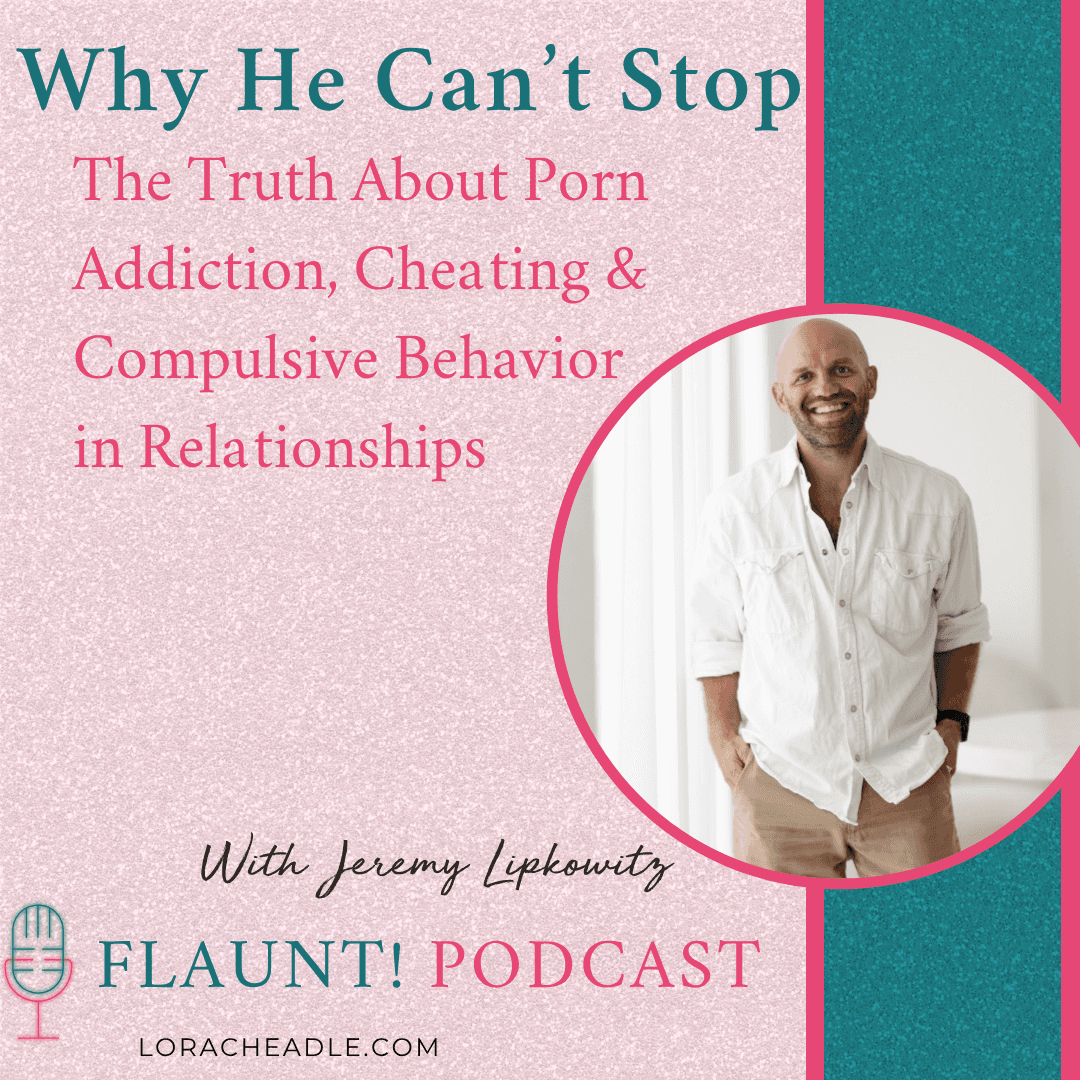
Why He Can’t Stop: The Truth About Porn Addiction, Cheating & Compulsive Behavior in Relationships
April 5, 2026 · with Jeremy Lipinsky
Show notes
You keep asking the same question:
Why does he keep doing this—even when he knows it hurts me?
In this eye-opening episode, Lora sits down with former Buddhist monk and addiction expert Jeremy Lipkowitz to unpack the real reasons behind compulsive behaviors like porn use, cheating, and addiction.
This conversation goes far beyond surface-level answers. Together, they explore how addictive behaviors form, why they aren’t about you, and what true recovery actually requires.
If you’ve ever felt confused, hurt, or stuck trying to understand your partner’s behavior—this episode will bring clarity, validation, and a new way forward.
Top 3 Takeaways
- It’s not about you—it’s a coping mechanism. Most addictive behaviors begin early and are rooted in emotional regulation, not love, attraction, or relationship satisfaction.
- Addiction is about pain, not pleasure. The real question isn’t “Why the addiction?”—it’s “What pain is being avoided?” Healing requires addressing the root, not just stopping the behavior.
- You can’t shame someone into change—but you can create awareness. True transformation happens through self-awareness, accountability, and building a life that no longer needs escape.
Favorite Quote
"Addiction isn’t about wanting more pleasure—it’s about trying to escape a life that doesn’t feel good.”
About Jeremy
Learn More about Jeremy at www.UnhookedAcademy.com
About Jeremy Lipinsky
Jeremy Lipkowitz is a former Buddhist monk, meditation teacher, and ICF-certified executive
coach who helps high-achieving men break free from compulsive behaviors—especially porn
addiction—and build lives of integrity, discipline, and deep fulfillment. With over 13 years of
meditation experience and hundreds of days spent in silent retreat, Jeremy blends ancient
wisdom with cutting-edge science to guide individuals toward emotional resilience and personal
freedom.
A former genetic researcher who earned Bachelor’s and Master’s degrees in Genetics &
Genomics and pursued a PhD at Duke University, Jeremy left academia after confronting his
own struggles with addiction, shame, and self-judgment. A brief period of monastic training in
Myanmar deepened his mindfulness practice and marked the start of a lifelong commitment to
personal growth and service.
As the founder of Unhooked Academy and host of the Unhooked Podcast, Jeremy is a leading
voice in destigmatizing porn addiction and educating the public on effective, science-based
recovery strategies. His work helps men overcome shame, understand the neuroscience of
addiction, and create lasting transformation through mindfulness, emotional intelligence, and
habit change.
For over a decade, Jeremy has taught at universities, recovery centers, and global companies
across the U.S. and Asia. His calm, grounded presence and ability to bridge analytical thinking
with inner work make him a sought-after guide for professionals and executives looking to
reclaim their lives from digital distractions and self-sabotaging patterns.
Credentials & Training:
CPCC, Co-Active Training Institute
ACC, International Coaching Federation (ICF)
Certified Teacher, Search Inside Yourself Leadership Institute (SIYLI – developed at
Google)
The Turning Point
After years of outward success—academic achievements, career accomplishments, and global
recognition—I still felt a deep sense of emptiness and disconnection. Behind the polished
exterior, I was battling a compulsive porn habit, struggling with shame, and silently wondering
what was wrong with me.
Eventually, I hit a breaking point. I left my PhD program, became a Buddhist monk, and began a
deep inner journey of healing and transformation.
Now, as a mindfulness-based executive coach and founder of Unhooked Academy, I help high-
achieving men reclaim their focus, integrity, and sense of self. Together, we replace shame with
clarity, and compulsive behaviors with purpose-driven action.
Learn More at www.UnhookedAcademy.com
Read the transcript
Intro [00:00:01]:
You're listening to Flaunt. Find your sparkle and create a life you love after Infidelity or Betrayal. A podcast for women who've been betrayed by their intimate partner and want to turn their devastation into an invitation to reclaim themselves and their worth. Tune in weekly so you can start making sense of it all and learn how to be okay on the inside, no matter what goes on on the outside. Download your free betrayal Recovery toolkit@betrayalrecoveryguide. Dot.
Lora Cheadle [00:00:36]:
So many of you have expressed concern, dismay, angst over your partner's behavior. Why is he doing this? Why can't he just quit? Oh, my gosh. If he loved me, he wouldn't look at porn. If he loved me, he would just stop.
Intro [00:00:52]:
Why?
Lora Cheadle [00:00:53]:
Why? Why is he doing it again? That's something that I hear so often, and that's what we're going to address in this show. This show. I am interviewing Jeremy Lipkowicz, and he's amazing. I'm going to let you talk. I'm going to let him talk a little bit more about himself. But he is a former Buddhist monk and he specializes in addictive behavior, whether it's porn use or anything else. He's going to talk to us today and to help you understand about your partner's compulsive behavior, what's really going on, why it doesn't mean that he just doesn't love you, and why it's not just as simple as saying, you know what? Let's stop. Yep, that's it.
Lora Cheadle [00:01:35]:
I'm going to stop. So with that, welcome to the show, Jeremy. I'm looking forward to our conversation.
Jeremy Lipkowicz [00:01:42]:
Yeah, I'm looking forward to it as well. And happy to be here.
Lora Cheadle [00:01:45]:
Yeah. Okay, let's start with a little bit about you. Who are you, and how did you come to do this kind of work?
Jeremy Lipkowicz [00:01:54]:
So my background in this, it stems from my own personal experience with porn addiction. You know, I started watching porn, like many you young man, at a very young age and maybe 7, 8, 9 years old, started getting into things that were sexual material. I wouldn't call it porn, but it was things like the Victoria's Secret catalog that came in the mail or the. The lingerie section of the. The JCPenney catalog. So things that I just started noticing when I look at this sexual imagery, it made my body feel good in a certain way. And so that slowly developed over time. You know, it got more and more pornographic as I got older to the point where when I got to college, I was looking at hardcore Internet pornography on basically a daily basis and went through my own struggles of addiction and found kind of recovery and found a way to break free from the grip of online pornography.
Jeremy Lipkowicz [00:02:52]:
And about eight years ago, I started helping other guys do the same. But really my background in this comes from my own personal experience.
Lora Cheadle [00:03:00]:
Right. Which I think is so much more powerful. You know, same thing. I came to this work because of my husband's long term and multiple infidelities. And yeah, having the personal experience with it I think is so helpful in helping other people be able to truly understand what is going on. One thing that I noticed about your story that I want to point out is it starts innocent, it starts kind of innocuous. It starts off with a catalog and it's not a big deal. And I think it's really important to note that because whether it is porn use or cheating, nobody sets out unless you're a psychopath.
Lora Cheadle [00:03:42]:
Nobody sets out to become an addict or to become a cheater. And it's same thing with cheating. Well, it's just having coffee. Oh, well, it is just staying after this meeting for 10 minutes to talk. Well, it's just a text here and there. And it's that slow progression where I think inside we often don't even realize, whoa, this is a slippery slope. And then at some point we cross the line and we go, I don't even know how that happened.
Jeremy Lipkowicz [00:04:11]:
Yeah. And that happens not just in terms of a behavior, but over the course of a lifetime. That slow buildup of, you know, slowly getting into behaviors where we get our. We feel like we get our needs met, we get some validation, we get a sense of control, we find a way to numb out or deal with unpleasant emotions and escape, really. And for most people, as you said, it starts very innocuous, very innocent, It's a little thing here or there. But over time, day by day, over the course of years or decades, it can grow into something where we barely recognize it. And the problem is that just as most people have this experience of gaining weight at some point, but because you see yourself in the mirror every day, you don't notice it until you see a photo of yourself from a few years back and you realize, wow, I've really put on a few pounds. It's the same with addictive behaviors.
Jeremy Lipkowicz [00:05:09]:
It grows slowly and imperceptibly to the point where you don't notice any real difference day to day. But over the course of years or decades, you can see some real changes.
Lora Cheadle [00:05:20]:
That's an excellent analogy because you know, when you're talking about the Weight loss thing or the weight gain thing? Absolutely. We've all been shocked by that. Who is that? I don't know that person. What's going on? So let's drop back for a second here. What do you define as addictive behavior? Because so many people say, I'm not addicted to whatever it is, Alcohol, porn, shopping. I just really like the taste of margaritas. I just really like shopping. I am.
Lora Cheadle [00:05:50]:
I'm a connoisseur of good shoes. So what is the difference between, yeah, I just like it and I do it a lot and I'm addicted?
Jeremy Lipkowicz [00:05:59]:
Yeah. It's really important to define addiction just so we're on the same page. And one way of defining addiction is any substance or behavior that you engage in that you repeatedly use the substance or engage in that behavior, and it causes negative consequences, and yet you continue to do it despite the harm that it's causing. So that's one kind of broad stroke definition of addiction. So if you are engaged in online shopping and it's causing harm in your life, you're spending money you don't have, you're avoiding work responsibilities, you're procrastinating, you could say, okay, I have an addictive relationship with this. I keep doing it even though it's causing these harmful consequences in my life. So same with porn, dating apps. Dating in general.
Jeremy Lipkowicz [00:06:48]:
You know, you can apply that to anything. Is it causing harm and you keep doing it despite that?
Lora Cheadle [00:06:52]:
Yeah. Okay, another question around that, because I hear this one a lot. Women will say to their husband, your porn use is causing me harm. I feel violated. I feel icky. I don't feel good enough. And they say, this has nothing to do with you. This is about me, and I'm a free man.
Lora Cheadle [00:07:13]:
I can do whatever I want. This doesn't impact you.
Jeremy Lipkowicz [00:07:18]:
Yeah. So there's so much to unpack here on that one.
Lora Cheadle [00:07:21]:
Yeah. So you've heard that before too, huh?
Jeremy Lipkowicz [00:07:24]:
I have, yes. And the. The frustrating thing is that there is a little bit of truth to it. And so let me explain the truth, and then let me explain the other side. The truth to it is the fact that for the most part, a guy's porn behavior has nothing to do with his partner. It most likely doesn't even have anything to do with his sexuality. It's something that he learned when he was 7, 8, 9, 10 years old as a coping mechanism to deal with stress. And so this far predates you and the relationship.
Jeremy Lipkowicz [00:07:56]:
You know, if you're in a relationship with somebody, chances are you didn't get Together when you were six years old. You know, so his porn behavior and his porn masturbation, all of that started long before he met you. And it evolved as a coping mechanism to deal with stress. It's not really about his sexuality. It's a way to. For him to numb out and escape emotions. So that side of that statement does have some truth to it. This isn't about you, this is about me.
Jeremy Lipkowicz [00:08:24]:
That being said, it's not a harmless thing. And so for the guys out there who are saying, hey, this is. Has nothing to do with you, just let me have my fun, you know, it's not true. It's not a harmless, innocuous thing. It does have an impact on intimacy and impact on your relationship communication, especially if it's something you're hiding, especially if you're engaged in looking at things that are maybe unethical or dubious at best. So there's a lot to go into there. But those are some of the things that I just want to highlight from that statement.
Lora Cheadle [00:08:56]:
Yeah, thank you. And listeners, listen to that again. If you need to rewind again, listen to that again, because what he says is so true. One, it has nothing to do with you. Two, it's a coping mechanism. And you have heard me say a million times, oftentimes, cheating is a coping mechanism. It is somebody trying to get their needs met, somebody trying to feel better, and they don't know what the problem is and they think it's going to help, but it has nothing to do with you. It has nothing to do with the relationship.
Lora Cheadle [00:09:26]:
But here's the kicker. In order to recover, one, you have to realize, oh, this is a maladaptive coping mechanism, and it's hurting me and it's hurting other people. And then, two, you have to go through this process of learning other coping mechanisms and figuring out a different way to be. So let's talk about that both in terms of how do you help people realize what, whoa, this is problematic. And then two, here's some other things that I can do. And no, learning how to meditate in three minutes and just applying it the first time out isn't going to be an easy fix.
Jeremy Lipkowicz [00:10:06]:
Yeah. So let's start with the first one, which is a lot of guys come to the world of recovery because their partner found out about their secret habit that they've been hiding. And their partner said, you got to stop this or I'm leaving. And so the guy comes to me and says, well, she says, I have to stop, so can you help me stop? And it never that's never a good starting point. You know, a guy has to understand this is not just harming his partner, it's also harming him. And so part of the work that I do is I get him to really look at the way that this habit is impacting his life on subtle levels. Because the problem is, with porn addiction in particular, there are a lot of subtle consequences to the behavior that most guys are not aware of. The way that it impacts your dopamine systems, your ability to feel motivated and to have drive to accomplish things, your ability to concentrate.
Jeremy Lipkowicz [00:11:05]:
And then there's also all the ways that it impacts your relationships with other people, how you objectify people, your sense of lusting after people, the dissatisfaction you might feel with your relationship if you're constantly comparing your partner to the porn stars you're looking at. So getting a guy, first of all, to understand this is not just something his partner wants, but this is something that is impacting his life also, and getting him to see that clearly. And one of the really powerful exercises that I do with guys is I have them envision their life five years or ten years down the line. And I say, if you don't stop this, if you keep going down this path, what do you think is going to happen five years from now or ten years from now? And that usually gets a guy to wake up and realize, oh, okay, it might not feel like a problem right now, but if I'm still engaged in this 10 years from now, my daughter, who's 2 years old, she's going to be 12 years old. And if she finds out that I'm looking at people who are six years older than her. And so he starts to realize, like, hey, I'm not on a good path right now. This is not the type of man I want to be. It's not the type of husband I want to be.
Jeremy Lipkowicz [00:12:18]:
They're not the type of father I want to be. And so that is one of the things that can help a guy start to see and start to practice recovery and take it seriously.
Lora Cheadle [00:12:29]:
Yeah. Before we move into kind of that second part, more of the things that you do, let's talk about some of those real negative behaviors, negative consequences of these behaviors, because you mentioned some really strong things that not everybody is aware of, dopamine pathways, like, whoa, let's talk about objectifying other people. That's huge. Because, no, we can't engage in this behavior and say, it's just pretend. It is just pretend that I'm doing these highly questionable things. But no, when I look at a 14 year old in real life. No, no, no. I don't think about anything.
Jeremy Lipkowicz [00:13:09]:
Right. Yeah. So one of the things that changed my life was really understanding this concept called neuroplasticity. And what it is. Essentially, it's the understanding we now have about the brain and how the brain functions, that what you do with your mind, where you place your attention, what you think about this, actually changes the structure and function of your brain. And there's this one quote from a neuroscientist that summarizes it really well. He said, neurons that fire together wire together. And the essential understanding there is that the more you use certain neural pathways, the stronger those pathways become.
Jeremy Lipkowicz [00:13:46]:
So, for example, if you are lusting after women every night when you go on to pornhub, you are strengthening the neural pathways of lusting after strangers. And if you happen to be looking at a certain type of porn star or niche, that is what you are strengthening your craving for. And so guys really have to understand that. That they are building an addiction to novelty. Building an addiction to, oh, I. What really does it for me is seeing a stranger on the screen who's not my partner. And over time, you start to believe that your real stimulation, that your real arousal comes from seeing a new stranger on the screen in front of you. Because you're just training your brain that way.
Jeremy Lipkowicz [00:14:33]:
And it's basic neuroscience. There's no getting around it. And so if you want to be, you know, in a deeply satisfied, content relationship with your partner, but you're engaging in porn every night, it just doesn't add up. The science doesn't work that way.
Lora Cheadle [00:14:51]:
Right, right. And it's. It's a deep groove. I use hypnotherapy to help people, and it's that deep groove. The more you do it, the deeper the groove gets. And climbing out of that groove is not easy. But you got yourself there. You can create a new deep groove somewhere else.
Lora Cheadle [00:15:09]:
So let's talk a little bit about that. What does it take to really break this addiction and then to find a satisfying life not to be living in this state of, well, I don't do this anymore. And it's the state of deprivation forever. But to actually climb out of that deep groove and then find joy, peace, contentment somewhere else?
Jeremy Lipkowicz [00:15:33]:
Yeah. Well, it's so funny because both of those questions you just asked link up very well together, which is if we really understand addiction for what it is, which is an attempt to escape a reality that, you know, that is not fulfilling, an attempt to escape unpleasant Emotions. The way to break free from addiction on a deep level is to create a life so wonderful that you don't want to escape from it. To give yourself the emotional resources, the skill sets to be able to handle what comes your way without feeling like you need to escape. And so real recovery doesn't really have anything to do with stopping the behavior. It has everything to do with looking at what is the void that I'm trying to fill with the behavior. So Gabor Mate, who's a wonderful kind of person in the field of recovery, he has this wonderful saying. He says we shouldn't ask why the addiction, we should ask why the pain.
Jeremy Lipkowicz [00:16:32]:
Which is saying we need to look at what's the source of. Why did I develop this, this addiction in the first place? What was I trying to escape? What could I not handle? Or what's going wrong in my life that I need to address? Am I feeling really unfulfilled in my social life? Do I have an unfulfilling career and no sense of purpose? So really looking at the deeper questions has to be done. If you want real recovery, you know, long lasting, deep recovery, not just the superficial thing. Because that's the big mistake that a lot of guys make is they just try a superficial recovery of just stopping. They just say, okay, my wife said I have to stop. So I'm just gonna. I'm gonna stop and I'm gonna use my willpower and try real hard, and I'm not gonna do it anymore. But they don't actually look at the root of the addiction.
Jeremy Lipkowicz [00:17:25]:
And so for recovery work, we have to do that inner work. And that entails a lot of things.
Lora Cheadle [00:17:30]:
It does, and it takes time. And I think that's something that I really want people to hear. It does take time. And most of you out there listening, some of you have, it is a porn addiction, Sometimes it's a sex addiction, sometimes it's a love addiction. Like whatever that addictive behavior is either for you or your partner, it is a longer term recovery. And that doesn't mean, oh, give up on it. Because, God, the idea of creating a life that I'm really satisfied, that sounds like such work. It's a journey.
Lora Cheadle [00:18:03]:
Yes. And it's a joyful journey in a lot of ways. I mean, you know, if you've been listening to me for a while, my husband and I are eight years out. It's still a journey. He is still doing work. But the joy and the satisfaction of, oh my gosh, I had this aha moment. Whoa, look at how we can connect here. It's a beautiful journey and it's just getting stronger and stronger and stronger.
Jeremy Lipkowicz [00:18:32]:
And I should say also, you know, just on that note, if you're doing recovery properly, like it's. Your life should feel like it's improving, you know, like you are becoming more of the person that you were meant to be. You are becoming less enslaved by these external things, you know, like you are having more. More freedom, more ability to choose how to live your life. And. And that is a really liberating experience, like when you realize you're less enslaved by the things you used to be enslaved by. So it's not all doom and gloom and you've got to be in recovery forever and live a life of suppression. It's like, oh, you become more and more liberated over time.
Lora Cheadle [00:19:16]:
Yes. And I'm so glad you said that because that's exactly what it is and that's exactly what it feels like. And then I think you become aware of other things. Oh, I'm actually a workaholic. Oh, gosh, there's some perfectionism in here. And it's just more things to release and it feels so incredible. Last, let's see, three shows ago, I did a show on happiness and how sometimes we don't really even believe we can be happy. We don't really believe we can feel that sense of joy and to really create a life.
Lora Cheadle [00:19:51]:
We don't believe we can have a happy, positive life. So when you work with people, how do you help them to see that actually you can have a great life? You are not enslaved by the system. You are not enslaved by anything. Freedom is there for you, connection is there for you, joy is possible. How do you help people bridge that gap in belief?
Jeremy Lipkowicz [00:20:15]:
Yeah, the belief thing is one of the hardest because for. And I'll just be real with you, you know, especially because I know a lot of your listeners are the partners of porn addicts and people who struggle with this. And for a lot of these guys, they have lived inside of the cage of their addiction for so long that they don't believe freedom is possible. And there is so much internalized shame and internalized lack of self belief that that's usually one of the hardest things to break the, the belief system of most of these guys, you know, really feel deep down like there's something wrong with them and like they're broken. And unfortunately, that's the final shackle that keeps a lot of guys chained to it. Is that belief that, oh, I'm. I'm just broken or I'M just a pervert or I'm messed up. And so that is something that does take time.
Jeremy Lipkowicz [00:21:15]:
And it, the only way it really comes is through actually showing yourself that you can choose differently. And that comes in these small wins. And it's why, you know, in the program that I teach, mindfulness is such a core component. Developing the capacity for mindful self awareness, the ability to see what's happening in the moment and to be aware of different emotions arising. And then having the capacity to say, how do I want to act in the next moment? Or do I want to follow this craving I'm having an urge to act out, do I want to click on that porn site? Oh, and then if a guy can have a few experiences where he chooses differently and he says, no, that's not the path I want to go down. I actually want to go for a walk or go give my partner a hug. It's those small moments where they show themselves. Oh, I made a different choice today.
Jeremy Lipkowicz [00:22:14]:
I am not just a slave to this thing, I actually have the freedom to choose. And that's a big difference between my type of program and things like 12 step programs. Is this belief system around, you're not broken, you're not an addict. You know, you don't have to live inside that identity. It's like, you can be free from this, but it takes action, it takes effort and awareness.
Lora Cheadle [00:22:43]:
Yeah, yeah. And I want to talk about that awareness because mindfulness, I think sometimes people don't really know what it means. Sometimes they think, oh, I don't want to do a mindfulness program because I don't have an hour a day to meditate. And it's like, no, no, no, you can use meditation or yoga or different mindfulness practices. But to me, and I want to hear what you think about this too, when you talked about mindful self awareness, it's just living in that state of being a little bit more aware that you are the observer and you were observing all at the same point in time and observing, oh, I've got a craving, or oh, I've got uncomfortable emotions, or oh, I've got, I'm feeling shame and I don't want to feel it. So say a little bit more about what you believe and think and teach around mindfulness.
Jeremy Lipkowicz [00:23:38]:
Yeah. So mindfulness is, it's a, it's a mind state. It's a state of mind. It's a way of paying attention. It's very much about being aware of what's happening in the present moment in different capacities, in terms of being aware of what's going on inside of you, in your body, you know, feeling different things inside your body, feeling tightness, feeling, you know, clenching of the fist. It can also be being aware of emotions that are arising in the present moment. Oh, okay, anger's here. Oh, I'm noticing frustration arising.
Jeremy Lipkowicz [00:24:10]:
It's also being aware of things in your environment, people around you, sounds, sensations. So being aware of these different sensations, but in particular with a certain quality of acceptance and, you know, a softness to the attention. It's not cold, it's not judgmental. It's an open, spacious awareness of what's happening in the present moment. So mindfulness can be done in a single moment. It's not something that you have to go off to, you know, and do for an hour. That being said, some of these longer meditation sessions, which could just be a five minute meditation, right. Can still help you cultivate the ability to drop into that state.
Jeremy Lipkowicz [00:24:54]:
And so that's the benefit of doing some prolonged meditation in terms of a mindfulness meditation, even if it's just a five minute meditation every morning, is it's training the mind to more readily drop into that state of noticing what's happening in the moment.
Lora Cheadle [00:25:12]:
Yes. And thank you for saying that. Because meditation is a tool to help you become more mindful, Yoga can be a tool to help you become more mindful. They're all tools. Just like porn use is a tool, it's a tool to help you feel better. So let's find some tools that cultivate things that are beneficial, that are helpful, that will help you in all areas of life.
Jeremy Lipkowicz [00:25:38]:
So yeah, and just on that note, real quick, I mean it, it's really about looking at what you're cultivating. So the word meditation is an umbrella term? Yes, for many different kinds of practices. And each different kind of meditation has a different thing that you're cultivating. So for example, there are mindfulness based meditations where the goal of that kind of meditation is to cultivate mindfulness. There's also concentration based meditations where the goal of it is not to cultivate mindfulness, it's to cultivate concentration, which is a distinct kind of mental quality. There's also loving kindness meditations, which again, different goal. The goal is to cultivate this feeling of love and kindness. So the same thing as you mentioned with porn.
Jeremy Lipkowicz [00:26:25]:
Porn, it's like really looking at what am I cultivating when I'm engaged in this practice. And for the guys out there who are engaging with porn, what they're cultivating is lust, craving, Dissatisfaction, you know, all of these things. And so for the guys out there, it's like really just looking at what are you strengthening by the things that you're engaged in.
Lora Cheadle [00:26:49]:
I really love the way that you explain that because it's step one, step two, step three, it's, what am I cultivating? And I think sometimes just asking that can shift the inner dialogue, the inner world. What am I cultivating if I say I want a good, happy, healthy relationship? Is this behavior cultivating that? No, it's just not.
Jeremy Lipkowicz [00:27:13]:
Yeah, and that's, you know, one of the key insights for me that helped me break free from porn was the realization that one of the biggest things I was cultivating when I watched porn was cultivating hunger and dissatisfaction, that I was, you know, creating this void inside myself of strengthening those neural pathways of feeling like what I had wasn't enough, and I needed something slightly better or slightly different. So again, I was cultivating this dissatisfied mind. And that was translating into how I engaged in relationship. Nothing really felt good enough.
Lora Cheadle [00:27:51]:
Isn't that crazy? You know, like, to really think about it, wow, I'm cultivating dissatisfaction. And the fact that we would do that. It's just. It's interesting. Okay, so that kind of leads perfectly into what I wanted to talk about next. Is that shame or that embarrassment or that guilt? Oh, my God. I did that. Because I know not only from the people that I've worked with, but from my own partner as well.
Lora Cheadle [00:28:18]:
There are moments where he's like, holy cow. I am so horrified. I am so embarrassed. I am so filled with shame. And nobody wants to feel that. And it's hard to sit there and just be in that state of, oh, my God, I did this. I did this, I did this. What are your thoughts around, first of all, sitting with that within yourself and then letting that flow through so you can get to the other side.
Jeremy Lipkowicz [00:28:48]:
Yeah. Shame is such an important topic. And, you know, it's one of. As I mentioned, it's one of the things that really keeps guys locked in the addiction. And it's. It's one of the biggest prisons. It's just so painful. The feeling of shame and the feeling of isolation and the feeling of, I'm broken, and if people knew the truth about me, they would think I'm a monster.
Jeremy Lipkowicz [00:29:10]:
And that's. It's a really painful experience, particularly given how social we are as creatures and how we evolved. And so learning how to process shame in a healthy way is really important. And so a couple things there that can really help. One is on an individual level, you know, to recognize, hey, I'm human. And, you know, to recognize there's nothing wrong with sexuality, there's nothing wrong with desire, that these are natural, beautiful human experiences. And to celebrate your sexuality and say, no, okay, my sexuality is a beautiful part of myself, so I don't need to shame myself for having desires. So that's the first step.
Jeremy Lipkowicz [00:29:54]:
The second step, again, is just to understand, hey, there's a reason why I developed these behaviors. It was a defense mechanism. There was a part of me that was trying to keep myself safe when I was younger, and I needed it. So again, more just understanding and having some compassion for yourself. But then the third and maybe most important thing is for guys to learn how to be seen in the thing that they're most ashamed of and realize that it's okay. And this is where men's groups and online communities are so important for. For guys to be around other men who get it, and they can say, yeah, I'm struggling with this, and I feel ashamed of this. And they're just in a group of guys that look at them and say, hey, I get it.
Jeremy Lipkowicz [00:30:40]:
Me too. I struggle with that also. That does more than anything else to help release that kind of internalized, toxic shame.
Lora Cheadle [00:30:51]:
Yeah. And yes. And especially for men. Men are supposed to be stoic. Men aren't supposed to show emotion. Oh, my gosh. You know, you can't. You can't hug another man.
Lora Cheadle [00:31:02]:
You can't, like, all of these societal rules on what it means to be a manly man keep so many men trapped. And you're right, just being able to sit with other men in community, with whether it's zoom or in person, I think is so powerful. And, you know, along those same lines, so many people, because my husband. I mean, I talk about this all the time. Everybody in the world knows exactly what my husband did. And people will say, isn't that horrifying? Isn't he embarrassed? How can you ashamed him? That's the part that set him free. He's like, I don't have to hide. This is the worst part about me.
Lora Cheadle [00:31:39]:
And I did it, and I'm okay. And. And it was hard. And, yes, I still have moments, but it's that being seen that truly set him free.
Jeremy Lipkowicz [00:31:50]:
Yeah. When you no longer have anything to hide, then you're really, you know, you're free from the prison of. Of feeling like if people knew the truth about you, they would call you a monster. And then once people do know the truth about you and you realize you're not a monster then. Then you have that freedom. That being said, I do. There's one thing I do want to highlight, which is, you know, I talk about the internalized toxic shame and I try to be clear that there's toxic shame, but there's also also healthy shame. There's pro social shame, which is that feeling of when you've done something wrong or unskillful, when you've caused harm, the icky feeling that you get from that is actually a beneficial thing.
Jeremy Lipkowicz [00:32:33]:
And we don't want to give that up completely. You know, we want to actually lean into that and say, you know, that's in Buddhism. It's actually called one of the great protectors of the world. This shame around kind of bad behavior. It's the thing that prevents us from causing that harm again.
Lora Cheadle [00:32:51]:
Yes.
Jeremy Lipkowicz [00:32:52]:
And so we don't want to forget it.
Lora Cheadle [00:32:53]:
Yeah. Thank you so much because that is exactly it. And again, for the listeners of this show, what if he does it again? What if he does it again? So yes, you want to feel a little bit of shame, a little bit of ick, a little bit of hope, horror, so you don't do it again. It's just, I think the difference is, and I'd love to know what you think the difference between I am a bad broken person, so therefore I am hopeless, so why not? I'm just going to lean in and act out all the time versus I am a beautiful child of God. I am part of this divine, beautiful energy. And I am worthy, healthy, whole and complete. And for a while, I made some very bad choices that caused harm. And I feel bad about those choices, but those choices don't define me.
Lora Cheadle [00:33:42]:
And I can move forward and be strong and choose not to go down that path again
Jeremy Lipkowicz [00:33:48]:
100%. I mean, the toxic shame is when you believe yourself to be broken and flawed and unlovable and unworthy. And the healthy shame is when you recognize, hey, I'm still worthy of love. I'm still worthy of respect. I am a good person deep down, and I did some unskillful things and those actions were unskillful. And I feel remorse about those actions.
Lora Cheadle [00:34:12]:
Yeah, yeah. And I'm curious about this. I feel remorse and I can become accountable and I can make amends. What do you think about amends? Accountability? How does that work for you with the men that you work with?
Jeremy Lipkowicz [00:34:31]:
Yeah, amends. You know, that's. It's a really interesting question. I don't personally use the, the terminology amends that much. It is something that's very common in like 12 step groups, you know, going, making amends and you kind of, you reach out to the people who you had harmed and you make amends. And that's less something that I focus on. But what I would say is that feeling remorse without changing your behavior, it's just empty noise, you know. And so whether you feel remorse, the question is, are you acting on it? Are you actually making an effort to change and to rewire your brain and to carve new pathways and to show up with integrity? You know, integrity is much more of kind of the, the line that we approach, which is, are you being honest? Are you living with integrity? You know, that's what's really important.
Jeremy Lipkowicz [00:35:25]:
And then the accountability, there is also a major component of that which is do you have real accountability in your life? And this is actually maybe a really good topic for us to dive into because a lot of the questions I get from guys that I work with and also some, some of the partners that I work with is should my partner be my accountability buddy and to what extent or to what level? And should my partner know every time I slip out or should they, should I have a weekly check in with them? And so there's a lot of questions about that. And what I'll say is that there's, in my opinion, there's different levels of accountability and different quality. And one of the best forms of accountability that I find is in something like a coaching group or a men's group where guys can hold you accountable and can call you out on your bullshit excuses and to say, hey, you can do better than this. Like I know you've got this, you know, and can see through your excuses and can call you out. And the reason being is that in like our men's group, for example, we don't have to worry about risking the relationship by calling a guy out and saying you can do better than this. But in a relationship, it's very tricky, you know, it's to have your partner call you out and say you can do better than this. A lot of times that will send a guy into his shame spiral hole.
Lora Cheadle [00:36:51]:
Yes.
Jeremy Lipkowicz [00:36:52]:
And it's a very tricky, nuanced thing. And so I usually don't recommend that you use your partner as your main accountability person.
Lora Cheadle [00:37:02]:
Right. No, I, I agree. That's. That to me, that crosses the line of I am not your therapist, I am not you, I am your wife, I can be your wife. You can share those things. Now, you also talked about something that's really interesting and it's Very nuanced. Do you let your partner know if you've slipped up? And how many slip ups are you, quote, entitled to? Because that's something I hear a lot. And I think, again, this is Lora's opinion.
Lora Cheadle [00:37:35]:
We all can have different opinions. I think it can be different. I think slipping up, maybe with porn use, is different than whoops, I slipped, slipped up and I slept with another woman. That's a different line to me. Maybe it's different for other people. But what. Where is that line? What? Because I like that you and I'm stuttering because there's like 50 thoughts in my head. I love how you went with integrity, because when it goes with integrity, I think that helps.
Lora Cheadle [00:38:04]:
But how many times is it, quote, normal to slip up? Because when you are breaking an addictive pattern, it's hard. So let's talk about that because there's. Yeah, a big ball.
Jeremy Lipkowicz [00:38:17]:
So much to talk about there. Yeah, there's so many things I want to get into and I'm like, oh, I got to remember to say these things because there's, there's so, so many important things. So if I forget, just remind me to talk about how porn is different from so many other things because of how accessible and pervasive it is. So just remind me to come back to that. Okay, but before I go into that, you know what I would say, like, in terms of the question, how many times is a guy entitled to whatever. It comes down to the partnership and the relationship and who's in it and the belief systems of the people. Because I know that I know couples who, the female, the partner says, I don't really have a problem with you watching porn. I just don't want you hiding things from me.
Jeremy Lipkowicz [00:39:01]:
And if you slip up now and again, that's fine. You know, like, I just don't want you sleeping with other people. And that's a totally fine stance for that person. There are other partners who, for. For whatever reason, there are many valid reasons, have a different view on porn. And they say, I don't want you watching it at all. And even one time feels like it's too many. And every time there's a slip, it's.
Jeremy Lipkowicz [00:39:25]:
It's a real process and there feels like real betrayal. And so what's more important than you and me giving some number, like, oh, two and a half times is the, the allocated amount. It's really about having a conversation about what are your expectations and what are your beliefs and where do we stand on this and hopefully you guys can come together to an understanding where, you know, you are able to see somewhat eye to eye. But what I will say, and this kind of comes back to the thing I wanted to say earlier, is that I work with a lot of guys, and a lot of the guys who I work with, many of them have gone through different kinds of recovery from substance abuse and others, drugs, alcohol. And every single person who I've worked with says that porn is one of the hardest things to break free from because it is so pervasive, it's so accessible, it's so normalized, and the line between it and just normal social media is getting thinner every day. The analogy I like to give is imagine you are a cocaine addict in recovery, and you are really trying hard to give up cocaine, but wherever you go, you have to carry a bag of cocaine in your pocket wherever you go. And that's what it's like to be a porn addict in recovery is. It is highly accessible.
Jeremy Lipkowicz [00:40:52]:
You have it in your pocket at all times. Wherever you go, you can pull it out. And it's. There's something called the three A's of porn addiction, which are these three things that make porn so highly addictive. It's the accessibility, the affordability, and the anonymity. So it's incredibly affordable because it's free. It's highly accessible because you can get it on any device, anywhere, and it's anonymous. You can do it without anybody knowing.
Jeremy Lipkowicz [00:41:18]:
And so it's a very tricky thing. And on top of that, it taps into something that is a deep, primal part of human nature, which is our sexuality. You know, you can't abstain from it and just cut off your sexuality completely. It's like you have to learn how to be in a healthy relationship with sexuality.
Lora Cheadle [00:41:36]:
Yeah.
Jeremy Lipkowicz [00:41:37]:
So there's so many reasons why. It's just. It's a really tricky thing and slips in. Porn recovery happen a lot. A lot. A lot.
Lora Cheadle [00:41:48]:
Couple things. First, I feel like we could talk in three hours on this one. But I also think there are so many unhealthy beliefs about sexuality in our culture. We are so weird about sexuality. And anyway, and perhaps if we had a culture and were raised in a culture where healthy, normal sexuality and normal is in quotes, was celebrated and seen, perhaps porn addiction would even be less, if that makes sense, because.
Jeremy Lipkowicz [00:42:17]:
Totally.
Lora Cheadle [00:42:18]:
Yeah. Yeah. Because like, leaning into sometimes the, ooh, this is. This is naughty, this is bad. Sometimes there's such the thrill just in doing something like that. And I feel like there's different layers.
Jeremy Lipkowicz [00:42:34]:
Yeah. I mean, we know that the More you suppress something, the more taboo it becomes, the more, you know, titillating and exciting it is. And there's a reason why, you know, the Bible Belt in the US has the highest rates of. Of watching porn. You know, the more that you push it underground and suppress it, it becomes more of this intoxicating, thrilling adventure. It's taboo. It gives you more of a rush. And, yeah, if we had a more open, embracing culture around sexuality, there probably would be less porn addiction.
Jeremy Lipkowicz [00:43:10]:
So it's. It's. One of the things that can help recover is learning how to embrace healthy sexuality.
Lora Cheadle [00:43:17]:
Yeah. And then going Back to the 3A's of porn addiction. Thank you for sharing that. I really like that. And. And on accessibility, when you were talking about that, it made me think. I. I have never searched for porn in my life.
Lora Cheadle [00:43:32]:
Honest to God, that's just not something I have ever searched for. And there have been so many times where I've picked up my phone to search something on Instagram or just, you know, and I'm hit with what is kind of a quasi porn site. And it's. You're right, that line is thin because I Google a lot of fitness stuff. I search a lot of fitness stuff, you know, health, wellness, and it'll be like, whoa, that's. What is that? And it draws you in because, a. It's shocking. But then I think as a mom, whoa, what are kids seeing? What are they tapping into? This is crazy how accessible and how it's almost, like, shoved on us.
Jeremy Lipkowicz [00:44:18]:
Yeah, it is. And here's the really scary thing, is the fact that you're getting it, even though it really has no kind of attraction to you. Just think about what it's doing to the guys who. It does kind of attract them. And the reason I bring that up is the algorithms are so sophisticated. Now. If you linger on. If you're scrolling through reels or through shorts and.
Jeremy Lipkowicz [00:44:44]:
And you linger on something for a millisecond longer than your average, it will pick up on that. And over time, it slowly starts to learn. Oh, if we show him something with some scantily clad women and bikinis. Oh, he lingered for an extra split second. Okay, let's do a little bit more of that. But in a very sneaky way. And so you don't have to search these things out. It will come and find you, particularly if you are, you know, a man who.
Jeremy Lipkowicz [00:45:14]:
Who is easily visually stimulated. And they're getting young kids, they're getting men. And it's just, you know, not just, you know, sexual Content, but only fans, models. You know, it's like it's all one big spectrum now. It's not like there's a division between, oh, this is a porn site and this is a non porn site. It's all intertwined now.
Lora Cheadle [00:45:37]:
Yeah, it's really, it's. The algorithm is fascinating and horrifying all at the same time. Yeah, yeah. Before we wrap up, and just so you know, I've really enjoyed this conversation. I think it's going to be very helpful for my listeners. How I want to wrap the show is first by having you share a little bit more about you and your programs and then second by letting listeners know how they might approach their partner if this is an issue for them. And what I mean by how approach their partner is not. Look what I signed you up for, honey.
Lora Cheadle [00:46:12]:
But what is a way to broach the conversation and to open this up in a way where perhaps the man might be a little bit more open to it?
Jeremy Lipkowicz [00:46:23]:
Yeah, well, let's start with that question and then I can talk more about the program after. But the best way, the worst way is to say, I signed you up for a recovery program, I'm packing your bags, you're heading out tomorrow. And you know, another kind of really unskillful way is to be accusatory and judgmental and all this stuff. So the best way to approach it is if you can, in a very curious, open minded way that feels like a safe setting. Because again, you have to remember that for most of these guys, their porn viewing behavior is one of the biggest skeletons in their closet that they've had since they were 8, 9, 10 years old. It's something that's very shameful and sensitive and they don't want to talk about it. And it's, it's a very scary thing for a lot of guys to talk about. And a lot of guys feel just really ashamed of it or defensive.
Jeremy Lipkowicz [00:47:18]:
All sorts of things come up. And so the more that you can make that conversation a safe one where you say, hey, you know, I'm not here to judge, I'm just, I'm curious, like what's your relationship with porn? You know, how often do you watch it, if you watch it at all, is that something you feel good about or is it something you wish you did less of? So really tapping into curiosity and creating a safe environment for the guy to open up and knowing that it might take a couple times and you might not get a straight answer at first and that's okay, but you know, to be patient and to really let him know that you're not there to judge him. You just want to understand.
Lora Cheadle [00:47:59]:
Yeah, I want to hop in on something. Because when you said you might not get a straight answer at first. Thank you for normalizing that. Thank you for validating it. Whether it's porn use, whether it's D day and discovering the affairs, that is such a hang up for people. I confronted him and he didn't come clean. No, nobody is going to. It's the very rare person who's going to dump it all out the first time and be like, hey, you're right, I was caught.
Lora Cheadle [00:48:25]:
Here it is. Can you just say a tiny bit about that? Like, why don't we come clean? Because that's a hang up for a lot of people.
Jeremy Lipkowicz [00:48:34]:
Yeah. And, and that's the, the sad part is that, you know, some guys won't come clean. And this, you know, this is something that we kind of were talking about just before we hit record. But like, there are some guys who are really able to take ownership of their actions and say, you know what, I did mess up and I have been out of integrity and, and I want to get better. And the sad truth is, is there are a lot of guys who won't take ownership and will continue to lie about it and hide. And unfortunately that's the case. And only the person listening to this will know, you know, which of those situations they're in. And there's sadly a lot of gray areas where it could go either way, depending on how you play your cards.
Jeremy Lipkowicz [00:49:21]:
And that's the scary part is, you know, it's like the more skillful you can be with those questions, you can tip that guy over to the side of, hey, I want to be in integrity and I want to take ownership.
Lora Cheadle [00:49:34]:
Yes.
Jeremy Lipkowicz [00:49:34]:
But also, you know, if it's done unskillfully, it can tip him more into shame and hiding and isolation and, and also to not put the ownership, the onus too much on the woman. They're like, sometimes it doesn't matter what you do, the guy's going to hide no matter what.
Lora Cheadle [00:49:48]:
Yeah.
Jeremy Lipkowicz [00:49:49]:
And so if you're in that situation, my heart goes out to you and it's not your fault. And you know, it's. It's up to him to find that, that strength of taking ownership.
Lora Cheadle [00:50:00]:
Yeah. But thank you for saying that because it is true. I can impact my partner's behavior based on who I am. And the more skillful and the more strong and the more self aware I am, maybe the higher percentage of him becoming self Aware and in integrity. And maybe not. So thank you for saying that because, yes, if we can all become better people, perhaps we can inspire each other. And if we can't, it's not my failure.
Jeremy Lipkowicz [00:50:33]:
Yeah. Yeah, exactly.
Lora Cheadle [00:50:35]:
Yeah. So where can people learn more about you, what you do, and how you help?
Jeremy Lipkowicz [00:50:42]:
Yeah. So the main program that I run is. It's called Unhooked Academy. And essentially, it's just. It's a men's group. You know, we have live coaching calls every week where guys can check in and get support. If they're struggling, they can be held accountable. You know, they could get advice from the group.
Jeremy Lipkowicz [00:50:59]:
It's just a place for guys to show up and actually. Actually show up and be themselves and say, hey, this is what I'm struggling with. And what's really great about the community is it's a space where you know that everyone else in the community gets it. Nobody's there to judge you. You know, we're all in there for the same reason, that we have a history with porn or sex addiction, and we want to get better. And so that's the group that I run. There's also some, you know, lessons and curriculum in there about overcoming this at the root. So that's kind of a little plug for the program that I run.
Jeremy Lipkowicz [00:51:32]:
But for anyone out there who's interested in learning more, whether you're, you know, the person who has a problematic relationship with porn or the partner, I have my own podcast. It's called Unhooked, and we go. Lora was on it herself, you know, a while back. We go into all kinds of topics around addiction and recovery and. And what this is like.
Lora Cheadle [00:51:53]:
Yeah, yeah. Well, thank you so much for that. And listeners, please check it out. You know, whether you're like, I know my partner has a problem, or I myself have a problem, or whether you're just curious, like, huh, could this be an issue? Check it out. Keep Jeremy as a resource. Check out his podcast. Have an amazing week. Let this information settle and percolate.
Lora Cheadle [00:52:17]:
This is not something you have to go out and do something with right now. Sit with it, feel it, practice mindfulness around it. What do you want to say, if anything? When do you want to say whatever it is you want to say? Just be with this understanding and have an incredible week. And as usual, always remember to own, to flaunt, and to love whoever you are, because who you are is always more than enough.
Intro [00:52:50]:
Tune in next time to flaunt, find your sparkle, and create a life you love after infidelity or betrayal. With Lora Cheadle every Wednesday at 7am and 7pm Eastern Standard Time on syndicated DreamVision 7 radio network. Uncover the truth of what's possible for you on the other side of betrayal, and develop the skills and strategies necessary to embrace the future and flourish today. Download your free Betrayal Recovery toolkit@betrayalrecoveryguide.com.
Never miss an episode
