
FLAUNT! Podcast · Infidelity & Betrayal · Rebuilding Trust
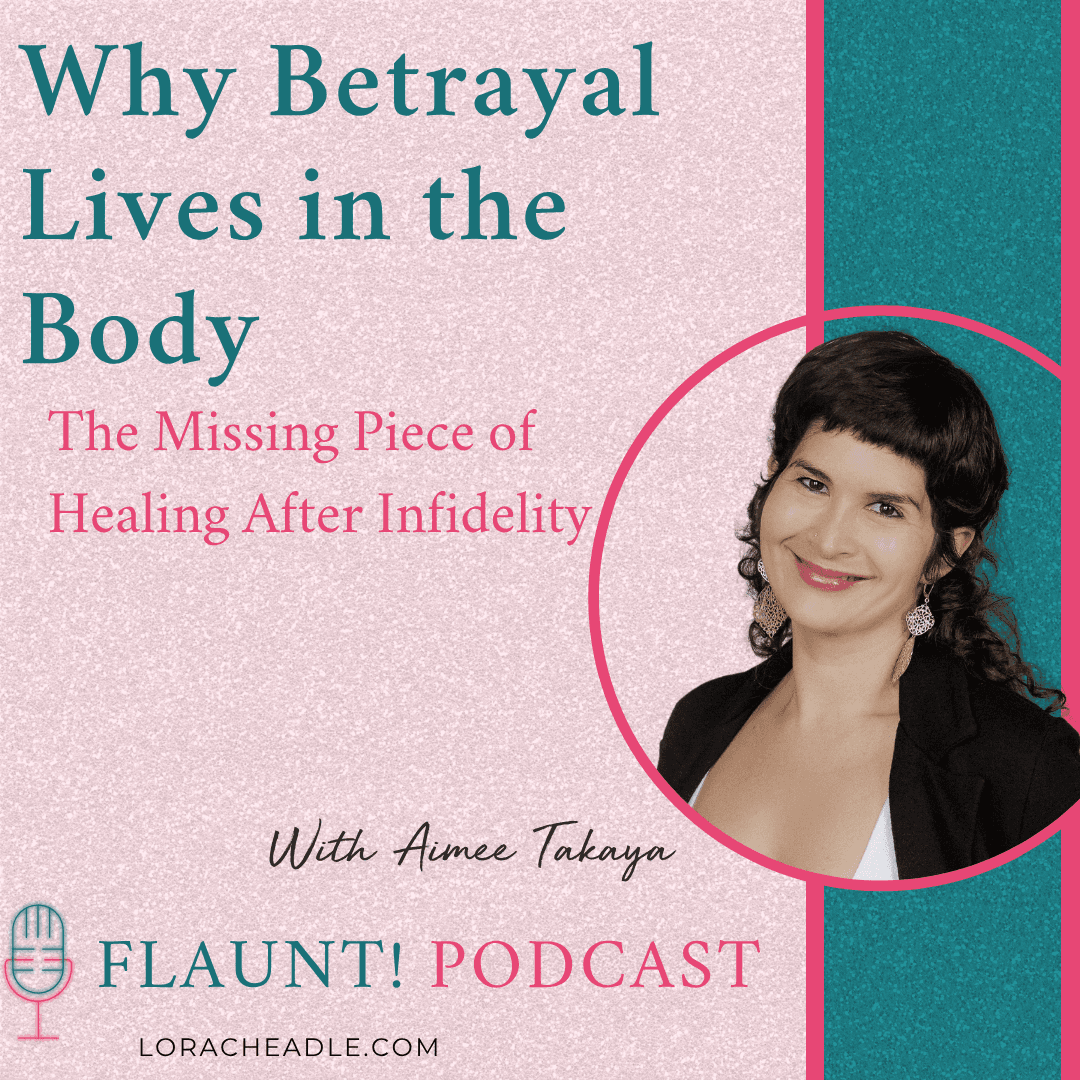
Why Betrayal Lives in the Body: The Missing Piece of Healing After Infidelity
April 19, 2026 · with Aimee Takaya
Show notes
What if the hardest part of betrayal isn’t just what happened—but what your body is still carrying because of it?
In this powerful conversation, Lora sits down with somatic educator and healer Aimee Takaya to explore the connection between betrayal, trauma, tension, and the body. Together, they unpack why betrayal lives in the nervous system, why talking about it is not always enough, and how unresolved pain can keep showing up as anxiety, hypervigilance, rage, tightness, exhaustion, and even chronic pain. Aimee shares her own story of betrayal in marriage, what healing actually looked like for her and her husband, and why somatic work can be the missing piece when you feel stuck in your healing. If you have ever wondered why you still feel activated even when you “know better,” this conversation will help you understand what your body is trying to tell you—and how to finally begin letting it go.
Top 3 Takeaways
- Betrayal is not just emotional—it becomes physical. Your body stores tension, fear, hypervigilance, and pain long after the event itself is over.
- Healing is not about “getting over it” as quickly as possible. It is a process of creating enough safety in your body to release what has been held for years—or even generations.
- Somatic work can help you listen with “new ears,” soften your nervous system, strengthen your boundaries, and stop reacting from old patterns of fear and pain.
Pull Quotes
“Betrayal is not just something that happens to your heart. It happens to your body, your nervous system, your sense of safety, and your ability to trust yourself.”
Hashtags
#SomaticHealing #BetrayalTrauma #InfidelityRecovery #NervousSystemHealing #HealingAfterInfidelity #SomaticTherapy #RelationshipTrauma #BodyKeepsTheScore #EmotionalHealing #BetrayalRecovery #TraumaHealing #WomenHealingAfterInfidelity
About Aimee Takaya
Aimee Takaya is a Certified Hanna Somatic Educator, Somatic Yoga Teacher, Podcaster and Transformation Facilitator. She has been professionally teaching movement and working with a wide range of bodies and challenges for over 14 years.
She loves to help you connect your body and ALL its messages in new and empowering ways. Aimee knows from personal experience the power of compassionate somatic practice to heal from chronic pain and adverse life experiences.
She works with clients in person, in the Western New York area, as well as internationally through zoom. She also creates somatic, bodywork-based retreats where you can deepen your self-trust & connection. to truly let go of what binds you.
Learn more at www.freeyoursoma.com
Or connect with Aimee on Instagram @aimeetakaya
Read the transcript
Intro [00:00:01]:
You're listening to Flaunt. Find your sparkle and create a life you love after Infidelity or Betrayal. A podcast for women who've been betrayed by their intimate partner and want to turn their devastation into an invitation to reclaim themselves and their worth. Tune in weekly so you can start making sense of it all and learn how to be okay on the inside, no matter what goes on on the outside. Download your free betrayal Recovery toolkit@betrayalrecoveryguide.com.
Lora Cheadle [00:00:35]:
There's some things that you're really going to like about this episode. Not only is my guest really interesting with some great wisdom to share, but she shares a story of a different kind of betrayal in her marriage, in her relationship. And the reason that I really like it is because betrayal comes in all forms. You know, it's not just infidelity. And so often, even when it is infidelity, there's other forms of betrayal too. I mean, the obvious, you know, financial, things like that. But her story just illustrates too, the way that people can show up and erode your boundaries or do things that just irritate you and how it is a form of betrayal as well. And I don't think we talk about that as often as we should.
Lora Cheadle [00:01:26]:
So often we focus on it was the, you know, sexual betrayal. It was the emotional betrayal. No, no, no, no, no. Does not having your back sometimes in a relationship is a huge betrayal and it's a bigger deal than we make it out to be. We feel not, we feel like, we think, we think that unless it's really big, we're not justified in feeling angry or hurt. And that's what I really appreciate about my guest and her story, because I think we've all been in situations like this where our partner just does something that feels like a betrayal. And if you're hurt, it's okay. You should be hurt.
Lora Cheadle [00:02:13]:
And I want you to know that you're not being overly sensitive. It is a violation and all violations need healing. Before we get into the show, I also want to encourage you to go to a fair recoveryforwomen.com that's affairrecoveryforwomen.com and check out my Stop the Spiral seven day program. It's only $47 and it is an amazing resource. It's a seven day program that you can download and keep forever that will help you stop that mental spiral after betrayal, after healing, after any significant stressor. So affairrecoveryforwomen.com and enjoy the show. We all know what it feels like to have our body not feel good. We all know what it feels like to feel literally heartbreak or stress or tension or just like that bogged down feeling.
Lora Cheadle [00:03:17]:
And then I think we also all know what it feels like to be completely numb and disconnected and to not even know what our body feels like. And we are going to talk about all of these experiences and more. Today I have got an incredible guest guest. Her name is Aimee Takaya and she does, she does so much and I'll let her explain all of that, but she is truly an expert in somatic movement, somatic healing, somatic processing, like all of those things. And you're probably thinking, okay, I've heard that, but I don't really know what it is or why it helps or what it can actually do for me. So before I bring her onto the show officially, I'm just gonna tell you something. When I first met Aimee, she offered me a somatic session and I was like, oh, well, sure, that's great. But I mean, I do all my own somatic stuff and I'm really aware I've taught fitness.
Lora Cheadle [00:04:23]:
Oh no, this was definitely something. Next level. She has that gift, that ability to take you inside the insides and helped me uncover and feel and find sensation that I didn't even know that I had. So with that as the backdrop. Welcome to the show, Aimee.
Aimee Takaya [00:04:47]:
Thank you, Laura. I'm very happy to be here.
Lora Cheadle [00:04:50]:
Let's start kind of with the basics. What, what is somatic processing? What is somatics? What is. Because I feel like there's so many of these words and phrases and people kind of have an idea what they are, but they don't really know what
Aimee Takaya [00:05:04]:
they mean for sure. And if you just look it up online, you're going to find lots of answers. Right. It's somatics. It's like body based practices. I'm like, wow, that's vague. Right. How I was trained to understand somatics is that your soma is your body, but it's not just your body, it's your body, including your thoughts, your feelings, your life experiences, your sensations.
Aimee Takaya [00:05:28]:
Right. Your memories, your like blood and tissues and DNA, but also your soul, your spirit, your essence, your energy field. Right. Your soma is the physical matter that contains all of what you are. Right.
Lora Cheadle [00:05:48]:
I love that.
Aimee Takaya [00:05:49]:
Yeah, it's, it's, it's profound. Right? It's not just a soma's, a somatic practice. Let's break it down. A somatic practice is one that connects you to that ongoing inner experience in your body as a source of wisdom and Power.
Lora Cheadle [00:06:07]:
I love that you just put that as a source of wisdom and power because I think especially in. In this infidelity and betrayal space, we think it hurts. I'm not going to go there. I'm not going to feel that I'm going to distract myself. But it's as a source of wisdom and power.
Aimee Takaya [00:06:24]:
And I will say that it's very human and normal to run from pain and chase pleasure. That's just very normal. And somatics, as a kind of realm of study and as a section or a part of a person's healing journey is actually more sophisticated. It's, it's. After we've kind of already done some other things. I also, you know, I talk about this sometimes where, you know, it's hard to do deep somatic reprocessing work with people who are currently in crisis. They kind of have to come out of some level of crisis in order to do that deeper system work. If they don't have that system safety, right.
Aimee Takaya [00:07:10]:
And we can, we can certainly, like, develop that safety through somatics. But some of the, you know, other layers of healing are only going to occur with our conscious, you know, embodied consent for those things to occur. Another way to say it might be like your nervous system's not going to process and let go of anything. It's not ready to process and let go of.
Lora Cheadle [00:07:32]:
Yes, I pause, feel that, hear that. Because healing is not just a destination to race to as quickly as possible. We have to feel, we have to experience, and it might not be the right time for you to just wake up and heal. So I'm. I'm really glad that you said that. And that was one of the things that, when I met you, I thought, this is so perfect because I do a lot of somatic work in the moment to ease the acute pain in that crisis in that moment. Let's do a few breaths. Let's soften our shoulders.
Lora Cheadle [00:08:13]:
But what you do is deeper. It's more expansive, it's more extensive. And I really appreciate that you use the word consent because if you are in an infidelity or betrayal space and you are still dealing with somebody that you don't know is safe, the last thing you want to do is fake the sense of, I'm going to trust the world now because you will be hurt.
Aimee Takaya [00:08:41]:
Right. Well, you know, a lot of us, and there's a big kind of cultural conversation I feel like that's going on about this over the last, like, 10 years or so, you know, with like, the me, me too. Movement and all these things. Like, there's a. More of a conversation about how culturally a lot of us, especially women, have been conditioned to not consider things like, do I like this? Do I want this? Is this okay with me? A lot of us grew up in a culture that said to tolerate all kinds of things from, you know, from our partners, from our relationships, even from ourselves, like thoughts and ideas that we have about ourselves that are really toxic. We've been taught that that's just normal and that's okay. And I see a lot of people question, questioning that, questioning, wait a minute, like maybe this isn't okay. You know, we're not letting ourselves get gaslit anymore, even by ourselves.
Aimee Takaya [00:09:32]:
I would say there's kind of a phenomenon, right, in the last few years where, like, the wool is kind of being pulled out from behind our eyes and people are waking up to, like, the way that we have had a very toxic culture. Some of us in our raising, you know, where we had to, you know, let ourselves be touched and kissed by relatives that we didn't want to touch or kiss, that we didn't have this say over our bodies, that we had relationship dynamics in our early years that were unhealthy, you know. And I'm sure that when you're going through, and I'm speaking for myself here too, when you're going through the kind of very painful awakening that a betrayal, Right, A deep betrayal can be, you start seeing how far back this goes in you. Right? In your own somatic experience.
Lora Cheadle [00:10:20]:
Yes. And I love that you went there, because what I talk about a lot is betrayal uncovers the truth, and it uncovers the truth about, like, that. What have you been hiding within yourself? It's the truth about, like you said, the culture, society, what we have been conditioned to accept. And yes, we have betrayed ourselves because we have been conditioned to accept ourselves sometimes as. As objects and is not fully human.
Aimee Takaya [00:10:47]:
Well, 100%. You know, it's one of these things I think I've been kind of just wrestling with my whole life. And, you know, I'm. I'm a very much. Like, I'm. I'm willing to share my story, and I'm willing to share my story with people that, you know, like, you know, we need to be able to talk about the hard things. And I want people to know who are working with me. Like, I'm not like someone who just has had.
Aimee Takaya [00:11:12]:
Had it easy and figured it. I haven't figured it out. Like, I still. Still process my own life experiences all the time. You Know, and I've gone through really difficult things, you know, and let's say, for example, this is. This is kind of, like, leading to the bigger story that I have today. But, like, I experienced betrayal through my mother's experience of betrayal because my father. And this was something that my mother kind of parentified me.
Aimee Takaya [00:11:37]:
And there were lots of inappropriate, like, boundaries when I was a kid that weren't, you know, there. But my mother told me about my father watching pornography and how much it hurt her. And then when I was a kid, I, like, found my father's pornography, and I got, you know, really, like, triggered by it. And then in my later years, I would feel incredibly betrayed by my partners when they watched pornography. Like, I would be, like, crying and devastated and, like, heartbroken because they were watching pornography. And it took me time to really unwrap. Like, yes, some of that was my own legitimate feeling of betrayal, but a big portion of it was the what I had absorbed from my mother and her pain about it and her pain about it in relation to my dad, you know, and when I started to uncover that, it was less painful for me because I realized that some of this grief that I'm carrying is generational. It's not all.
Aimee Takaya [00:12:30]:
It's not all me. It's not all, you know, this specific dynamic with this specific person. Exactly.
Lora Cheadle [00:12:36]:
And there is so much generational. There's so much generational trauma. And sometimes, like, that. You can know the story with your mom, you know, the story with the pornography, but you might not know what impacted her from generations past, great grandparents.
Aimee Takaya [00:12:53]:
I mean, I. Parents, I. Crazy enough. My mom and I are very open with each other. I mean, sometimes, like I said, too open. She has told me, you know, and some of it comes from, you know, childhood sexual abuse that happened to her. You know what I mean? And that was a trigger. You know, she was very alarmed by my father's use of pornography because it triggered her, you know what I mean? And she had an unresolved thing that had gone on, you know, in her life as an early child, you know, childhood being objectified.
Aimee Takaya [00:13:20]:
So, like, 100%. Like, it's. It goes back these things, especially, I think, betrayal, because there's. There's a real depth to it. It's not just one of these simple kinds of experiences. Like, I think, you know, it's. It's up there with grief in terms of its complexity, Right?
Lora Cheadle [00:13:38]:
It is. It is. And I'm glad that you recognize that, too, because it's a universal human experience. It is very deep it is very. I really feel like it is soul shattering in a lot of different ways because it ruptures not only the external, but that internal piece of who we think we are.
Aimee Takaya [00:13:59]:
Yeah, yeah, absolutely. And. And we can hold on to a bitterness that erodes us and erodes our relationships. If we don't address the bitterness, if we don't address the pain.
Lora Cheadle [00:14:12]:
Yes. And when we talk about, you know, your business, free your soma, it is being aware of that soma. This is the physicality, this is the container. Energetic, thought, ancestral, all of that. So when you talk about freeing it, what, again, just to be clear for the audience, what does that exactly mean? Because it's not like, oh, poof, okay, I got rid of that bad feeling. Ooh, I don't have tension in my back anymore. Go a little bit deeper with me about what, what it, what it means, what that looks like. Is this a one and done? Yep, I did the work.
Lora Cheadle [00:14:52]:
Let's talk more about that.
Aimee Takaya [00:14:53]:
Let me just explain. You know, what I do is specifically called, and you guys can look it up if you want. It's called Hannah H A N N A. So education. And it is, if you read about it online, kind of like if you, you know, Google Soma and it says Body Practices, it will say, hana, Somatics is a neuromuscular re education method that is, you know, helpful for chronic back and neck and shoulder pain. Right. And a lot of my colleagues do function from a very clinical place when it comes to this modality. But as I've been practicing it, you know, for, I mean, the first session that I had with my father, actually, my father is a Hannah Somatic educator as well.
Lora Cheadle [00:15:33]:
Oh, wow.
Aimee Takaya [00:15:34]:
Yeah, yeah. And so the first session I had was in 2011. So that's 15 years ago. Right. And as I've been practicing it very intensely, especially for the last decade, I really think there's something to releasing or teaching your brain how to let go of your muscle memory, which is what we're doing. Not in, like, let go of it. Like, now, I don't know how to move my body, but let go of the buildup. For all of us.
Aimee Takaya [00:16:03]:
There's a buildup of stress that many of us are living with, and it's in our bodies. And you can literally feel it. It's like in your neck, it's in your shoulders, it's in your back. Some of it is like positive stress from maybe weightlifting or working out or, you know, dancing or doing things with your body that are active. But there's A good portion of it that is literally from pain and trauma and unresolved emotional things that our body is clenching and holding onto. Right. And so if you're thinking about, like, your body releasing an emotional pattern, it's a physical pattern, too. It's literally a muscular pattern.
Aimee Takaya [00:16:39]:
And so when we release in this way, through Hanasomatics, which is very literal, and it's beautiful in that sense, we're contracting a group of muscles and then consciously, slowly, slowly releasing it and then waiting until you feel, where's the end of this movement? Where has the muscle or the muscle group relaxed and let go and is supported by the floor, by the bed, by gravity. Right. And you do this a few times. You actually train or get the muscle fibers to lengthen and relax internally, and you show your body how to let go, because there's a how that most of us aren't taught. So, yes, with this work, it's like, you know, it's. It's looking at how much has accumulated throughout your entire life. And some of it isn't yours too. Some of it is stuff you picked up from your family, from your friends.
Aimee Takaya [00:17:31]:
You know, when I learned about transpersonal trauma, it changed my life.
Lora Cheadle [00:17:34]:
Yes.
Aimee Takaya [00:17:34]:
You know.
Lora Cheadle [00:17:35]:
Yes, yes. And in that same vein, if you think right now, think about whether it was your D day, you know, discovery day of infidelity, Think about whatever that moment is. What does your body do? You know what? I'm asking this not to send you into a trigger, but what does your body do? It. It clenches, it contracts. The breath becomes a little bit more shallow. Can you stay in your head and analyze what is my body doing in this moment? And then when Aimee was talking about the. How most of us, we distract. Okay, well, now I'm relaxing a little bit because I'm distracted, or now I'm relaxing a little bit because maybe I'm journaling or I'm taking a power walk, but it's not staying with the body to do.
Lora Cheadle [00:18:27]:
How do I release that?
Aimee Takaya [00:18:30]:
Well, and the thing, too here is that most of us have a baseline tension that we call relaxed. And say you go through a traumatic experience, like, you know, discovering that your spouse is cheating on you or something like this, Right? And you are going into now a high, acute level of tension. Maybe now suddenly you're all of your kind of areas in your body that are usually uncomfortable or, like, very uncomfortable for a sustained period of time, and you're having stomach cramps, and you're, you know, you're feeling all this buildup, and maybe you're having a migraine, like all of that is this physical reaction to a high level of stress, right, in your body, specific to what's happening. But then let's imagine that you kind of calm down, you take a bath, you know, you go on a walk, right. Whatever it is, you might just come down to this baseline again, which is actually still tight, which is actually still stressed. But you don't know that because you haven't yet experienced being able to release further than that. Right. And so that's the whole point of Hannah Somatic education is to, you know, the sciencey speak around it is to reset the muscle tension, Right.
Aimee Takaya [00:19:38]:
And actually deepen the body's ability to reach lower and lower levels of tonicity, especially in areas that have been chronically contracted and tight for a long time. Yeah.
Lora Cheadle [00:19:51]:
And you know what? I where my brain went with that? Obviously all the women listening, but also for the women who were listening who are still with their partner, being a betrayer creates stress too. And I say so many times, like hurt people, hurt people. My husband, I mean, his first significant trauma occurred in utero when his father physically attacked his mom and beat his belly. You know, his first trauma was pre birth. Think about his little body and the tension he carried before he was born. So, I mean, this is for all of us. Your kids, if you've got kids, everybody is impacted by this.
Aimee Takaya [00:20:42]:
I've worked with children, and it's really quite remarkable because, you know children, their nervous systems are still developing, and this is a very natural thing. This is a part already existing part of your brain that we're working with in Hannah Somatics. We're working with your motor cortex to remind the motor cortex to unclench muscles, basically, right. That are running automatically. And children's bodies do this very efficiently. You know, they don't have decades and decades of tension, you know, and so children's bodies respond quite quickly, that resiliency, you know, but it, it's never too late. Like any person can start along this path of saying, I'm tired of living under this, like clenched tight, you know, constant pressure and I need relief. You know, whether it's showing up as actual pain or it's showing up as anxiety, you know, your body's holding on and what your body wants to do.
Aimee Takaya [00:21:33]:
Like at the end of the day, if you give it the opportunity, your body craves release, craves letting go.
Lora Cheadle [00:21:39]:
It does. It really does. And I'm going to go out on a limb here. I'm not saying, I'm not saying this, but I am saying it all at the same time. I am not saying if you and your partner go through this, there's never going to be any cheating again and there's never going to be any triggers again. I'm not saying that. But what I am saying is this is a different piece of the healing we. You know, I always tell my people, you need coaching.
Lora Cheadle [00:22:07]:
Flat out you need it, you need some therapy. Flat out you need it. But I also feel like flat out you need some body based work, whatever that is, you need that because like you were saying, that is the body's baseline. We need a new baseline.
Aimee Takaya [00:22:21]:
Oh yeah, 100%. Because the other big thing here is co regulation. Right. And a lot of the work I do, like you experienced a zoom session. But I'd say the vast majority of what I do because I run retreats, I run bodywork based retreats with Hannah Somatics and water therapy, which is another incredible modality I'm happy to share about. But I do a lot of hands on work in Buffalo where I am, I have a pretty big building, you know, gradually building. I just moved here two years ago, but a building repertoire of people who are regularly coming to see me for hands on work. Because the hands on work, it's like next level because of the co regulation and when you've been betrayed by the person you were co regulating with.
Aimee Takaya [00:23:02]:
Right. And, and if you didn't have great CO regulation growing up, if you grew up in a hostile environment or with a detached, you know, parent, you know, it's, it's really hard for you to come down by yourself and relax on your own. You need that coach, you need that therapist, you need that body worker to hold space for you to remind your nervous system how to let go. Right. And that's what we're doing too. When we're releasing muscles, we're doing it through a calming of your nervous system through entering a parasympathetic state.
Lora Cheadle [00:23:35]:
Yes. And it's huge. Okay, so, so where I want to go now is have you say a little bit more about your story and how your story and your body have evolved.
Aimee Takaya [00:23:48]:
Well, I mean, I have so many pieces to my story, but the one I really felt called to share on your show today is actually about my marriage and about my husband. Because I think that, you know, my husband and I went through a couple of years of really heavy, heavy stuff in our relationship, including, you know, a few like pretty devastating betrayals.
Lora Cheadle [00:24:10]:
Yes.
Aimee Takaya [00:24:11]:
And we're still married. Yeah. And we have healed so much And a large part of that is the somatic work that I was doing and that he also ended up doing because he's married to me, you know, and because he was willing to. I don't, you know, I say it over and over. The somatic work that we did saved our marriage. We would not have lasted without being able to downregulate our nervous systems. Without me being able to become calm, I would have just completely destroyed everything I was in that, you know. You know, my default, like, you know, emotion when I get like, really triggered is like rage.
Aimee Takaya [00:24:44]:
Like, if I'm totally honest, like, I'm so comfortable in anger, I'm, you know, much less comfortable with the vulnerability of like, sadness. Right. So, you know, I just would have blown everything up if it wasn't for like, you know, my ability to calm myself down and co regulate with teachers and with practitioners that could help me find calm. And I'm, I'm open to telling the story on this show today. It's a pretty weird one.
Lora Cheadle [00:25:08]:
Yes. Yeah, no, let, let's go into it because I think it's important and I, I appreciate what you say about the anger because so many women listening and I was in this boat eight years ago too. He did this to me and I'm mad and I'm not going to calm down and I'm going to tear you apart.
Aimee Takaya [00:25:27]:
Right, right.
Lora Cheadle [00:25:28]:
Yeah. And same thing. My husband and I are still together and, and had I continued to go into the anger and the tear apart, I guarantee I'm, I would be standing here today being bitter and hateful and sick. You know what I mean?
Aimee Takaya [00:25:44]:
I, I know exactly what you mean, you know, because it took me a while to come out of it and that's, you know, the circumstances I will explain, like, definitely created a lot of charge for this. But, you know, basically I had spent my 20s traveling globally, all over the world, teaching Bikram yoga. That was my former career. Completely different podcast episode there to share about transferring from a really aggressive form of yoga to somatics, which is so gentle. But that was my kind of character arc at the time. And I came back to the United States because my family, my dad's sisters, he has four sisters, they asked me and my cousin to care for my grandmother at her end of stage life. And my cousin was like, you know, living in, not, not at the time, but she had been like living in her car and she was a hippie and she like lived without money. And here I was a yoga teacher traveling the world.
Aimee Takaya [00:26:36]:
We were the perfect Candidates to, like, drop everything and come care for our grandmother, you know. So they asked that of us. And so I canceled my plans. You know, I left. I was living in Sweden and Norway at the time I left. Sweden, Norway. I canceled my plans to teach in Mexico because I asked myself, you know, will I regret doing this? Will I regret caring for my grandmother for the last stage of her life? And the answer was, no, I won't regret doing this. And then I asked myself, will I regret not doing this? I was like, yes, I would regret not doing this.
Aimee Takaya [00:27:06]:
So there's no choice here. This is what's happening, right? So I moved back into my grandmother's house in California with my cousin. And during that time, you know, it was a big growing up for me because I'd never done end of life care. And I was so, you know, my grandmother had become demented, you know, and didn't remember us half the time and didn't remember the people around her and become. Had become like a little girl. And, you know, she needed you to feed her and she needed you to clean her. And it was very intense work that I really hadn't done before. You know, I'd barely wiped baby butts, you know.
Aimee Takaya [00:27:39]:
So basically during this time, I met my husband, and he was. He was. He's an artist, and he was living with this really rich guy who had hired him to draw on his pool table. So it was like a kind of a weird situation where his. He got all his student loans paid off by this rich guy, but it was a weird situation. So we were hanging out all the time. We gradually became more than friends. And then, you know, that November I found out I was pregnant and we didn't know each other that well.
Lora Cheadle [00:28:13]:
Wow.
Aimee Takaya [00:28:14]:
And he was very. He's a very intense guy. And he basically said, like, we're getting married, you know, and he'd already been pushing for us to get married before I got pregnant, but then I got pregnant and it was like, we're getting married, you know, and it was a lot, especially for someone who comes from a divorced household who was kind of marriage phobic and like a free spirit and all this stuff. But I was in love with him. Like, I couldn't deny that I was, like, really in love with him, you know, but he kept doing some things that were, like, really big red flags. He's three years younger than me, you know, and hadn't had as much experience in relationships or in life. So he was pretty insecure in a bunch of ways. And the first, like, really major betrayal in our relationship was that he was like, you know, we would have, you know, I need to go run to the grocery store.
Aimee Takaya [00:29:00]:
Can somebody stay here with my grandmother? Because we couldn't leave her alone in the house. Right, Right. So I had, like, gone to the store or whatever and left him alone with her. And he had gone into my room, and he had found a box full of all of my journals, my travel journals. Oh, and he read all of them. Oh, yeah. And then he. Not only that, he, like, judged me harshly and lectured me about the things in the journals, you know, about my.
Aimee Takaya [00:29:27]:
About my promiscuousness or about my, you know, whatever. My attitude about men or whatever it is that he was threatened by.
Lora Cheadle [00:29:34]:
Right.
Aimee Takaya [00:29:35]:
And, you know, like, it be. You know, and it was this thing, like, part of me was like, I just wanted to be, like, wiping my hands of him and be, like, done and, like, gone. Like, that's it. You can't do that. This is such a betrayal. And at the same time, I was also, like, really aware of how insecure he was, and I felt for him, you know, And I had enough experience to not, like, let him, you know, fully. Like, I mean, I let it happen a little bit, but I didn't let him shame me. I was like, you did the wrong thing here.
Aimee Takaya [00:30:00]:
This is.
Lora Cheadle [00:30:01]:
You're.
Aimee Takaya [00:30:01]:
You're in the wrong, you know, and it took him about, like. And this is another thing with him. It took him a couple of weeks, but he eventually apologized to me with tears in his eyes. And it was like this thing that, like, I felt like I could move past. Right. But just kind of to show you, like, his level of maturity at the time. Right. And his perception of boundaries at the time.
Lora Cheadle [00:30:22]:
Yes.
Aimee Takaya [00:30:23]:
Oh, exactly.
Lora Cheadle [00:30:23]:
Exactly. And we all. We all live and learn and grow and perpetrate and have things like that happen against us, so.
Aimee Takaya [00:30:33]:
Right. Right.
Lora Cheadle [00:30:34]:
No judgment to that. The only judgment is if we don't grow.
Aimee Takaya [00:30:38]:
Right. Or we don't figure out how to clean it up. Right. And so, basically, throughout my pregnancy, there was an incredible amount of stress because my cousin, like, basically didn't want to live with two people in a relationship. She wanted me to, like, move out. She wanted me to move in with him. I didn't feel like I could move in with him because I didn't know him that well. I felt like I was getting, you know, booted out by my family, and I didn't want to be homeless and pregnant or, like, have to shack up with this guy.
Aimee Takaya [00:31:04]:
I didn't know that well, even though we were engaged, like, it was very complicated and weird, right? And he was. And he was struggling to figure out what to do because he was not going to be living in that guy's house anymore. So he was. It was. It was a very, like, you know, difficult situation. And basically, when I was seven months pregnant, we did get married.
Lora Cheadle [00:31:27]:
Okay.
Aimee Takaya [00:31:27]:
And I. And I felt good about that decision, and, you know, we had gone through a lot together, but, like, it really felt like the right thing. And. And it's further complicated by the fact that the five days leading up to my getting married, my grandmother was actively dying, and I was the only person who was there. Miraculously, like, I don't know, whatever. My cousin was out of town. My. A bunch of people were out of town.
Aimee Takaya [00:31:50]:
And so I was with her 24, seven for five days. And I left the house to get married because I had this plan to get married up on the mountain, right up in Mount Baldy, the Zen center. And so I left the house to get married. I. We left her with a family friend, and my wedding started at 11, and she died at 1120.
Lora Cheadle [00:32:13]:
Oh, my goodness.
Aimee Takaya [00:32:14]:
So it was a very hard day for me. I'm seven months pregnant. I was caring for my grandmother for a year and a half, right? And then she dies the day that I get married. Oh. So I'm super tender, right? And so then 10 days after my grandmother's death, right, we have a memorial, and my new husband, right, Everybody's getting up and telling stories and everything. My new husband decides to get up at the memorial and tell a story. And he tells, like, this really, really awkward story of, like, basically knocking me up. It was, like, horrible standup.
Aimee Takaya [00:32:53]:
It was like, you expected this from, like, a drunk person, right?
Lora Cheadle [00:32:56]:
Right.
Aimee Takaya [00:32:56]:
Was bad. And so he tells this really cringy story about, like, the beginning of our relationship. And then he tells this story about this time that he was, you know, helping out with my grandmother. You know, one of those things where I went to the store or something like that. And she tells this story like it's some kind of parable, like it's some sort of wise tale. And it goes like this, that he's sitting there with her, and she turns to him and says, are you my granddaughter's husband? And at the time, we're not married yet. He says, no. And she said, are you my daughter's husband? And he said, no.
Aimee Takaya [00:33:31]:
And then my grandmother apparently says, will you have sex with me? And he says, no. But he told this story like it was some, like, she was some wise character in a story, like, you know, kind of, kind of wagging her finger at him for not marrying me right away or something. And everybody else heard it as a dirty sex joke about my dead grandma.
Lora Cheadle [00:33:55]:
Right. Which is so not the time or the place.
Aimee Takaya [00:33:59]:
And my family had already been kind of on the fence about him because of all this, like, kind of drama and me not moving out with him and, you know, all of that. So now, you know, they just, like, hated him.
Lora Cheadle [00:34:09]:
Oh, I'm sure.
Aimee Takaya [00:34:10]:
And, yeah, and it was. And I was just completely mortified. Like, I couldn't. I was so humiliated. I mean, I'm seven months pregnant. My grandmother's dying, was dead. All I want is this new husband to just hold my hand and, like,
Lora Cheadle [00:34:22]:
be sweet with me. Yeah, yeah.
Aimee Takaya [00:34:24]:
That's all I wanted. And so I immediately fled, you know, and I was so consumed with, like, anger and rage because I knew, like, I knew that he wasn't going to apologize. I knew that I was just going to hear justification after justification. And I felt, like, super deeply, like, fundamentally betrayed. Yes. Like, how could you do this to me? You know, and, and then I also questioned, who is this guy I married? Like, do I even know this person? Is he just, like, a sociopath? Is he, like, mentally ill? Like, who does that? Who thinks it's okay? You know, so in the. The crazy thing is, like, you know, he didn't apologize. It took him a month to apologize to me.
Aimee Takaya [00:35:04]:
Right. And he did try to justify it, and he did try to explain himself. And I called all of his friends and relatives, and I tried to, like, reason with him to get him to see, like, you need to apologize to my family.
Lora Cheadle [00:35:16]:
Everyone.
Aimee Takaya [00:35:17]:
Everyone. Right. And, and you know, what's crazy is, like, you know, it carried on and on. That was what was so painful about it, you know, because partially because of my experience of the betrayal. Right. It's. I, I, I wouldn't let it go. It hurt too bad, and I wanted him to suffer.
Aimee Takaya [00:35:37]:
I wanted him to, like, hurt. Hurt, you know, and this is coming from somebody who's like a yoga teacher and, like, in a somatic educator training and, like, you know, but. Right. Like, that's, that's what it was at the time. Like, he hurt me so badly. I wanted him to hurt.
Lora Cheadle [00:35:52]:
Yes.
Aimee Takaya [00:35:52]:
Right. And, and so, you know, the craziest thing is that, you know, after years and years, we would periodically. Because we stayed married, because he was so determined that we wouldn't get divorced, you know, he was so determined that we would stay together. And I kept, you know, letting myself feel all kinds of things. I kept letting myself express all kinds of things. And then I would quiet myself and I would calm myself and I would go into myself and I would validate what I was experiencing, even if he couldn't do that. And I would just do the work to take care of me.
Intro [00:36:23]:
Right.
Aimee Takaya [00:36:24]:
Keep taking care of me. You know, confiding in people I could confide in, speaking about it with people I could speak with it about. But mostly it was just a lot of emotional work of feeling my feelings and not turning away from myself and abandoning myself in this situation. Right. And that's, you know, that was completely what saved our marriage on my end was my ability to keep being with myself.
Lora Cheadle [00:36:47]:
Right. Yes. There's so. There's there's so many different layers in that story that I just want to kind of unpack a little bit. Other people do weird, horrible, bad things. You know what I mean? They just do. And from where we stand, so many of the women here are like, I would never do that. I can't imagine how somebody else could do that.
Lora Cheadle [00:37:08]:
It doesn't necessarily even matter what the situation is. You know, the funeral things, pornography, you know, emotional affairs, physical affairs, other people's behavior impacts us. It just does. And like that. We want them to apologize and to clean it up and to take care of it. And there's a tension between, okay, if I'm going to go forward in this relationship long term, they do need to start cleaning it up and they do need to start changing it. And sometimes they won't. But how do I take care of myself when they won't? Because we can't keep ourselves a victim to somebody else.
Lora Cheadle [00:37:50]:
Well, 30 years ago, my, you know, husband told this bad sex joke and he never apologized. And I felt horrible for the last 30 years.
Aimee Takaya [00:37:59]:
Right, right.
Lora Cheadle [00:38:00]:
Yeah. And just sitting with yourself and calming yourself while also giving yourself to be. Giving yourself to be angry with him. Like, there's a lot of moving pieces.
Aimee Takaya [00:38:15]:
Oh, yeah.
Lora Cheadle [00:38:15]:
It's complicated.
Aimee Takaya [00:38:16]:
And I'm glad.
Lora Cheadle [00:38:17]:
Glad that it's a complicated story because I think sometimes we simplify things. Well, he was a jerk. You gotta leave.
Aimee Takaya [00:38:24]:
Right, Right. And I. And, you know, I wanted to at different times, but I also, like, I also wanted. Here's the. The bottom line was that I believed he had a good heart.
Lora Cheadle [00:38:36]:
Yes, Right.
Aimee Takaya [00:38:37]:
I believed in his good heart. That's why I married him. Even with the red flags and the immaturity and whatever this was, because I. I really sat with it a lot And I grilled him. I tried to figure out, like, why did you do this? Like, what, What, What. What in your brain thought this was a good idea? You know what I mean? Like, not, like, what story you thought, but, like, if you look at it objectively, if you, like, imagine just saying those words at somebody's grandmother's memorial about their grandmother. Like, I don't think you're. I challenged him.
Aimee Takaya [00:39:05]:
I was like, go ask people, tell them what you said in that situation and see if anybody thinks that was a good idea. Yeah, there's nobody. There's nobody that's gonna think that was a good idea. You know, everybody is like, what? Why did you do that? You know what I mean? But it's crazy because, you know, part of the result of it, you know, was that after I had the baby, I had, like, no tolerance. I had no tolerance for any, like, other shitty behavior. Like, I didn't. And I put up really strong boundaries. You know, There was a period of time where we were living separately, you know, and he felt betrayed by that.
Aimee Takaya [00:39:41]:
He wasn't allowed to, like, be near me and the baby for, you know, periods of time because I couldn't. I didn't feel safe. I didn't feel safe around him. Like, the one thing that was, like, the other really big thing that happened was I had literally just given birth. It was a home birth, right? And the birth was amazing, actually. And I gave birth in the room where my grandmother had passed in a water tub.
Lora Cheadle [00:40:02]:
Wow.
Aimee Takaya [00:40:03]:
Of all the things like that happened during that time, the birth was like, these. One of the easiest, in a crazy way. But, yeah, like, I had just given. Been given. Given birth. And the midwife was gonna. I had torn a little bit, and she was gonna sew me up. And I just asked for some privacy.
Aimee Takaya [00:40:20]:
And he argued with me. He's like, I just was here when you gave. Why should I have to leave? And I was like, because I'm telling you to. Because I'm saying that I want privacy while my lady parts get sewn up.
Lora Cheadle [00:40:31]:
Right?
Aimee Takaya [00:40:32]:
You know, so he. He did. And then he came back later and he picked up my brand new journal that I had bought just for me to start coming up with baby names in it. He just, like, opens it up and starts writing in it. And I was like, hey, dude. Like, I bought that just for me. This is not scratch paper. Oh, but it's fine.
Aimee Takaya [00:40:51]:
It's for the baby, like. And I'm like, no, it's not fine. I'm telling you, it's not Fine. And then he's like, okay, fine. Well, then go get me a piece of paper. I'm like, are you serious? I'm sitting here with stitches. I just gave birth. I was like.
Aimee Takaya [00:41:02]:
I screamed. I was like, get out of here. You know, and I just made him leave. You know, it was like. I don't think if we had hadn't had that betrayal, I might have just carried on in the relationship, putting up with all kinds of shit.
Lora Cheadle [00:41:17]:
Yes.
Aimee Takaya [00:41:18]:
That I. That the betrayal caused me to be like, these are my boundaries. This is not okay. And I really reinforced that, you know, and then he felt betrayed by that. You know, he went through his own betrayal process with, you know, feeling like he was being treated unfairly with, you know, being shamed and not being able to just see his son whenever he wanted and, you know, being treated unfairly. And how could I treat him like this? How could people treat him like this? Which, you know, I understand is, like, his own valid experience at the time. I was like, serves you right.
Lora Cheadle [00:41:50]:
Right, right.
Aimee Takaya [00:41:52]:
You know, and.
Lora Cheadle [00:41:54]:
And, like, that. You're feeling all that charge, and then he's feeling all this charge, and you're going to spark off of each other.
Aimee Takaya [00:42:02]:
Oh, yeah. And it went on and on, and, you know, we just kept coming back to it, like, calmer. We just kept feeling our feelings, having it out. We would have the same fight that would kind of end the same way, and it went on for some cycles. But the crazy thing is, is that the fighting, because we were actually in our bodies with it. You know, I was doing my somatics. He was receiving somatics from me and doing the somatic work himself sometimes, you know, mostly about his back tension or something. Right, right.
Aimee Takaya [00:42:31]:
It's like the fights, instead of getting worse or more detached from each other, we, like, got closer through them. We, like, started listening to each other more like the fight, even though it was the same fight we had last time. Like, it's like I listened to it with new ears because I wasn't living with this buildup of, like, tension in my body. I was resetting my nervous system on a regular basis. So I literally did have, like, new ears and different capacity to hear him out. And he had that for me, too. And so slowly, over time, you know, these conversations, like, went from shouting, yelling, yelling, fights that were predictable, to, like, a little bit more exploration, a little bit more understanding, a little bit more, like, sensitivity on his part, you know, and. And wrecking me, also recognizing, like, just how.
Aimee Takaya [00:43:21]:
How my anger just wanted him to burn and Was that really fair at the end of the day, you know, or was that just my way of feeling safe?
Lora Cheadle [00:43:31]:
Right, right. Because our nervous systems are designed to keep us safe.
Aimee Takaya [00:43:36]:
Yes.
Lora Cheadle [00:43:37]:
So if you can set him on fire and burn him to the ground, suddenly threat is gone. Hahaha. But not really.
Aimee Takaya [00:43:44]:
Right. Yeah, yeah.
Lora Cheadle [00:43:47]:
I like how you described it, listening with new ears. Because how many times have you have I. Have everybody listening had that opportunity or that experience where somebody comes in and says something and inside your head you think, are you freaking kidding me? We're going to talk about this again one more time, and you instantly amp up and nothing has been said. And then even if your partner is addressing something that is completely not what you thought it was, you're already responding from that place of here we go again.
Aimee Takaya [00:44:22]:
Right, right. In defensiveness and anger, in your own pattern of protection versus being able to feel yourself going into it, soften part way and go, wait, like, what is he actually saying? What has he actually said? Right. And why might he be saying that? You know, it's, it's really interesting and I, you know, I've shared this with a few people, you know, my husband, when I further investigated it, because like a couple of years later, it was really crazy, there was this lawsuit against the Boy Scouts of America. And they contacted my husband because he had actually made a complaint about one of his Boy Scout leaders when he was like 13 years old.
Lora Cheadle [00:45:04]:
Oh, wow.
Aimee Takaya [00:45:05]:
And so he had to like tell the story to these lawyers. And I overheard it and we talked about it. And then there were these other things that happened. And when he was a young man. Right. With like people who were older than him, where he was basically kind of, you know, not when necessarily in the case with the Boy Scout leader, but being propositioned by older people.
Lora Cheadle [00:45:25]:
Yeah.
Aimee Takaya [00:45:26]:
And he, he had some trauma around having spoken out about it at the time. And people didn't believe him. They thought he was making it up. He got accused of lying. Right. By the Boy Scout, you know, people around him, because everybody loved this guy.
Lora Cheadle [00:45:40]:
Right, Right.
Aimee Takaya [00:45:41]:
So that I had this light bulb moment where I was like, maybe he got traumatized by my grandmother saying that to him and he wanted to tell on her.
Lora Cheadle [00:45:53]:
Exactly.
Aimee Takaya [00:45:54]:
I was like, that could have been what it was. It was this like almost impulsive, compulsive thing to like tell people that she did this, you know, and it was the way that he got to like do that because it was some past thing that obviously hadn't been resolved, where he had had older people try to objectify him or sexualize him. And he was pushing back, you know.
Lora Cheadle [00:46:18]:
Exactly, exactly. And it creates those layers of tension and those layers of anxiety. So. Yeah, and that makes sense too because so many of the people listening have situations where like in my case, my husband had severe trauma and his trauma led to these decisions, his decision to cheat, because on some level he thought he was protecting himself.
Aimee Takaya [00:46:46]:
Right.
Lora Cheadle [00:46:46]:
He would say when times were too good, I knew you were faking it. When we were having the best relationship, I knew you were faking it and you were just setting me up to leave. Oh wow, that's not it. And then when times were tough and we'd be having really tough times, we were having tough times. I knew you were about to leave me. So again, it's this whole body nervous system responds when you're soma, when your physical container, your energy is activated, you're not thinking clearly and making good decisions. You are making decisions like that. Haha, I'm going to tell on her.
Lora Cheadle [00:47:23]:
Haha, I'm going to cheat on her and protect myself.
Aimee Takaya [00:47:26]:
And it's not even something that people do consciously at all. It's just, it happens. Right? He, he, in his conscious mind, he thought he was telling this like edgy story, you know, that had this like my grandmother kind of like being this wise lady who's like messing with him. And I'm like, I really think it was something else.
Lora Cheadle [00:47:44]:
Yeah, yeah.
Aimee Takaya [00:47:45]:
And these things add up, you know, and he had, you know, my husband now like, you know, he's one of those guys where it's like having a child really softened him. Right. And you know, he's continuously, you know, kind of made reparations with my family. Like he, it took him a year, but he finally made a real apology because he made kind of these half assed apologies that nobody believed, but he made a real apology about a year later and then even as recent as last year. Right. Because all of this happened in like 2018. Right. So this is a while ago.
Aimee Takaya [00:48:21]:
And just last year he was at a wedding and all of my family was there and you know, he again like initiated and had conversations where he basically like apologized again or like said, you know, I appreciate you guys forgiving me. You know, I appreciate you guys including me and being, I really actually love this family. And I'm so sorry that like, you know, I did things that made people think otherwise, you know, and that's, I,
Lora Cheadle [00:48:48]:
I'm so glad that you said that because oftentimes when I talk, we talk about, well, this is why he did it, and this is why he did it. People will get angry and they'll say, yeah, doesn't matter. I've been hurt, too. I don't. I didn't cheat. I. I was emotionally neglected, but I didn't do this. And it's like, it's.
Lora Cheadle [00:49:09]:
Having that cognitive understanding is where we start, but then it is. It's about the reparations. It's about the. What do you do with that? I'm not excusing it. I'm not saying, oh, that's okay. You and your family didn't just be like, oh, that's okay. It's work. It's deepening.
Lora Cheadle [00:49:27]:
But that is that softening of the body, of the nervous system. So I think where I want to go with this is then. So how. How do you do that then? Because it's more than just saying, oh, I dropped my shoulders, and, oh, let's see if I can go a little bit deeper. Draw that connection between, like, so having the session and then how does that work? How does that show up in real life to calm you, to get you to that point where you can say, we can have a conversation and I'm not going to instantly be triggered, and we're not going to be instantly fighting.
Aimee Takaya [00:50:08]:
So I'd say it's a process because, again, we're dealing 90% of the time with a buildup of muscular tension. Like we were saying before, this betrayal is not the first betrayal. It's, you know, it was the journals, right? It was. It was these other things that happened, you know, and then it's beyond that. It's like the betrayals of, like, you know, my father betraying my mother in the various ways that he did, or, you know, boyfriends that betrayed me by lying. And, you know, so it's all piled up in my nervous system, in my body. And so often in the process of releasing things, you know, especially things that you haven't been consciously feeling, there's kind of an unraveling phase, right? You start practicing, like, the somatic release, right? I do a session with someone, they leave. This just happened today.
Aimee Takaya [00:50:54]:
We do a session, and there's all this tension and this crunchiness. You know, we've just had this long conversation about the things that are, you know, kind of going on for this person. She leaves, she feels light and relaxed and calm and really good. Later, she goes home and she's crying. She feels all of these emotions. She feels sad and. And I have to say. And like, this is part of it.
Aimee Takaya [00:51:18]:
This is that releasing of the buildup. This is the clearing out, right? And sometimes it's not that you'll feel better, you'll just feel right. And that's part of the process. And then kind of you keep going with it. You don't give up. You keep going with the releasing, you keep going with the calming. You know, people come see me usually for eight sessions in a two month period to really make a huge change in how their nervous system has been operating, Right. Or they come to a retreat where we're holding this container for them, right.
Aimee Takaya [00:51:46]:
And then when they leave, there's this like new person that they're getting to meet who's not burdened by everything that ever happened in their body.
Lora Cheadle [00:51:57]:
Yes.
Aimee Takaya [00:51:58]:
And that's that space where a shift can occur when you're not being pulled around by all your patterns all the time. When there's less of that now you can create and you've been building new pathways, right? Now you can create a new way of operating, a new way of doing things, like listening with the new ears again, right? So I'd say it's a process. And I will say also, like, again, going back to this idea that like this betrayal and the stuff that happened at the beginning of my marriage, it made me create boundaries and have strength that I would never have had before. And some of it was the somatic I was doing. It was the somatic that I was doing that was like letting the shit come up and also creating really good boundaries. Because somatics does that too. It helps us create boundaries because I know what's me and I know what's not me. And I can feel when my body says no to something, I can feel it in my body.
Aimee Takaya [00:52:47]:
My body's going no, right? Yeah. So I would joke with my husband because, you know, I could be really, I could be really fierce sometimes. Like, I could be really like, no, like with, you know, top of my lungs. And I was never like that in my previous relationships. Like, you know, go ask my ex boyfriends. I was much more like of an avoidant, kind of sulky, like, you know, oh, you should figure it out. You should find out why I'm upset. Like, that's more of kind of my type, you know, Inside I'd be like seething and like angry, you know.
Aimee Takaya [00:53:18]:
But outwardly I wouldn't express that stuff that, that easily. You know what I mean? This relationship, I was like, you get to finally hear my. No, you hear hearing all the nos I didn't say to all the other guys because I'm finally saying it, you know.
Lora Cheadle [00:53:32]:
Yes. And that's that creation piece of a new relationship. Because, you know, again, betrayal uncovers the truth. And it uncovers the truth of where I haven't spoken up, where I have let my body be silenced, be shrunk down. And yes, I'm going to start showing up differently, and then I want my partner to show up differently. So then, like, that we are cleaner and clearer with each other. When you're creating the new relationship, it, it, it's not that you just all instantly go into this beautiful relationship too. Sometimes you might start expressing yourself in louder ways, but then you realize, whoa, that's not exactly me too.
Lora Cheadle [00:54:15]:
I have slid into something that's not it. How do I back that off?
Aimee Takaya [00:54:19]:
Yes.
Lora Cheadle [00:54:20]:
You know, same thing. It's that dance of figuring it out. And you had said earlier that this is a process, and I think that's kind of how I want to wrap this show. It is a process. It's figuring some things out. It's going too far sometimes. It's not going far enough sometimes.
Aimee Takaya [00:54:37]:
Well, with, you know, with boundaries, it's like if you didn't have boundaries, if you were that, like, you know, proverbial doormat, if you were just, like, letting someone in the relationship kind of push you around, you know, like, when you start creating boundaries, you gotta push hard in the beginning because it's hard for you. You don't know how to do this. You're, like, trying to figure it out. Your body's reacting, like, strongly because it's been pinned down for so long. And then, like you said, over time, you learn to be able to say no in a calm tone. Yeah. With certainty. And not have to scream it.
Aimee Takaya [00:55:11]:
Right. You. You learn to pare it back. Right. 100.
Lora Cheadle [00:55:14]:
Yeah, absolutely. And there were times where early on in, you know, working through the betrayal with my husband, we would both dread having these conversations. Oh, my God. We brace, we prepare. Now it's like, hey, I was thinking something about this. I'm relaxed talking about it. He's relaxed talking about it. It's not a big deal.
Lora Cheadle [00:55:33]:
That charge is not there. And my health and my happiness and my peace is fully restored.
Aimee Takaya [00:55:40]:
Yeah, yeah, yeah. I. I really know what you're talking about. Because I couldn't tell this story without, like, getting sad and weepy and, like, outraged and, like, ready to bite my husband's head off the next time I see him like that. That's a new thing in the last, like, five years.
Lora Cheadle [00:55:56]:
Yes, yes. Being able to tell the story because there's that shame piece. And around the infidelity, there's so often where people are like, I don't want to say anything. I'm embarrassed. It feels embarrassing to say. And you know what? You tell the story. And I bet 90% of the women out there are nodding along and they'll be like, you wouldn't believe what I, what, what happened? And then it's this horror. I put up with it.
Lora Cheadle [00:56:21]:
I shouldn't have put up with it. Who is he? What's going on? When we tell the story, not only do we set the story free, we set our own bodies free.
Aimee Takaya [00:56:31]:
Yeah, absolutely.
Lora Cheadle [00:56:32]:
So where can people learn more about you?
Aimee Takaya [00:56:35]:
You can go to FreeYourSoma.com right? You can check out my podcast for your soma. My retreats are body work based retreats. We do have couples come on them sometimes, which has been really amazing. People who are healing together and growing together. And the, you know, the way that we handle it at the retreats is really allowing your nervous systems to show us where you are in your process. And we don't, you know, it's not talk therapy. It's like, it's kind of like the next level when you've already been talking and talking and talking and talk therapy. Those are usually the people that come to me and have the most success.
Aimee Takaya [00:57:11]:
They've been in talk therapy. They're reaching a plateau. They're feeling that their body is still not really letting go of something and they want to try this because, you know, the body keeps the score. And they're like, I'm having back pain, neck pain, and I know it's related to my emotional states, right?
Lora Cheadle [00:57:30]:
Wonderful listeners, have an amazing week. I would like you right now to just feel your container, feel your body. It's, it's not like dropping your shoulders or breathing. I just want you to feel, just feel and see what's there. Have an incredible week. And as usual, always remember to flaunt exactly who you are, because who you are is always more than enough.
Intro [00:58:00]:
Tune in next time to flaunt. Find your sparkle and create a life you love after Infidelity or Betrayal with Laura Cheadle every Wednesday at 7am and 7pm Eastern Standard Time on syndicated Dream Vision 7 radio network. Uncover the truth of what's possible for you on the other side of betrayal and develop the skills and strategies necessary to embrace the future and flourish today. Download your free betrayal Recovery toolkit@betrayalrecoveryguide.com.
Never miss an episode
