
FLAUNT! Podcast · Infidelity & Betrayal · Affair Recovery
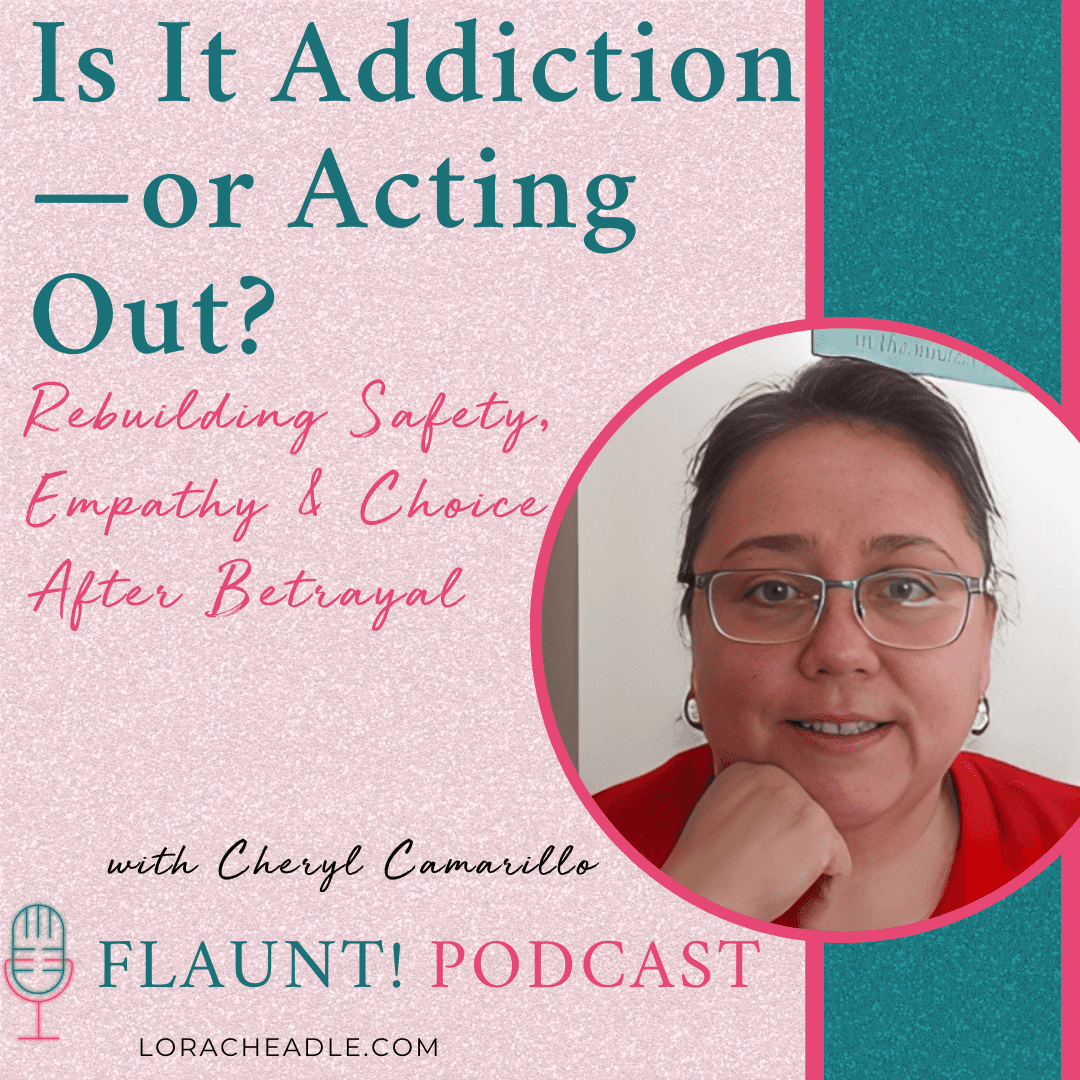
Is It Sex Addiction—or Acting Out? Rebuilding Safety, Empathy & Choice After Betrayal -with Sexologist Cheryl Camarillo
November 9, 2025 · with Cheryl Camarillo
Show notes
After betrayal, you’re left asking impossible questions: Was it an addiction? A choice? Can it change? This powerful conversation with sexologist and social worker Cheryl Camarillo brings clarity, compassion, and grounded hope. Together, Lora and Cheryl unpack how to tell the difference between sexual addiction and acting-out behavior, what integrity abuse really means, and why empathy—not shame—is the foundation for healing.
You’ll learn how to assess whether reconciliation is truly possible, what real accountability looks like, and why safety, trust, and emotional regulation must come before intimacy. Whether you stay or go, this episode will help you understand the path forward so you can heal on every level—mind, body, and soul.
Top 3 Takeaways
- Addiction vs. Acting Out: Understanding the root of your partner’s behavior determines the right kind of help and prevents further harm.
- Integrity Abuse & Entitlement: When promises and empathy break down, healing can’t begin until accountability replaces defensiveness.
- Safety Before Sex: Real intimacy rebuilds through empathy, co-regulation, and emotional safety—not through “hysterical bonding” or performance.
Favorite Quote
“You don’t go back to who you were before betrayal — you become someone wiser, clearer, and more grounded in truth.”
About Cheryl Camarillo
Cheryl Camarillo, LCSW, CST, CSAT-C, is a licensed clinical social worker, certified sex therapist, and sex addiction specialist who helps individuals and couples rebuild safety, trust, and intimacy after betrayal. Drawing on decades of experience in trauma, adoption, military, and mental health work, Cheryl brings deep compassion and real-world insight to her practice. As a consultant for the Lone Survivor Foundation, she continues to support veterans and families in finding healing and resilience. Today, Cheryl’s passion lies in helping people navigate the complex intersection of sexuality, trauma, and recovery—so they can reconnect with themselves and others from a place of integrity and empathy.
Read the transcript
Lora Cheadle [00:00:02]:
What does it mean to talk to a sexologist? Oh, my gosh. What even is a sexologist? And what's a social worker? And how is that different than a therapist or a counselor or a psychotherapist? When you are facing something like infidelity or betrayal, sometimes making a decision like, who do I see? And why can become so overwhelming that we freeze up and we don't take action. Not only are we going to kind of explain all of that and take you through, but we are also going to have an amazing conversation today about infidelity, betrayal, addiction, pornography, all of the different things. Today my guest is Cheryl Camarillo, and she is a social worker and a sexologist, and she has got both personal lived experience as well as professional experience around infidelity, betrayal, all of the things. So without further ado, welcome to the show. Cheryl, I'm so glad you're here.
Cheryl Camarillo [00:01:14]:
Hi, I'm glad to be here.
Lora Cheadle [00:01:16]:
Yeah. Let's start from the beginning. What do you do? What does it mean to be a social worker, a sexologist? What do you do?
Cheryl Camarillo [00:01:27]:
So I'm in private practice, and I made a decision and have been training pretty consistently to get a broad range of knowledge. And so I've. So I've 30 years of experience and worked in child protective services with young children all the way up to adults across the 30 years. And my latest adventure happens to be working in sex addiction and betrayal trauma. And in addition to that, working on reunification of couples that, you know, are interested in that if the dynamics right and the safety's there. And then the other piece is the returning back to a sex life for. For those couples, because that's a very difficult path to. To set back up in order to, like, it has to be under a lot of safety and trust, and there needs to be this sense of empathy, a good connection, and a flow and passion.
Lora Cheadle [00:02:24]:
So, yeah, yeah. I'm glad that you were underpinning safety with all of this because both in reunification and in having sex again, it's so important to have that foundation of safety.
Cheryl Camarillo [00:02:38]:
And I know.
Lora Cheadle [00:02:39]:
I know a lot of the people that I work with have the idea initially they switch, but initially it's like, if I could just get back to how it was. If I could just get back to how it was, everything would be okay. If I just didn't know that this has happened, everything would be okay. And that's not really it.
Cheryl Camarillo [00:02:56]:
No. They. There's a Dr. Omar Manwala that has a lot of information online, but he says once you have that secret Sexual basement, all the secrets of the partner and you have the person that has the experience of discovering that when it intersects, you will never be the same again. Pre existing reality is now that's pre existing. It's not there. You have a new reality with the discovery and then you'll. If, if the work is happening from both sides, then the, the next level would be the relationship in a different place.
Cheryl Camarillo [00:03:31]:
So here and here never, you know, that's, that's gone. So.
Lora Cheadle [00:03:37]:
Right, right. Yeah, it's, it's definitely a jarring reality. And no, it is a new path forward. And while that new path forward can be really good and really powerful, it takes a lot of work to get there. And I'd love for you to talk a little bit about what does that work look like. How, how do you start that reconciliation process? How do we even know early on if reconciliation is possible?
Cheryl Camarillo [00:04:11]:
The, the biggest tell is do both people enter with the same intention? And if there's still blaming going on by the partner that acted out, there's really not too much that can be done. It's still very unsafe for the partner and it's going to be causing more damage. But if both partners come in and they are willing to look at the situation and do their healing in their own ways, in their own areas areas, then you have a chance to move into a later piece of the, the, a later piece of the relationship where there's resiliency and it's a better than we were before situation. So, you know, there's this assessment piece like what, what do we have going on here? And then you have this stabilizing piece like how do we get this, you know, how does the person that acted out get himself re situated or herself? And how does the person that's been betrayed get themselves situated and also feel like their partner is doing the work that they need to. And then they meet at the top where they're able to look at everything together and say we're just going to keep looking at this for a little while longer as we start to re, you know, get to know each other in the new way. And then kind of from there then you're going down learning everything you can about how to have a successful happy relationship. And then the, the end part is the we've grown, we're flourishing and everything feels good to both parties. The trauma that started is now the trauma that gave the gift of healing.
Lora Cheadle [00:05:45]:
Yeah, yeah. You said early on that the very first thing to do is kind of assess and figure out where, where, where we're at what's going on. I want to talk a little bit more about that because so often people have D day, they discover something is going on and they think it's one thing ends up being a series of things. It's not just an affair. Maybe there's some addiction, maybe there's a chemical dependency, maybe there's this, maybe there's that. I'd love for you to talk a little bit about what does this assessment phase mean? And where is, I guess, the defining moment of is this really a thing or is it just behavior that somebody has moved into? When is it clinical? When is it acting out? Say more about all of that assessment because I know that gets confusing for people as well.
Cheryl Camarillo [00:06:38]:
Sure. I think when it comes to the person that acted out, we're looking for, is there any underlying mental health issues? Is there any underlying, you know, psychological issues, emotional issues, relationship issues from their past? Then we actually go back and we look at what did they get exposed to from 0 to 18. Where did their sexual acting out maybe first show up in their lives? Because I'm going to be honest, so many people, a large segment of people get their first exposures in their teens or pre. Teen years. And it's that distorted beginning reality of what sexuality is about that just plays itself all the way through and makes it a situation where when you're, you're discovering these things about your partner, there's this sense of entitlement, of this is just the way it is. Okay. I can remember when my husband, when I, you know, when I found out that my husband was using pornography, I just, I use the statement, well, that's just what men do.
Lora Cheadle [00:07:41]:
Right.
Cheryl Camarillo [00:07:41]:
Well, my line was, you know, he didn't care where he was watching it, and it ended up being in a place where my daughter happened to be walking by. And that's my line. She's not going to be exposed to that kind of stuff. And she asked me, what is that about? And I was like, well, it ain't going to be about that anymore. So I asked him for a separation and, and you know, ultimately, always protect your children. And then, you know, of course, protect yourself, but you do what you need to. That was my turning point. And that's how I ended up being in this field, was watching my husband just be inactive and not knowing where was I supposed to ask him to go? What was he supposed to be doing? Had no idea.
Cheryl Camarillo [00:08:23]:
And so I just started this long journey. And now this is what I make my living from because I really believe that people can either heal or they can get better and move on to maybe a healthier relationship down the line. If this isn't the right one, it's not the right one. I get that question sometimes. If you have to question, why should I start? If it's the partner that's acted out, why should I start doing anything? She's going to leave me anyway. It's kind of like, well, you know, then, yeah, you're right. She's gonna leave you because you're not doing it for the right reasons. So.
Lora Cheadle [00:08:56]:
Right, right. Yeah. Distorted reality, the whole distorted path. I. I can appreciate that so much. I'm still with my husband. He has done a lot of work, but, yeah, the awareness that he had to go through that, whoa, what? The way he lived, that's not normal. And that was.
Lora Cheadle [00:09:20]:
That was its own destabilizing reality shift that he had to go through. Wait, what? This? This? And it'd be like, no, that's not normal. That's not. That's your reality, not mine. And I liked how you had said something about, like, where the couple then can look at all of it together, because, yes, I have to look at his past, he has to look at my past. We have to look at each other's reality and find acceptance in that in order to move forward together. And, you know, a lot of my clients will say to me, like, I don't know if I can get over it. And, you know what? That's fair, too.
Lora Cheadle [00:09:55]:
If there's certain things where you're like, I just don't ever want to deal with that again. Possibly the safety could be there, but I don't want to deal it with it. You don't have to.
Cheryl Camarillo [00:10:04]:
Right. It's. It's ultimately the partner's decision, what she wants to do or not do. That's the biggest deciding factor in whether the relationship is going to go forward. And I know a lot of women come in and they don't feel like they're empowered. They feel like the power and control was in the hands of their partner and that, you know, they don't have choices, but they have lots of choices. So my job is to help make sure that women figure out how to grow themselves so that they're feeling empowered, they feel stronger, they can request safety, they have expectations and that it's not too high to say, I don't like this particular behavior and it needs to stop. Um, and, you know, that's a big struggle.
Cheryl Camarillo [00:10:51]:
It's very, very scary and feels unsafe. But, you know, if you want to continue the relationship. It's something that has to be done.
Lora Cheadle [00:11:00]:
It is a big struggle. I think, especially women. We have been conditioned to keep the peace, to not rock the boat, to not be emotional, to not. And it is both empowering and terrifying. I think when we first start saying, and no, this is my boundary. And no, yeah, exactly.
Cheryl Camarillo [00:11:21]:
I, you know, I think my job usually this is my favorite line. And a lot of the women really appreciate it when they start getting stronger and they look like they could run their life without somebody else being involved. That's usually what gives their partner the kick in the pants to start moving a lot faster. And, and I certainly have men that come in and say, she's so far ahead of me. And I'm like, good, because, you know, she's been so far behind you.
Lora Cheadle [00:11:50]:
Yeah, yeah. And that's empowering. That's. Yeah. Okay. So we diagnose, we figure out who's got what going on. We kind of come to terms, we create some of that safety. Then how does that treatment look, especially around some of the sexual acting out, the addictive behavior? Because it is up to, just for simplicity sake, the man.
Lora Cheadle [00:12:15]:
It's up to him to deal with his issues while she deals with her issues. But what does that look like? Because sometimes there's that balance of, how can I support you in getting healthy but not own your therapy? Not be codependent, but being supportive.
Cheryl Camarillo [00:12:34]:
Right. So there's like three components going on when a person finds their partner has been cheating. The first is the actual sexual acting out. So that behavior. The second is the entitlement. It's the mentality of, I get to do what I want when I want. It's no biggie. They'll say all kinds of things.
Cheryl Camarillo [00:12:54]:
And then the, the third piece is the part that impacts the partner, which is integrity abuse. Like, your word doesn't mean anything. You joined this relationship and, you know, and entered a contract saying always and forever and that there would be trust and honesty and truth and all of that. And it didn't happen. And what, what the partner, the person that acted out does is they just don't see how that's such a big deal on this person. But it is, it causes a level of trauma. And a lot of cases it's post traumatic stress. Like, it becomes actually something bigger.
Cheryl Camarillo [00:13:31]:
And for, you know, relationships specifically with betrayal, it's usually relabeled betrayal trauma, but it is seriously post traumatic stress. And people know what that is. It's. You've been traumatized by something Huge. And again, your life before, no longer the same.
Lora Cheadle [00:13:50]:
No, no, it's not the same at all. And some of that, just coming to terms with that, you know, just being like. And I don't want to say it's okay, but it has happened. We do have to move on. We can't go back to before.
Cheryl Camarillo [00:14:06]:
Right, Right. So when I talk about the men, working on their behavior and working on their entitlement, learning to say, okay, I can't be all about me. They need to learn to be empathetic. What's going on in this side is they have to start doing things. Like, a lot of them find it going to sex addiction anonymous, or sex and porn addiction anonymous, or finding a sponsor might be the thing. Everybody's different, but that might be their thing. And then getting a sponsor might be their thing. But ultimately, these guys need a community because they start.
Cheryl Camarillo [00:14:39]:
They start into therapy thinking, I'm so ashamed. I feel so guilty. How could I have done this to my partner? They might have actually started and. And stopped and restarted. They could have repeatedly caused problems 3, 4 times. A lot of the people I see, they've been through multiple therapists until, you know, before they show up at my door looking for someone that specializes in this. And if you don't get a specialist, that has its own negative impact for a lot of couples and especially for the partner, because there can be more abusiveness in attitude that comes across. Not intentional, but this accidental.
Cheryl Camarillo [00:15:17]:
You're, you know, you're just making a big deal here, or, you know, you know, you need to cut him some slack. Or family members saying, just, you know, just forgive him. It'll be okay. He promises. And that's the thing, you know, the entitlement piece says, yes, I promise, but then I don't promise. Like, they go up and down. And it's a true addiction. It's a brain hijacking.
Cheryl Camarillo [00:15:41]:
They have a neural pathway that says, you know, I need dopamine, I need pleasure, I need adrenaline rush, I need fantasy. Whatever's going on with them, that's what's driving the behavior. And so they need to have some kind of set pattern of changing that so that they're not stuck in that anymore. So a lot of them have to form, you know, some kind of structure for themselves in order to just stay on track.
Lora Cheadle [00:16:07]:
So, yeah, and I'm glad you're saying that, because oftentimes, you know, I started the show saying, like, social work psychologists, psychotherapists, like, people don't know who does what and what they Need. And sometimes I'll hear somebody be like, well, my, my husband saw a therapist that doesn't do it, you know, or we read the book. Great. And it's so much deeper than that. And I think sometimes people do get lost in what kind of a professional do I need? And what does it really even mean to get help? And what do you mean by a new neural pathway? And what do you mean by a support group? Can't I just fix this and move on? And I'd love for you to hear, to share your thoughts on we don't just fix it and moving on. Move on. And it's also, it's also not something that. Okay.
Lora Cheadle [00:17:07]:
For the rest of my life, every single week, I have to work this hard. Can you talk a little bit more about that arc of recovery and what that looks like and how it's more intense and then where it eases off, but where it doesn't ease off and just that whole addictive brain patterning.
Cheryl Camarillo [00:17:22]:
Yeah. So I, I guess I'll just kind of like run a case, you know, where I have somebody that came in, they're on. I'm therapist number three. They have several kids. They've been married, you know, 20 years. She totally had, you know, thought that he had kicked this pornography thing that he said he'd taken care of. He'd had some other multiple addictions like alcohol and shopping and stuff like that. So that multiple addiction piece.
Cheryl Camarillo [00:17:51]:
But because he'd taken care of his 12 step AA stuff and took care. He knew the process of what it takes to be committed to treatment or to a treatment plan or sobriety plan, actually. Because he understood that it was so much easier when he came in. It became an issue of trying to help empower the partner. But, you know, I'm sorry. Re. Another, another part of the question. What was just.
Lora Cheadle [00:18:19]:
Just for. For the addicted partner. Yeah. For what? What can they. Because so often people will just say in the spur of the moment, I'll get help. I'll go figure it out. But what does that really mean? Because what are they really looking at?
Cheryl Camarillo [00:18:33]:
Yeah. So it doesn't mean anything. Yeah. You know, some of them will say, I'll never do it again. Some of them will say, you know, if only you would have. And they put it.
Lora Cheadle [00:18:44]:
The.
Cheryl Camarillo [00:18:45]:
Put the blame back on their partner. Other people will come in and say, if only you would have helped him in this way. So basically it's. It's about the part. The person that's acted out. They. They need to learn to take accountability for their behavior, that they're not blaming other people, that they're no longer using all the tricks and trades of trying to keep their secret. And because they've.
Cheryl Camarillo [00:19:07]:
They've been practicing that kind of stuff for a really long time, and it's hard to give it up. And I've had some people come in and they're like, I'm a liar. And I'm like, you're a liar? Yes. I lie about everything. And I'm just listening. And, you know, that's sad to me that that's their identity, it's their behavior. Lying is a behavior. You need to change that.
Cheryl Camarillo [00:19:26]:
Do you understand how you change that? And so.
Lora Cheadle [00:19:29]:
Right.
Cheryl Camarillo [00:19:30]:
You know, we go back in time. Where did that first lie happen? I can remember this one kid that was like, oh, I got. I cursed at a party, and everyone said, we're gonna go tell your dad. And he was the perfect child. Well, the dad said, you know, did you do this? And the boy said, no, I didn't, because he didn't want to get in trouble. And he got away with it. And it was his first boost of, wow, I can do this. And, you know, as long as I'm acting innocent and sweet, I get away with it.
Cheryl Camarillo [00:19:59]:
And it was like the beginning of, like, the next 35 years of I get to do whatever I want. That's that entitlement piece. You know, like, I learned if I want something, I have to make it happen or I have to be manipulative about a situation. And so, yeah, that. That would be one of those pieces that goes with, like, where. Where does this behavior come from and how does it, you know, how does it continue? You know, I guess some of the other things that, when we're looking at, you know, struggles, is a certified sex addiction therapist will come in and be able to see some of the things that need to be seen and also not allow certain behaviors to continue because it gets called out. I had somebody today, I just was like, well, but you're using a I get what I want when I want it mentality. Because he was like, he's been struggling for a while, and I just finally got.
Cheryl Camarillo [00:20:55]:
I just finally got the gumption to just say, okay, I'm just going to spell it out for you, dude. And that's what you need is a therapist that'll spell it out. Not gonna pussyfoot around, is still gonna be aware. Shame and guilt is at the source, but once they move, they need a therapist that pushes them past shame and guilt, helps them learn to stay present for the partner, because that is like a whole other way of abusing or hurting the partner is when they, you know, the partner's upset, crying, angry, and they just turn into this like stone. They don't say anything because they feel like, I can't say anything. There's nothing I can say. She doesn't want to hear. Sorry, she doesn't want to hear this.
Cheryl Camarillo [00:21:33]:
She's, you know, it's, it's that, it's that mentality.
Lora Cheadle [00:21:37]:
So yeah, yeah, yeah, it's hard. I mean, it's, it's a lot of different layers. And I think what I want, what I want you to say to the listeners, to the women who are listening to give them a realistic perspective of how long it's going to take for their partner to do this work. Because you don't just go in and all of a sudden have that aha moment. There's peaks and valleys, there's two steps forward, there's one step back. And how, how would somebody realistically be able to assess that situation and know, know what they're up for?
Cheryl Camarillo [00:22:17]:
So first, everybody's different in how they present and what they need. So, so if you've had a life of complex post traumatic stress, if you're the person that acted out, you could be acting out because you have a lot of other things from your childhood taking, taking space in your head and needs to be resolved in order for you to be able to work on some of the stuff that has to do with the damage you've caused in the relationship. So the person that I said, you know, worked in aa, it took about six months to get everything back in a flow and she, you know, she got healed, she felt empowered, she, she knew that she could ask for things. He had to be accountable. He took, he used a tracker, he did everything that needed to happen and he did it without being resentful because, boy, you can tell when someone's just doing something because, well, that's what she's telling me to do. It's like it doesn't work like that. The resentment is felt. There's a vibe going on between the two of you and if you're just doing it to appease her, she feels it and she starts to feel unsafe again and resentful because there's no way that you're going to continue to be sober if you can't do these things willingly.
Cheryl Camarillo [00:23:26]:
But then there's other people that I've seen for a couple of years and their investment has to do with working on different pieces like first it was, you know, here's the problem. And it might take three or four or five months or six months. It just depends on how long the, the person that acted out wants to stay entrenched in. I don't know what you're talking about. No, I don't do this. The, the lying is what I was bringing up before, right? You know, and then there's others that stay in a lot longer. But if you're staying in a lot, a lot longer, I kind of feel like there maybe something's not right. If you're still struggling with, you know, continuous lying, etc.
Cheryl Camarillo [00:24:04]:
Maybe there needed to be some kind of residential program or an intensive program where they go away for two weeks and they, you know, you know, get all of this. I just had someone go away for a two week program. So you get 33 hours worth of therapy. Like 33 hours of therapy concentrated is worth more than 33 hours. That's like a hundred plus hours of therapy all at one time. Because you lose time every time you come in for your one hour session. You know, 10 minutes of how are you doing? 10 minutes at the end. This is what I need you to do.
Cheryl Camarillo [00:24:35]:
It's like, no, you, if you do an intensive or you do a residential program or something like that, it's like bam, you are hitting the problem and then you're, you know, trying to move into like, how do we keep this sober living going? How do we keep this trust level growing? And that's when they start working on things like the intimacy pyramid. You know, trust and honesty at the bottom or truth and honesty at the bottom. You know, empathy, you know, does your partner have empathy for you or do they just look at you like you're the source of all their problems? They wouldn't have all these issues. Do, is there a sense of safety? Does he feel responsible for managing your safety? You know, is there, you know, trust building? Is there vulnerability? Because if he can't come and tell you I'm having some thoughts or I, you know, I picked up the phone or whatever it is, if he can't tell you what's going on in his head, then you're, you're just sitting wondering, does he even think about these kind of things? That takes a lot for me to help men cross that line into. Believe me, she wants to know that you even care about your thoughts and what she is having to think about or worry about. Like, you know, it's a constant question in her head. And then the last pieces are connection and then Intimacy will just become a, a natural part of the whole process. So.
Cheryl Camarillo [00:25:56]:
But yeah, so it could be a couple of years. It could be more intensive work at the beginning. You know, some people are like, you know, takes me three months to get people to reduce some of their defensiveness. Some of the anger, some of the emotion, you know, I'd probably say 50 are like that. And then there's others that there's been a lot of damage and a lot of pain that was caused and pain from both sides because, you know, now it's like, how do we fix this? I feel powerless, you know, from his side, from her side. Everybody's feeling like we're drowning here. And, you know, we don't even know if there's a, if there's a rope or a safety thing, a buoy or anything like that. We're just out there, you know, we, there could be sharks around us that for all we know.
Cheryl Camarillo [00:26:41]:
So.
Lora Cheadle [00:26:42]:
Right. And we don't know. And not all infidelity is caused by an addiction. Right. And yeah, say more about that because I feel like there are some different considerations.
Cheryl Camarillo [00:26:54]:
So infidelity can be just a one time situation that, you know, is causing just as much damage as multiple, you know, infidelities. But it's not necessarily because their brain has built a pathway to say, keep cheating, keep cheating, keep cheating. It's more along the lines that they were doing something that gave them, gave them some kind of emotional or physical need met, but they weren't turning to the person they needed to, which is their partner. And if they rebuild the partnership and they go through and they do all that work I was telling you about on the other side, is this like blooming relationship that's better than it was before. Now we talk if we have problems. Now if I get snappy, you know, ugly remarks, I can say, that was kind of snappy. What's that about? Instead of staying silent and thinking, is he going to cheat again if I even tell him, you know, why are you talking to me that way? Like, all of those defensiveness mechanisms go down and people are trying to be more authentic and genuine. That is ultimately where you're trying to get to at the end is, you know, do I feel like there's all of those intimacy pyramid things that I talked about? Is there authenticity and genuine interaction? Because you can feel it.
Cheryl Camarillo [00:28:16]:
There's energy that crosses both sides.
Lora Cheadle [00:28:19]:
Right, right. And if it's not, you can feel that too. And one of the things that I think is really valuable is it's not always about just reconciliation, how can we each become better people? And you know, like you said earlier, maybe it's the relationship and maybe it's not. And really either way is okay, but let's just all get healthy regardless. Yeah.
Cheryl Camarillo [00:28:41]:
And especially if you have children, you know, your children have to figure out what does it take to be in healthy relationship. If the parents haven't been talking, have been distant, detached, they don't like each other, they see that and they, you know, now they're thinking, is that okay for me in a relationship if I'm distant, detached from my partner, is that okay? Well, yeah, mom and dad did that. It's no biggie. But you know, you could have a really, you know, a really healthy, connected relationship. And that's what you hope that your kids have is a healthy, connected relationship. And I have a 20 year old daughter and I have to just sit and be quiet, but I just watch and I, you know, encourage her when she's saying, this just doesn't seem right. I'm like, well, you know, if your gut instinct tells you that, you know, go with that. Do investigations ask more questions, but you know, don't hold on to what you think you need to ask.
Lora Cheadle [00:29:35]:
I really appreciate that you said something too about like, do you like your partner? Because I think, I think that's really important. We can say I love somebody, but I don't really like him. And I think it's different being like, I'm not really liking you right now. Because marriage is hard and we go through phases versus I really don't like this human being.
Cheryl Camarillo [00:29:55]:
Yeah, I've seen, I've seen it a couple of times. And you can just see that both parties kind of come to an understanding and one will make the decision to move on. And, and then it becomes an issue of how do we get healthy for the next possible relationship we have.
Lora Cheadle [00:30:16]:
Yeah. And that's powerful. I want to talk a little bit about the intimacy piece and rebuilding intimacy. I know a lot of women go into the hysterical bonding right afterwards. Some people are like, don't ever touch me ever again. But other people go into the hysterical bonding, which is, I want to have sex all the time, I want to be touched all the time. I want to talk about that. Where does that come from? How do we manage that? How do we find peace and balance around that?
Cheryl Camarillo [00:30:45]:
So if your partner has gone off and gotten it from someone else or using pornography for it and it. You had a happy, healthy sexual life prior to this acting out, there's just this like, I Had somebody use the words, I'm. I am de. I am so parched and dehydrated. I need something. And. And you could have given it to me. You wanted that, and you didn't give it to me.
Cheryl Camarillo [00:31:09]:
You know, that was the piece that, you know, some couples have. And when that returns, that intimacy level and the honesty, even if there's a little bit of safety, then sex starts happening really soon, and it's really, you know, a great experience. And people start feeling like they've got some energy and they're moving, and then it might flip into, I don't. I don't want to have sex with this person anymore. And that's fine, too. You're. You're just going to be constantly figuring out where, you know, where do I, you know, what's stable for me, how do I get my footing here? And so they will back off from the sex piece because they need to actually do more work in the intimacy part, which is all those steps that, you know, now that they realize, oh, he doesn't have empathy for me with regard to what I'm suffering, you know, so let me back off, because I need that. That's part of me feeling like he wants me.
Lora Cheadle [00:32:06]:
Empathy is huge. And empathy, it does run along some gender lines, too. I mean, again, I think women are trained to have more empathy, and men have it trained out of them. And it's a real interesting learning curve to learn how to, I think, at first, kind of fake empathy, but then to move into feeling, actually feeling it, and then sustaining, sustain that empathy. Can you share a little bit more about the work around empathy?
Cheryl Camarillo [00:32:36]:
So with empathy, I. I'm going to use one of my favorite couples. They. They came in and they'd been working for maybe a year, and he was really not the empathetic part, a partner and kind of resentful about all the work he had to put in, all the money he had to put in. He's super intelligent. And so having to sit and talk to a therapist was kind of demeaning on some levels. But we grew a good. We grew a bond.
Cheryl Camarillo [00:33:04]:
And he felt like he could talk to me. And he did neurofeedback because I do brain training as well to calm the nervous system down. And one of the things that happened was that we did a rating, like 0 to 10. You know, how. How empathetic do you think you are? And he had to look at her, and he said, maybe three. And she goes, I was thinking more like two. And it was like, you know, but they were on the same page about that. All the other ones that I mentioned, the vulnerability, the safety, the trust, all of that, that was up in the 70s, 80s, and they were kind of almost in agreement on all of those.
Cheryl Camarillo [00:33:39]:
And yet, you know, the empathy piece was a big issue. And a lot of that had to do with the messages that he received in childhood. How men show them show up in a relationship. Some of it had to do with like the gender identity, gender shaping. You know, if you're from certain cultures, there's certain ways to behave or ways to treat women. And there's a great, there's a great video out there called the Man Box. I think his name is Tony. I can't remember what his last name is, but just look up man box on YouTube.
Cheryl Camarillo [00:34:16]:
And it's been really eye opening for, for the men in my group to watch that because it helps them understand that they've been dragging all of these messages from their young years. Like I think the guy said, oh, you know, you should be having sex from the age of two. That's the way it is in the Bronx. People treat each other like that. And I was like, this is true, you know, like, did you get some. That's phrases from the gender, you know, which base did you get to? Girls don't normally go and chit chat about, you know, I let him get to base three, but you know, to second base or whatever it is, it's not. Yeah. So it, it becomes a positive thing if you can do these things.
Cheryl Camarillo [00:34:57]:
And it's like, well, now you're detaching. Healthy, you know, healthy connection, relationship, etc, and becoming something else which is part of what the gender in society, whatever is being presented to them. And then the sexuality piece too. It's like, well, how did your dad treat your mom? Oh, she's subservient and you know, and she needs to make sure she's at home a certain time and if he wants to go to the bar, it's okay. And like depending on, you know, where you came from, whatever's going on, you get your messages on how to treat people with, you know, in terms of sexuality as well. It could even be that, you know, there's no hand holding, there's no kissing or, you know, there's a lot of kissing and, and you know, dad will embarrass mom in public and break boundaries, grabbing her butt or whatever. Like those kinds of things are messages that these men get. And so, you know, Dr.
Cheryl Camarillo [00:35:53]:
Manwalla calls that the below the surface stuff. The above surface is you're acting out stuff. You know, I, you know, I, I've. I've used pornography or I've cheated. And I think I deserve to be able to do this if I want to. It helps keep me from feeling guilty and ashamed and then, you know, breaking my, my word. But underneath are all these things that shape this person to do some of these things that they did, even infidelity, if they learned that if you're feeling hurt and you know someone isn't going to be able to meet your needs, go find the next person. And that could be something that was learned in childhood as well.
Cheryl Camarillo [00:36:32]:
So.
Lora Cheadle [00:36:33]:
Yeah. And so many of those beliefs never even rise to conscious level. It's just how. How we are. And that untimely piece is huge. That entitlement piece is really huge. I know personally for myself, like, my husband has a very traumatic background, very poverty stricken, very. And he's worked really hard, so for so long, he'd be like, I'm entitled to this.
Lora Cheadle [00:36:57]:
I deserve this. And it's like, yes, yes, you do. And then at some point that crosses a whole other line. And it's like, and no, you're in a partnership.
Cheryl Camarillo [00:37:07]:
Mm.
Lora Cheadle [00:37:08]:
And I know a lot of men struggle with that. You know, they'll say, I work for this. And a lot of women are like, well, I know when you should. But it's hard sometimes to identify where is the boundary and what is entitlement and what is self care. Yeah.
Cheryl Camarillo [00:37:26]:
Yeah. I think the main issue is do you want a partner or do you want just another person that's in the household? You know, with this transactional thing going back and forth, I give you the, I give you the, you know, the payment for the house, etc, and you, you know, make sure the kids are okay. And like, it's, it. When it goes transactional with no love and no emotion and no, you know, safety, security, and trust. When you get together in a relationship, that's what you look at your partner and say, I can give them that. And the same thing with this partner saying, I can give them that. It's not showing up and saying, well, can he give me this? Because if that's the way you're going to start, it ain't gonna, it ain't gonna work out very well. But, you know, being able to say safety, security and trust, that's what you got in the beginning when you were a little baby, your mom is holding you, looking in your eyes, you know, the eye to eye contact is causing this oxy, you know, oxy, oxytocin.
Cheryl Camarillo [00:38:21]:
Release and that, you know, that's that love hormone. Right. And so you've got that going on. And here's this child saying, if I cry, they're gonna pat me, and if I'm wet, they're gonna change me. And, you know, that's the beginning of people can. I can rely on people to meet my needs. I can be attached to you and you can be attached to me. And that's.
Cheryl Camarillo [00:38:41]:
If that's healthy and that's safe, then they continue to do that in the rest of their life. But, you know, there's some people that struggle because they didn't get this part, and they don't know how to show up like that in a relationship.
Lora Cheadle [00:38:54]:
Yeah. And that's hard to learn. You can learn it, but that is hard to rewire. You were talking about the brain training, and I know that's very powerful. I'd love you to. To share about that because I'm sure some listeners are like, I have no idea what that is.
Cheryl Camarillo [00:39:08]:
Yeah. So I go out there and look for the things that are going to help reshape brain pathways. So we. If we have a. We have a brain that we're driving somewhere and we get there and we realize, I didn't even know that. I. I didn't pay attention. How did I get here? That's that autopilot thing.
Cheryl Camarillo [00:39:27]:
Your brain knows what it's doing, and you're. You could be, you know, still monitoring everything and being safe, but you're on autopilot. And that's a brain pathway. That's automatic. I get in the car, I go here to the school every single day. My brain knows what it needs to do. And the car, you know, if it's a Tesla, knows what it's supposed to do, that kind of thing. But the, the other side of that is, you know, at the brain training, I do neurofeedback training, that one, you know, depending on placements and stuff, I have some people come in and they're getting the physical calming piece.
Cheryl Camarillo [00:40:02]:
So it's basically sensors that are reading brainwave activity and the computer is trying to encourage or help shift and change. And when your brain starts thinking, I can shift and change, wow, it starts doing it all the time. So that's usually my first line for a lot of the men that I work with and the women, because they're super anxious, super on fight or flight, and they need something to calm themselves down. And so that's usually my first line of, you know, intervention after. Here's what's going on. Here's your plan of action. Look, this is how we assess this. You know, this is, you know, the way forward, how this should look.
Cheryl Camarillo [00:40:43]:
Get all the educational stuff and then start something like brain training or neurofeedback. You know, neurofeedback started in the addictions field in the 70s with alcoholic alcohol addiction centers. You know, they were trying to increase alpha theta brain waves that are relaxing but also creative. And so all of that was going on. Well, you know, it's just continued to evolve and it's incredible. And you know, if you have anxiety, if you have adhd, if you've got trauma, if you have like emotional overwhelm, like there's just a variety of place based on placements. I can impact what's going on sometimes with the. With the brain responding to things.
Cheryl Camarillo [00:41:26]:
So I like that. And then as a brain hacker, I really believe in learning to get inside your body. And everybody needs to learn something about mindfulness, deep breathing exercises, you know, mindful walking, where you're paying attention to everything that you're noticing around instead of thinking about, I wonder what he's doing and I wonder where he's at. And let me look at my life360. That just gets draining when you're having to feel like you're micromanaging everything about this partner. Like you, you know, did you want another child? No. But that's the only thing that makes you feel safe in the moment. But I'm.
Cheryl Camarillo [00:42:03]:
If you turn around and put that energy into yourself, and like I said, if you grow past that into your own, they notice that and they start shifting and changing. Those things are still important for you in the very beginning. The, you know, the Life360 the accountability app for porn. Pornography. Because there's some apps you can put on phones and computers to get notification on porn use or sexting, texting, kinds of stuff. So. Yeah. Yeah.
Cheryl Camarillo [00:42:32]:
So that's where I'm at.
Lora Cheadle [00:42:33]:
Yeah. Yeah. And it's hard. I. I appreciate that you, you know, called out betrayal. Trauma is ptsd. It's trauma. And I think sometimes that's even hard to acknowledge because we're like, no, I.
Cheryl Camarillo [00:42:47]:
Can figure this out.
Lora Cheadle [00:42:48]:
I'm a strong, capable woman, blah, blah, blah. Yes. And you can be a strong, capable woman and you can be traumatized and you can be suffering from betrayal trauma, and you can. And it's all the different things. And yes, early on I did want to monitor and I felt safer monitoring. But no, I didn't. I didn't want to monitor the Rest of my life that's not. So learning how to soothe myself was huge.
Lora Cheadle [00:43:16]:
Yeah, yeah.
Cheryl Camarillo [00:43:19]:
I think for a lot of women, you know, when they're able to redirect away from those things, eventually their partner has to be on board, though they need to be showing. I go to meetings, I, you know, I do readings, I open up about my thoughts and feelings. You know, if they're still not telling you why they're sitting there selling about something. Instead of using you as a partner to help co regulate. That's one of those things. That's a phrase that you're going to hear. Emotional regulation. Can you calm yourself down from fight or flight or, or bring yourself up from freeze and co regulation is can you and your partner, you know, provide assistance and support to each other to help each other balance out your moods?
Lora Cheadle [00:44:00]:
So yeah, yeah. And that co regulation piece is huge, really huge. I think, especially for people who have never done it before. You know, I know just for me personally, my girlfriends and I, my parents, like, we all co regulated and the way my husband was raised, it's, you figure it out for yourselves. And it felt very vulnerable. You know, you talked about that vulnerable vulnerability piece. Feels very vulnerable. For him to engage in that, it's scary.
Cheryl Camarillo [00:44:31]:
I mean, you talk about worst fears. If you go back, you can probably pinpoint that point where they like stepped over the edge of. This isn't just, you know, I'm a little scared child, it's I'm a terrified child because nobody's showing up or giving guidance or maybe other people are showing up and causing more trauma. And that's why the sex addiction field is largely focused a lot of times on trauma. Probably 80% of the time or more, there's a need for some kind of trauma work.
Lora Cheadle [00:45:05]:
Oh, absolutely. Now I'm sure there's listeners thinking, well, I don't know if, if my partner is really addicted or not. How do you know when it's truly an addiction versus a bad habit? Where is that line?
Cheryl Camarillo [00:45:23]:
So the line is if your partner's not happy about it, that's a line, you know, especially if you're not able to take part in the, the necessary parts of a relationship, like having a sex life and being able to perform, you know, effectively if you need to, or being able to even be present with each other. And if you have to just do something on autopilot without being aware of who you're with, that's the benefit of a sex sexologist. That's why I went and got that additional certification is Because I needed to be able to help guide and encourage a reconnection on that level. Because it's just not an automatic thing. Things have to be talked about. I mean, this whole thing started out of, you know, mis. Misguided or misdirected energies into other sexual outlets. So, you know, we're gonna have open communication and, you know, ask questions.
Cheryl Camarillo [00:46:26]:
And so, yeah, I have people that are like, did she just ask me that? And it's kind of like. But then they're relieved because they're like, this is a conversation I really wanted to have. I just didn't know how to start it. And since I have that experience and I know where people get stuck, I just. I know where to look and say, let me ask this one question. To unstick everything else that needs to be, you know, unstuck.
Lora Cheadle [00:46:48]:
So, yeah. Yeah, I love that. And then what about multiple addictions? Why do the multiple addictions tend to stack in there?
Cheryl Camarillo [00:46:57]:
Because it's. So you said, how does this turn into, you know, what's the criteria for addiction? It, you know, if you're overindulging in something because it's helping self soothe you, or you're seeking a dopamine hit and you need that constant dopamine pleasure hit, that could be signs of an addiction. There's a lot of, you know, free, free things online to just, you know, do I have an addiction? Kind of thing. But, you know, multiple. My husband had multiple addictions. Right. And, you know, I. He's.
Cheryl Camarillo [00:47:32]:
He, you know, talk about the ultimate cover up. Like, your wife is a therapist and, you know, has worked in the addictions field, and you were able to hide lots of stuff. Yeah. So if you feel like, you know, oh, you know, how could I have not known that? Believe me, I've said the same thing. And several of my therapist friends have said, how could I have not known that? But, you know, the goal is like, how do you move past that? It doesn't matter. Like, why didn't you know? I mean, it does matter. Your body helped you do that. Your body helped you block out things that you didn't want to see.
Cheryl Camarillo [00:48:05]:
Your body and your brain, you know, kind of helped readjust the story. You didn't want to know that all these secrets were there because that meant that your partner that you trusted and loved was hurting you. You know, I didn't want to think my husband was doing anything. So the stacking has to do with, I need things to help help me self soothe and, you know, that it's over the line. If you have legal problems, if you have relationship problems, if you, you can't show up as a parent because you have to, you know, skip all the practices your kids have. All the other dads show up, but not you because you need to go and have time acting out or you need to have sexting on, you know, on your phone. Open up five different dating apps, like, things like that, you know, when it crosses the line and affects other parts of your life, it's probably a problem.
Lora Cheadle [00:48:54]:
I also really appreciate that you said, like, why didn't you know? Because same thing I, I'd sometimes think, why didn't I? And I know when I work with people, they'll say that too. And I really am a firm believer that it comes out when you're ready to have it come out. When you are psychologically safe enough within yourself, when you are resourced enough, it will come out. And I don't think there's anything like magical or better having something come out too soon because I think if I would have found out too soon, it would have been much more catastrophic than when I did find out.
Cheryl Camarillo [00:49:28]:
Yeah, your brain will actually let you do the things it needs you to do when it feels like this is a space where you can handle it, you know? Now sometimes things come tumbling out because of the partner's behavior. But for the most part, if, if you're, if you've been walking past the same thing over and over and just not seeing it, you know, it's because that's what your brain is saying it needs and what it's feeling and, and it'll eventually restabilize. So that's the main thing is, you know, am I going to get my mind back? I lost my mind. Am I going to get my mind back? And the answer is yes. And why didn't you know? You know, it's a protection. The self protection is in there, self preservation. Your brain shuts down what it doesn't want to see. It's like, you know, it's like men that go to war, they learn to stop thinking about the danger and just focus on what do I need to do here.
Cheryl Camarillo [00:50:21]:
And if you're a mom, you have like five kids in all kinds of sports and you work. It's survival. What do I have to do here to make it through the day?
Lora Cheadle [00:50:29]:
Yeah, yeah. And I think it's interesting, I know for me especially to look back and to see where I was in survival mode when I didn't realize I was in survival mode at the time. Yeah, yeah, yeah.
Cheryl Camarillo [00:50:43]:
I just want to get to the surface. Right. It's like you've been pushed under, and you're just like, I'm looking for some air. Anybody got some air? Because my partner's not giving it to me. And that's when you have to really keep on top of who. Who is your support system? Are you doing the basics of taking care of yourself if you're not eating well, not exercising, not sleeping? That's like level one of, you know, 101 of taking care of yourself. Because you're not gonna. You're.
Cheryl Camarillo [00:51:09]:
You're just not gonna show up as strong as you need to show up if you don't take care of those three basic areas.
Lora Cheadle [00:51:15]:
I love the phrase support system. I wrote that down because we were talking about safety, security, and trust, and I think sometimes people get lost over what that means. Well, I. Oh, I'm safe enough. There's a roof over my head. I'm not getting hit. I'm just getting emotionally yelled at.
Cheryl Camarillo [00:51:30]:
Yeah.
Lora Cheadle [00:51:30]:
You know, like, people safe, secure, and trust, that's sometimes hard. And support system. And while I think while it's also fair that we can have different definitions for ourselves, also really being able to step back and be like, no, I am safe, and I deserve safety. And being yelled at, being demeaned, being. Being belittled, that isn't safe either. And I do deserve more than that.
Cheryl Camarillo [00:51:56]:
Yeah. I think that's why community for me is very important. I had to set up a women's support group and a men's support group for my practice because I had a woman come in and say, great, he's got therapy, and he's unburdened. What about me? I'm the one in pain. I'm the one that has to wake up every day with crying, and I still have to get the baby and the kids to school and, like, who's there for me? Cheryl? And I would just be like, okay, I'll take. Challenge accepted. And so I formed, you know, I started seeing people individually for the betrayal trauma piece, and then I started working on some of the couple piece as a system. And it really helped, though, for women to be able to have a space, to not feel ashamed, to not feel guilty, to not feel, you know, because you have people coming up and saying, just give them another chance, girl.
Cheryl Camarillo [00:52:49]:
It's okay, or leave that rat. You know, we need to, you know, you need to stand up for yourself. And it's like, you know, if you really want to help your girlfriend out when she's saying this, has happened to me. You just be there and listen and, you know, not give opinion, not say what she should or shouldn't do because that actually causes more pain for them. Because now they don't have you to turn to. Not not only do they not have their partner, now they don't have their bestie to turn to.
Lora Cheadle [00:53:18]:
Yeah. Such good advice. Such good advice. And I know it's hard. It's hard to keep your mouth shut as the best friend sometime, but. Yes. How can you support. How can you be supported? Well, where can people learn more about you and your work and get in touch with you?
Cheryl Camarillo [00:53:35]:
Sure, they can. They can reach out to my website. It's cherylcamarillo.com you can find me on YouTube, on Instagram, on Tick Tock, at sharing with Cheryl, at sharingwithsheryl. And then also I started putting a lot of, you know, X, you know, statements on there because I really get random thoughts. And I'm like, this is a good place to just drop this stuff until I can make videos. So, you know, hopefully there'll be a lot more videos coming out. I've, you know, gotten some support in that area, but the YouTube videos will be coming out. A lot of this stuff that we've been talking about, Dr.
Cheryl Camarillo [00:54:14]:
Man Wallace, stuff about entitlement, you know, behavioral acting out and integrity. I'll be doing a lot more videos online on YouTube, so at sharing with Cheryl and hope that y' all subscribe and jump on there. But the website, if you go on there, there's three free webinars for women on betrayal trauma.
Lora Cheadle [00:54:34]:
Oh, nice.
Cheryl Camarillo [00:54:35]:
Yeah. So you just fill in saying, I want that. And you'll be put on a. You'll be put on a list, and they'll start sending you emails with three different, you know, webinars. One is just, what is betrayal, trauma and sex addiction? And one is on, you know, what are the treatment options so that you have a place to say, do I do residential? Do I, you know, do I need a couples therapist who. Who specializes? Yeah. And then the third one is the ultimate self care. Like, what are you gonna do? Because if you don't stay strong, ain't nobody gonna survive this.
Lora Cheadle [00:55:07]:
Exactly.
Cheryl Camarillo [00:55:08]:
Good.
Lora Cheadle [00:55:08]:
Thank you. Thank you. And those will be very useful resources because you're right, we have to stay strong. And it is overwhelming. And I don't want to say there's a lot of bad therapists out there, but there's a lot of people who don't specialize in this and sometimes end up doing more harm than good as you alluded to earlier. So thank you. Yeah. Thank you for the work that you do.
Cheryl Camarillo [00:55:31]:
Thank you so much. I appreciate you hearing, hearing this information and sending it out because there's so many people so lonely and, and desperate, thirsty for information. And I think this really helps, you know, helps with the start of mending and healing. So. Yeah. Thank you.
Lora Cheadle [00:55:48]:
Yeah. You're welcome. Thank you, listeners. Reach out. Check out some of these webinars. Reach out to either one of us. If you have a question, we will get you sent in the right direction. Have an amazing week.
Lora Cheadle [00:56:00]:
And as usual, always remember to flaunt exactly who you are, because who you are is always more than enough.
Never miss an episode
