
FLAUNT! Podcast · Infidelity & Betrayal · Rebuilding Trust · Affair Recovery
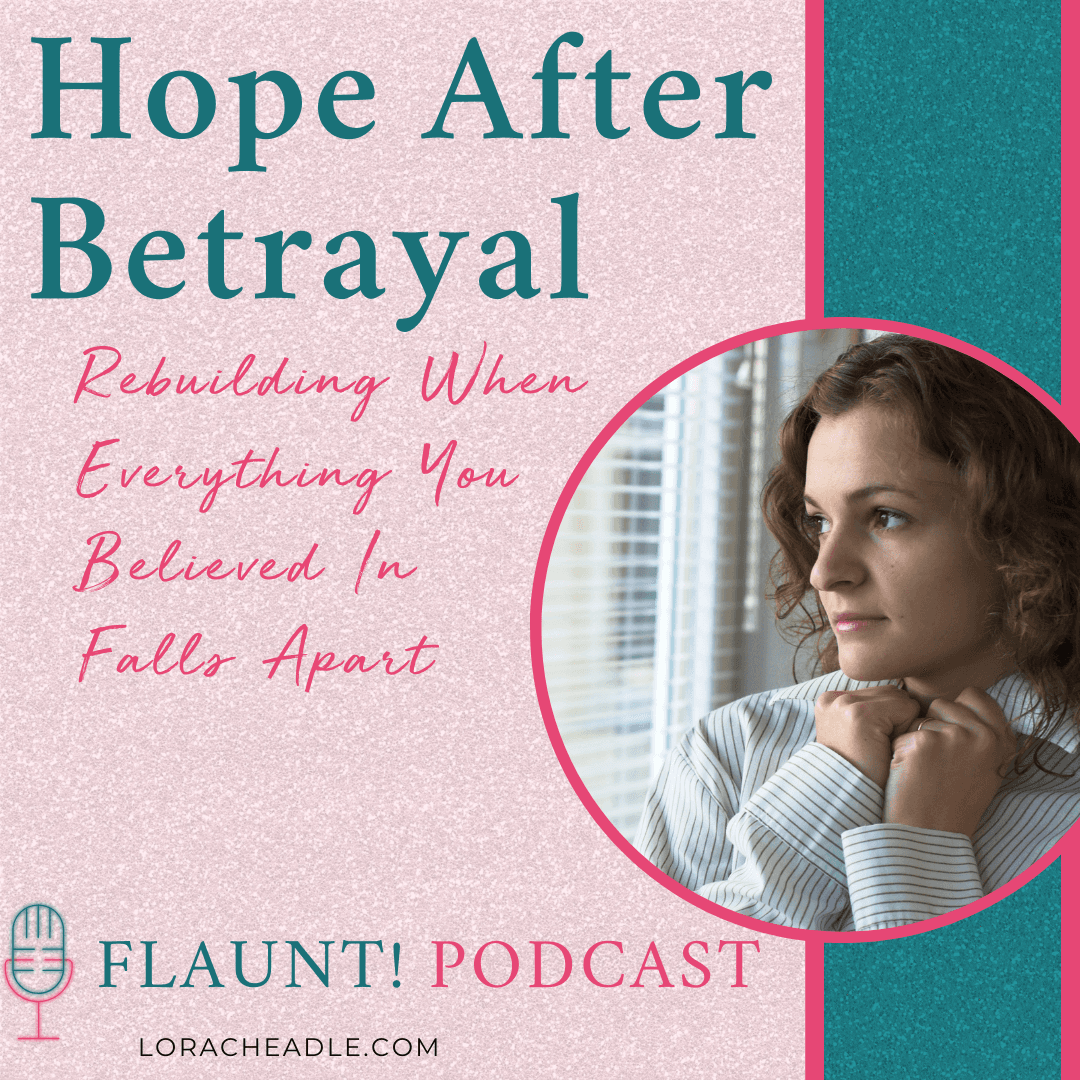
Hope After Betrayal: Rebuilding When Everything You Believed In Falls Apart
November 2, 2025
Show notes
“We don’t always realize it, but one of the hardest parts of betrayal isn’t the lies or even the loss of love—it’s the shattering of hope.” — Lora Cheadle
In this intimate episode, Lora reframes hope as the bridge between devastation and a life rebuilt—not toxic positivity or waiting for someone else to change, but grounded, embodied hope rooted in your choices, compassion, meaning, and connection. You’ll hear the four stages of hope after betrayal (from false hope to grounded hope), how to spot the difference between wishful thinking and true hope, and five practical ways to bring hope back online in your body and your life—no matter which path your relationship takes.
Top 3 Takeaways
- Name the real injury: The deepest wound of betrayal isn’t just the loss of trust—it’s the death of hope. Feeling hopeless is a nervous-system protection, not a personal failure.
- True hope vs. toxic hope: Toxic hope waits for someone else to change; true hope trusts you to create peace, safety, and joy again—regardless of the outcome.
- From flicker to foundation: Rebuild hope through Connection, Choice, Compassion, Meaning/Faith, and Embodiment—small, consistent actions that restore agency and let your body feel hopeful again.
Favorite Quote
“The deepest wound of betrayal isn’t just the loss of trust—it’s the death of hope.”
Special Offers
- $97 Introductory Session – “Hope Rebuild Session” One hour, 1:1 on Zoom to locate your stage of healing and map your next right step. Book at: IntroductorySession.com
- Free FLAUNT!® Book Club + Workshop (Dec 1) Walk through the five steps of FLAUNT! to move from collapse to expansion—and rekindle hope. Register free: TheFlauntBook.com (buy the book wherever books are sold)
- Free Betrayal Recovery Guide Your step-by-step companion for healing after infidelity. Download: BetrayalRecoveryGuide.com
LOVE THE SHOW? TAKE THE NEXT STEP
Read the transcript
Lora Cheadle [00:00:01]:
You're listening to Flaunt. Find your sparkle and create a life you love after infidelity or betrayal. A podcast for women who've been betrayed by their intimate partner and want to turn their devastation into an invitation to reclaim themselves and their worth. Tune in weekly so you can start making sense of it all and learn how to be okay on the inside, no matter what goes on on the outside. Download your free betrayal Recovery toolkit at betrayalrecoveryguide.
Lora Cheadle [00:00:36]:
The deepest wound after betrayal isn't just the loss of trust. It's the death of hope. We don't always realize it, but one of the hardest parts of betrayal, it isn't the lies. It isn't even the loss of love. It truly is the shattering of hope. Hope for your marriage. Hope for your future. Hope that life is ever going to feel normal or good again.
Lora Cheadle [00:01:08]:
The deepest wound of betrayal isn't just the loss of trust. It truly is the death of hope. And yet hope is the one thing we really can't heal without. Hope is that bridge between destruction and transformation, between destruction and our new life, between destruction and healing. Hope is that bridge. And today, that's what I want to talk about. I want to talk about how to rebuild hope, not false hope. Like, I just really hope somebody else is going to change, and I hope he's going to be different.
Lora Cheadle [00:01:54]:
And I hope, I hope, I hope, I hope. But the kind of hope that rebuilds you, a hope that becomes your compass through every stage of betrayal, recovery. For those of you who have listened to my show before, welcome back. I'm really glad to have you here. This is our space, just for us. Just for those of us who have been through this. And for those of you who are new, welcome. You have found the right place.
Lora Cheadle [00:02:33]:
Yes, I have been through this journey. I'm eight years out. I am still with my husband. I think I made just about every mistake in the book, and I learned how to do it better. And that's why I'm here, to be your guide, to show you the way, to give you those aha moments so it doesn't have to be so devastating or so hard. And to be that support when you need support and guidance. Now, we've been talking about hope. So often when we talk about betrayal, we hear about, how can I trust again? How can I ever trust him again? How can I trust another person again? How can I? And everything focuses on trust.
Lora Cheadle [00:03:27]:
And while, yes, betrayal does shatter trust more primarily, it really shatters hope because it shatters the story of the life that we thought we were living. It shatters that whole narrative of who we are and what we think is going to happen, what we expect. I do a lot of work around expectations and the show. We're definitely going to be taking a deep dive in that. But when your expectations are not met at this level, and this is like a primary level, you know what I mean? Not cheating is like one of the basic things. And when those expectations don't get met at this base of a level, really all hope collapses. Hope that other people are good, hope that you can trust other people. The ripples ripple out.
Lora Cheadle [00:04:30]:
Like, if I couldn't even trust the one person who was supposed to have my back, what hope do I have of finding somebody else? What hope do I have of trusting my employer? What hope do I have of people doing the right thing? And I want to normalize the fact that you feel hopeless. You should feel hope. Hopeless. When something this primary is taken away from you when you were violated at this level, it's supposed to make you lose hope, lose hope for humanity, lose hope for marriages, lose hope for, like. I can't tell you how many of the women and couples that I have worked with really talk a lot about. I don't know how things can even go good for me. I don't have hope of health or relationships or healing or happiness. It's this complete loss of hope which spirals them into this flat depression where then they can't even feel anything.
Lora Cheadle [00:05:37]:
And then since they can't feel anything and they don't have any hope anyway because they don't think anybody's ever going to do the right thing anyway, they just stop. They just stop. Why bother trying when there is no hope? And what I want to say to you, whether you're in a state of depression or whether you're still dealing with that hopelessness, but now it has turned to a little bit more cynicism. Feeling hopeless is not a weakness. It's the nervous system's way of protecting you. Your heart has been hurt, and your nervous system is protecting you by saying, if you don't feel hope, you're not going to try. And if you don't try, you're not going to get hurt. So it is okay that you feel hopeless right now.
Lora Cheadle [00:06:29]:
In fact, you're supposed to feel hopeless because that's the nervous system protecting that heart. But here's the thing. Hopelessness isn't a failure. Hopelessness is grief in disguise. Hopelessness is where we go to when we don't feel like we are Resourced enough to feel grief where we feel like the grief is going to overwhelm us and shut us down. Hopelessness is grief in disguise. So you might move from hopelessness to grief and it still feels bad, but at least you're feeling something where in hopelessness you're totally numb. And it's better to feel bad than it is to feel numb.
Lora Cheadle [00:07:26]:
Now I also want to touch on that whole protection mechanism. Why we're told not to hope, why people have told us since we were little, just don't get your hopes up. Don't get your hopes up again. It's protection. And I think in particular, so many betrayed women resist hope because they feel foolish and they don't want to risk feeling foolish again. So toxic hope, false positivity is not good. And when we talk about false hope, it's not. It's not false hope to think you're going to meet the love of your life or have another relationship.
Lora Cheadle [00:08:21]:
It's not false hope to think that you can't work things out. It is false hope, however, to think that somebody else is going to change. It is false hope to think that somebody else is going to give you closure. It is false hope to think that you're going to feel better when somebody else does something. And there is a fine line between that. It's false hope to say I'm going to feel better once my partner cleans up their act. If my partner would only tell me what happened and the affair partner would tell me this, that or the other thing, then I would feel better. That's not something that's healthy.
Lora Cheadle [00:09:02]:
To hope for what is healthy to hope for what is true. Healthy hope that we want to restore is a hope that I will be stronger. Hope that I can build my future. Hope that I can trust myself again. Hope that I will learn all of the ways I abandoned and betrayed myself in the past and that I will start standing up for myself in new and different ways. Hope that I will be able to create happy and joy filled moments in the future. Hope that I will feel that sense of peace and freedom again. Hope to have a stable life again.
Lora Cheadle [00:09:52]:
That's the kind of hope that I'm talking about. I want you to hope for all of the things that are within your control. Don't hope for somebody else to get healed. Don't hope for somebody else to change now. They might and they might not. But when you're placing your hope on something that's outside of you, that's not hope. That's called wishful. Thinking hope is generated inside of you and you have control over it.
Lora Cheadle [00:10:29]:
I mean, even when I was talking about, like growing up, people say, don't get your hopes up. Don't you get your hopes up. I want you to start thinking about distinguishing that phrase. If somebody says, don't get your hopes up about being valedictorian in high school, what are the things you can control? You can control your grades, you can control like this whole variety of things. So you can get your hopes up when you start taking action. Now, are you completely in charge of the way a subjective essay is graded? No. But there's a lot of things that you can do. So have hope over the things that you can control.
Lora Cheadle [00:11:11]:
You might have hoped to get pregnant, to have a baby. Some of those things are in your control, some of those things aren't. But even like with the baby analogy, I just have a client who is going through IVF right now and she's got hope that this is going to work and she's doing all of the things within her control and she's struggling with that tension of, I don't want to get my hopes up because this isn't completely in my realm of control. Like, I can control the timing, the temperature, the things that I'm eating, giving myself shots. I can control all of that. I can't control if this embryo actually attaches and implants and becomes a full term child. So it's like hope for the things that you can control and then releasing and having acceptance and surrender to those things that you can't control. I often talk about the analogy of a dance.
Lora Cheadle [00:12:22]:
Whether you're doing a tango or a two step or any kind of a partner dance, the way that you push and lead against each other and informs what the other person is doing. So yes, when you get healthy, when you become more whole, when you become the wise observer and the wise creator in your own life, you might be able to impact your partner. You might be able to get them to air quotes, change their ways because the impact that you were having on them with your own change, and you might not. The goal in healing yourself is to heal yourself. The goal to healing yourself is to heal yourself. If it impacts or changes your partner, your kids, your friends, your family, and it positively impacts them, that's bonus. That's gravy. That's fabulous.
Lora Cheadle [00:13:33]:
But you need to heal for you. And that's the kind of hope that I'm talking about. You have hope for a better life. You have hope for a better future. You can and should and will have hope over all of the things that you can control. Now, I want to be honest with you, too. We. There are stages of recovery.
Lora Cheadle [00:14:06]:
The stages of hope after betrayal go like this. Number one, false hope. I'm going to recreate the old relationship and everything is going to be fine. I'm going to let him know and he's going to change. And then she's going to do this. You know those crazy stories in your head about what they must have said or done or thought and who's going to say what, and then you're going to call her and she's going to say this, and then you're going to tell him, that's false hope. That is you desperately, weirdly, dysfunctionally, but also completely normally trying to regain control. Stage one is false hope.
Lora Cheadle [00:14:42]:
The next stage after that is hopelessness. Oh, my God. Nothing matters. This is that crash. I have spun. I have spun up into this false hope, and bam, none of it works. So it goes into a crash and the complete loss of hope that nothing matters. And like I said earlier, this is the phase where your nervous system is trying to protect you, where your nervous system is saying, I can't handle grief right now.
Lora Cheadle [00:15:17]:
So we're just going to go numb for a bit. We're going to let some things shift. We're going to do some healing, even if it's subconscious healing, until I can open myself up again. The third stage, and I see a lot of people in this stage, this is often where people sign up for coaching and come see me, is flickering hope. They see small glimpses. There's some laughter for an afternoon. They feel normal. They go to work and they're not obsessed about it for a whole afternoon.
Lora Cheadle [00:15:53]:
And they're like, whoa, that felt good. Or they see family or friends and, like, they laugh and they're free, where they're more present in themselves and they just feel a little bit better. Kind of like, I can handle this. And then what happens is they crash. This is the roller coaster. We all talk about the roller coaster. This is that roller coaster. I'm going to be okay.
Lora Cheadle [00:16:20]:
I'm not going to be okay. Everything is going to be fine. It's never going to be fine. We go through this roller coaster stage for a long period of time. And again, when you frame it in terms of hope, I have hope. I'm going to be okay. And I see evidence that I'm going to be okay. Here is the evidence that I'm going to be okay.
Lora Cheadle [00:16:40]:
I went out to dinner with my Friends and I laughed, and we didn't talk about it. I had a whole project at work, and I never even thought about it. I just dove into the project. We're starting to find evidence that we can move ahead. Somebody might smile at us, and we're like, oh, there might be good people in the world. We have a conversation with somebody, and we're like, oh, my gosh, I don't think everybody is a jerko face. We feel hope. We start collecting evidence.
Lora Cheadle [00:17:11]:
Yep, I'm gonna be okay. Yep, I'm gonna be okay. Then an intrusive thought comes. Then we have a conversation with our partner that doesn't go the way we thought, whatever it is. And then suddenly, bam. No hope. Then we have hope. No hope.
Lora Cheadle [00:17:27]:
Hope. No hope. That's our third phase. The fourth and final phase is grounded hope. And that grounded hope is knowing that you will be okay no matter what. And you might have heard me say this on podcasts, because I get a lot of emails with people saying, oh, my God, I heard you say that. And how can you say that? What do you mean? And what I say is, do I want it to work out with my husband and I? Absolutely. But I'm okay if it doesn't happen.
Lora Cheadle [00:17:59]:
Do I think he's going to cheat again? No way. I really don't think he would. But if he does, I can handle it. And people are always like, if you really think he's going to. No, I don't really think he's going to. But I have that grounded hope that no matter what happens, I'm okay. Do I think we're going to separate? No. Do I think he's going to cheat again? No.
Lora Cheadle [00:18:23]:
But my hope is so grounded and so realistic that I know, no matter what, I'm going to be okay. I'm going to be loved by family and friends. I may or may not have another relationship, but I'm going to have people in my life that love me, and it doesn't matter. I'll be okay. It's a grounded hope. Not in a hopeless way that nothing matters, but in a positive way that nothing matters. The external world can shift around me, and I can go through grief, and I can go through rage, or I could go through anger, and I could go through disappointment, and I'm still going to be okay. And not only okay.
Lora Cheadle [00:19:09]:
I'm still going to find things to look forward to. I'm still going to find things that make me happy, and I'm still capable of feeling calm and happy and good inside my body. For me, how that feels in my body. A lot of times people talk about the heart, and yes, the heart is part of it, but for me, I feel that, like, in my low belly. My low belly feels really soft. To me, hope is a soft, low belly, and it might be different for you, and that's totally fine. We don't all have to feel it the same. But when I'm feeling hopeful, my low belly feels soft and the crown of my head feels open, and my eyes feel like they're up and looking around.
Lora Cheadle [00:20:00]:
I am looking for people to smile at. I'm looking for people who are smiling at me, both literally and metaphorically. I'm looking up and I'm looking ahead. And again, I want to normalize those oscillations, those ups and downs. The rollercoaster. Totally normal. Healing is not linear. Do you get better every day? You can, but you can also have really bad days along the way.
Lora Cheadle [00:20:31]:
I had a session yesterday with one of the women that I coached, and she said, so tell me how this is for you. You know, eight years later. Do you ever think about it? And it's like, yeah, of course I think about it, but it doesn't take me down. We can still have conversations about it, or I can have a thought, and it's like, oh, yeah, that's a thing. It doesn't grab my nervous system. It doesn't raise my hackles. I don't feel threatened. I don't feel afraid.
Lora Cheadle [00:21:04]:
I feel that sense of hope throughout my life. I feel like everything is going to be okay. And that is my hope for you. And that's why we need hope to get from that place of devastation to that place of happy and healthy and free. And it's hope that will get you there. And what I want to say about that, too, is wherever you're at right now, it's okay. A hope is patient. You know, they say love is patient.
Lora Cheadle [00:21:44]:
Love is kind. It's hope. Hope is patient. Hope is kind. I want you to ride Hope right now. I want you to think about what hope means and feels like for you. I remember going back elementary school, middle school, high school. You know, I was a dancer and I sang in choir.
Lora Cheadle [00:22:17]:
And I would audition for things, and I would have hope that I would make the choir or that I would get cast in a part in the play or in the ballet. I was hopeful. And when you have hopes, you have dreams. And I would practice. I would practice my audition songs, and I would practice my dances, and I would think about all the things that I could do to make myself better. Not from a place of, like, I gotta prove myself because I'm so unworthy, but from a place of, isn't this exciting? Isn't this wonderful? And then, same thing as I grew up and practiced law. You're applying for jobs, and you have hopes. And I remember walking in this one office building, and it had, like, these beautiful floors and this big glass elevator, and it was like, oh, my God, I could work here.
Lora Cheadle [00:23:12]:
And you have hopes and you have dreams about what it might be like. And sometimes those hopes come to pass, and sometimes they don't. And it's okay, because in those moments of hope, didn't it feel good? Like, didn't it feel good to have those dreams? You know, I mentioned earlier, like, getting pregnant. You start thinking about my body and the baby and the nursery and what this is going to be like, and I'm going to be a mom. I'm going to work here. We're going to do this. I'm going to have this role. I'm going to love this.
Lora Cheadle [00:23:51]:
Like, hope to get into college. Hope. Think about all the things that you hope for and how good it feels to hope. And sometimes the further away that dream is, the more delicious it feels to hope. Sit with that. The further away something is, the more delicious it feels to hope. Like, how good does it feel to hope for something small? Feels really good. How good does it feel to hope for something big? My God, I'm going to be on Oprah's couch.
Lora Cheadle [00:24:34]:
Oh, that's a big dream. That's a big hope. That's a lot of fun. And it's the same thing here. Since when does hope become negative? When does hope become negative instead of fun? When it's not when. It's when you are already in a state of fear or trauma or grief. So noticing. How does this hope feel? God, it feels terrifying.
Lora Cheadle [00:25:17]:
Okay, I'm still. I'm still traumatized. I'm still protecting myself. Back away from that. Feel that grief. Move through some of that sadness. Okay, now, how does it feel to have hope? How does it feel to have hope of a new relationship or a better relationship? How does that hope feel? Ooh, that's starting to feel kind of exciting. But I don't want to get my hopes up there.
Lora Cheadle [00:25:39]:
Notice that. Do a little bit more healing. What are some more things you can do in you? What are some more conversations you can have? How can you have your own back? How can you facilitate some of your own healing? Okay, great. Now you're having Hope for this future. You're thinking about this amazing future and these trips in this house and this clinking champagne glasses and cuddling on the couch. How does that feel? Oh, my God. That feels so, so exciting. That feels exciting.
Lora Cheadle [00:26:10]:
This is the kind of relationship I want again, whether it's with your partner or with somebody else, once that hope starts feeling good, that's when you know you're healed. When hope starts feeling exciting and good again, that's how you know you've healed. So many people say to me, what does it mean to heal? When I first start coaching people, I ask them, what does healing mean to you? And for me, what I've really come to realize is healing means the ability to have hope again. When you're healed, you have hope. And when you can have hope, you're healed. It's like this perfect dovetail fit. If you want one, go for the other. If you want to have hope, lean into the healing.
Lora Cheadle [00:27:06]:
And if you want to have healing, lean into the hope. Assess how you feel and then do the work until that hope can feel exciting again. Now, I also want to be clear. We have different personalities. For some people, hope might feel like fireworks and blah, blah, blah. And for other people, it's like this, ah, softness or this buoyancy. How do you feel in your personality? How did Hope feel when you were hoping for whatever it was to get into college, to get her to a part, to get a raise, to get a job, to get a new car? Like, how did that hope feel to you? Notice that. Notice it in your mind, notice it in your body, and see if you can recall that feeling of hope.
Lora Cheadle [00:28:08]:
I like to say also that hope is like your soul calling you forward. There's more for you. You're not done. There's more for you. There's more for you. I'm going to pause here halfway through the show with a little bit of a call to action. If you are listening right now and if this is speaking to you either, like, oh, my gosh, I get it, something is clicking around hope and healing. Or if you're on the other extreme where you're like, it's not clicking, but I really want it to click because feeling hopeful again, what would really feel good then? I want to invite you to come have an introductory session with me.
Lora Cheadle [00:28:57]:
They are only $97. You get an hour, one on one, zoom session with me. We can talk about hope, we can talk about healing. You can tell me your story, you cannot tell me your story. It is our time together where we can assess where you're at, what you need, what might be possible for you. Just go to introductory session.com. that's the calendar and the payment link right there. Www.introductorysession.com.
Lora Cheadle [00:29:34]:
we can figure this out. This is a lot of work, and I know how hard it is to talk to somebody about it. I so vividly remember when I first found out, knowing that I needed to talk to somebody and to get help. But I didn't want to say anything to anyone. First, because I was embarrassed. I didn't think I was the kind of person that would get cheated on. I was like, how could this happen to me? That doesn't even make sense. Second, I didn't have hope.
Lora Cheadle [00:30:11]:
I had no hope that they could help me. I thought I was so different. I even told the first lady, I talked to him like, we're totally different. Like, we were in love. We are not total freako people who are living in garbage. We're like normal, healthy, happy, educated people. We are so different. I don't know if you can help us, because that's what I thought.
Lora Cheadle [00:30:38]:
I thought we have no hope. We are different. We're different. We're different. That happens to other people, not like us. Let me fill you in on a secret. We weren't different, and you're not different, and that's kind of jarring. Affairs happen to people like us.
Lora Cheadle [00:31:01]:
Affairs happen to educated people, to happy, healthy, functional people, to dysfunctional people who haven't dealt with their trauma. Affairs happen in every socioeconomic class. You fit the mold. Like that, to me, was so shocking. What? My husband and I, we fit the mold. No, no, no, no, no, no, no. Other people have that. So I didn't reach out right away because I didn't think there was any hope in it, because I thought we were so different.
Lora Cheadle [00:31:35]:
I thought I would be judged. I thought it wasn't going to help anyway. And then I also didn't want to get my hopes up. I didn't want to get my hopes up and then find out it wasn't going to work and then have no hope. Have you ever heard about Schrodinger's cat? There's this. I don't even know what it is. It's not a story. It's not an allegory.
Lora Cheadle [00:32:02]:
It's. I don't even know there's a word for it, but Schrodinger's cat in a box. Is the cat in the box alive or dead? Until you open the box and see if the cat is alive or dead. It's in this state of infinite possibilities. The cat could be alive, the cat could be dead, and that box with a cat in it is there. And you can have all of these different dreams about the cat and whether it's alive or dead and what the cat might do tomorrow and da, da, da, da, da. And until you open the box and know you're in a state of possibility, you're in a state of hope. And that's how it was for me.
Lora Cheadle [00:32:48]:
It was like, I'm terrified to reach out and get help and talk to somebody because what if they tell me it's not going to work? What if I find out the cat's dead and then I have no hope and then I have to deal with that. And as long as I'm in this state of not getting help and not talking to somebody, the cat is both alive and dead all at the same time. And I have this weird sense of twisted hope. And I was so afraid somebody was going to tell me the cat was dead. And I'm curious about you. Where do you sit with that? Do you kind of have that sense of hovering and being like, I'm not in and I'm not out. The cat's not alive. The cat's not dead.
Lora Cheadle [00:33:36]:
Oh, my God. I also took a ton of online quizzes. Is this going. What kind of affair is it? You know what I mean? Is it going to work? Is this going to. Is your. Will your marriage survive? Will you? Because I wanted somebody to tell me, but I didn't want them to tell me what I didn't want to hear, because I wanted the hope that I could figure out what I wanted and then get what I wanted. It's a little convoluted, but I think. No, no, no.
Lora Cheadle [00:34:06]:
I know, I know. You get where I'm coming from on this one. So reach out. Www.innumeratelysession.com I'm not going to tell you that the cat is dead because I don't know. But I am going to tell you about hope. I'm going to help you figure out the hope, whether the cat is alive or dead and what to do. So let's talk a little bit next about how to rebuild hope. I have got five actionable and spiritual steps to give you to help restore hope.
Lora Cheadle [00:34:50]:
Because whether the proverbial cat is alive or dead, you still have hope. It just might go in different directions. Okay? The very first way to rebuild hope in whatever stage that you're at is through connection. Both you connecting with other people, friends, colleagues, co workers, People in your life, people in your environment, but also in communities like this, with others who have reignited their marriages, with others who have separated but have found connection elsewhere. Look for the happy stories. What you look for is what you will find. What you look for is what you will find. I reached a point where I had to back out of a lot of Facebook groups and I had to stop reading certain blogs and listening to certain podcasts because it was all about how bad things were and how it was never going to work out and how my.
Lora Cheadle [00:36:11]:
The fact that my husband was kind of showing up to repair things and how that really wasn't real and how I needed to be aware because there's no such thing as a unicorn. Don't go down that path. And I had to distance myself because I'm like, this isn't connection. This is stoking my fear. I needed to see connection. I needed to see people who were doing amazing things. I wanted to see the couples who had made it. Early on, my husband and I actually went to a conference filled with people who had made it work after infidelity.
Lora Cheadle [00:36:54]:
And we all talked to each other and we all told stories. And it's like I'm witnessing that it can happen. And I'm also witnessing people who it didn't happen for, but who made these amazing lives afterwards. So I am seeing all this happy connection, both in partnership and on your own. And that just reignited all of my hope. My hope in humanity, my hope in healing, my hope in everything. So that's the number one way to rebuild hope, is by finding and rebuilding that connection. Put yourself in environments where people have happy, healthy connection.
Lora Cheadle [00:37:33]:
Put yourself in healing communities where people are healing and thriving. And stay away from all the negativity. Stay away from all of the fear. The second way to rebuild hope is through choice, making even micro decisions. But having an awareness around those micro decisions really helps you restore your agency. And it can be small. It should be small when you start because it helps reinforce that you can do it. What do I want to make for dinner? There was that Runaway Bride movie with Julia Roberts where she always was so enmeshed with a guy that she didn't even know how she liked her eggs.
Lora Cheadle [00:38:22]:
So there's the scene where she's like, I have. Do I like him scrambled? Do I like them fried? Do I like them poached? She had eggs in all the different ways so she could figure out how to. How she liked her eggs. I had a client who did that with fabric softener. She was Like, I always use the same kind of fabric softener because my husband's mom used it. So we just used it. She's like, when we separated, I went to the store and I smelled fabric softener because I didn't know what kind of fabric softener I wanted. These are those micro choices.
Lora Cheadle [00:38:55]:
I choose to feed my body healthy. I choose to go outside and take a walk. I choose to smile and laugh. I choose to call a friend. I choose to say yes or no to a conversation with my partner. I choose make little tiny choices, build your confidence and build your hope that you can do a good job. Because so many people say to me, I think my picker is broken. How did I pick such a bad person? I didn't think I was picking somebody who was bad.
Lora Cheadle [00:39:28]:
So then all of a sudden we think, I make bad decisions. You don't make bad decisions. That's victim blaming. Do not blame the victim. Yes, you have been victimized. You don't have to wear the hat of the victim and play that role forever. But yeah, if you've been betrayed, you've been victimized. Don't blame yourself by making it your fault, because it's not.
Lora Cheadle [00:39:51]:
You didn't choose the wrong person. You chose a great person for a lot of great reasons. And that person made choices that betrayed your trust. When you lean into making your own choices now, it's going to help you rebuild choice, rebuild hope, connection, engaging in it and witnessing it, and choice, making small little choices. Number three, compassion. Compassion. Number three is compassion. I can't even tell you how powerful leaning into compassion is.
Lora Cheadle [00:40:34]:
Not only compassion for the other person, because that's really powerful too, but compassion for yourself. Compassion that you are not where you're supposed to be, compassion that you made a choice, compassion that you didn't make a choice, compassion that you haven't healed quickly enough, compassion that you spiritually bypassed whatever it is, have compassion for yourself along the journey. Your life has been rocked, your heart has been broken, your soul feels like it's been shattered. Can you give yourself a little bit of compassion?
Lora Cheadle [00:41:10]:
Yes.
Lora Cheadle [00:41:11]:
That helps you have hope. If this were your friend going through this, think how much compassion you would have for them. How can you bring that amount of compassion to yourself? And I also want to talk about compassion for your partner. And do you feel prickly when I say that? That's okay. It's okay if you feel prickly. But I want to talk about compassion for them and for their journey. And again, I am not excusing what they did, but how can you feel compassionate that they are going through a lot too? And I know all the things that you will be saying, like, oh, my God, it was their choice. I don't really care about them.
Lora Cheadle [00:42:07]:
They brought this upon themselves. How would they not know? Yes. And go to that human level of when we make mistakes, it still feels bad to eat crow. When we make mistakes, it's still really hard to own up to them. Even if it's our fault, even if we deserve it, it's still really hard. So just having some compassion for God, it would be really hard to sit in this. If I made this mistake, if I made these choices, if I chose this plan of action and then I had to sit in it. Can you imagine how bad that would feel? In a lot of ways, I'd rather be on this side of things than on the other side of things.
Lora Cheadle [00:43:01]:
I think it would feel awful to be a perpetrator. I think it would be awful to victimize somebody, and that would be really hard to stand myself. So can you find, even if it's the tiniest glimmer of compassion for your partner, for the other women, for other people involved in this situation, just a glimmer, not excusing them, not bypassing them, just on the human level, can you find that compassion for them and then for yourself? Because that is the third way to start rebuilding hope. The number four way to start rebuilding hope is either through faith or through finding meaning in this. It's anchoring into something that is bigger. Is it divine timing? Do you think you've got a soul contract with this other person? Is this about ancestral healing? Is this about God? Whatever it is for you, why would God do this? What is the greater purpose? What is the greater meaning? I very clearly feel like my husband and I had a soul contract. I feel like his ancestral wound was, well, a few things, but around abandonment and very conditional love. And I feel like this experience that we've gone through has allowed him to experience what true unconditional love is like.
Lora Cheadle [00:44:57]:
He did pretty much one of the worst things you can do to a partner in a marriage, and yet he's still receiving love from this. That's a balm for a deep wound that to me, feels like a soul contract. On the other side of that coin, he helped me step into my power, step into my voice, step into my agency. He helped me stop betraying myself. He helped me stop putting myself last. I am so never going to put myself last again. I used to put myself last all the time. It's going to be every.
Lora Cheadle [00:45:38]:
I'll do everything for anyone, all the time. And if I have needs, I'll figure them out or I'll sacrifice. We helped each other grow. That was like my ancestral wound, also just being female, because females historically have been undervalued and have not been entitled to speaking up, identifying their needs, or fulfilling their needs. So I feel like, for me, there was definitely a soul contract here. I understand the meaning around that, and it helps me make sense of it in a way. Does it matter if it's true or not? No, because it makes me feel better because I've made sense of it. So whatever it is for you, whether it's religion, whether it's faith, whether it's soul contract, whether it's ancestral healing, how can you make meaning of this? And when you have meaning, then you have hope, because it's not.
Lora Cheadle [00:46:46]:
Your pain was for a purpose. Your pain was about something bigger than you. It wasn't just this personal experience that you were slighted because you were bad. There's purpose, there's meaning. And when it makes sense, you've got hope. Because you're like, ah, I learned. It was hard and I learned, and now I'm better. And the number fifth way to rebuild hope is embodiment.
Lora Cheadle [00:47:18]:
Embodiment. I say this all the time, but you can't think your way out of trauma. You can't think your way into hope. You have to feel your way into hope. You have to feel your way through trauma. You have to feel breath, touch, movement, joy. What does it feel like to embody hope when you can embody hope? You get out of bed in the morning, you try again. You lean in, you make calls, you take medication, if that's what you need.
Lora Cheadle [00:48:05]:
You eat good, you work out. When you feel it in your body, when your body is smiling at you, when you. And this might sound superficial, but it's not. When you dress cute, when you do your hair and makeup, you feel better. And you're embodying hope because you like the way you look in the mirror. So it's not superficial. Go buy yourself a cute top, nice shoes, earrings, get up, get dressed, and embody somebody that has hope. Embody somebody that has connection, makes choices, feels compassion, has understood and made meaning of things.
Lora Cheadle [00:48:53]:
And embody what it feels like to have hope. And again, like I said earlier, go back to all those times earlier when you had all that hope. I'm going to get cast in the play. Ooh, I hope I get accepted to the school, whatever it is. Those are the Five ways to have hope. Closing it out. My book, my ip Flaunt. Drop your cover and reveal your smart, sexy and spiritual self.
Lora Cheadle [00:49:29]:
It's all about the energy. A flaunt. When we are hurt, we crumple and we collapse and we fold in and we protect ourselves. When we flaunt, we are eyes open, smile, positive expectations. We are filled with hope. Flaunt is about hope. If you haven't already, grab the book. You can get it on Amazon, Barnes and Noble, New World Library, anywhere books are sold, you can get a copy of the book.
Lora Cheadle [00:50:07]:
Flaunt is an acronym. It'll take you through that framework. But it is that framework of finding hope. It's that framework of going from collapse to expansion. And when you're expanded and open, that's when you have hope. Now, to make it even better, we have a free Flaunt book club and workshop coming up on December 1st. Yep, book club and workshop that goes through all of this. That takes you through the five steps of Flaunt.
Lora Cheadle [00:50:48]:
We walk through the book, we do the activities, and it helps you develop that presence, that power, that hope, that upliftment. So you will definitely not want to miss that to register. It's free. It is all free. The flauntbook.com the flauntbook.com that will put you on the list. You can't buy the book there. That is just to get you the zoom link for the book club and workshop and to give you those details. Buy the book wherever books are sold.
Lora Cheadle [00:51:28]:
Go to theflauntbook.com Register for the book club and workshop. Start reading so you can be ready. Start reading and start finding hope. Start. Start reading. Start flaunting and start finding hope. Hope for peace. Hope for purpose.
Lora Cheadle [00:51:58]:
Hope for you. Hope beyond just the relationship. It's not just about a happy ending. Even if you don't believe in happy endings or even if you don't want this happy ending, can you believe in the possibility that you will get some sort of happy ending, maybe even happier than you originally thought? You just haven't thought about it yet because we get so locked into what I had and what I lost. Well, what if you lost it? Because there's something better on the horizon for you. If it's safe for you to close your eyes, I want you to close your eyes right now. I want you to imagine, visualize, or pretend that it's one year from today. And I want you to see yourself, your posture, how are you carrying yourself.
Lora Cheadle [00:53:03]:
I want you to feel yourself on the inside, steady radiant, smiling, peaceful. Whatever it is, feel yourself on the inside. That version of you exists. See her there, feel her there and see where you're at now. Hope is the bridge that is going to get you where you want to be. The fact that you can see yourself means that version of you exists. She is proof that hope was never gone. It was just waiting for you to reconnect, to remember.
Lora Cheadle [00:54:01]:
To remember the power of hope. Whether you're joining us for the book Club and the workshop on December 1st the flauntbook.com or whether you are joining me individually in a one on one introductory sex sec session, I can't say that word@introductory session.com. please know that I have hope for you. That there is hope, there is healing. And just because you can't quite see your future yet doesn't mean that your future isn't out there better, happier and more positive than before. I really look forward to having a session with you or to seeing you in our group workshop. Have an amazing week and as usual, always remember to flaunt exactly who you are. Because who you are is always more that enough.
Lora Cheadle [00:55:22]:
Tune in next time to flaunt, find your sparkle and create a life you love after Infidelity or Betrayal with Laura Cheadle every Wednesday at 7am and 7pm Eastern Standard Time on syndicated Dream Vision 7 radio network. Uncover the truth of what's possible for you on the other side of betrayal and develop the skills and strength strategies necessary to embrace the future and flourish today. Download your free Betrayal Recovery toolkit@betrayalrecoveryguide.com.
Never miss an episode
