
FLAUNT! Podcast · Infidelity & Betrayal · Betrayal Trauma
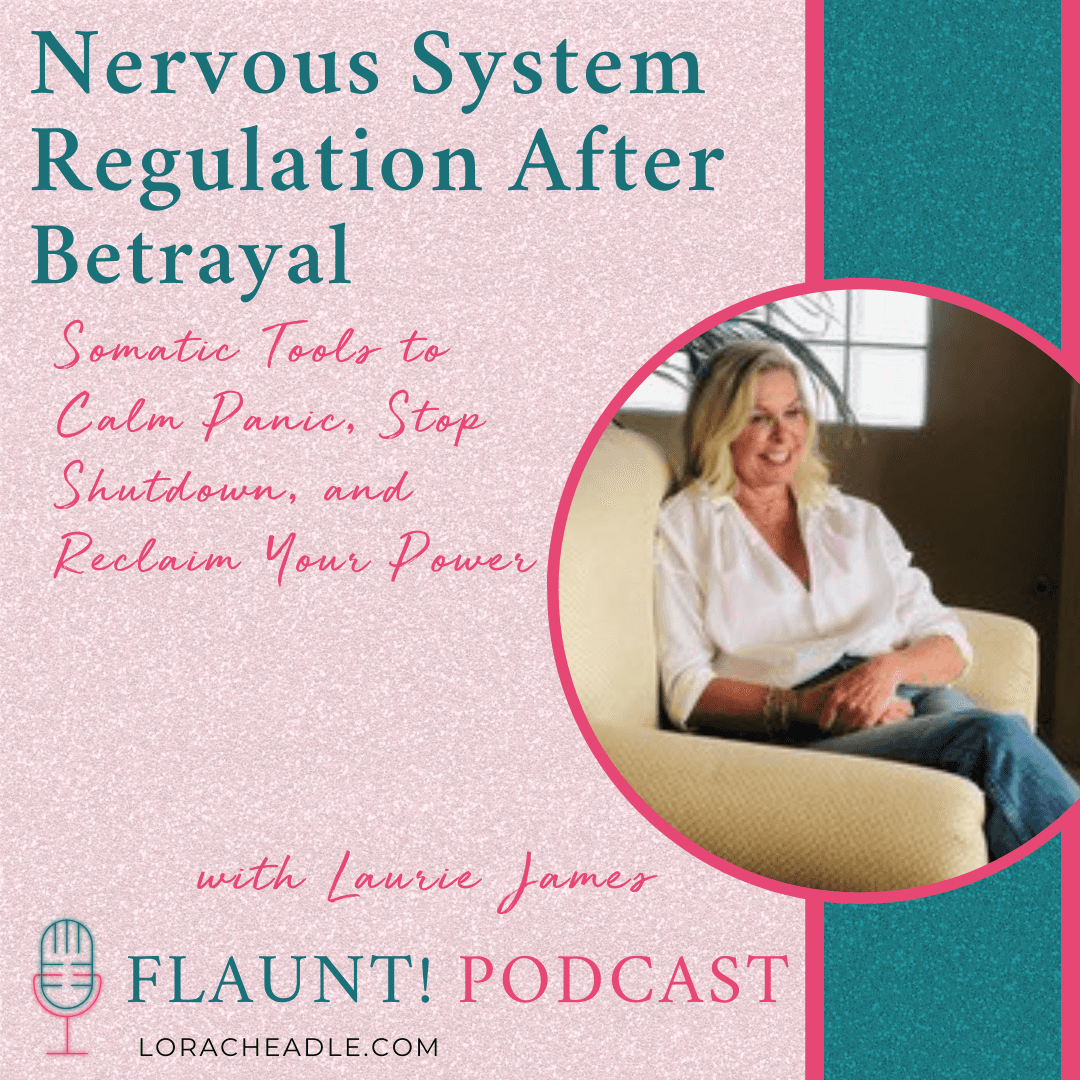
Nervous System Regulation After Betrayal: Somatic Tools to Calm Panic, Stop Shutdown, and Reclaim Your Power
September 14, 2025 · with Laurie James
Show notes
“Sensations are the language of the nervous system. When you notice—and stay with—the feeling, the cycle completes and your system comes back to safety.” -- Laurie James
When betrayal scrambles your nervous system, healing isn’t just “mindset”—it’s body-based. In this episode, we unpack somatic, practical ways to calm panic, prevent shutdown, and rebuild your capacity so you can make clear decisions and feel safe again.
Betrayal shocks the body as much as the mind. Lora talks with somatic practitioner and coach Laurie James about nervous system regulation after infidelity—what “somatic” really means, how polyvagal states show up (ventral vagal, sympathetic, dorsal), and simple practices that help you come out of anxiety, numbness, or overwhelm. You’ll learn how to complete the stress cycle, set body boundaries, and create five-minute rituals that expand your capacity without adding more to your plate. Whether you’re staying, leaving, or still deciding, these tools help you feel safer now—so you can choose your next step from clarity, not crisis.
Top 3 Takeaways
- Know your state to change your state. Learn the cues of ventral (present/connected), sympathetic (fight/flight), and dorsal (shutdown). Naming your state reduces shame and gives you a map back to safety.
- Small pockets > big pushes. Micro-practices (5 minutes to ground, orient, breathe, feel sensations) complete the stress cycle and build capacity—so you can handle life with more ease and fewer blowups.
- Somatic ≠ “just think positive.” 80% of information travels from body to brain; regulation starts in the body. Gentle, titrated work prevents re-traumatization and supports wiser decisions during hard conversations, mediation, or reconciliation.
Subscribe, rate, and review FLAUNT! to help others uncover the power of radical self-worth and post-betrayal joy.
About Laurie James
About Laurie James — Somatic Practitioner & Life Coach
Laurie James is a mother, divorcée, recovering caregiver turned author, somatic relationship coach, and podcaster. Laurie’s podcast, Confessions of a Freebird, was inspired by her youngest of four children leaving the nest and is the sequel to her book, Sandwiched: A Memoir of Holding On and Letting Go.
Laurie’s book is about her journey from loneliness to finding belonging during a time when she was raising four teenage daughters, her mother had a heart attack and needed care, all while her marriage began to crumble.
Now Laurie helps women divorce, heal, and date differently in midlife. She blends her coaching and somatic training to help her clients develop a better relationship with their bodies and nervous system. Doing so allows them to find the inner freedom to experience more happiness, joy and create the life they desire.
When she is not coaching clients or podcasting, she can be found nurturing her free spirit by walking her dog, skiing, sailing, hiking, spending time with close friends or planning her next adventure.
Website: https://www.laurieejames.com/
Podcast (site page): https://www.laurieejames.com/podcast2
Podcast (Apple): https://podcasts.apple.com/us/podcast/confessions-of-a-freebird-midlife-divorce-heal/id1694026063
Free download – Beginner’s Guide to Somatic Healing: https://notable-apricot-657.myflodesk.com
Read the transcript
Lora Cheadle [00:00:01]:
You're listening to Flaunt. Find your sparkle and create a life you love after Infidelity or Betrayal. A podcast for women who've been betrayed by their intimate partner and want to turn their devastation into an invitation to reclaim themselves and their worth. Tune in weekly so you can start making sense of it all and learn how to be okay on the inside no matter what goes on on the outside. Download your free Betrayal Recovery toolkit@betrayalrecoveryguide.com here's the thing about infidelity. You don't have to do the healing alone. You shouldn't do the healing alone. Because if you're anything like me when you're alone, when you're in it, that's when you start spiraling.
Lora Cheadle [00:00:50]:
That's when you start making up all of these stories in your head about how bad things are and what it meant and how you're never going to get over it and how unfair it was. And pretty soon it you don't feel better, you feel worse. That's why I have created the Sanctuary of the Soul. It is a $47 a month membership where healing meets sisterhood meets soul level support. Starting September 13, you will join me and other women going through exactly what you are going through every month in a live two hour group coaching call. You will also get a monthly moon ritual to help align your energy, continue the process of sacred release and intention setting. You'll also get monthly somatic processing videos, sometimes in the form of dance so you can learn a dance and shake your groove. Other times in the form of small movements that you can do every day in the moment that will help calm, realign your nervous system and bring you back home to who you are.
Lora Cheadle [00:02:14]:
This is the kind of deep soul level connection that can only happen in a safe sacred circle with other women who truly get it. If you've been betrayed, you know the ache in your heart, you know the questions in your mind and the exhaustion, the knots in your body. But you also know the longing. The longing for a safe place to land, to be held, to be witnessed and to rise into your own power. You can join right now for only 47amonth. You can cancel any, anytime, but this is your opportunity to start building the future that you choose. Sacred, sovereign and free. Go to SparkleAllSeason.com and claim your spot in the Sanctuary of the Soul today.
Lora Cheadle [00:03:14]:
Because healing is powerful, but healing together is unstoppable. My life would be perfect if I could just take care of this whole infidelity thing. Everything was fine and then this infidelity thing, it just knocked me off and I just want to get back to it because then everything is going to be fine. If you have ever thought that, then this show is absolutely 100% for you. Today we are going to talk about nervous system regulation. We are going to talk about all the things that are wearing you down, stressing you out and causing you to just feel like a cat with our claws out. My guest today is Lori James and she is a certified somatic practitioner and life coach who specializes in somatic and body based modalities, including so many different things that she's going to talk to you about today. But I recently had the opportunity to be a guest on her show and I think it was just one of those magic moments where it was like, oh my gosh, we're speaking each other's language.
Lora Cheadle [00:04:28]:
And I knew you all had to hear from her. So welcome to the show. Laurie, I'm so glad that you're here.
Laurie James [00:04:36]:
Yeah, thank you, Laura. No, there was definitely a connection right off the bat. And my God, you have such great energy too. And so your listeners are very lucky. And I'm so excited to dive into this conversation and share what I know about nervous system regulation and healing trauma and all the joys and all the muck that.
Lora Cheadle [00:05:01]:
Exactly.
Laurie James [00:05:02]:
Or have been in and got out and now we're helping others do it. Exactly.
Lora Cheadle [00:05:08]:
Let's start just kind of with the basics because I feel like nervous system regulation is kind of a buzz phrase and we're all like, yeah, I got to regulate my nervous system.
Laurie James [00:05:16]:
Yeah.
Lora Cheadle [00:05:17]:
How's your. What does that even.
Laurie James [00:05:19]:
People. People are doing it well. So I'd love to actually start with a story, if I may, about what happened because I think through story people will understand a little bit more. And then I will go into the definition of what somatic experiencing is, because it's all related. Right. So I went through a divorce. You know, I wrote about it. And at the tail end of my book, spoiler alert, which is Sandwiched a memoir of holding on and Letting Go, about the sandwich generation and about my introspective journey through a very long eight year period of time in my life.
Laurie James [00:05:58]:
But at the end of that book, I fell very ill and I ended up in the hospital twice within a two week period of time. And the doctors could not figure out what was wrong with me. And if we backtrack. Two weeks prior to all that happening, I was walking with two friends and I said, you know, everything is really good, but I'm stressed and I don't know how to back out of it. Right. I. My nervous system was very dysregulated. I had lived in a very dysregulated.
Laurie James [00:06:32]:
My world was very dysregulated because I was caring for elderly parents for 10 years. My marriage was falling apart. I had been raising 10. Not 10 kids. Sorry, not 10 kids. Four. Four, but four felt like 10 sometimes. And I was a doer.
Laurie James [00:06:48]:
I got shit done, but at the expense, my own expense. And so my body shut down in that period because I didn't know how to back out of what was going on inside. So. And doctors couldn't figure out what was wrong with me. I had all kinds of weird ailments, like, you know, fluid around my lungs. I had migrating arthritis. These like, hot spots. Severe pain in my lower back that caused vertigo.
Laurie James [00:07:25]:
The. They were chasing my symptoms. Low oxygen level, anemic, low blood pressure. I kept passing out. That was my body slowly shutting down. Yeah. Because what happens is I was even further above my sympathetic nervous system and up what we call dorsal vagal. And that's when we shut down.
Laurie James [00:07:47]:
So I eventually was. Was diagnosed with an unnamed virus of the migrating arthritis. I had not done any somatic work. I was in tune with my body and had done some energy work and was writing my book, which was very cathartic. And I was working with a talk therapist. But I hadn't done a lot of body work like yoga and some meditation and those types of things. Some spiritual spirituality around being more present and, you know, Eckhart Tolle and all that. But when I got well enough, which was a couple months because I couldn't do anything for two weeks, and, you know, news alert listeners, don't let your body fall to the level that mine did.
Laurie James [00:08:37]:
Yeah. Warning. So when I was well enough and I was able to drive, I started working with a somatic practitioner that a therapist friend referred me to. His name is Bob, really great guy. He was a therapist and a somatic experiencing practitioner. So what is somatic experiencing? Somatic comes from the Greek word soma, which means body experiencing. It's experiencing the body. What is happening inside our body.
Laurie James [00:09:15]:
Because what happens. Our society has not taught us how to complete the fight flight or freeze response that our bodies naturally do and has kept us alive for all these years. Right. And we don't want to over. And we have overridden them. So that energy stays stuck in our nervous system and can wreak havoc on our bodies. And first it is in the term of, you know, it shows up as unease in our body. So that could be like a restriction in the chest or, you know, that gut restriction or churning or tightness in the shoulders.
Laurie James [00:10:01]:
Then it turns into unease in the body. Could be joint pain, it could be ibs, chronic symptoms. Because you, when your nervous system is in a constant state of stress or what we call the sympathetic nervous system, it is constricted and then eventually it goes up into dorsal vagal, which is shut down, which is what I happen to sadly experience. And I tell you, the year, the first year that I worked with the somatic practitioner and therapist, I did more healing in that year than I did five and a half years of talk therapy.
Lora Cheadle [00:10:42]:
Oh yeah, 100%.
Laurie James [00:10:46]:
So the more. And the nervous system are. They're afferent. So 80% of our sensory information travels from our body up to our brain. Only 20% travels from our brain to our body. So yes, affirmations are important. Yes, mindfulness work is important. But until you can really start connecting with your body, and we'll talk later about how to do that, that's when the real healing happens.
Laurie James [00:11:18]:
Yes. Nervous system regulation and body based healing is the foundation, in my opinion, of all healing.
Lora Cheadle [00:11:28]:
Yes. I 100% agree with you. Because we are bodies. We are bodies. We live inside our body. Whether you think it's the soul or just magnetic energy or whatever, we are in body. And when you talk about what is somatic experiencing. It's experiencing having a body.
Laurie James [00:11:48]:
Yeah. And it's experiencing also the emotions. Right. We have, we're, we are human beings and we are emotional beings. And our society has also taught us not to feel. Yes. And our parents and our, you know, whether it's the way you were raised or our society. And when we don't feel and we shove stuff down, which I did a lot of in my marriage, which I'm also divorced for all you women and I had, I experienced betrayal in a very severe way, which wasn't infidelity, but it felt equal to.
Laurie James [00:12:29]:
And I even said in therapy, when we were in couples therapy, this is just as bad to me as infidelity. Yes.
Lora Cheadle [00:12:37]:
Yeah.
Laurie James [00:12:37]:
But I didn't leave.
Lora Cheadle [00:12:39]:
Right.
Laurie James [00:12:39]:
Because it wasn't infidelity.
Lora Cheadle [00:12:41]:
Right, right. But betrayal is betrayal. It's that. Yeah, it hurts the body. And you know, when you're talking about we are emotional beings and it doesn't always feel good to feel.
Laurie James [00:12:54]:
Right.
Lora Cheadle [00:12:55]:
You know?
Laurie James [00:12:56]:
Yeah. I mean, emotion, when we feel it, can it, it is like physical pain. You experience physical pain. And here's one of the beautiful things, you know, and the other thing I want to talk about just briefly about somatic experiences. So the program I was trained under was by Peter Levine. He is the creator of Somatic Experiencing. It's a three year program. You know, somebody's somatic informed.
Laurie James [00:13:24]:
There's a lot of people that are using the word somatic and nervous system regulation and they don't necessarily know what they're doing.
Lora Cheadle [00:13:32]:
Yes.
Laurie James [00:13:32]:
And so it's so, you know, whether you work with me or you work with Laura or you work with somebody else, if you're listening, make sure that they have been trained in a well respected program. I just want to say it because somatic and nervous system regulation is buzzword right now and it's getting thrown out all over the place.
Lora Cheadle [00:13:54]:
Yeah, yeah. I'm so glad, yeah, so glad that you said that. Because yes. Can we do things on our own? Yes. Can well meaning people help us? Yes. But at the same time we need to be careful with ourselves. We need to be careful with our bodies, we need to be careful with our emotions. We don't want to be pushed somewhere where we're not ready to be.
Laurie James [00:14:15]:
Yeah, yeah. And that's why also, you know, in our, in the somatic world and coaching, we process in small doses. Sometimes we talk about just touching the edges of that if it feels too big or too overwhelming for, you know, when I'm working with my clients, if it feels. Because we don't want to overwhelm the nervous system. Because if we overwhelm the nervous system, then we're re traumatizing the individual and we don't want that. So if we just touch the edges or just go into it a little bit. And that's why healing is a process and it takes time to heal because we want to do it in small tolerable doses or steps.
Lora Cheadle [00:15:00]:
Yes. And I love that word tolerable because wherever you are at right now, you've been through some stuff, you will continue to be go through some stuff and finding that tolerable is how do I feel okay, in my everyday life without numbing out and without pushing myself to that place of shutdown. And yeah, it's. It's sometimes a never ending. How do I feel right now? How do I feel right now? What do I need right now? What do I need right now?
Laurie James [00:15:33]:
Sometimes it's like a minute by minute, like when I was in my shit and you know, and healing and you know, what I write about in my book. I mean sometimes it was like, what, what do I need to do to get through this hour, what time? What do I need to get through this day? What do I need to do to get through this week? Especially when you're in it and you're dealing with betrayal and you're dealing with your current or soon to be ex spouse and you've got kids and you've got family that you're taking care of and you've working, it is a lot.
Lora Cheadle [00:16:10]:
Yes, it is. And when you talk about nervous system regulation, like what it really means is not being perfect 24 7. It doesn't mean, well, if I have a regulated nervous system, I'll be able to handle everything all the time. To me, and I want your opinion on this, but to me, nervous system regulation really is about that awareness. And sometimes I go into it and sometimes I go out of it, but I try to at least be aware of I'm losing it and what can I do to bring myself back, Right?
Laurie James [00:16:42]:
So yes, yes, yes, yes, yes. And so within. So within somatic experiencing and nervous system regulation, this actually stems a little bit more from polyvagal theory. But we have three different parts of our nervous system. We have our ventral vagal, we have our sympathetic, and then we have our dorsal vagal. So ventral vagal is like our parasympathetic, that is joy, when we can be present. That's, you know, when we feel grounded, when we feel curious and compassionate and mindful. Right.
Laurie James [00:17:19]:
That is, we also call that our parasympathetic or rest and digest state. Then we have the next level is our sympathetic. That's when we're in fight flight. And there's obviously various degrees. You know, somebody cuts you off, you know, on, on the freeway versus you're fighting for your life or you're fighting to keep somebody else alive. Like, you know. But what happens is when we're more in our sympathetic, we feel more frustration, we feel more irritation, we have more fear, panic, rage, anger. Those are the feelings that are associated with it.
Laurie James [00:17:56]:
And then we go up to our dorsal vagal. That's what happened to me where you shut down, you feel hopeless, you feel trapped, you feel a lot of shame, you feel disassociation, maybe even moving towards depression or numbness. And what's interesting about those three scenes states is our thought patterns are also very associated. So when we're in our ventral vagal and you know, that social engagement, that's our parasympathetic, we feel like we can, I can do this. I'm capable, even though that this is really difficult, I'm going to be okay. Even if my world feels like it's going to fall apart, you still have some curiosity. You feel like you have belonging in a place in the world. When we're up in our sympathetic, which is where we're feeling anger, fear, panic, anxiety.
Laurie James [00:18:52]:
You're like, I'm scared to do this. I'm afraid they won't like me. I'm afraid of being rejected. I have to do this now or else I'm not going to be able to sleep. There isn't enough time. This isn't going to work out. And then when we go up into our dorsal vagal, which is, I need to. You know, I need to, but I can't.
Laurie James [00:19:14]:
You're more in a free state. I need to, but I can't. I want to learn, but I. I want to lean into this relationship, but I can't. I have to, but I can't. I married the wrong person. No. If I divorce, nobody will want me.
Laurie James [00:19:25]:
Right. Those are so. It's really interesting. The more I've dug into this and through the training, you know, so the key is, even if your life is really challenging and you've got all this stuff going on, it's important to take small opportunities. Even if it's five minutes twice a day, to just sit with yourself, feel the sensations or emotions, even if it's just for five minutes. And I have a free guide that's got. They're like little sensation bubbles. So if you're unfamiliar, like, I've never checked in with my body, like, I don't know what that is.
Laurie James [00:20:10]:
It's a. It's a guide that will help walk you through that.
Lora Cheadle [00:20:14]:
Yeah.
Laurie James [00:20:14]:
Yeah.
Lora Cheadle [00:20:15]:
And I appreciate that you say just five minutes because sometimes when we're in that state, that can feel overwhelming.
Laurie James [00:20:23]:
Yeah.
Lora Cheadle [00:20:24]:
And it's not even necessarily about success or failure because there's times when. Where I've sat there and I'm like, I'm going to do this, and my mind is all over the place and it's insane. And I think that wasn't successful. But then I always come back to, no, that was successful. It's not about reaching nirvana because I sat there. It's about the practice and the process of bringing that all back in. And I felt all that agitation and I felt all that discomfort.
Laurie James [00:20:52]:
Yeah. And this is a practice. Just like mindfulness is a practice, just like yoga is a practice, this is a practice. And I don't want somebody to, like, turn off the recording. Like, I can't add one more thing. And here's the thing. Is like our nervous system. And we were talking about this before we jumped on, is our, our nervous system that the youngest part of our nervous system is 200 million years old.
Laurie James [00:21:19]:
Yeah. Right. It doesn't have the capacity to manage all the sensory information that is thrown at us in our world. No. Right. Between social media and, you know, our smartphones and zooming and work and billboards and music and everything, we cannot process everything. I mean, our bodies process a lot more. But, but that's why it's so important to go for a walk out in nature for five minutes even just to clear your head, right? Stop and just.
Laurie James [00:22:00]:
This sounds so, so what's the right word? But stop and smell the fucking roses, right? Like I walk my dog, I have a dog, so. And I will stop and smell the roses. Use your five senses. That helps to signal your nervous system. Even for that five minutes that you're safe. Stop and just watch the breeze blow through a tree or blow through bushes and just stare at it for five minutes. We don't do that. We get on our phones immediately.
Lora Cheadle [00:22:34]:
Yes, yes. And what I want to say about that is it's not just do it because you're supposed to do it. Do it because it changes the way you process. You become a clearer thinker. You can make better decisions. You feel better, you don't. You're not constantly taking Tums or ibuprofen. You're not having the aches and pains and it's not like, oh, I guarantee wellness, but our body does keep the score.
Laurie James [00:23:05]:
Yeah, absolutely. And as you know, there's a, there's a book that's titled that, which is a great read. Right? Or your shoulders aren't up in your ears constantly. Yeah. Stop and feel your heartbeat. You know, have, have, have you ever just stopped and like, okay, I'm just gonna sit here and I'm gonna notice my heart beating for two minutes. Yeah, right. And the more that we can do this right, the more that we can come up and down, up and.
Laurie James [00:23:34]:
Cause we come up into our sympathetic every day, right? Oh, you know, our, you know, we walk the dog, we go to work, we work out, but to then just come down and even if it's just sitting in the chair for five min after your workout or before you jump on a zoom call or start your day and then you have lunch and instead of scrolling on your phone at lunch, can you be present eating your lunch or you know, whoever you're talking to at lunch? And then in the afternoon, I often will just take a 510 minute break in the afternoon and I'll just lie in my bed and just like feel where the bed is supporting me and I can drop into my body and that helps me to down regulate my nervous system. And what that actually does, if you can take these small pockets, it actually gives you more energy. People think, oh my God, I can't add one more thing in there. But it actually is the opposite.
Lora Cheadle [00:24:32]:
Yes.
Laurie James [00:24:32]:
Because it builds capacity in the nervous system. So that way you can handle your life with more ease and a little more ease, a little bit more joy, a little more presence. Yeah.
Lora Cheadle [00:24:50]:
Couple of things that I want to follow up on because I think they're really important to talk about, first of all, is the nervous system can't just rev, rev, rev, rev, rev, rev, rev, rev, rev. We have, we do have capacity and we also have the capacity to expand that capacity. And I think that's huge for people to hear. It's not just that I'm a low tolerance person. I can't handle much. We can expand our capacity. That's huge.
Laurie James [00:25:22]:
Yeah. And you know, I've talked to friends about this and I'm careful about saying that because that can sound overwhelming when you're already overwhelmed. Oh my God. I can't. I don't want to add anything else on it, but what if you could just handle the life that you have right now with a little bit more ease in the body and things don't feel so overwhelmed. Because when you're already running. You know, I call it a treadmill on high. Right.
Laurie James [00:25:55]:
I lived. I mean, that was my running joke when I was raising my four kids and Carrie, like, get me off this treadmill. It's on high and I don't know how to turn it off.
Lora Cheadle [00:26:04]:
Yes, yes.
Laurie James [00:26:06]:
So but if you can turn it lower and turn it down to walking instead of running and slow down throughout the day, then you don't experience that burnout. You don't. Because when you're overwhelmed already and then it's that one little thing. It's. All it is is the straw and you're like, I'm going to fucking kill somebody.
Lora Cheadle [00:26:31]:
Yeah.
Laurie James [00:26:31]:
Yeah. You're told I'm out of here or whatever.
Lora Cheadle [00:26:34]:
Yeah, yeah. And I think I, I hear you on like being careful because it's not like this game that now you can be the super, superwoman and do more. It's not that. It's. You've got a lot going on. We all have a lot. Like, how can you make this easier?
Laurie James [00:26:51]:
Yeah. And sometimes that's saying no to things too. Right. I mean, I off, like, I was out three nights in a row, which is like so not me. And then last night I didn't sleep well because, like, two nights.
Lora Cheadle [00:27:08]:
Yeah.
Laurie James [00:27:08]:
Is like my max. Because I'm more in tune with my body. I'm more in tune with what I know that I can tolerate and manage without getting overwhelmed. Right. Three nights, it pushed it. Like, I don't drink.
Lora Cheadle [00:27:28]:
Right.
Laurie James [00:27:29]:
I mean, I drink very, very little now because one, I'm older and it affects me differently, but it also affects my nervous system, you know, and maybe people think, you know, it could be viewed as you're more sensitive. I like to think of it as you're more in tune with your body and what your body really needs. So our bodies are always speaking to us.
Lora Cheadle [00:27:51]:
Yes. It's like body boundaries is how I like to think about it. My body can't take this. My body doesn't want to take this, and my. Doesn't need to take it.
Laurie James [00:28:00]:
Yeah, yeah, yeah.
Lora Cheadle [00:28:02]:
And then the other thing that I want to talk about is, you know, we've got that rest and digest, which doesn't mean that we're not doing anything. It just means that we're in. In a good state.
Laurie James [00:28:12]:
Yeah.
Lora Cheadle [00:28:13]:
Then you talked about going all the way into overwhelm, into shutdown. And what I want to talk about is how being in shutdown is not rest and digest and how people can know what is the difference between those two states? Because I think sometimes people get a little confused.
Laurie James [00:28:31]:
Yeah, no, that's a great, great question. Shut down basically means that you physically can't like me, I fell ill. You physically can't do anything. You are so exhausted, you've reached a point of exhaustion. And then you're sleeping. If you're sleeping and you're waking up still exhausted, you're in shutdown. If you feed, if you have this list to do, and you're like, oh, my God, I have all these things to do and I can't do it. You're up in your dorsal vagal, shut down.
Laurie James [00:29:11]:
If you are numbed out, like, you're like, you know, this is happening and I don't feel anything. That means you're up in your dorsal vagal shutdown. When you're in your ventral vagal, you're down in your parasympathetic. You feel. And you can feel those emotions. Because here's the thing. We cannot grieve and we cannot process what we're experiencing when we're up in our sympathetic or up in our Dorsal vagal. And I'm a classic.
Laurie James [00:29:44]:
Like, you know, I took care of my elderly parents for 14 and a half years and like, I'm task oriented. So like when things would go wrong or, you know, whether it was my mom was in the hospital or, you know, when one of my parents died, I was like, okay, I got to do A, B, C, D and E. Right. And once I. Then a week later was when I actually was able to start feeling my emotions because I went up and I was activated to get stuff done up in my sympathetic. And then I came down into my parasympathetic and that's when I was able to finally my body felt safe enough to feel and to then start grieving the loss.
Lora Cheadle [00:30:26]:
And that's normal.
Laurie James [00:30:28]:
That's. It's very normal. But you know, but that's the difference, right? When you can, you know, you want to be. So when you're in your ventral vagal, parasympathetic. When you're in your ventral vagal, you can be alone and you can feel okay or you can be with other people and be okay. When you're up in your sympathetic and up in your dorsal vagal, you're you again. It goes to the thoughts of I'm a loser or I'm lonely or, you know, I don't have a partner and my ex husband is with somebody and so I'm not. Why? Well, you know, why am I not with somebody? Right.
Lora Cheadle [00:31:13]:
It's.
Laurie James [00:31:14]:
And, and I understand, like the whole grieving process takes time. There's.
Lora Cheadle [00:31:19]:
Oh yeah.
Laurie James [00:31:21]:
And there's secondary grief and all of that that goes with it.
Lora Cheadle [00:31:25]:
So when we recognize, okay, I'm, I'm out of whack, you know, I'm just somehow I'm, I'm out. I can sit for five minutes. What are some other things that I can do to maybe start pulling myself back? Because I know for me and for some people, sometimes the more out of it you go, the more you're compartmentalizing and the more you're shutting down. And then. Yeah, and then it's like, I'm not going to rest until this is done. And, and I'm an achiever. And it's, it's really hard to pull back.
Laurie James [00:31:56]:
Yeah, it is very, very hard to pull back. So there's two. There's a couple different things. One, and again, this is in my, my free guide. But when I'm working, when I first start working with somebody, I always ask them. One of the things that I ask them to do is develop a List of things that they, that help regulate their nervous system. So do you feel better after you go for a walk? You know, 90% of people do. Right.
Laurie James [00:32:26]:
If you have a lot of fight in you, maybe you go do a kickboxing class. Right. And you like, like the other day I was, you know, something happened and I went through a breakup recently. I was with somebody for three and a half years. I left my marriage seven and a half years ago. But, you know, and something happened and so I was pissed. And so I took these like sand weights and I, you know, in this exercise class and I was just throwing them. Right.
Laurie James [00:32:57]:
And then, but here's the key. It's throwing it and then tapping into the feeling the sensations in your body. That's the difference between somatic experiencing and other forms of mindfulness. It's tapping into the sensation. So that could be tightness, that could be restriction, that could be openness though. That's what is the difference. So one, the self regulating toolbox. What are the things petting your dog, reading a book.
Laurie James [00:33:29]:
Those are things that can help regulate your nervous system. Sitting and enjoying a cup of coffee in the morning without any interruption, without any social media and just, you know, watching the sunrise or, you know, those are all examples and everybody's different. So, you know, put together your own list. One of the second, one of the places that I always start with, there's two really great exercises. One, as I kind of talked about it is we call a stabilization exercise grounding. And it's really just taking a moment. And we can do it right here. Feel the chair underneath you.
Laurie James [00:34:10]:
Feel where the back of your legs are making contact with the chair. Feel where your feet are touching the floor right now. And I don't know about you, but just doing that, I can feel my energy dropping down into the lower part of my body.
Lora Cheadle [00:34:32]:
Yeah.
Laurie James [00:34:32]:
I'm not as much in my head and I feel more grounded. I feel more in my parasympathetic nervous system. Yeah. So. And I also have like a little $29 nervous system regulation kit that's got an ex, that's got three exercises for those people who can't connect with their bodies as easily and because they've lived from their neck up, which a lot of people do.
Lora Cheadle [00:35:03]:
Yeah.
Laurie James [00:35:04]:
Is taking a moment and also again, feeling the chair underneath you, but just orienting to your space and just looking around the room or looking outside a window and noticing and letting your eyes just wander and stop on anything that's pleasant. I have a picture of one of my daughters and her fiance. And that just brings me a lot of joy. So I love looking at that picture. I have an orchid that's got all these beautiful colors in it. And just taking a moment and looking at your orchid for a minute, even if you zone out, it's signaling to your nervous system that even though all of this stuff is going on, in this moment, I am safe. Yes. And that is key, because when people have been betrayed and going through a difficult time, they don't feel safe because there's so much uncertainty on the other side.
Lora Cheadle [00:36:11]:
And I really appreciate what you said in this moment, because so much is in our head and it's in the future or it's in the past. And I do not want to minimize betrayal or anything else. But truly, right now, listening to this, my guess is you are okay. You are sitting somewhere, you are walking somewhere, you are driving somewhere. You are probably okay.
Laurie James [00:36:40]:
Yeah.
Lora Cheadle [00:36:41]:
And when you're focusing on us and you're listening, this can be regulating because you're out of the future and you're out of the past.
Laurie James [00:36:50]:
Yeah. And in this moment, you are okay. Even if you're driving to mediation, even if you're driving to, you know, drop your kids off at your exes or soon to be exes or whatever the situation is, in this moment, you are okay. Yeah.
Lora Cheadle [00:37:08]:
Yeah.
Laurie James [00:37:08]:
And that is key, because the more you know, and that brings us down to our ventral vagal parasympathetic, that's when we can feel presence. We can be present. And that, again, is a practice.
Lora Cheadle [00:37:22]:
It is. And again, why do we want to be present? Well, we can make better decisions. We feel better. And sometimes there's a lot of fancy words. You know what I mean? And sometimes I think it can be as simple as. Do I really feel okay right now? Yes or no?
Laurie James [00:37:39]:
Yeah. Yeah.
Lora Cheadle [00:37:41]:
And you want to feel okay.
Laurie James [00:37:42]:
Yeah, exactly. And we. That's, I think, our. Everybody's goal. Right. We want to feel okay. Yeah.
Lora Cheadle [00:37:53]:
Yeah.
Laurie James [00:37:53]:
Because it's even. Even though everything's burning down around me.
Lora Cheadle [00:38:00]:
Let's talk a little bit about the difference between healthy compartmentalization and, like, unhealthy compartmentalization. Because, like, you were talking to, whether it's aging parents or filling out divorce paperwork or you, you know, or you're having a meeting with your spouse and you're trying to work things through, there are times where. Here are the five things I gotta do. I gotta buckle down and do one. What? What? Is that healthy? And when is it not healthy?
Laurie James [00:38:27]:
Yeah. So it's not healthy when you are when you are, it's 10 o' clock at night and you're still doing. Because you don't feel like you can go to sleep or you can't sleep. Right. If you, if you're really struggling to have sleeping, that's a sign that you are chronically dysregulated or chronic stress. Right. And I lived that way for many years especially you know, when the last five and a half years of my marriage I lived that way and you know, my mom was on again off again off of a hospice too. I mean it was just.
Laurie James [00:39:06]:
And you know, throw some other crazy, you know, brother stuff in there.
Lora Cheadle [00:39:11]:
Right?
Laurie James [00:39:11]:
Drug addict brother and yeah, it's fun stuff. So. So did I answer your question or.
Lora Cheadle [00:39:20]:
Yeah, just how, how can listeners know like I'm just going through a tough time. Like I'm just going through it, but I'm doing okay versus I'm going through it and I'm killing myself at the. And I'm not going to come out of this okay because like you I went through some really tough stuff before the infidelity and I ended up with adrenal fatigue and, and I didn't realize I was burning myself out versus now I'm going through some really tough stuff now and I'm still doing it healthily and I'm returning home to my body and.
Laurie James [00:39:53]:
Right, right. Because you're doing it in a more regulated state and you're taking care of yourself. If you, if you say yes when you really feel in your body you want to say no, that's a sign you're not putting your needs first, which is people pleasing. It's appeasement we call it in somatic experiencing fawn. The fawn response because it's a learned pattern, learned behavior that oftentimes we learned. And so you know, it's really tuning in before you say yes or before you take something else on or you just say to your ex, I'll just do it, I'll just take it or I'll figure this out. They're manipulating you. And you, you know, when you can't set a healthy boundary, that's a sign that you are going to go into overwhelm if you're not already there.
Laurie James [00:40:58]:
Right. So and those are hard things to do especially if you haven't been doing them all along. So be kind to yourself and be gentle with yourself. But again like the more that you can just give yourself some small pockets at the beginning. And here's the other thing too that I will say from a somatic place is I wouldn't recommend doing deeper trauma healing while you're going through this. Like, you want to do the nervous system regulation stuff, because really, with somatic experiencing, there's. There's two categories in my mind. We regulate the nervous system, so then once the nervous system is regulated, we can go deeper into the healing of the trauma that happened.
Lora Cheadle [00:41:49]:
Yes.
Laurie James [00:41:50]:
Right. And so the more that you can learn through the, you know, the chaotic period that you're going through to take these small opportunities to regulate your nervous system, the better off you're going to come out on the other end. And like you said, you're going to make better decisions because your prefrontal cortex is on. Your prefrontal cortex is not working properly when you're in a heightened state of stress or dysregulated.
Lora Cheadle [00:42:17]:
Yeah. Yeah. I'm really glad that you said that, because I know for me and for so many people, we want this fixed. We want it done now. And it's like, I'm just going to get this part done so I can feel better. I'm going to get this part done so I can feel better. And we can't rush it. And the more that we try to rush it, the more dysregulated we become.
Lora Cheadle [00:42:36]:
Which is the irony of it.
Laurie James [00:42:38]:
Right.
Lora Cheadle [00:42:38]:
Yeah. And taking breaks. I want to speak to that a little bit because a lot of people listening are trying to work things out with our partner or trying to figure out if they want to work things out with their partner.
Laurie James [00:42:51]:
Yeah.
Lora Cheadle [00:42:51]:
They're trying to come up with a decision.
Laurie James [00:42:54]:
And.
Lora Cheadle [00:42:54]:
And you can't just lean into that. I know when my partner and I were trying to figure this out, we would work really hard and then we'd hit that. I'm totally overwhelmed. I can't do this.
Laurie James [00:43:05]:
Yeah. And that is really important. That's a great example, because even when you're in that state, it's okay to take breaks. It's okay to say, you know what, I'm feeling overwhelmed right now, or I'm starting to. I'm getting a little triggered. Or I'm getting a little upset. Upset or frustrated. I don't want to say something that I'm going to regret.
Laurie James [00:43:30]:
So can we take a break right now? That is honoring your nervous system. That's honoring what's happening in you. So then you can come back in a more grounded, centered place. So that way then you can. Which is ventral vagal. Which. Then you can make better decisions for yourself. Yeah.
Laurie James [00:43:49]:
And your family.
Lora Cheadle [00:43:51]:
Exactly. So say that to other people and Then also, if other people say that to you, how can you honor that too and not be like, yeah, but, but we're just gonna finish this. But, but, but I wanna know this, but you gotta answer this.
Laurie James [00:44:06]:
Right, right. Because when you need that answer right now, that means that your nervous system is a heightened state. And you're. And I get it, you're looking for safety, you're looking for that security from your partner, but we have to then go in. And that's an opportunity. It's like, okay, where am I feeling this frustration or this panic that I need an answer now? Can you stay with that sensation? Can you give your partner the time and space and let me go sit with that? Because if we can sit with that emotion and feel the sensations, nine times out of ten, that will dissipate. And what that does is it completes that fight for flight response that your body is in. In that moment.
Lora Cheadle [00:44:52]:
Yeah, and I'm glad that you came back to that because you had mentioned that earlier that we are not used to completing that cycle and completing that response. And I'd like you to say more about that because it is a cycle that does need completion. And people might be saying, what do you mean, completion? What do you mean by that?
Laurie James [00:45:10]:
So, yeah, like I talked about this earlier, but our nervous system obviously will go up into our sympathetic. And so let's take an example of an easy example. I think explaining it helps. So, Laura, you and I are in the, you know, in the same house, and you come around the corner and you. I don't know that you're there, and you surprised me, and I'm shocked. I'm like, oh, my God, they didn't know you were there. Right. And then what ha.
Laurie James [00:45:47]:
As you're looking at my body, what's happening? I'm tightening my, you know, I'm pulling back, I'm tightening. My shoulders are scrunched up. My chest feels activation. I can. I'm feeling a constriction there and allowing. And I'm like, oh, my God. Okay. It's just.
Laurie James [00:46:04]:
Laura, I'm safe and allowing that sensation, staying with that feeling instead of just going on, oh, my God, I gotta get on another call. Like, no, I'm just gonna give myself a minute and allow that energy that I'm feeling, this heightened state of energy that's in my body that scared me. I'm gonna let it. I'm just gonna sit with it and notice what's happening with it. So that is completing the threat response. Animals do this in the wild. Animals know how to do it. If you've ever seen your dog shake, like, get up and they shake.
Lora Cheadle [00:46:43]:
Yes.
Laurie James [00:46:43]:
That's them either bringing on more activation or shaking off activation. Yeah, right. You know, if you've ever seen an animal, a lion trying to attack a gazelle or some animal, what do they do? They play dead. Right. Let's say that they get away. They. They wake up, they look around, they orient to their space, which is what we talked about earlier. They shake it off and then they run and they get away.
Laurie James [00:47:16]:
Because animals do not experience trauma because they know how to complete that response. We as humans have not been taught that. And that's so much of Peter Levine's training as he was watching animals in the wild and how they do this and brought a lot of that along with, you know, taking our current physiology and ancient ways of healing and neurobiological processes for. To teach people how to do this.
Lora Cheadle [00:47:45]:
Yeah, yeah. I'm going to tell a story because I think it's, it's. It brings together some of that. It's kind of rattlesnake season here in Colorado right now. There's a lot of rattlesnakes crossing the trails. And my son had seen a rattlesnake. My dad and my other son had seen us a rattlesnake. Like, snakes are kind of on my mind.
Lora Cheadle [00:48:05]:
So we were out hiking last weekend, and my son and his fiance were in front of us. And he turns around, he's like, stay back. And it was just a gardener snake, and it slithered across the trail, but he spins, he does stay back, and. And he puts his flashlight on the snake. And I do this, and I did everything that he did. My body, my, you know, everything jerks up, I scream. And then we see that it's a gardener snake. It slithers away.
Lora Cheadle [00:48:35]:
But I was doing like this. I'm like, doing the icks, and I'm like dancing around. And I had. It was funny because I thought I'm dancing around and being all weird and getting it out because I'm with people that I love and that I'm comfortable with. You know, when I'm like. And it was funny because I was thinking if I was hiking with somebody I didn't know very well or who kind of intimidated me, how I would want to pull that in and be like, oh, wow, that startles me. But that would have been inside.
Laurie James [00:49:07]:
Yeah. And you wouldn't have been able to completely. You wouldn't have been able to complete that fight, flight response that you were experiencing in that moment. Yeah, that's a beautiful example. Yeah.
Lora Cheadle [00:49:19]:
And just how many ways has that been trained out? You know, whether we're sitting in a mediation and we want to stand up and go. But we don't do it because it's not socially acceptable.
Laurie James [00:49:29]:
Right. But what you can do, and I recommend people do, because I did this during my mediation, I got up and I excused myself and I went to the bathroom.
Lora Cheadle [00:49:38]:
Yes.
Laurie James [00:49:39]:
And you give yourself as much time as you need in there. This was before I even knew about somatic experiencing. But, you know, I had enough bodily awareness of, like, I need to remove myself right now. Because my ex was very spiteful, unfortunately. And so he made. I mean, it wasn't the hardest divorce, but it wasn't the easiest either.
Lora Cheadle [00:50:00]:
Yeah, yeah, exactly.
Laurie James [00:50:01]:
Which is why I felt sick.
Lora Cheadle [00:50:03]:
Exactly. Exactly. But like, that you don't have. It's great if you can do it in the moment, but if you can get into your car and on the steering wheel, if you can go to the bathroom and jump up and down if you like. There's so many different things that you can do. And what I want to say to listeners, and you can tell me if you. If you think this is incorrect, but I feel like there's really no wrong way to do it. There are some tips and techniques that are more effective, but if you're in the moment and on the fly, what does your body want to do? Do that.
Laurie James [00:50:35]:
Exactly. Right. But there. There is a wrong way to do it, and that is take it out on other people. Yeah. Right. So that's where I think. And I do it, too.
Laurie James [00:50:45]:
It's like, you know, you get pissed and you're like, they're such an asshole there. Sorry if I'm cussing too much on your podcast, but, you know, but even if you're in a meeting, you can push against the table or push against the desk and then let go and notice the sensations. That helps to release what we call healthy anger. But push underneath the desk and back. Push your feet into the floor, and then release. And notice. But the key is to notice the sensations, because sensations are the language of the nervous system. Yeah, yeah.
Lora Cheadle [00:51:23]:
Notice these sensations. I think that that is the biggest takeaway for all of this. Notice it. And how often do we not notice? What are the 10 sensations you had yesterday? Who could answer that?
Laurie James [00:51:38]:
Yeah, yeah, yeah. I mean, I probably could.
Lora Cheadle [00:51:42]:
Because you know it. Yeah. When we're.
Laurie James [00:51:48]:
Yes. Even if you can only identify two. Yeah, yeah, that's good.
Lora Cheadle [00:51:55]:
Yeah, I love that. Well, where else can people find you and learn more about you and download your, you know, your somatic processing work. And they.
Laurie James [00:52:04]:
Yeah, thank you. So my website is Lori E. James, L, A, U r I, e, middle initial e.james.com. i'm also on Instagram at Lori James, and I have a podcast also, which you're a guest on. And we're going to be dropping these really close to each other, so listen to both. So you get both sides of it. And my podcast is Confessions of a Freebird, found on all the outlets that. That you get your podcast at.
Laurie James [00:52:34]:
Yeah. And. And I'll send you the link for my free guide if anybody wants to download it.
Lora Cheadle [00:52:40]:
Yeah, absolutely.
Laurie James [00:52:41]:
And so you can throw it in the show notes.
Lora Cheadle [00:52:43]:
Yeah, everything's in the show notes. And. And what I also want to say to you listeners, whether you're like, yeah, I know all of this, or whether this is the first time you've heard any of this, and you're going, polly, dorsal vagal nerve.
Laurie James [00:52:55]:
What?
Lora Cheadle [00:52:56]:
Yeah, you're in the right place. You know, this is awareness. This is. We're all starting somewhere. And it's not only just you, like, the science of somatic experiencing, somatic processing. It's. It's relatively new field, even though it's something that humans have known since humans were humans.
Laurie James [00:53:19]:
Yeah.
Lora Cheadle [00:53:20]:
So if you're not behind, you're not well.
Laurie James [00:53:22]:
And here, and I'll bring it full circle, is if you can't remember anything from today, take a few minutes each day to experience what's happening in your body. As simple as that. Yeah, I have a lot of tingling. I have a lot of energy that flows. I, you know, I constantly am feeling tingling, and before I got onto the podcast, I felt, you know, I always get just a little. A little nervous before I record, so I get a little tightness and I just sat with it. Because the more that we can just observe what's happening in the body without making sense of it or trying to make sense of what's happening, that's when it dissipates, and that's when we complete that threat response that we're feeling in the moment.
Lora Cheadle [00:54:11]:
Yeah.
Laurie James [00:54:11]:
Experience the body.
Lora Cheadle [00:54:13]:
Yeah.
Laurie James [00:54:13]:
That simple.
Lora Cheadle [00:54:14]:
Yeah, absolutely. Just don't judge it. Just feel it and see what it is.
Laurie James [00:54:20]:
Yeah.
Lora Cheadle [00:54:20]:
Yeah. Well, thank you, Lori. I think this was really useful for everybody. Just dipping your toes in. Feel the body, understand what it means and how to feel better.
Laurie James [00:54:35]:
Yeah. Yeah. It's so true. So thank you for having me. It was a joy to have this conversation with you, and I look forward to staying connected with you.
Lora Cheadle [00:54:44]:
Yeah, likewise, listeners. Do exactly what Lori said. Drop in. Just feel your body and notice. And you know what? Even if you're like, this feels icky, that's okay. Just notice it. That's all part of the process.
Laurie James [00:54:57]:
Feel the ickiness.
Lora Cheadle [00:54:59]:
Yeah, it's all good. Have an amazing week. And always remember to flaunt exactly who you are, because who you are is always more than enough. Tune in next time to flaunt. Find your sparkle and create a life you love. After Infidelity or Betrayal with Laura Cheadle every Wednesday at 7am and 7pm Eastern Standard Time on syndicated DreamVision 7 radio network. Uncover the truth of what's possible for you on the other side of betrayal, and develop the skills and strategies necessary to embrace the future and flourish today. Download your free Betrayal Recovery toolkit@betrayalrecoveryguide.com.
Never miss an episode
