
FLAUNT! Podcast · Infidelity & Betrayal · Affair Recovery
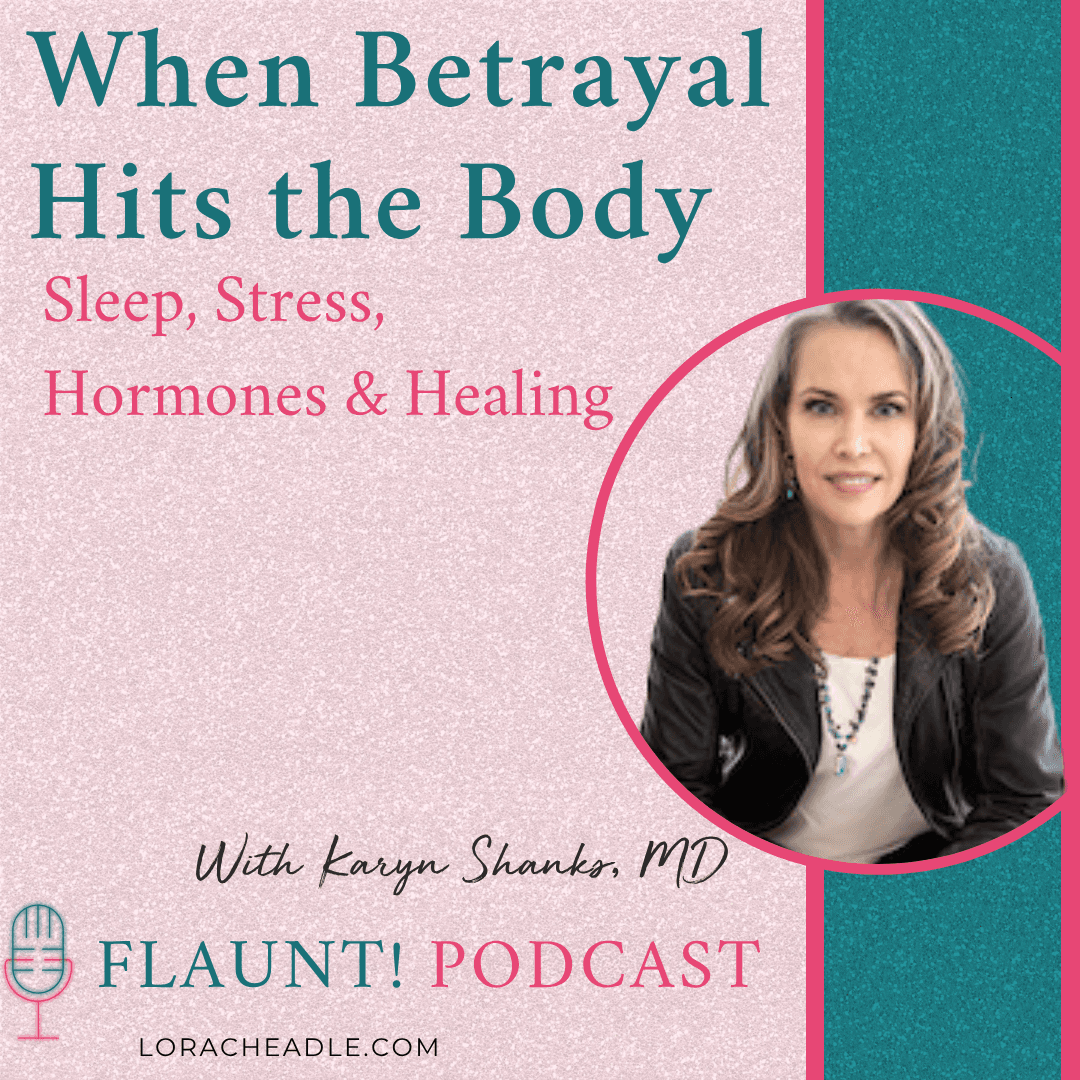
When Betrayal Hits the Body: Sleep, Stress, Hormones & Healing With Karyn Shanks, MD
July 5, 2026 · with Karyn Shanks MD
Show notes
Betrayal doesn’t just affect your heart and mind — it affects your body too.
In this compassionate conversation, Lora sits down with physician and functional medicine expert Dr. Karyn Shanks to explore the very real physical impact of betrayal trauma, chronic stress, and emotional overwhelm.
Together, they discuss how trauma affects sleep, hormones, inflammation, energy, digestion, nervous system regulation, and overall health — and why these responses are not signs that you’re weak or broken, but signs that your body is trying to protect you.
This episode also explores self-compassion, the stories women carry around productivity and worthiness, and how healing begins when we stop fighting our bodies and start listening to them with curiosity and care. Betrayal trauma and the body are deeply connected. When betrayal trauma hits the body, it can affect sleep, stress, hormones, digestion, inflammation, energy, nervous system regulation, and overall healing.
Top 3 Takeaways
- Betrayal trauma affects the entire body — including sleep, hormones, digestion, energy, and nervous system regulation.
- Your body is not betraying you. Many physical symptoms are intelligent survival responses.
- Healing does not require perfection. Small moments of rest, nourishment, support, and compassion matter deeply.
Favorite Quote
“Your body isn’t broken. It’s trying to protect you.” “You don’t need to rush your healing. But you do need to take care of yourself first.”
About Karyn Shanks
KARYN SHANKS MD is a physician, author, and teacher who helps clients recover their lives from chronic complex Illness—a journey she’s walked herself. Her work integrates the sciences of directable human potential—epigenetics, neuroplasticity, systems-based functional medicine, and transformational psychology—with the lived wisdom that safety, compassion, and story are the true foundations of healing. Over four decades, she's learned one enduring truth: everyone can heal, and the best medicine comes from within. She is the author of Heal—A Nine-Stage Roadmap to Recover Energy and The Wisdom of COVID-19—How to Rejuvenate, Reclaim Hope, and Heal in the New Post-Pandemic World.
Links: KarynShanksMD.com, Facebook, Instagram, LinkedIn
About Karyn Shanks MD
KARYN SHANKS MD is a physician, author, and teacher who helps clients recover their lives from chronic complex Illness—a journey she’s walked herself. Her work integrates the sciences of directable human potential—epigenetics, neuroplasticity, systems-based functional medicine, and transformational psychology—with the lived wisdom that safety, compassion, and story are the true foundations of healing. Over four decades, she's learned one enduring truth: everyone can heal, and the best medicine comes from within. She is the author of Heal—A Nine-Stage Roadmap to Recover Energy and The Wisdom of COVID-19—How to Rejuvenate, Reclaim Hope, and Heal in the New Post-Pandemic World.
Read the transcript
Intro/outor [00:00:01]:
You're listening to Flaunt. Find your sparkle and create a life you love after Infidelity or Betrayal, A podcast for women who've been betrayed by their intimate partner and want to turn their devastation into an invitation to reclaim themselves and their worth. Tune in weekly so you can start making sense of it all and learn how to be okay on the inside no matter what goes on on the outside. Download your free Betrayal Recovery toolkit@betrayalrecoveryguide.com
Lora Cheadle [00:00:35]:
have you ever had one of those experiences where something happens? Maybe it's the D day, maybe it's the first revelation of the infidelity, or maybe it's something later on. But whatever it is, you have kind of a traumatic experience hit and then you don't feel well and you're not quite sure what it is. Or you have a traumatic experience happen and then everything starts to snowball and you start thinking, what is going on with me? Why is everything in my life falling apart right now? That's one of the things that we are going to talk about today. We are going to talk about the impact of trauma on stressful life situations, on on our bodies, on our health. Because whatever you're experiencing, you're not crazy. It's not just in your head. You're not making it up. Your body responds to trauma, and trauma can create illness.
Lora Cheadle [00:01:42]:
Karyn Shanks, MD, is a physician, author and pioneer in the field of root cause healing with over 40 years of experience experience helping clients recover their lives from chronic, complex illnesses. She is board certified in both internal medicine and functional medicine and a founding diplomat of the American Board of Integrative and Holistic Medicine. She is also trained in trauma informed psychotherapy. Through Dr. Gabor Mate's compassionate inquiry professional Training program, Karyn brings together the science of directable human potential, epigenetics, neuroplasticity, core functional systems biology, and transformational psychology with the deep wisdom of lived experience, spiritual inquiry, and narrative transformation. Her work centers on the belief that people are not broken, but wise and whole, and that sustainable healing begins with reclaiming that truth. Her private practice, teaching and writings are deeply influenced by her own journey through illness and recovery. Karyn is the founder of the Unbroken Academy, an online educational platform for healing through story, self trust, and embodied resilience.
Lora Cheadle [00:03:01]:
She is the author of two previous books, Heal A Nine Stage Roadmap to Recover Energy, Reverse Chronic Illnesses and Claim the Potential of a Vibrant New you and the wisdom of COVID 19. Her voice is known for its clarity, warmth, and fierce compassion. Yeah, let's just kind of start with that, that basic premise that I was saying. Having a traumatic incident can make you feel ill or it can actually make you truly ill. Let's talk about that a little bit.
Karyn Shanks [00:03:33]:
100%. We have this notion that our life experiences have really nothing to do with our health. Right? Yeah. And yet that's just because in our culture, we don't have a language that, that combines h, the body and the mind and the spirit and the emotions and all, you know, all the things that we are. Yet the body is. The mind is. The emotions is it, you know, that's it. It's all body.
Karyn Shanks [00:04:01]:
Let's just start saying body because that's what it is. And when we've had a traumatic experience or we've been living under high levels of stress for a long time, the body begins to organize itself around keeping you safe in that experience. And our resources are limited. So the energy and resources that we have get diverted toward safety, survival, what we have to do just to stay alive each day. And therefore they get diverted away from other parts of our being. Right. So we can become more inflamed, we can become exhausted because our mitochondria, the parts of the cell that makes the energy is, you know, it's downshifting. All kinds of biological processes that shift when we're under a lot of stress are going through a very traumatic time.
Karyn Shanks [00:05:04]:
Yeah. It's how the organism works. And it's all about keeping us alive. It's not like this bad thing that's happening to us. It's meant to protect us.
Lora Cheadle [00:05:13]:
Right.
Karyn Shanks [00:05:14]:
But it makes. It feels bad and it feels really hard. Right.
Lora Cheadle [00:05:19]:
And it makes sense because, you know, even when you think about, if you are running, you can't be digesting at the same time. If you're thinking, thinking so hard and really working on something, you burn more calories. It's like, it makes sense. We don't have different pockets of energy. This is my healing pocket of energy. This is my digestion pocket of energy. This is. We are one body, one organism.
Lora Cheadle [00:05:45]:
And that energy needs to keep us alive first.
Karyn Shanks [00:05:49]:
A hundred percent. And that's correct. And that's the, the body's primary, like, priority is to keep us safe, to keep us alive. That's it. And it will do whatever it needs to do.
Lora Cheadle [00:06:02]:
Yeah.
Karyn Shanks [00:06:02]:
And a, a huge emotional trauma is a big deal. And it, it does require a lot of resources and energy and thought. And, you know, and everybody knows that. You know, I'm probably hearing me say that like. Yeah, yeah. I mean, of course it Feels like a lot. Right. Um, but then we forget that it's all, you know.
Karyn Shanks [00:06:25]:
Yeah, the. The body is like, has to process that. And, and maybe it's calling for certain types of support so that we can get through our experience, you know, more robustly. Yes. And, and, and I think that's our call, is to learn what is the body saying when it's organizing itself to help us survive and we feel the effects of our energy and resources being diverted? What is our body asking us to do? What do we need to support ourselves?
Lora Cheadle [00:07:01]:
Yes. And that's huge. And also, I love how you define it as reorganizing itself, because it could be a temporary reorganization. Most people are like, I'm losing all this weight. I can't eat, I can't sleep it. And it's like, well, yes, but this is not the whole rest of your life. So what do you need to do right now to take care of yourself? And then later your body will reorganize itself? It just needs some extra support right now.
Karyn Shanks [00:07:27]:
That's right. So we go towards safety. We give ourselves the support we need. We get through that, that time in our lives. Then we shift into repair, restoration. Hopefully we get all the way back to feeling resilient. That's how the organism works. And it helps to know what it.
Karyn Shanks [00:07:45]:
What to do. What does the body need when we're. When we're, you know, we're going through a terrible time? Yeah.
Lora Cheadle [00:07:53]:
It does help to know because I think it's easy to catastrophize things when one thing is starting to go wrong. We catastrophize. It's everything. It's awful. And I think the truth of the matter is too, we can lock into unhealthy pathways. Our thoughts can create chronic illness, chronic disease. And I think there's a piece of it where the knowledge is, it doesn't have to be this way. And then I think the second part is, so what do I do? What do I do to repair? How do I restore my body? What does resilience really mean? Because right now I don't feel like it.
Lora Cheadle [00:08:30]:
I just need to lay on the bathroom floor and cry.
Karyn Shanks [00:08:33]:
Exactly. And that's probably what you need to do at that moment. If you feel that urge and be. And be compassionate with yourself, that that's where you are in your healing cycle. That you are in a healing cycle, even though you may be at the lowest end of it and you feel terrible and it's so hard, and it feels like it's never going to end, it's all healing. And so if you, if you can remember that and let that help you make sense of what you're going through. I just feel like it takes a, like a whole load of shame off of the whole process, you know, like, man, I, I should be able to handle this. What's going wrong? I'm.
Karyn Shanks [00:09:14]:
God, I'm just, I'm, I'm broken and falling apart. But to put, to understand that it's part of a healing process, there's an organization to it. There are actual, tangible things that we can do to support ourselves that are really important to support ourselves beyond the therapy, you know, you know, work through the emotional crisis. There's a lot you can do to support your body, which is, which, which is where your emotions are and you can regulate. And you talk a lot about that on your podcast about emotional regulation, nervous system regulation, which is really, really important. But also sleep and movement and what you're eating, food, even if you can't eat. But really prioritizing the nutritional quality of what you eat, all of those things are going to help provide the energy and resources you need to be in crisis. Yes.
Lora Cheadle [00:10:12]:
And let's say more about that because it gets to be overwhelming. What can I do to support myself? Well, oh my God, I can't even think about that right now. I might be getting kicked out of my home. I might not be able to pay the bills this month. I don't know what's going to happen with my kids. What are some of those basic base level things that we can do even when we're completely overwhelmed, that will support our physiology and that's going to be
Karyn Shanks [00:10:42]:
different for every person. But maybe it is like not, you know, not even thinking about any of those things. Maybe you do. You've got to get housing, you've got to get your, you've got to get your kids settled. You've got all these like super high priority responsibilities that you need to take care of and you'll get back to yourself. But maybe right now, you know, the best you can do is manage those as well as you can. I would think in a time like that, it's to ask for help. It's like call in your, your all your reinforcements.
Karyn Shanks [00:11:15]:
Let everybody on your team know that you're in crisis so that they can support you. Maybe they'll bring you food, maybe they'll remind you to get, to get to bed. Maybe they'll take the kids for you. Whatever high level crisis is meant to be shared with your community and your people. Whoever they are. And if you feel like you don't have the people you need yet, find somebody. Yes. You know, find somebody.
Karyn Shanks [00:11:48]:
Ask somebody for that somebody. There's all. There's always going to be a way for you to like, tap into some kind of resource that is there to support you.
Lora Cheadle [00:11:58]:
Yeah. And I'm glad that you said that too, because I know when I was going through my infidelity journey, one of the first things I did was reach out to a lot of friends. And I was shocked and disheartened. My really good friends obviously were there, but there was a whole group of people who were like, I don't want to touch this. You know, it was like, yeah, going there. I don't want to take sides. I don't know what's really going on. Marriage is private and it was really harmful and hurtful.
Lora Cheadle [00:12:29]:
And I really like that you said, and give people permission. Reach out to somebody else. You know, like, I've got a couple of women's circles, it's 47amonth. Reach out. I know there's a lot of free places you can look on meetup. You can find online communities and support. Just reach out. Just reach out.
Lora Cheadle [00:12:50]:
If your people are letting you down. There's a lot of people, either free, low cost or high level, that will give you exactly what you need.
Karyn Shanks [00:13:00]:
Exactly. Yeah. And, you know, hold yourself in compassion through all of this, the journey. Right. Yeah. And what you just said about some of your friends not showing up for you, that's devastating. That can feel really devastating. Yeah.
Karyn Shanks [00:13:16]:
To feel abandoned all over again.
Lora Cheadle [00:13:18]:
Yeah.
Karyn Shanks [00:13:19]:
That's so hard. That's so. Yeah. So, man, it's like, it's like, I think. And sometimes here I am talking about, get your sleep, get your. Eat the good food, move your body. And you're right. There are times in, in a crisis where you can't do anything, any of those things.
Karyn Shanks [00:13:36]:
You're going to survive regardless if you can neglect yourself, if that's what you need to do. Right. In some of those ways. And hopefully at some point you'll be guided to get back on track with those things because they will help you get through the crisis in the long run. Yeah.
Lora Cheadle [00:13:54]:
And I do think sleep is one of the hardest things at first because you cannot sleep. But then once you start sleeping. Sleeping, oh my gosh. You start thinking so restorative.
Karyn Shanks [00:14:06]:
Oh, yeah. Energy recovers. Thought. Yeah. Mind expense. You can start seeing the bigger picture of what's going on and not that, like, little, those little points that you, you know, zero in on. Yes, yes. That we all zero in on.
Karyn Shanks [00:14:23]:
Yeah.
Lora Cheadle [00:14:23]:
So what are some of your recommendations for? I think supporting sleep first?
Karyn Shanks [00:14:30]:
Yeah, and that can be tricky when you're highly triggered and your, your sympathetic nervous system is on overdrive and you feel overwhelmed and so in so much pain. It's very tricky and it helps, I think it helps to first understand that sleep will help you restore, to have some way to regulate at the beginning of sleep first. Have a sleep time.
Lora Cheadle [00:14:58]:
Mm.
Karyn Shanks [00:14:59]:
Put your. And put yourself first. I think women have trouble with getting to bed on time on the, in the best of times. Yes, I, I did. Especially when my kids were little.
Lora Cheadle [00:15:09]:
Yes.
Karyn Shanks [00:15:10]:
You know, it's taken me a long time to be really like militant about my bedtime. So you know, set a bedtime and do whatever that regulating thing is, whether it's your, you know, your breath work or listening to something very relaxing, reading something that helps you sort of get lost in a story and you know, you're out of these stories and you're more into, you know, a fictional story and you know, having your sleep space as comfortable as possible. Dark, super dark, comfortable bed temperature set the way you need it and, and just give it a go. There's lots of, there are lots of very safe sleep supplements. I would say that some, many people will need something stronger than that short term during a crisis. I'm a huge fan. I'm a, I'm totally on board with that. We do what we can to protect something that's as important as sleep.
Karyn Shanks [00:16:12]:
So don't be afraid to reach out to your trusted doctor or nurse practitioner and ask them for some a sleep aid that you know that's non addicting and that's going to help you for those short term times when you really need help.
Lora Cheadle [00:16:27]:
Yeah, because it is short term and it's going to, you will heal faster if you get the support sometimes.
Karyn Shanks [00:16:33]:
Yes, yes, absolutely. Yeah.
Lora Cheadle [00:16:36]:
Which is really important. And then I think after the sleep, you know, the nutrition, the movement, things like that will slowly start coming in. And I also think it's kind of a self rewarding cycle. Once you realize, oh I do feel better, it's easier. And yeah. And then something you said in your unbroken book and I think this is really important to put in here and to talk about here. The body does heal. The body is driven to heal.
Lora Cheadle [00:17:02]:
The body knows how to heal and it wants to heal. And I think sometimes, especially women, we get locked into that mindset that my body is my enemy.
Karyn Shanks [00:17:14]:
Yeah, that's kind of, that's interesting. Like, I, it's all, it's working against me. Yeah. You know, and even when you're in the throes of despair and suffering, you're healing right then. Yeah. Even when your nervous system is, like, hijacking you, you're healing right then because it's all about your body working for you. There's. I don't even like the word, like, the, the, the.
Karyn Shanks [00:17:37]:
It's a phrase that's used commonly. Nervous system disregulation. It's not really disregulated because it's working for you. There's like an intelligence in it. Right. Like, you may feel totally shut down and you have no energy and you can't get out of bed, and that feels really dysregulated. But it really is purposeful. It's to slow you down and shut you down and conserve.
Karyn Shanks [00:18:03]:
It's a conservation response, and it's very meaningful. So it's like learning to respect what the body is doing, even when it feels wildly, you know, like it's off the rails. And I, I have to do this myself. You know, I, I, I have to say, I recently had lyme encephalitis, and I was really sick, and I had to. And I had to keep reminding myself, karen, you're healing. This is a healing process. How can we support it? But I had to, like, keep reminding myself. And as I did that, I felt better about.
Karyn Shanks [00:18:44]:
It's like, okay, this is all very perfect because it's easy to get really scared about what's happening, whether it's emotional or physical, whatever it is, we can get very scared about what we're going through.
Lora Cheadle [00:18:55]:
Yeah, I really, really feel that, that it's, it is wise. The body is doing what it needs to do. Because how often do we drag ourselves out of bed once we finally have fallen asleep? Because I should be doing this. How often do we say, why am I crying so much? Why am I falling apart? How often are we angry at our body for doing what it needs to do? Because I know whenever I've been sick or something, and I'm so frustrated that I want to sleep. Why am I so tired? Oh, my gosh, I hate this. I'm not honoring myself.
Karyn Shanks [00:19:31]:
I know. We all do that. I do that. We're works in progress. But you're right. I mean, when, when we get sick and our body shuts us down, it is so frustrating. We want to work on our book. We want to, we want to work out or whatever, whatever it is.
Karyn Shanks [00:19:49]:
And there is nothing in the tank to Support that.
Lora Cheadle [00:19:52]:
Yeah.
Karyn Shanks [00:19:52]:
Surrender. We have to surrender the body and. Yes. And learn from that frustration.
Lora Cheadle [00:20:03]:
Do we?
Karyn Shanks [00:20:03]:
Why do we get so frustrated with our bodies? What kind of, what kind of. You know, I always think that when I, when that happens to me, I'm like, well, I'm on that. It's that productivity mindset that, you know, that. What do I call it, just the grind culture kind of thing. Like you've got to produce, you've got to be active, you got to get. It's what we do that makes us valuable. Right. It's all in what we do.
Karyn Shanks [00:20:30]:
And sometimes we're, our bodies are asking us to not do, to be. Yeah.
Lora Cheadle [00:20:36]:
I. And it is, it's, it's, it's bizarre. I mean, I'm just thinking, even yesterday, I have recently told myself, you know what, you're going to work out hard every day. I work out pretty much every day anyway. But I was like, I'm committing to myself. I'm going to do it. Well then yesterday I'm in Colorado, we had a whole bunch of snow. I got to do some wedding things with my to be daughter in law.
Lora Cheadle [00:20:58]:
My son came over and asked to take a walk and watch a movie. And it was like I wanted to do all of these things and be in the present moment. Yet underlying was this frustration like, why aren't you doing it? Why aren't you doing it? And then I was like, my body is actually kind of sore. And then I got really mad. Why is my body sore? Well, duh. Hello. You've been working out at a higher level every day and now you're mad that your body is sore. I mean, we set ourselves up for failure and to be in these weird frustrating loops sometimes and it's, it's bizarre.
Lora Cheadle [00:21:28]:
But we do it.
Karyn Shanks [00:21:29]:
We do do it. And I think it's worth looking at. I, I kind of get a kick out of looking at. That's like, okay, what, what it, what's that all about?
Lora Cheadle [00:21:38]:
Yeah, yeah.
Karyn Shanks [00:21:41]:
You know, and it's good to be curious. And we all get like in that loop.
Lora Cheadle [00:21:46]:
Yeah.
Karyn Shanks [00:21:47]:
And we need to be compassionate about that because we all do that and, and we do get frustrated and we have competing desires for wanting to do different things and we can't do everything. We can't do everything. Right, right. And it sounds like you had a great day. Like you.
Lora Cheadle [00:22:05]:
Exactly, you know, exactly. It's like, so what, that I didn't get my workout in. I can do that. Today I nourished myself and by nurturing thing. Other things that were important to me. It's all good.
Karyn Shanks [00:22:21]:
It is. And do you feel that way today? How do you feel?
Lora Cheadle [00:22:24]:
I do. I feel so happy today.
Karyn Shanks [00:22:26]:
Good. Good. That's good.
Lora Cheadle [00:22:28]:
Yeah. Yeah. And that's something that you talk a lot about in your books, too. That. That curiosity, those questions, the stories that we tell ourselves about what's good, what's bad, what's right, what's wrong. I, too, am a big believer in stories and the power of the stories that we tell ourselves. And I'd love for you to talk a little bit more about your work around stories and healing and questions and compassion and how we talk to ourselves.
Karyn Shanks [00:22:59]:
Well, to be honest, you know, it's all story.
Lora Cheadle [00:23:03]:
Yeah.
Karyn Shanks [00:23:04]:
It is everything we think we know, we think we believe, we think it's all a story. It's just. It's how the brain has taken our circumstances and packaged them for us. And many of those stories are beautiful and they're as true as anything can be true. But a lot of the stories are incomplete. Maybe they're. They're wrong. Maybe they need to be updated.
Karyn Shanks [00:23:33]:
Maybe they're holding us back because they're beliefs we held as children from our childhood experiences and that were processed through our child, our childish, you know, sensibilities, and they just don't apply anymore to us as adults. And that's why I talk a lot about curiosity, because I think curiosity is a thing that kind of gently just opens up our stories and makes room for something, for us to bring something else in, to learn something new, to try something new, to. Maybe our story is going to completely shift after we've done some exploring. So I just think we get. And we all do this. We get very locked in on our stories. This is the truth. This is the way it is.
Karyn Shanks [00:24:21]:
And I really want people to know. And part of the reason for me kind of harping on that in my book Unbroken is that that's part of why our healthcare system has been such a disappointment to so many of us, is because it's also built on stories.
Lora Cheadle [00:24:40]:
Yes.
Karyn Shanks [00:24:41]:
And part of the story is like, not really seeing us as whole people with very complex needs and complex problems that don't fit what is a fairly simplistic model of looking at human beings that comes from. I want people to understand that they need to question their disappointments in medicine or any other institution or relationship or whatever, because it's never the whole story, and it's not always, you know, it doesn't. The relationships and communities and institutions that we're a part of and interact with, don't always tell the whole story or get us. And they're not always capable of understanding us because they're limited by the way they define things, if that makes sense.
Lora Cheadle [00:25:39]:
Yes, it does. And I think we've all heard those big stories where somebody doesn't know they're quote, supposed to die, so they don't. You know, we've heard about those big things where people are defying all the odds or something like that. But I think we forget that sometimes it can be smaller than that. It can be very small beliefs, small stories that then over time add up and become a huge untrue story that we just didn't unpack along the way.
Karyn Shanks [00:26:18]:
Yes. And isn't that often the basis of why people are so. Their lives are so disrupted and they suffer so much when something bad happens? Yeah. And the crisis comes and they're, they don't have the, they don't have that. A well developed, supportive story to help them navigate that crisis. It's like everything falls apart and everything. Right. So isn't that, that's kind of like the trauma that opens up the old trauma.
Karyn Shanks [00:26:50]:
Right.
Lora Cheadle [00:26:51]:
Yes, yes.
Karyn Shanks [00:26:53]:
And we have to go back and sort through that because we told ourselves a whole bunch of false stories and we have a bunch of false beliefs that came with us that now are part of what we're dealing with today. I'm worthless. I need to work hard and burn the midnight oil and never take care of my own needs in order to be worthy. Like, you know, stuff like that.
Lora Cheadle [00:27:16]:
Yes. Yeah. And going, going back to kind of what we were saying earlier, that sometimes women especially have a hard time taking care of themselves going to bed on time. There is such a cultural belief that a good woman is self sacrificial, A good wife, a good mom puts everybody else's needs before her. And yeah, that's. First of all, that's not true. But second of all, then when we have the story that this is selfish and this makes me a less than person or having needs makes me weak.
Karyn Shanks [00:27:50]:
That's right.
Lora Cheadle [00:27:51]:
No wonder we start developing disease because our body is saying, if you're not going to do it, then I'm going to do what for you.
Karyn Shanks [00:27:59]:
Exactly. Or I can't sustain this life any longer of you never getting enough sleep.
Lora Cheadle [00:28:05]:
Yeah.
Karyn Shanks [00:28:05]:
We are not, you know, you're not, you're not able to detoxify your brain and your body the way you need to. You're not able to, you know, create new energy. You know, you're all these things that are so important for our biology. Yeah. The body will shut you down.
Lora Cheadle [00:28:21]:
Yeah.
Karyn Shanks [00:28:22]:
In one way or another it's going to shut you down.
Lora Cheadle [00:28:25]:
Yeah, yeah.
Karyn Shanks [00:28:26]:
And that's, and, and that's not just true for sleep, but it's also, you know, the way you habitually eat. Right. Or the way you, you know, you name it. All, all the, all the lifestyle patterns that we have are going to have an impact one direction or another.
Lora Cheadle [00:28:50]:
Right.
Karyn Shanks [00:28:50]:
Right.
Lora Cheadle [00:28:51]:
So here's my question around that. Because trauma is stored in the body. You know, it is the combination like that of the lifestyle, the things that we've done along the way, but then also the energetics in the moment and also how we are being responsive or non responsive to our body. You were saying we are. The bodies heal. The body is always healing. It's always doing what it needs to be doing. And then you have that layer of story on top of that.
Lora Cheadle [00:29:23]:
So I believe it's both. I believe the body is healing and then I think our mind helps create that healing as well. But I was curious, you know, for you, like when is it good enough? Do we have to jump all the way to the best healing story? Like I am healthy, happy, whole and complete. I have energy. Like do we have to jump all the way there, there or can we do these little tiny steps along the way? What do you think or have seen as most effective or what would you
Karyn Shanks [00:29:52]:
say on that when you say that? I'm, I think, wow, that is such perfectionism. That is such exceptionalism. Like that is, that's a story we tell ourselves. Maybe. Is it women and men or I mean whatever it is. Both. But that we have to be perfect. Yes.
Karyn Shanks [00:30:13]:
We have to do it all right. We have to. Oh my God, no. So I would say no, I think that brings its own sets of problems. So that, that smacks of unresolved trauma. So those are, those are trauma stories. And there's a biology and there's a biological price to that that will, that's going to interact with the good biological things we get from eating well and doing our exercise and doing our medit, you know, all the rest. So it really is about just balance and having a regular kind of practice, whether it's a meditation practice or just a sort of a mindful check in process, a nervous system regulation practice where we get quiet, where we can really like feel our bodies, feel our feelings, feel what our bodies are telling us about what we need.
Lora Cheadle [00:31:13]:
Yeah.
Karyn Shanks [00:31:14]:
And in listening. And we're gonna know what to do. And it doesn't have to be perfect. And maybe on a day when we can't do the thing we think we really need, like you did yesterday, maybe you needed to not do that thing. Yeah, right.
Lora Cheadle [00:31:31]:
Yes.
Karyn Shanks [00:31:32]:
It's just being more compassionate, more relaxed, more tuned in so that we can do, you know. So I'm not saying it's not good to sort of do a review, a little life review, a check. Am I getting enough sleep? I've been pretty tired in the morning. I'm having to set my alarm. There's probably a little bit of work to be done there. That's fair game. That's necessary. Oh, I'm.
Karyn Shanks [00:31:55]:
I haven't. I've been eating fast food. I've been so busy this week. Not only am I. So what I'm. I'm saying probably two things. I'm too busy for some reason.
Lora Cheadle [00:32:06]:
Yeah.
Karyn Shanks [00:32:06]:
And I'm not eating well. So probably I need to address that as well. And what can I do that is not going to be overwhelming and do me in to address some of those needs?
Lora Cheadle [00:32:20]:
Yeah. And I'm glad. Thank you for saying yes. That's a trauma response because it is all or nothing for so many people. I didn't sleep my eight. Eight hours last night. I ate sugar for breakfast. The whole day is ruined.
Lora Cheadle [00:32:33]:
I'll start again tomorrow.
Karyn Shanks [00:32:35]:
Exactly. Yeah. So the problem there isn't the sugar, is it?
Lora Cheadle [00:32:39]:
No, not at all. And I know you talk a lot about, like, resiliency and what it takes to be resilient, and I think that resiliency is. Is in the moment. It's not day at a time or week at a time. It's. Can I grab an apple right now instead of a thing of French fries? Maybe I can, maybe I can't. That's okay. But maybe for dinner, then it'll work out.
Lora Cheadle [00:33:04]:
And maybe for dinner I can grab a salad instead of a fast food hamburger.
Karyn Shanks [00:33:07]:
Right.
Lora Cheadle [00:33:08]:
Or maybe I can't, but then what I will do is.
Karyn Shanks [00:33:11]:
Exactly. That's right. Yeah. So it's. It's just about being in the very best balance you can be in right now, being compassionate for that particular balance you're in, which is. Probably has some flaws, if you really looked at it, but that's okay, right? Yeah. But then having some kind of commitment to ourselves, to reflect and, you know, consider, where do I need to change things? Where am I doing too much and kind of going off the Duke deep end? And, you know, why don't I ever have room to, like, have healthy food in the house? What's going on There. Is that a trauma response? You know what I mean? Or do I really not have the time? But, you know, then you can order, you know, and have it delivered to your house.
Lora Cheadle [00:33:56]:
Right, right.
Karyn Shanks [00:33:57]:
So, yeah, it's just being real. If we all have to be real with ourselves about what's going on at the same time. Compassionate. Because none of us are purposely trying to mess ourselves up.
Lora Cheadle [00:34:10]:
No, no. And sometimes the best we can do. Isn't that great? And I love when you talked about being compassionate. I know this is going to trigger some listeners. That's okay. Just breathe and just be open. Yes.
Karyn Shanks [00:34:26]:
Yeah.
Lora Cheadle [00:34:26]:
When I look at my husband who cheated on me for 15 years with multiple women, I can see now how he was doing the best he could in those moments. Was he. Was he doing a good job? No, he was trauma responsing all over and he was doing the best he could in that moment.
Karyn Shanks [00:34:50]:
Exactly. That's. And that's the perspective of a mature mind. It's. You're not saying he shouldn't have done what he did. And, and you know, those of us with childhood trauma, we're not saying that they should be. That they weren't at fault. Right, right.
Karyn Shanks [00:35:05]:
But we're saying we now can see the bigger picture and we understand where that behavior came from. Right. And that's. That is the adult mature mind that can see it that way. And that might be triggering to some people, too. There are things I'm not very adult about that I'm learning to be. So I think we're all. You know what I mean?
Lora Cheadle [00:35:28]:
Yes. Yeah. Because it's not about being. Being the Buddha, being the Christ and being perfect and just being like nothing is triggering me. And I just love and accept in Kumbaya. It's about, I think, seeing that I can see differently than this. There is a different perspective here. I still might be angry and bitter and mad and that's okay, too.
Lora Cheadle [00:35:50]:
I can be that way.
Karyn Shanks [00:35:51]:
That's right.
Lora Cheadle [00:35:52]:
But there's also another way to look at this.
Karyn Shanks [00:35:54]:
There's always another way to look at it. That's right. Yeah. Compassion. Deep, deep breaths and compassion.
Lora Cheadle [00:36:02]:
Yeah. And compassion is hard. It. It really is. And I just did a show last week about being the good girl and I made a comment. Did you? Good.
Karyn Shanks [00:36:13]:
Yes.
Lora Cheadle [00:36:14]:
Good.
Karyn Shanks [00:36:14]:
I didn't think I would. I didn't think I was a good girl. I did.
Lora Cheadle [00:36:18]:
Right.
Karyn Shanks [00:36:20]:
I thought I. Yeah. Anyway.
Lora Cheadle [00:36:22]:
Yeah. Yeah. Well, I had. Had so many people reach out and say, like, do you know what brought me to tears when you said, Laura, that you have so much compassion for that woman that you used to be. And they were like, I never thought about that way. I just was so angry at myself for being innocent and sweet and naive. And I tried so hard and I feel so stupid. And it was like, compassion.
Lora Cheadle [00:36:44]:
You can be compassionate for yourself.
Karyn Shanks [00:36:48]:
Gotta be. But isn't it interesting that we have to learn it? I had to learn how to be compassionate toward myself.
Lora Cheadle [00:36:54]:
Right.
Karyn Shanks [00:36:57]:
You know, it's not part of our culture to teach compassion or compassion practices or. Yeah, we're. See, that's part of what makes current day trauma so hard is we don't have the skill set that would have been really nice to have learned when we were children. Right. Yeah. How to like love and respect yourself. How to, how to check in, how to assess your feelings and talk about your. I mean.
Karyn Shanks [00:37:28]:
Yeah, yeah.
Lora Cheadle [00:37:30]:
And on the one hand, we are so driven to succeed, to achieve, to get the good grades, to get the gold star, to go higher and higher in your career, more and more education. And it's like, I think there's also a fear that if I'm suddenly self compassionate, that I'm not going to reach my full potential.
Karyn Shanks [00:37:53]:
Yeah, there might be. Yeah. Yeah. Because to be self compassionate sometimes, oftentimes is to pull back from a lot of what we are spending our time doing. Right. Like a lot of the, I don't know, just the hustle, the over. Over. Yeah.
Karyn Shanks [00:38:10]:
The juggling. So many things I'm. And I, I'm thinking about women especially because with families and trying to have the big career and the kids and to do it all perfectly and keep the husband happy and it's just, it's so overwhelming. It's like I. I need to stop and take a deep breath because it's just really. It's so much to do. It's too much to do. So I think you're right.
Karyn Shanks [00:38:35]:
I think there, I think that compat. The kind of, the lack of compassion. Well, it's a trauma response. Of course it's a trauma. It's a trauma response.
Lora Cheadle [00:38:48]:
Right, Right. Yeah. And then how it feeds into our biology, the whole trauma biology. Like I did it all. I really did. And when my kids were in middle school, I had adrenal fatigue and literally it was like a truck hit me and I couldn't. I couldn't get up, I couldn't do it. And it was so distressing.
Lora Cheadle [00:39:14]:
And it's interesting because along about that same time, a few years after my husband hiding all of these things, the center of his spine went out. He Slipped a disc and could not move. So we each. Yeah. About five years before all this came out, we each had a complete flattened moment.
Karyn Shanks [00:39:35]:
Wow.
Lora Cheadle [00:39:36]:
Interesting, right?
Karyn Shanks [00:39:37]:
Yeah, it's very interesting. Yeah. Yeah. The body keeps the score. The body. So it's like everything the body says, everything you feel, every sensation, every pain, you know, it's the la. It is an intelligent language. So don't ignore any of it.
Karyn Shanks [00:39:55]:
Yeah, right. And honor it. If you feel uncomfortable and scared and whatever it is, that's intelligence. That is wisdom. Right.
Lora Cheadle [00:40:10]:
Yes.
Karyn Shanks [00:40:10]:
You've gotta. We all have to pay attention to that. But we feel like such weenies. Like, you know, we. We can. You know what I mean? To. To have to. To learn to honor fear and vulnerability is really tough.
Karyn Shanks [00:40:27]:
It's really hard because all kinds of shame, I think.
Lora Cheadle [00:40:31]:
Yeah. Oh, I do. And that's right there with compassion. Like you were saying, we're not taught how to be compassionate, really, to anybody, but especially to ourselves. I think sometimes we. Our idea of compassion is almost like pandering, you know, like, well, bless your heart, you know, I'm too bad for you. We don't really. We don't connect into that.
Lora Cheadle [00:40:53]:
And I think that's with a vulnerability, too. We don't want to be weak. We don't want to say no. You know, people before COVID I feel like so many people would take the cold medicine and show up at work and power through. And one of the benefits that I saw was from. From the pandemic was a more willingness for people to say, I don't want to expose my entire workplace. I don't feel well. I'm going to take some cold medicine, and I'm going to stay in bed.
Lora Cheadle [00:41:21]:
Whereas right before that, it was no power through.
Karyn Shanks [00:41:25]:
Exactly. I know. And I thought, wow, why don't we always think that way? My co workers don't want the common cold either.
Lora Cheadle [00:41:33]:
No, no. You know, no. There's nothing worse than that.
Karyn Shanks [00:41:39]:
I know.
Lora Cheadle [00:41:39]:
Yeah. And then I'm curious about this too, because having traumatic experiences driving ourselves, we. It can. It can make us lock into chronic illnesses. Menopause is not an illness.
Karyn Shanks [00:41:56]:
Right.
Lora Cheadle [00:41:56]:
When I found out about the affair, it kicked me into menopause literally overnight. It's not illness, but it's also a body response. And I've had other people say similar things that have happened with their body. In particular, menopause, trauma. Pause is a thing. And I would just. Yeah. Love your wisdom around chronic illness.
Lora Cheadle [00:42:20]:
Normal bodily processes and functions, the flow of aging, you know, because our bodies are dynamic and we do flow and what's illness and what's process and all of that.
Karyn Shanks [00:42:33]:
That's right. And you know, in a way, you know, going into that menopause early, that's process. Because that your, your hormonal biology was reorganizing itself to support those high cortisol levels which will draw from the other, the sex hormones. Menopause overnight. And your, your levels, your hormone levels were probably already changing, right?
Lora Cheadle [00:42:56]:
Oh, I'm sure they were, yeah.
Karyn Shanks [00:42:58]:
Yes. Yeah. So hormone. And we could say, I won't say imbalance. Hormone insufficiency is a common part of people who are living trauma and a really important area to look at with your health care person because hormone replacement can be very supportive as you're going through your, you know, your trauma work. Very supportive.
Lora Cheadle [00:43:31]:
Yeah, yeah. Because hormones, I think whether it's sex hormones or anything, I mean, adrenal fatigue, that's hormones. You know, it's, it's that we are such a biological being and I think sometimes we lose track of the fact that we are a biological being, that we think I have control over my body, I have control over my mind, and we don't. It flows.
Karyn Shanks [00:43:53]:
That's right. But we also just have a lack of knowledge and we're not necessarily supposed to know everything, but we're largely disconnected from our bodies. So it would be nice if people understood a little bit more about how things work, how it operates, and that it is all an intelligent design and, you know, get somebody to work with you. I'm tired. Well, there, that is a biological problem that is probably intermingled with emotional and psychological issues, but it's also biological. So someone, there are, there are people who can help you with that.
Lora Cheadle [00:44:30]:
Yeah, it is biological. And you know, I love all the woo woo stuff. I love the manifesting, I love all that. And there's a lot that we can do. And there's also things that we can't control.
Karyn Shanks [00:44:43]:
Correct.
Lora Cheadle [00:44:44]:
Yeah.
Karyn Shanks [00:44:45]:
There's a lot of mystery. Yes. Yeah, yeah.
Lora Cheadle [00:44:51]:
It's so good.
Karyn Shanks [00:44:53]:
Damn it. We can't control all of it. Are you kidding?
Lora Cheadle [00:44:56]:
Wait, I want to lose 10 pounds and grow 2 inches. And. Well, I'd love for you to share a little bit more about your Unbroken book, share your website, some of the things that you've got so people can start learning a little bit more, understanding a little bit more and just kind of having those conversations with themselves about, hmm, what might be possible for me next.
Karyn Shanks [00:45:24]:
I know it. So Unbroken Reclaim your Wholeness is my newest book and it really. The Content is a lot of what you and I have just discussed. And it's. And I. I want people to understand, you know, the. Just the basic framework of how the human body operates in the context of our. All of our life experiences and our lifestyles and the environment and how most of that is largely under our control.
Karyn Shanks [00:45:58]:
Like, there's so much we can do about everything. You know, I call that all that, the terrain. And that is all those aspects of our lives that interact with our genes to shift genetic expression that then makes us who we are and what we are.
Lora Cheadle [00:46:14]:
Yes.
Karyn Shanks [00:46:15]:
Body, mind, spirit, and knowing, sort of just the basics can be very powerful because there's so much you can do on your own without necessarily working with a professional. And. And a good half of the book is practical. It's the how to. So. And it's not a blueprint. It's not a here's your. You know who.
Karyn Shanks [00:46:43]:
Here's your exact roadmap. It's more like, well, here's what you can explore. Your body will tell you what you need. Choose a thing or two. Choose a thing or two. And along the way, be compassionate. Be curious, be compassionate. And yes, you're.
Karyn Shanks [00:47:00]:
You are healing anyway. Your body is always healing. You might as well direct it a little bit, give it a little nudge, and you can. And you can take it further. And so I talk a lot about how to achieve resilience, which is really just how to manage life's challenges successfully
Lora Cheadle [00:47:22]:
without falling apart, because there will be challenges.
Karyn Shanks [00:47:25]:
Always.
Lora Cheadle [00:47:26]:
Always. Okay.
Karyn Shanks [00:47:28]:
Yeah.
Lora Cheadle [00:47:29]:
Yeah, it's okay. Yeah. And there's some great questions in there, too, where you can just kind of read them and think about them and just kind of. I wonder. So definitely. Well, thank you so much for being here. I've. I've really enjoyed the conversation.
Lora Cheadle [00:47:46]:
I will put all the links in the show notes to your website, to all of your books, social media, all of that good stuff. And is there one thing that you would like to leave everybody with, to think about, to ponder in the weeks ahead?
Karyn Shanks [00:48:05]:
I think it would be. It's a good exercise to just ponder, you know, where. What in. Is there a part of my life in which I can be a little bit more compassionate with myself? Like where. And that's usually, like, that's an intersection between my needs not being met and my expectations for. For what people expect of me or what I believe people expect of me.
Lora Cheadle [00:48:39]:
That's it right there.
Karyn Shanks [00:48:41]:
Which is usually an assumption, not a fact.
Lora Cheadle [00:48:45]:
Huh?
Karyn Shanks [00:48:46]:
Right. So where can we be more compassionate with ourselves? Where can we Give ourselves a little bit of that, just, you know, just a little bit of space to be who we are and consider how we can improve things for ourselves.
Lora Cheadle [00:49:02]:
Yeah. And I'm going to follow up with one thing on that. How would you define compassion? Because I think sometimes people don't really know. It's, it's, it's a word. But what does it really mean to be compassionate?
Karyn Shanks [00:49:16]:
That's a really good question. And there are a lot of different definitions depending on. But it's a, it, some of the early definitions are, and this comes out of like religious context is about suffering. It's, it's. What am I, Let me make sure I get this right. It's like, has to do with suffering, with like, like having that just empathic connectedness. So it doesn't, it doesn't have to mean love. It doesn't have to mean, you know, I, I put this person first.
Karyn Shanks [00:49:57]:
It. But it's just sort of this heartfelt, heart centered, empathic connected. If that. Does that make sense? So.
Lora Cheadle [00:50:08]:
Yeah, it does.
Karyn Shanks [00:50:09]:
You're just, you don't even have to use the word if you don't like it. I mean, I can see it being a triggering word for people. Right. Like how about just, I'm just, I'm, I'm connecting in. I'm just checking in and I have my hand over my heart. Because it is a heart centered process. Yeah. And it's just saying I matter.
Karyn Shanks [00:50:31]:
My suffering matters, my feelings matter.
Lora Cheadle [00:50:35]:
Yeah.
Karyn Shanks [00:50:35]:
That's how I would define it. Compassion. When we're talking, especially when we're talking about self, compassion. I matter.
Lora Cheadle [00:50:42]:
Yes. And my feelings matter. Because how many of us have been gaslit? You don't feel that way.
Karyn Shanks [00:50:49]:
That's right.
Lora Cheadle [00:50:50]:
I do feel that way. And it's okay.
Karyn Shanks [00:50:52]:
Yes.
Lora Cheadle [00:50:54]:
Yeah.
Karyn Shanks [00:50:55]:
Yep.
Lora Cheadle [00:50:56]:
I love that. Thank you so much for that, for all of that. But I really love where it ended that I matter. My feelings matter. It's okay for me to feel this way. It's all right. It's all good.
Karyn Shanks [00:51:10]:
That's right.
Lora Cheadle [00:51:11]:
And I am healing.
Karyn Shanks [00:51:12]:
That's right. Yeah. Yep. Thank you for having me.
Lora Cheadle [00:51:16]:
You're welcome.
Karyn Shanks [00:51:17]:
A great conversation.
Lora Cheadle [00:51:18]:
It was. It was. Listeners really take this challenge to put your hands on your heart, to feel what it feels like to be you and to be okay with whatever you're feeling. You don't have to prove it, you don't have to defend it. Just be who you are, feel how you feel and know that you are healing, even if it doesn't feel like it. In every moment. You are healing in body, in mind and spirit. In all of that, have an amazing week.
Lora Cheadle [00:51:54]:
And as usual, always remember to flaunt exactly who you are. Because who you are is always more than enough. It's coming to my attention that many of you don't know something, and you don't know something that's really important. What you don't know is that I do work with people. I work with people both one on one and in a group context. And I would love nothing more than being in your corner as you navigate this journey. So whether we connect once, twice, or we see each other every week, or we talk on a daily basis, I am here for you. Not only have I been there, done that, I've made all the mistakes, and I've shepherded so many other people through this journey.
Lora Cheadle [00:52:48]:
There is no judgment. It's not about staying or going. It's not about making a certain decision. What it's about is really, truly reclaiming yourself, learning how to feel your feelings, learning how to regulate your nervous system, and then being confident and clear enough to advocate on behalf of yourself, to advocate for your own needs so you can come out of the other side of this journey stronger, happier and healthier than you were before. The other thing that some of you don't know that I'm learning is what is the difference between coaching and counseling? Coaching is very forward, motion oriented. I will hold you accountable. I will help create a plan with you, and I will help guide you through those next steps of the plan. I am your sounding board.
Lora Cheadle [00:53:49]:
I am the person who will give you the insight that maybe you don't have or you haven't thought about yet. I am your partner in creating a life moving forward. I'm also here to help and to guide you. Like when you need therapy, I can help you identify that, maybe find a therapist who is a trauma informed, trauma aware. We can talk about the difference between couples counseling, individual counseling, what it is you need, and then I can help guide you through that process. Counseling therapy is more digging out the past. It's about dealing with those childhood issues, some of those core wounds, and it's about cleaning out the past so you can go forward. So in a perfect world, you are doing a little bit of both.
Lora Cheadle [00:54:39]:
You are moving into the past and clearing out some of the trauma, and you are creating a plan going forward. And you are having somebody with you, me or another coach to guide you, to help move you through the blocks, to help you feel and be the way you want to feel and be. If you want more information, you can go to introductorysession.com and you can book a $97 introductory sess with me. Or you can just shoot me an email and say, laura, what do I need? I want to talk about this. And if you're like yes, I do need some therapy, I partner with better help. Go to betterhelp.com forward/flaunt and you will get 10% off an entire month of therapy. So introductory session.com to figure out how to best work with me and then betterhelp.com flaunt for 10% off of all of your therapy needs.
Intro/outor [00:55:43]:
Tune in next time to flaunt, find your sparkle and create a life you love after Infidelity or Betrayal with Laura Cheadle every Wednesday at 7am and 7pm Eastern Standard Time on syndicated DreamVision 7 radio network. Uncover the truth of what's possible for you on the other side of betrayal and develop the skills and strategies necessary to embrace the future and flourish today. Download your free Betrayal Recovery toolkit@betrayalrecoveryguide.com.
Never miss an episode
